This is an IELTS writing task 1 sample answer essay showing the process by which carbonated drinks are made (also called a diagram essay).
Be sure to sign up for my Patreon here for my exclusive PDFs released weekly.
Dave
IELTS Essay Task 1: Carbonated Drinks
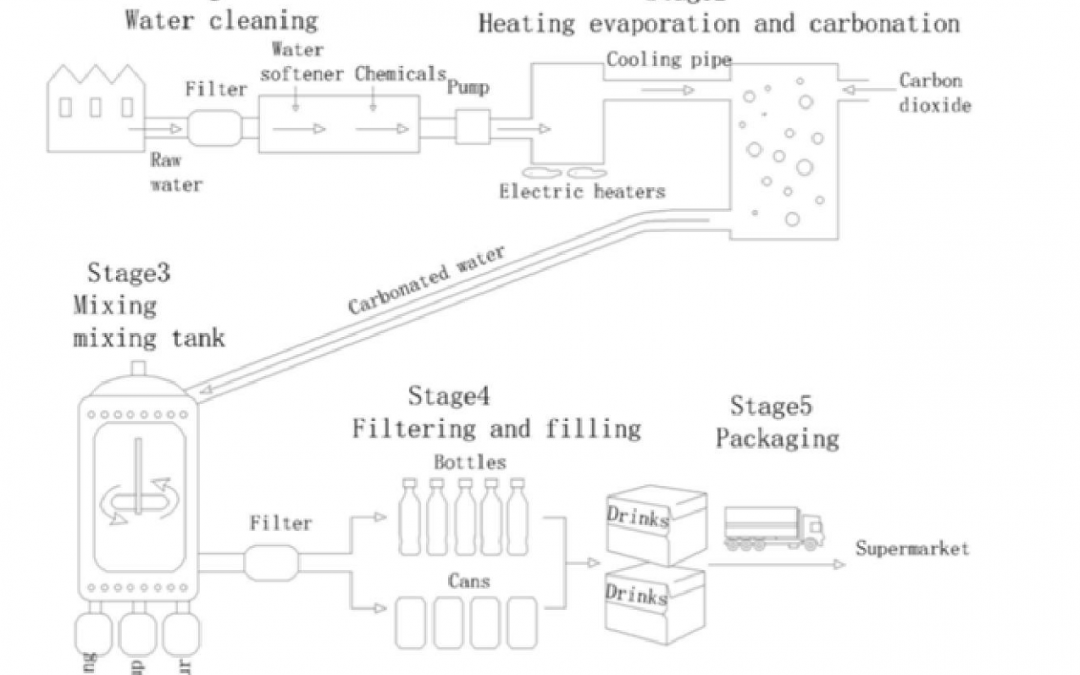
The diagram details the process by which carbonated drinks are produced. Looking from an overall perspective, it is readily apparent that this 5 stage man-made process is comprised of the filtering of raw water and addition of carbon dioxide in the early steps, mixing with additional ingredients in the middle, and finally packaging it off to be sold.
At the beginning, raw water is cleaned by passing through a filter before water softener and chemicals are added. The clean water is then pumped into a heater and is eventually sent through a cooling pipe to the pivotal stage where carbon dioxide is introduced to create the carbonated effect.
From there, the carbonated water is mixed with colouring, syrup and flavours and filtered again prior to bottling and canning. The finished drinks are then boxed up and sent to supermarkets for retail.
Analysis
1. The diagram details the process by which carbonated drinks are produced. 2. Looking from an overall perspective, it is readily apparent that this 5 stage man-made process is comprised of the filtering of raw water and addition of carbon dioxide in the early steps, mixing with additional ingredients in the middle, and finally packaging it off to be sold.
Paraphrase the overall essay topic.
Write a general overview for the process. Read more about general overviews here.
1. At the beginning, raw water is cleaned by passing through a filter before water softener and chemicals are added. 2. The clean water is then pumped into a heater and is eventually sent through a cooling pipe to the pivotal stage where carbon dioxide is introduced to create the carbonated effect.
Begin with the early stages of the process.
Detail all the stages and paraphrase as much vocabulary as possible.
1. From there, the carbonated water is mixed with colouring, syrup and flavours and filtered again prior to bottling and canning. 2. The finished drinks are then boxed up and sent to supermarkets for retail.
Continue descriping the process – do not include any opinion.
Finish with the last stage of the process.
Vocabulary
What do the words in bold below mean?
The diagram details the process by which carbonated drinks are produced. Looking from an overall perspective, it is readily apparent that this 5 stage man-made process is comprised of the filtering of raw water and addition of carbon dioxide in the early steps, mixing with additional ingredients in the middle, and finally packaging it off to be sold.
At the beginning, raw water is cleaned by passing through a filter before water softener and chemicals are added. The clean water is then pumped into a heater and is eventually sent through a cooling pipe to the pivotal stage where carbon dioxide is introduced to create the carbonated effect.
From there, the carbonated water is mixed with colouring, syrup and flavours and filtered again prior tobottling and canning. The finished drinks are then boxed up and sent to supermarkets for retail.
Answers
details illustrates
by which through which, this is how, showing
carbonated drinks fizzy drinks like Coca-Cola
looking from an overall perspective, it is readily apparent that in general
The diagram d__________s the process b__________h c___________________s are produced. L_______________________________________________________t this 5 stage m___________e process i____________________f the f_______________________r and addition of carbon dioxide in the early steps, m________g with additional i__________________s in the middle, and finally p________________________f to be sold.
At the beginning, raw water is cleaned by p___________________h a filter before water softener and chemicals are added. The clean water is then p_______________d into a h______________r and is e_______________y sent through a c______________e to the p______________e where c_________________e is i______________d to create the c________________t.
From there, the carbonated water is mixed with c____________g, s_________p and f________________s and filtered again p_________________g and c____________g. The f__________________s are then b__________p and sent to supermarkets for r________l.
This is an IELTS writing task 2 sample answer essay on the topic of traditional and fast food from the real IELTS exam.
Be sure to sign up for my Patreon here so that you don’t miss out on any other sample answers.
Dave
IELTS Essay: Traditional Foods and Fast Food
In many countries, traditional foods are being replaced by fast food. This has a negative impact on families, individuals and society.
To what extent do you agree or disagree?
The rise of fast food globally is often thought to have an injurious impact on families, individuals, and society at large. In my opinion, fast food is a negative overall despite some tangible benefits.
The advantages of fast food vary according to the segment of society in question. Individuals get enjoyment out of fast food, the clearest evidence of which is its popularity. Fast food is also relatively cheap and, as its name suggests, saves time. For families, the advantages are similar. In many working-class families, parents spend at a lot time and energy at their jobs and do not have the luxury of preparing a nutritious, time-consuming meal for their children. Fast food is therefore a necessary, viable alternative. Finally, society benefits in a general sense because of the employment opportunities. Fast food restaurants employ thousands of, admittedly, lowly paid workers and is a safe transitional job for students and struggling individuals.
Regardless, the negative impact of fast food is greater. Though people enjoy the taste and convenience of fast food, they are doing irreparable harm to both their short and long-term health. Research has shown that the high fat and sugar content in fast food not only affects daily energy levels but also contributes to conditions such as heart disease and diabetes. These same health risks extend to families, with the added caveat that children are forming potentially life-long bad habits. Society also suffers from the growth of the fast food industry as local businesses lose revenue to these international conglomerates that enrich primarily the already wealthy or foreign nationals.
In conclusion, despite the benefits related to convenience and economics that fast food brings, the health drawbacks should serve as strong deterrents for countries looking to encourage these industries.
Analysis
1. The rise of fast food globally is often thought to have an injurious impact on families, individuals, and society at large. 2. In my opinion, fast food is a negative overall despite some tangible benefits.
Paraphrase the overall essay topic.
Write a clear opinion and include some hints at your main ideas. Read more about conclusions here.
1. The advantages of fast food vary according to the segment of society in question. 2. Individuals get enjoyment out of fast food, the clearest evidence of which is its popularity. 3. Fast food is also relatively cheap and, as its name suggests, saves time. 4. For families, the advantages are similar. 5. In many working-class families, parents spend at a lot time and energy at their jobs and do not have the luxury of preparing a nutritious, time-consuming meal for their children. 6. Fast food is therefore a necessary, viable alternative. 7. Finally, society benefits in a general sense because of the employment opportunities. 8. Fast food restaurants employ thousands of, admittedly, lowly paid workers and is a safe transitional job for students and struggling individuals.
Develop it fully.This paragraph is a little too long.
1. Regardless, the negative impact of fast food is greater. 2. Though people enjoy the taste and convenience of fast food, they are doing irreparable harm to both their short and long-term health. 3. Research has shown that the high fat and sugar content in fast food not only affects daily energy levels but also contributes to conditions such as heart disease and diabetes. 4. These same health risks extend to families, with the added caveat that children are forming potentially life-long bad habits. 5. Society also suffers from the growth of the fast food industry as local businesses lose revenue to these international conglomerates that enrich primarily the already wealthy or foreign nationals.
Write another topic sentence with a new main idea at the end.
Explain that main idea.
Use research to support your ideas.
Make sure that you cover all areas.
This paragraph should have stronger reasons since it is the side you agree with.
1. In conclusion, despite the benefits related to convenience and economics that fast food brings, the health drawbacks should serve as strong deterrents for countries looking to encourage these industries.
Repeat your opinion, summarise your main ideas and add a final thought. Read more about conclusions here.
Vocabulary
What do the words in bold below mean?
The rise of fast food globally is often thought to have an injurious impact on families, individuals, and society at large. In my opinion, fast food is a negative overall despite some tangible benefits.
The advantages of fast food vary according to the segment of society in question. Individuals get enjoyment out of fast food, the clearest evidence of which is its popularity. Fast food is also relatively cheap and, as its name suggests, saves time. For families, the advantages are similar. In many working-class families, parents spend at a lot time and energy at their jobs and do not have the luxury of preparing a nutritious, time-consuming meal for their children. Fast food is therefore a necessary, viable alternative. Finally, society benefits in a general sense because of the employment opportunities. Fast food restaurants employ thousands of, admittedly, lowly paid workers and is a safe transitional job for students and struggling individuals.
Regardless, the negative impact of fast food is greater. Though people enjoy the taste and convenience of fast food, they are doing irreparable harm to both their short and long-term health. Research has shown that the high fat and sugar content in fast food not only affects daily energy levels but also contributes to conditions such as heart disease and diabetes. These same health risks extend to families, with the added caveat that children are forming potentially life-long bad habits. Society also suffers from the growth of the fast food industry as local businesses lose revenue to these international conglomerates that enrich primarily the already wealthy or foreign nationals.
In conclusion, despite the benefits related to convenience and economics that fast food brings, the health drawbacks should serve as strong deterrents for countries looking to encourage these industries.
Answers
rise increase
globally around the world
injurious impact negative effect
society at large all people
negative overall bad in general
tangible benefits concrete advantages
vary different
segment part
in question being discussed
clearest evidence of which best instance includes
relatively somewhat
as its name suggests can be figured out from the name
saves time doesn’t waste time
working-class families normal, working families
luxury privilege
preparing making
nutritious good for your health
time-consuming takes a lot of time
necessary needed
viable alternative good second option
in a general sense overall
employment opportunities job chances
admittedly it must be said
lowly paid workers don’t make a lot of money
safe transitional job not risky in-between work
struggling individuals people who need help
regardless nonetheless
irreparable harm can’t be fixed injury
short and long-term health in the near and far future
content what’s inside it
affects daily energy levels impacts how much energy you have
contributes to adds to
conditions such as diseases including
diabetes disease from eating too much sugar
health risks extend to health problems include
added caveat extra warning
forming potentially life-long bad habits possibly last forever habits
suffers hurt from
growth of the fast food industry more powerful fast food companies
local businesses lose revenue neighborhood shops lose money
international conglomerates big companies
enrich primarily mostly get money from
foreign nationals people from other countries
related to similar to
should serve as ought to be
deterrents dissuades people
encourage these industries support those companies
The r____e of fast food g________y is often thought to have an i_____________t on families, individuals, and s______________e. In my opinion, fast food is a n________________l despite some t_________________s.
The advantages of fast food v_____y according to the s__________t of society i_______________n. Individuals get enjoyment out of fast food, the c___________________h is its popularity. Fast food is also r___________y cheap and, a_____________________s, s_________e. For families, the advantages are similar. In many w____________________s, parents spend at a lot time and energy at their jobs and do not have the l________y of p___________g a n____________s, t_______________g meal for their children. Fast food is therefore a n___________y, v__________________e. Finally, society benefits i____________________e because of the e________________________s. Fast food restaurants employ thousands of, a_____________y, l__________________s and is a s____________________b for students and s________________________s.
R______________s, the negative impact of fast food is greater. Though people enjoy the taste and convenience of fast food, they are doing i____________________m to both their s_________________________h. Research has shown that the high fat and sugar c____________t in fast food not only a____________________s but also c__________________________s heart disease and d_____________s. These same h____________________o families, with the a______________________t that children are f_____________________________________s. Society also s________s from the g________________________________y as l________________________________e to these i____________________________s that e_____________________y the already wealthy or f_____________________s.
In conclusion, despite the benefits r______________o convenience and economics that fast food brings, the health drawbacks s__________________s strong d________________s for countries looking to e________________________s.
Listening Practice
Watch the video below to learn more:
Reading Practice
Read more about this topic below in The New York Times:
This is an IELTS writing task 2 sample answer essay on the topic of whether or not every child should be taught to play a musical instrument.
If you are enjoying my free essays, please consider supporting me and sharing with your friends about my Patreon here (and getting access to additional, exclusive materials and Ebooks!).
Dave
IELTS Essay: Education
Some educators believe that every child should be taught how to play a musical instrument.
To what extent do you agree or disagree?
Many teachers feel that learning to play a musical instrument is an indispensable part of a student’s education. In my opinion, there are socioeconomic concerns with this tenet but it is still advisable overall.
Detractors can easily argue not every child has access to the supportive environment required to learn an instrument. Firstly, a family might not have enough money if a child wants to learn piano or buy a quality guitar. There are also related expenses that include the fees for private lessons and other equipment. Added to this, they will need their parents to have enough time to drive them to and from rehearsals and recitals. At home, the entire family will have to listen to them practice and this could be contentious if there are a lot of people living in one home or a child shares their room with siblings or relatives. All these factors affect underprivileged children and place them at a decided disadvantage.
Nonetheless, the above issues can be mitigated with more funding for schools and the developmental benefits of music outweigh all other concerns. Research has shown that in early development, physical changes take place in the brains of both children and adolescents. Some of these relate to music and children who take up an instrument, even if they quit later, have demonstrated improved cognitive flexibility and creativity in longitudinal studies across a variety of cultural backgrounds. Apart from the scientific grounding, it also common sense that children will feel more fulfilled and derive a lot of joy from playing music. This can provide a boost to not only academics but also their long-term mental well-being.
In conclusion, though policymakers will have to account for accessibility issues, learning an instrument is key for neurodevelopment. Schools, parents, and teachers should work together to ensure the best chances of success.
Analysis
1. Many teachers feel that learning to play a musical instrument is an indispensable part of a student’s education. 2. In my opinion, there are socioeconomic concerns with this tenet but it is still advisable overall.
Paraphrase the overall essay topic.
Write a clear opinion. Read more about introductions here.
1. Detractors can easily argue not every child has access to the supportive environment required to learn an instrument. 2. Firstly, a family might not have enough money if a child wants to learn piano or buy a quality guitar. 3. There are also related expenses that include the fees for private lessons and other equipment. 4. Added to this, they will need their parents to have enough time to drive them to and from rehearsals and recitals. 5. At home, the entire family will have to listen to them practice and this could be contentious if there are a lot of people living in one home or a child shares their room with siblings or relatives. 6. All these factors affect underprivileged children and place them at a decided disadvantage.
Write a clear topic sentence with your main idea at the end.
Begin to develop your main idea.
Use a real or hypothetical example.
Add more detail to fully support your main idea.
Don’t switch to a new main idea.
Finish with a summary.
1. Nonetheless, the above issues can be mitigated with more funding for schools and the developmental benefits of music outweigh all other concerns. 2. Research has shown that in early development, physical changes take place in the brains of both children and adolescents. 3. Some of these relate to music and children who take up an instrument, even if they quit later, have demonstrated improved cognitive flexibility and creativity in longitudinal studies across a variety of cultural backgrounds. 4. Apart from the scientific grounding, it also common sense that children will feel more fulfilled and derive a lot of joy from playing music. 5. This can provide a boost to not only academics but also their long-term mental well-being.
Write another topic sentence with a clear main idea at the end.
Use research to support your idea.
Develop the research.
Add in more detail if possible.
Conclude with a strong statement.
1. In conclusion, though policymakers will have to account for accessibility issues, learning an instrument is key for neurodevelopment. 2. Schools, parents, and teachers should work together to ensure the best chances of success.
Repeat your opinion and summarise your main ideas.
Add a final thought. Read more about conclusions here.
Vocabulary
What do the words in bold below mean?
Many teachers feel that learning to play a musical instrument is an indispensable part of a student’s education. In my opinion, there are socioeconomic concerns with this tenet but it is still advisable overall.
Detractors can easily argue not every child has access to the supportive environment required to learn an instrument. Firstly, a family might not have enough money if a child wants to learn piano or buy a quality guitar. There are also related expenses that include the fees for private lessons and other equipment. Added to this, they will need their parents to have enough time to drive them to and from rehearsals and recitals. At home, the entire family will have to listen to them practice and this could be contentious if there are a lot of people living in one home or a child shares their room with siblings or relatives. All these factors affect underprivileged children and place them at a decided disadvantage.
Nonetheless, the above issues can be mitigated with more funding for schools and the developmental benefits of music outweigh all other concerns. Research has shown that in early development, physical changes take place in the brains of both children and adolescents. Some of these relate to music and children who take up an instrument, even if they quit later, have demonstrated improved cognitive flexibility and creativity in longitudinal studies across a variety of cultural backgrounds. Apart from the scientific grounding, it also common sense that children will feel more fulfilled and derive a lot of joy from playing music. This can provide a boost to not only academics but also their long-term mental well-being.
In conclusion, though policymakers will have to account for accessibility issues, learning an instrument is key for neurodevelopment. Schools, parents, and teachers should work together to ensure the best chances of success.
Answers
indispensable crucial
socioeconomic concerns questions about class
tenet principle
advisable overall in general good
detractors critics
easily argue point out effortlessly
access to can get to
supportive environment required good family support
firstly first of all
quality guitar good guitar
related expenses other money that must be spent
fees cost
private lessons one on one lessons
other equipment other musical items
added to this moreover
rehearsals practicing
recitals a mini-concert
entire family whole family
contentious controversial
shares their room with live in the same room
factors elements
underprivileged children poor kids
place them at a decided disadvantage definitely worse off
nonetheless regardless
mitigated somewhat countered by
funding money for
developmental benefits positive impact on how they grow up
Many teachers feel that learning to play a musical instrument is an i_________________e part of a student’s education. In my opinion, there are s_____________________s with this t_______t but it is still a__________________l.
D_______________s can e____________e not every child has a___________o the s___________________________________d to learn an instrument. F__________y, a family might not have enough money if a child wants to learn piano or buy a q_______________r. There are also r________________s that include the f____s for p_________________s and o_________________t. A_________________s, they will need their parents to have enough time to drive them to and from r______________s and r____________s. At home, the e______________y will have to listen to them practice and this could be c______________s if there are a lot of people living in one home or a child s_______________________h siblings or relatives. All these f__________s affect u__________________________n and p_______________________________________e.
N____________________s, the above issues can be m______________d with more f____________g for schools and the d_______________________s of music o____________________________s. Research has shown that i_____________________________t, physical changes t____________e in the brains of both children and a_________________s. Some of these r__________o music and children who t__________p an instrument, even if they q____t later, have d__________________________________________y and creativity in l_______________________s across a variety of c____________________s. A____________m the s_____________________g, it also common sense that children will f____________________d and d_________e a lot of joy from playing music. This can p________________t to n_____________y academics b__________o their l________________________________g.
In conclusion, though p__________________s will have to a_____________________________s, learning an instrument is k___y for n____________________________t. Schools, parents, and teachers should w_________________________r to e_____________e the b________________________s.
This is an IELTS writing task 1 sample answer essay related to a table that shows international tourist arrivals.
Sign up for my Patreon here so you don’t miss any other answers.
Dave
IELTS Essay Task 1 Table: International Tourist Arrivals
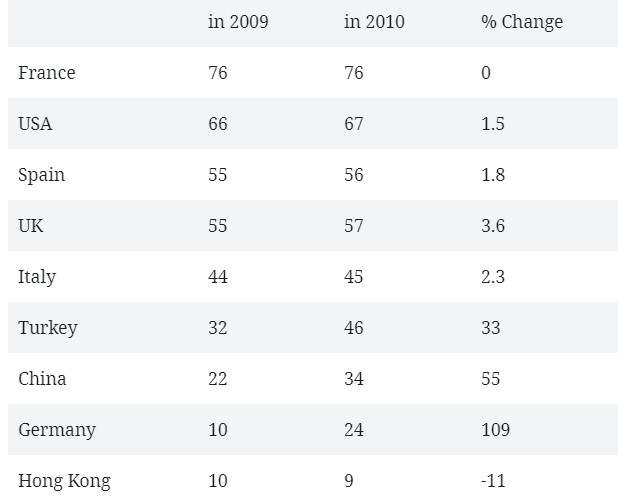
The table details the international tourist arrivals in millions in 8 countries in 2009 and 2010 and the changes (in percentages).
in 2009
in 2010
% Change
France
76
76
0
USA
66
67
1.5
Spain
55
56
1.8
UK
55
57
3.6
Italy
44
45
2.3
Turkey
32
46
33
China
22
34
55
Germany
10
24
109
Hong Kong
10
9
-11
The table compares the number of tourists arriving in 8 countries in 2009 and 2010. In general, tourism rose slightly in the United States, Spain, the UK, and Italy and increased dramatically in Turkey, China, and Germany. Figures fell in Hong Kong and were stable in France, which had the most tourists overall.
Looking first of all at France, numbers were unchanged at 76 million tourists in both years. The United States increased by 1.5% from 66 to 67 million and Spain followed a similar trajectory (55 to 56 million tourists). Tourists to the UK increased by double that rate (3.6%) and overtook Spain in 2010 by 1 million visitors. In Italy, the rate of growth was slower at 2.3%, translating to an increase to 45 million. Turkey surged past Italy, rising 33% to 46 million.
There were also significant increases in China, which went from 22 to 34 million (a 55% growth), and Germany (a 109% expansion to 24 million). The lowest numbers were in Hong Kong as tourism fell by 11% to end at 9 million.
Analysis
1. The table compares the number of tourists arriving in 8 countries in 2009 and 2010. 2. In general, tourism rose slightly in the United States, Spain, the UK, and Italy and increased dramatically in Turkey, China, and Germany. 3. Figures fell in Hong Kong and were stable in France, which had the most tourists overall.
Paraphrase the overall essay topic.
Begin to give the trend for most countries.
Cover the complete trend for all countries. Read more about writing your general overview and the mistake most students make with tables here.
1. Looking first of all at France, numbers were unchanged at 76 million tourists in both years. 2. The United States increased by 1.5% from 66 to 67 million and Spain followed a similar trajectory (55 to 56 million tourists). 3. Tourists to the UK increased by double that rate (3.6%) and overtook Spain in 2010 by 1 million visitors. 4. In Italy, the rate of growth was slower at 2.3%, translating to an increase to 45 million. 5. Turkey surged past Italy, rising 33% to 46 million.
Begin writing about the data.
Always compare.
Continue comparing the data.
Be sure that all data is included or implied.
1. There were also significant increases in China, which went from 22 to 34 million (a 55% growth), and Germany (a 109% expansion to 24 million). 2. The lowest numbers were in Hong Kong as tourism fell by 11% to end at 9 million.
Write a new paragraph for the countries with different trends/numbers.
Detail all the data clearly and accurately.
Vocabulary
What do the words in bold below mean?
The table compares the number of tourists arriving in 8 countries in 2009 and 2010. In general, tourism rose slightly in the United States, Spain, the UK, and Italy and increased dramatically in Turkey, China, and Germany. Figures fell in Hong Kong and were stable in France, which had the most tourists overall.
Looking first of all at France, numbers were unchanged at 76 million tourists in both years. The United States increased by 1.5% from 66 to 67 million and Spain followed a similar trajectory (55 to 56 million tourists). Tourists to the UK increased by double that rate (3.6%) and overtook Spain in 2010 by 1 million visitors. In Italy, the rate of growth was slower at 2.3%, translating to an increase to 45 million. Turkey surged past Italy, rising 33% to 46 million.
There were also significant increases in China, which went from 22 to 34 million (a 55% growth), and Germany (a 109% expansion to 24 million). The lowest numbers were in Hong Kong as tourism fell by 11% to end at 9 million.
Answers
compares contrasts
in general overall
rose slightly increased a little
increased dramatically increased a lot
figures statistics
were stable unchanged
most tourists overall highest numbers in general
looking first of all at comparing first
unchanged stable
similar trajectory almost the same pattern
increased by double that rate went up twice as much
The table c____________s the number of tourists arriving in 8 countries in 2009 and 2010. I____________l, tourism r_____________y in the United States, Spain, the UK, and Italy and i_________________________y in Turkey, China, and Germany. F_________s fell in Hong Kong and w___________e in France, which had the m__________________l.
L_______________________t France, numbers were u____________d at 76 million tourists in both years. The United States increased by 1.5% from 66 to 67 million and Spain followed a s___________________y (55 to 56 million tourists). Tourists to the UK i________________________e (3.6%) and o_____________k Spain in 2010 by 1 million visitors. In Italy, the r________________________r at 2.3%, t_________________o an increase to 45 million. Turkey s_____________t Italy, r__________g 33% to 46 million.
There were also s________________________s in China, which w__________m 22 t__ 34 million (a 55% growth), and Germany (a 109% e______________n to 24 million). The lowest numbers were in Hong Kong as t_______________l by 11% to e_________t 9 million.
This is an IELTS writing task 2 sample answer essay on the topic of public art.
Sign up for my Patreon here so that you don’t miss any question PDFs.
Dave
IELTS Essay: Public Art
Some people believe that the government should spend more money putting in more works of art like paintings and statues in cities to make them better places to live in.
To what extent do you agree or disagree?
Some feel governments should invest more in public art in cities to boost the quality of life. Personally, I am in disagreement with this idea because it has little actual importance for the average citizen.
On the one hand, public art beautifies a city. A city stripped of all art gives off the dreary appearance of being purely for utilitarian value and the daily rigour of work. In contrast, cities that have invested heavily in public art, such as New York City, offer their residents a beautiful and inspiring home. A child who sees sculptures and murals walking home will feel the city is a nicer place to live and workers passing by works of art will have some emotional relief from the demands of the day. This not only builds up the character of urban areas for local inhabitants and instills a sense of pride, but also attracts tourists and professional artists to the city, both of which contribute to a vibrant city.
Nonetheless, public art has little quantifiable positive value. Most city-dwellers are too engrossed in their hectic schedules to notice public art. This art, therefore, means nothing to most locals, while also diverting an outsized share of a city’s budget. There are other more vital areas requiring development such as high-end infrastructure, well-rounded healthcare systems, and modern recreational facilities. Moreover, the public space used to house these works of art cannot be used for practical purposes including critical public facilities like restrooms, bus stops or parks. Those who rely on these other facilities will have more trouble finding them and their quality of life may be somewhat impacted by a preference for art.
Despite the aesthetic value of public art, government bodies should focus more on urban issues that truly matter to their constituents. There must be a degree of balance but it should always tip more towards pragmatic concerns.
Analysis
1. Some feel governments should invest more in public art in cities to boost the quality of life. 2. Personally, I am in disagreement with this idea because it has little actual importance for the average citizen.
Paraphrase the overall essay topic.
Choose a clear side. Read more about introductions here.
1. On the one hand, public art beautifies a city. 2. A city stripped of all art gives off the dreary appearance of being purely for utilitarian value and the daily rigour of work. 3. In contrast, cities that have invested heavily in public art, such as New York City, offer their residents a beautiful and inspiring home. 4. A child who sees sculptures and murals walking home will feel the city is a nicer place to live and workers passing by works of art will have some emotional relief from the demands of the day. 5. This not only builds up the character of urban areas for local inhabitants and instills a sense of pride, but also attracts tourists and professional artists to the city, both of which contribute to a vibrant city.
Write a topic sentence with a clear main idea at the end.
Explain your main idea.
Give a specific example.
Develop the example.
Finish developing the example fully.
1. Nonetheless, public art has little quantifiable positive value. 2. Most city-dwellers are too engrossed in their hectic schedules to notice public art. 3. This art, therefore, means nothing to most locals, while also diverting an outsized share of a city’s budget. 4. There are other more vital areas requiring development such as high-end infrastructure, well-rounded healthcare systems, and modern recreational facilities. 5. Moreover, the public space used to house these works of art cannot be used for practical purposes including critical public facilities like restrooms, bus stops or parks. 6. Those who rely on these other facilities will have more trouble finding them and their quality of life may be somewhat impacted by a preference for art.
Write another topic sentence with a new main idea.
Explain your main idea.
Continue to explain or develop the idea.
Give specific examples to support your idea.
The more detail, the better!
Conclude with a strong statement.
1. Despite the aesthetic value of public art, government bodies should focus more on urban issues that truly matter to their constituents. 2. There must be a degree of balance but it should always tip more towards pragmatic concerns.
Summarise your main ideas and repeat your opinion.
Add a final thought. Read more about how to write an IELTS conclusion here.
Vocabulary
What do the words in bold below mean?
Some feel governments should invest more in public art in cities to boost the quality of life. Personally, I am in disagreement with this idea because it has little actual importance for the average citizen.
On the one hand, public art beautifies a city. A city stripped of all art gives off the dreary appearance of being purely for utilitarian value and the daily rigour of work. In contrast, cities that have invested heavily in public art, such as New York City, offer their residents a beautiful and inspiring home. A child who sees sculptures and murals walking home will feel the city is a nicer place to live and workers passing by works of art will have some emotional relief from the demands of the day. This not only builds up the character of urban areas for local inhabitants and instills a sense of pride, but also attracts tourists and professional artists to the city, both of which contribute to a vibrant city.
Nonetheless, public art has little quantifiable positive value. Most city-dwellers are too engrossed in their hectic schedules to notice public art. This art, therefore, means nothing to most locals, while also diverting an outsized share of a city’s budget. There are other more vital areas requiring development such as high-end infrastructure, well-rounded healthcare systems, and modern recreational facilities. Moreover, the public space used to house these works of art cannot be used for practical purposes including critical public facilities like restrooms, bus stops or parks. Those who rely on these other facilities will have more trouble finding them and their quality of life may be somewhat impacted by a preference for art.
Despite the aesthetic value of public art, government bodies should focus more on urban issues that truly matter to their constituents. There must be a degree of balance but it should always tip more towards pragmatic concerns.
Answers
invest put money into
boost increase
quality of life standard of living
I am in disagreement with don’t agree with
little actual importance not much real impact
average citizen normal person
beautifies makes beautiful
stripped of doesn’t have
dreary appearance boring look
purely for utilitarian value only for its use
daily rigour of work daily grind of a job
invested heavily giving a lot of money to
offer their residents give to citizens
inspiring elevating
murals large paintings
passing by walking past
emotional relief makes you feel better
demands of the day rigor of work, life
builds up the character creates a sense of identity
urban areas cities
local inhabitants people who live there
instills imparts
attracts makes come there
contribute to a vibrant city makes the city better
nonetheless regardless
little quantifiable positive value not much actual import
city-dwellers city residents
engrossed lost in
hectic schedules busy days
notice pay attention to
means nothing to has no value to
diverting sending in a different direction
outsized share of a city’s budget take up too much money
vital areas important parts
high-end infrastructure roads, plumbing, electricity, etc.
well-rounded healthcare systems hospitals
modern recreational facilities gyms
moreover furthermore
house verb of house
practical purposes concrete reasons
critical public facilities key places for all residents
Some feel governments should i_______t more in public art in cities to b______t the q______________e. Personally, I______________________h this idea because it has l_________________________e for the a________________n.
On the one hand, public art b_____________s a city. A city s______________f all art gives off the d__________________e of being p_________________________e and the d______________________k. In contrast, cities that have i_____________________y in public art, such as New York City, o________________________s a beautiful and i_____________g home. A child who sees sculptures and m________s walking home will feel the city is a nicer place to live and workers p_____________by works of art will have some e____________________f from the d_____________________y. This not only b____________________________r of u_____________s for l____________________s and i_____________s a sense of pride, but also a____________s tourists and professional artists to the city, both of which c_________________________y.
N________________s, public art has l________________________________e. Most c____________________s are too e______________d in their h_________________s to n_________e public art. This art, therefore, m_________________o most locals, while also d______________g an o____________________________t. There are other more v_____________s requiring development such as h____________________________e, w____________________________s, and m______________________________s. M_____________r, the public space used to h__________e these works of art cannot be used for p______________________s including c_________________________s like restrooms, bus stops or parks. Those who r__________n these other facilities will have more trouble finding them and their quality of life may be s______________________d by a p_______________________t.
Despite the a_____________________e of public art, g_____________________s should focus more on u_______________s that t_________________r to their c_______________s. There must be a d__________________e but it should always t___________________________________s.
"The highest quality materials anywhere on the internet! Dave improved my writing and vocabulary so much. Really affordable options you don't want to miss out on!"