This is an IELTS writing task 2 sample answer from the general training test about the topic of leisure time.
It’s a very common topic and you can read the exact structure that you should use on IELTS below as well as do some some practice yourself.
Enjoy!
-Dave
Attention: if you are enjoying my free essays, please consider supporting me and sharing with your friends about my Patreon here (and getting access to additional, exclusive materials and Ebooks!).
IELTS Writing Task 2 General Training Sample Answer: Malls and Leisure Time
Shopping is now one of the most popular forms of leisure activities in many countries for young adults.
Why is this?
Do you think this is a positive or a negative development?
Shopping has become more common as a result of the introduction of large shopping malls. I strongly believe this has brought considerable economic benefits to society at large.
Since the advent of the mall, companies have relentlessly sought new ways to attract consumers, resulting in today’s megamalls. In the past, shoppers would make dedicated trips to specific stores for products. In the 1980s in the United States, the novel combination of shopping plazas and department stores with entertainment venues like state-of-the-art cinemas and appetizing foods courts made them the centre of social activity for a generation. It is therefore no wonder that youths and adults alike the world over opt to spend their time and money shopping at malls that cater to all their needs.
While some might argue that shopping is largely a waste of time, I feel that its economic advantages outweigh other concerns. Masses of wealthy middle-class consumers contribute greatly to economic prosperity and that brings various benefits to all socioeconomic classes. A counter-point illustrating this would be in Japan in the last two decades where a long recession has decimated the middle-class, leading to decreased shopping, closures of malls and a stagnant economy. The government has desperately lowered interest rates in order to stimulate the type of spending that malls encourage. Malls, as one crucial part of a consumer society, serve to encourage spending and national prosperity.
In conclusion, an increasing number of people frequent malls for their convenience and this boosts the economy. If governments were to invest more money in tax cuts this would further encourage spending at malls and help developing nations and developed ones whose growth has plateaued.
Analysis
1. Shopping has become more common as a result of the introduction of large shopping malls. 2. I strongly believe this has brought considerable economic benefits to society at large.
1. Since the advent of the mall, companies have relentlessly sought new ways to attract consumers, resulting in today’s megamalls. 2. In the past, shoppers would make dedicated trips to specific stores for products. 3. In the 1980s in the United States, the novel combination of shopping plazas and department stores with entertainment venues like state-of-the-art cinemas and appetizing foods courts made them the centre of social activity for a generation. 4. It is therefore no wonder that youths and adults alike the world over opt to spend their time and money shopping at malls that cater to all their needs.
Write a clear topic sentence answering the first question with your opinion at the end.
Explaing your main idea.
Start a specific example and develop it fully.
State the results of your example.
1. While some might argue that shopping is largely a waste of time, I feel that its economic advantages outweigh other concerns. 2. Masses of wealthy middle-class consumers contribute greatly to economic prosperity and that brings various benefits to all socioeconomic classes. 3. A counter-point illustrating this would be in Japan in the last two decades where a long recession has decimated the middle-class, leading to decreased shopping, closures of malls and a stagnant economy. 4. The government has desperately lowered interest rates in order to stimulate the type of spending that malls encourage. 5. Malls, as one crucial part of a consumer society, serve to encourage spending and national prosperity.
Write another topic sentence with a new main idea.
Explaing your main idea.
Give an example or counter-example.
Develop the example.
State the final results.
1. In conclusion, an increasing number of people frequent malls for their convenience and this boosts the economy. 2. If governments were to invest more money in tax cuts this would further encourage spending at malls and help developing nations and developed ones whose growth has plateaued.
Repeat and summarise your main ideas.
Add a final thought/detail. Read about conclusions here.
Vocabulary
What do the words in bold below mean?
Shopping has become more common as a result of the introduction of large shopping malls. I strongly believe this has brought considerable economic benefits to society at large.
Since the advent of the mall, companies have relentlessly sought new ways to attract consumers, resulting in today’s megamalls. In the past, shoppers would make dedicated trips to specific stores for products. In the 1980s in the United States, the novel combination of shopping plazas and department stores with entertainment venues like state-of-the-art cinemas and appetizing foods courts made them the centre of social activity for a generation. It is therefore no wonder that youths and adults alike the world over opt to spend their time and money shopping at malls that cater to all their needs.
While some might argue that shopping is largely a waste of time, I feel that its economic advantages outweigh other concerns. Masses of wealthy middle-class consumers contribute greatly to economic prosperity and that brings various benefits to all socioeconomic classes. A counter-point illustrating this would be in Japan in the last two decades where a long recession has decimated the middle-class, leading to decreased shopping, closures of malls and a stagnant economy. The government has desperately lowered interest rates in order to stimulate the type of spending that malls encourage. Malls, as one crucial part of a consumer society, serve to encourage spending and national prosperity.
In conclusion, an increasing number of people frequent malls for their convenience and this boosts the economy. If governments were to invest more money in tax cuts this would further encourage spending at malls and help developing nations and developed ones whose growth has plateaued.
Answers
as a result the outcome is
introduction of since they started
considerable economic benefits good for the economy
society at large all of society, all citizens
advent beginning of
relentlessly sought looking hard for
attract consumers bring in shoppers
resulting in the result/effect is
megamalls really big malls/shopping centres
make dedicated trips going there just for
novel combination new mix
plazas publick places
department stores malls
entertainment venues cinemas, arcades, etc.
state-of-the-art cinemas new movie theatres
appetizing foods courts enticing restaurants in a mall
centre of social activity social hub
for a generation for all people born around the same time
no wonder little surprise
alike the same
the world over everywhere in the world
cater to all their needs can do whatever they want there
largely a waste of time mostly not a good use of time
economic advantages outweigh other concerns benefits to the economy more important than
masses large groups of people
wealthy middle-class consumers people with some money, not too rich or poor
economic prosperity good for the economy
socioeconomic classes rich and poor people
a counter-point illustrating this would be in an example of the opposite case is
long recession lengthy economic downturn
decimated hurt a lot
closures of malls malls closing down
stagnant economy economy not growing
desperately lowered interest rates hurriedly cut the rate for borrowing money
stimulate encourage
crucial part key element
consumer society people shopping
encourage spending stimulate buying
national prosperity a country making money, doing well
frequent go to a lot (verb)
boosts increases
tax cuts reducing the money you have to pay in taxes
growth has plateaued stable, not increasing or decreasing
Shopping has become more common a___________t of the i________________f large shopping malls. I strongly believe this has brought c______________________________s to s_________________e.
Since the a__________t of the mall, companies have r_______________________t new ways to a________________________s, r_____________n today’s m_______________s. In the past, shoppers would m______________________s to specific stores for products. In the 1980s in the United States, the n________________________n of shopping p_________s and d____________________s with e________________________s like s__________________________s and a___________________________s made them the c_________________________y f_____________________n. It is therefore n________________r that youths and adults a______e t__________________r opt to spend their time and money shopping at malls that c______________________s.
While some might argue that shopping is l_____________________e, I feel that its e______________________________________s. M_________s of w________________________________s contribute greatly to e__________________________y and that brings various benefits to all s_____________________________s. A__________________________________________n Japan in the last two decades where a l____________________n has d____________d the middle-class, leading to decreased shopping, c________________________s and a s__________________y. The government has d_____________________________s in order to s______________e the type of spending that malls encourage. Malls, as one c_______________t of a c______________________y, serve to e________________________g and n__________________________y.
In conclusion, an increasing number of people f______________t malls for their convenience and this b__________s the economy. If governments were to invest more money in t___________s this would further encourage spending at malls and help developing nations and developed ones whose g______________________d.
Listening Practice
Listen about this topic below with an example from The Philippines:
Reading Practice
Learn more about this from Psychology Today as well:
This is an IELTS writing task 2 sample answer essay on the topic of whether or not historical objects should be returned to their country of origin.
For my sample answer PDFs, sign up to Patreon here.
Dave
IELTS Essay: Historical Objects
Historical objects should be brought back to their country of origin.
To what extent do you agree or disagree?
Many today are calling for historical objects currently residing in, largely Western, museums to be returned to their nation of origin. In my opinion, though these items were typically acquired fairly, repatriating them would go a long way to easing international resentment against past colonial powers.
The argument of the institutions currently displaying these items is that they have a legal right. Some objects were unlawfully stolen, but the majority of those have already been sent back. The artifacts now in exhibitions have proofs of sale. The prices appear to modern observers as scandalously low but they were agreed upon in another era and there is no legal basis to revoke these sales. The British Museum in England, for example, has produced unequivocal evidence that all the items they preserve were fairly bargained for and obtained. In any other situation, demanding a product that has been sold be returned would not even be broached and items of historical and cultural importance should be no different.
Regardless of the just case museums can make, there is a practical argument for returning these objects that does not exist for keeping them. A good example of this is in many African countries where their historic artifacts were pillaged during colonialism. The powers that, in effect, stole their history tended to be predominately white, European nations like The United Kingdom, The Netherlands, Belgium, Germany, France, and Spain. Since many of these wealthy countries now charge expensive fees to view artefacts from poorer African countries, a natural resentment festers. By returning the property, some of the pain of colonialism could abate. Countries subjected to colonial rule will be able to move past feelings of hostility if there is an attempt made to rectify and sanction the offenders.
In conclusion, though many of these cultural relics were bought legally, there is critical value in giving them back as they can repair historically fraught relations. Every country must balance these an abstract respect for justice against these more utilitarian concerns.
Analysis
1. Many today are calling for historical objects currently residing in, largely Western, museums to be returned to their nation of origin. 2. In my opinion, though these items were typically acquired fairly, repatriating them would go a long way to easing international resentment against past colonial powers.
Paraphrase the overall essay topic.
Give a clear opinion – choose a side! Read more about introductions here.
1. The argument of the institutions currently displaying these items is that they have a legal right. 2. Some objects were unlawfully stolen, but the majority of those have already been sent back. 3. The artifacts now in exhibitions have proofs of sale. 4. The prices appear to modern observers as scandalously low but they were agreed upon in another era and there is no legal basis to revoke these sales. 5. The British Museum in England, for example, has produced unequivocal evidence that all the items they preserve were fairly bargained for and obtained. 6. In any other situation, demanding a product that has been sold be returned would not even be broached and items of historical and cultural importance should be no different.
Write a clear topic sentence with a main idea at the end.
Explain your main idea.
Continue to explain or develop your main idea.
Don’t switch to a new idea – keep adding more detail to your first one.
Give a clear example.
Conclude with the further possible results/implications.
1. Regardless of the just case museums can make, there is a practical argument for returning these objects that does not exist for keeping them. 2. A good example of this is in many African countries where their historic artifacts were pillaged during colonialism. 3. The powers that, in effect, stole their history tended to be predominately white, European nations like The United Kingdom, The Netherlands, Belgium, Germany, France, and Spain. 4. Since many of these wealthy countries now charge expensive fees to view artefacts from poorer African countries, a natural resentment festers. 5. By returning the property, some of the pain of colonialism could abate. 6. Countries subjected to colonial rule will be able to move past feelings of hostility if there is an attempt made to rectify and sanction the offenders.
Write another topic sentence with a new main idea at the end.
Begin an example early in the paragraph if possible.
Explain the example.
Keep developing the example.
Vary long and short sentences.
Conclude your example with a strong statement.
1. In conclusion, though many of these cultural relics were bought legally, there is critical value in giving them back as they can repair historically fraught relations. 2. Every country must balance these an abstract respect for justice against these more utilitarian concerns.
Repeat your opinion and summarise your main ideas.
Add a final thought. Read more about conclusions here.
Vocabulary
What do the words in bold below mean?
Many today are calling for historical objects currently residing in, largely Western, museums to be returned to their nation of origin. In my opinion, though these items were typically acquired fairly, repatriating them would go a long way to easing international resentment against past colonial powers.
The argument of the institutions currently displaying these items is that they have a legal right. Some objects were unlawfully stolen, but the majority of those have already been sent back. The artifacts now in exhibitions have proofs of sale. The prices appear to modern observers as scandalously low but they were agreed upon in another era and there is no legal basis to revoke these sales. The British Museum in England, for example, has produced unequivocal evidence that all the items they preserve were fairly bargained for and obtained. In any other situation, demanding a product that has been sold be returned would not even be broached and items of historical and cultural importance should be no different.
Regardless of the just case museums can make, there is a practical argument for returning these objects that does not exist for keeping them. A good example of this is in many African countries where their historic artifacts were pillaged during colonialism. The powers that, in effect, stole their history tended to be predominately white, European nations like The United Kingdom, The Netherlands, Belgium, Germany, France, and Spain. Since many of these wealthy countries now charge expensive fees to view artefacts from poorer African countries, a natural resentmentfesters. By returning the property, some of the pain of colonialism could abate. Countries subjected to colonial rule will be able to move past feelings of hostility if there is an attempt made to rectify and sanction the offenders.
In conclusion, though many of these cultural relics were bought legally, there is critical value in giving them back as they can repair historically fraught relations. Every country must balance these an abstract respect for justice against these more utilitarian concerns.
Answers
calling for requesting
historical objects relics from a country
residing in staying in, housed
largely Western mostly from European countries
returned to given back
nation of origin where they come from
typically acquired fairly usually bought legally
repatriating giving back to the original country
go a long way contributes a lot towards
easing international resentment reducing tension between countries
past colonial powers countries that used to own other countries
institutions governments, companies, etc.
displaying showing
legal right entitled to
unlawfully stolen taken illegally
majority most of
already been sent back repatriated already
artifacts documents, relics, paintings, sculptures, etc. from the past
exhibitions displays of items
proofs of sale documents showing something was bought
appear seem
modern observers modern people, people today
scandalously low shockingly little
agreed upon contracted
another era a different time
no legal basis unlawful
revoke these sales overturn the contract
British Museum a museum in England with many historic items
unequivocal evidence clear proof
preserve keep safe
fairly bargained for agreed upon fairly
obtained received
in any other situation in comparable conditions
demanding asking for
broached asked
cultural importance key for a country’s culture
no different the same
regardless of nonetheless
just case fair situation
practical argument pragmatic view
historic artifacts relics from the past
pillaged stolen
colonialism a period when European countries controlled countries around the world
powers important countries
in effect essentially
stole their history took their relics, artifacts
predominately white mostly white
wealthy countries rich nations
charge expensive fees ask for a lot of money
natural resentmentfesters normal animosity grows
property what someone owns
pain of colonialism resentment from the past
abate disappear
subjected to colonial rule under the rule of European countries
move past get over
hostility resentment towards
attempt made tried to
rectify fix
sanction punish
offenders those who did something wrong
cultural relics historic artifacts
legally within the bounds of the law
critical value very important
repair historically fraught relations fix problems between countries
Many today are c______________r h___________________s currently r_______________n, l_________________n, museums to be r_____________o their n________________n. In my opinion, though these items were t__________________________y, r__________________g them would g_______________y to e______________________________t against p_______________________s.
The argument of the i___________________s currently d_________________g these items is that they have a l______________t. Some objects were u_______________________n, but the m_____________y of those have a___________________________k. The a_____________s now in e______________s have p_______________e. The prices a____________r to m___________________s as s_____________________w but they were a_______________n in a______________a and there is n_________________s to r__________________s. The B_______________m in England, for example, has produced u_________________________e that all the items they p______________e were f_________________________r and o_____________d. I_____________________n, d_______________g a product that has been sold be returned would not even be b______________d and items of historical and c_________________e should be n_________________t.
R__________________f the j______________e museums can make, there is a p_____________________t for returning these objects that does not exist for keeping them. A good example of this is in many African countries where their h____________________s were p___________d during c______________m. The p__________s that, i__________t, s__________________y tended to be p_________________________e, European nations like The United Kingdom, The Netherlands, Belgium, Germany, France, and Spain. Since many of these w_____________________s now c______________________s to view artefacts from poorer African countries, a n_____________________________s. By returning the p_____________y, some of the p______________________m could a_________e. Countries s______________________________e will be able to m____________t feelings of h___________y if there is an a______________e to r__________y and s__________n the o___________s.
In conclusion, though many of these c_________________s were bought l___________y, there is c________________e in giving them back as they can r__________________________________s. Every country must b__________e these an a_____________________t for justice against these more u_________________________s.
This is an IELTS writing task 2 sample answer related to looking after children from the real past IELTS test.
This is an interesting question but there are some tricky areas as well.
The question is:
These days more fathers stay at home and take care of their children while mothers go out to work.
What could be the reasons for this? Is it a positive or negative development?
In some ways, the question is too easy – the answer is too obvious.
That can make it harder to write about.
Keep scrolling to read how I handled this both easy and hard question!
Attention: if you are enjoying my free essays, please consider supporting me and sharing with your friends about my Patreon here (and getting access to additional, exclusive materials and Ebooks!).
Dave
IELTS Essay: Looking after Children
These days more fathers stay at home and take care of their children while mothers go out to work.
What could be the reasons for this? Is it a positive or negative development?
It is becoming increasingly common for fathers to be primary caretakers while wives develop their careers. I believe this is because of a societal shift in gender relations and it is a positive development.
The most obvious cause of more women in the workplace is modern gender relations. As recently as the 1950s in the United States, it was the unquestioned role of women to cook, clean, and look after the children. Many progressive women began to feel that they were more than their biological prerogative and feminism movements sprouted up in the 1960s. There have been years of struggle and the wage gap is still a hotly debated issue but now most reasonable adults accept that both men and women should have equal opportunity to pursue a career.
On the whole, I believe this is a positive development because women can contribute greatly to society. Since women have come into the workforce en masse there are countless examples of high performing professionals including CEOs like Shery Sandberg, athletes like Serena Williams, and authors like Margaret Atwood. That belies the impact of millions of women performing well in the average job. A company meeting a few decades ago might have been more one-sided in its male dominated viewpoints, but now it is likely to showcase more female viewpoints. This added perspective is one key to creative thinking and greatly enhances decision-making and the resultant products and services of many companies.
In conclusion, the advent of women in the workforce has brought great benefits to the world. The pertinent question is now how quickly will all parts of the world adopt these progressive improvements.
Analysis
1. It is becoming increasingly common for fathers to be primary caretakers while wives develop their careers. 2. I believe this is because of a societal shift in gender relations and it is a positive development.
I paraphrase the overall essay topic to begin.
Then write clear answers to both questions. Read more about introductions here.
1. The most obvious cause of more women in the workplace is modern gender relations. 2. As recently as the 1950s in the United States, it was the unquestioned role of women to cook, clean, and look after the children. 3. Many progressive women began to feel that they were more than their biological prerogative and feminism movements sprouted up in the 1960s. 4. There have been years of struggle and the wage gap is still a hotly debated issue but now most reasonable adults accept that both men and women should have equal opportunity to pursue a career.
I write a clear topic sentence with my main idea at the end.
Then I start a especific example.
And develop the example.
I state the full results so that my idea is fully developed.
1. On the whole, I believe this is a positive development because women can contribute greatly to society. 2. Since women have come into the workforce en masse there are countless examples of high performing professionals including CEOs like Shery Sandberg, athletes like Serena Williams, and authors like Margaret Atwood. 3. That belies the impact of millions of women performing well in the average job. 4. A company meeting a few decades ago might have been more one-sided in its male dominated viewpoints, but now it is likely to showcase more female viewpoints. 5. This added perspective is one key to creative thinking and greatly enhances decision-making and the resultant products and services of many companies.
Here is another topic sentence with a new main idea.
Then I explain and begin developing the idea.
I vary my use of long and short sentences.
I include a hypothetical example.
Finally, I state the full results.
1. In conclusion, the advent of women in the workforce has brought great benefits to the world. 2. The pertinent question is now how quickly will all parts of the world adopt these progressive improvements.
I repeat my opinion.
Then I add a final thought/detail. Read more about conclusions here.
Vocabulary
What do the words in bold below mean?
It is becoming increasingly common for fathers to be primary caretakers while wives develop their careers. I believe this is because of a societal shift in gender relations and it is a positive development.
The most obvious cause of more women in the workplace is modern gender relations. As recently as the 1950s in the United States, it was the unquestioned role of women to cook, clean, and look after the children. Many progressive women began to feel that they were more than their biological prerogative and feminism movements sprouted up in the 1960s. There have been years of struggle and the wage gap is still a hotly debated issue but now most reasonable adults accept that both men and women should have equal opportunity to pursue a career.
On the whole, I believe this is a positive development because women can contribute greatly to society. Since women have come into the workforce en massethere are countless examples of high performing professionals including CEOs like Shery Sandberg, athletes like Serena Williams, and authors like Margaret Atwood. That belies the impact of millions of women performing well in the average job. A company meeting a few decades ago might have been more one-sided in its male dominated viewpoints, but now it is likely to showcase more female viewpoints. This added perspective is one key to creative thinking and greatly enhances decision-making and the resultant products and services of many companies.
In conclusion, the advent of women in the workforce has brought great benefits to the world. The pertinent question is now how quickly will all parts of the world adopt these progressive improvements.
Answers
increasingly common more and more popular
primary caretakers main persona responsible for looking after the kids
societal shift change in how society thinks
gender relations how men/women interact
most obvious cause clearest source
modern gender relations recent developments in males and females in society
as recently as starting as soon as
unquestioned role undoubted place
look after take care of
progressive women forward thinking women
biological prerogative what our bodies are meant to do naturally
feminism movements the rights of women
sprouted up started to appear
struggle conflict with
wage gap differences in pay
hotly debated issue fiercely argued topic
most reasonable adults accept the majority of normal people recognise
equal opportunity the same access, ability
pursue a career have a job
contribute greatly add a lot
come into the workforce start working
en massein total
countless examples many instances
high performing professionals top level workers
belies undermines
performing well doing a good job
average job normal work
a few decades ago 20 – 30 years ago
one-sided not showing both perspectives
male dominated viewpoints the opinions of men
showcase display
female viewpoints women’s opinions
added perspective different viewpoint
one key one important part
greatly enhances decision-making makes a big difference in making decisions
resultant products products produced as a result
advent of women start of women
brought great benefits to the world added a lot of positives for everyone
It is becoming i______________________n for fathers to be p___________________s while wives develop their careers. I believe this is because of a s___________________t in g_________________s and it is a positive development.
The m__________________e of more women in the workplace is m_____________________s. A_________________s the 1950s in the United States, it was the u____________________e of women to cook, clean, and l______________r the children. Many p_____________________n began to feel that they were more than their b___________________e and f______________________s s_________________p in the 1960s. There have been years of s___________e and the w____________p is still a h__________________e but now m_________________________t that both men and women should have e________________________y to p________________r.
On the whole, I believe this is a positive development because women can c____________________y to society. Since women have c_____________________e e___________ethere are c______________________s of h____________________________s including CEOs like Shery Sandberg, athletes like Serena Williams, and authors like Margaret Atwood. That b__________s the impact of millions of women p___________________l in the a______________b. A company meeting a______________________o might have been more o____________d in its m_____________________________s, but now it is likely to s______________e more f______________________s. This a______________________e is o_________y to creative thinking and g__________________________________g and the r______________________s and services of many companies.
In conclusion, the a____________________n in the workforce has b_______________________________________d. The p____________________n is now how quickly will all parts of the world a_________t these p___________________________________s.
Listening Practice
Learn about the history of women in the workplace here:
Reading Practice
Read an interesting, related article from The Atlantic below:
This is an IELTS writing task 1 sample answer essay featuring two graphs, a pie chart and a bar chart, related to students in Singaport for 200 to 2010.
For more sample answers like the one below, follow my Patreon here.
Dave
IELTS Essay: Two Graphs (Pie and Bar Charts)
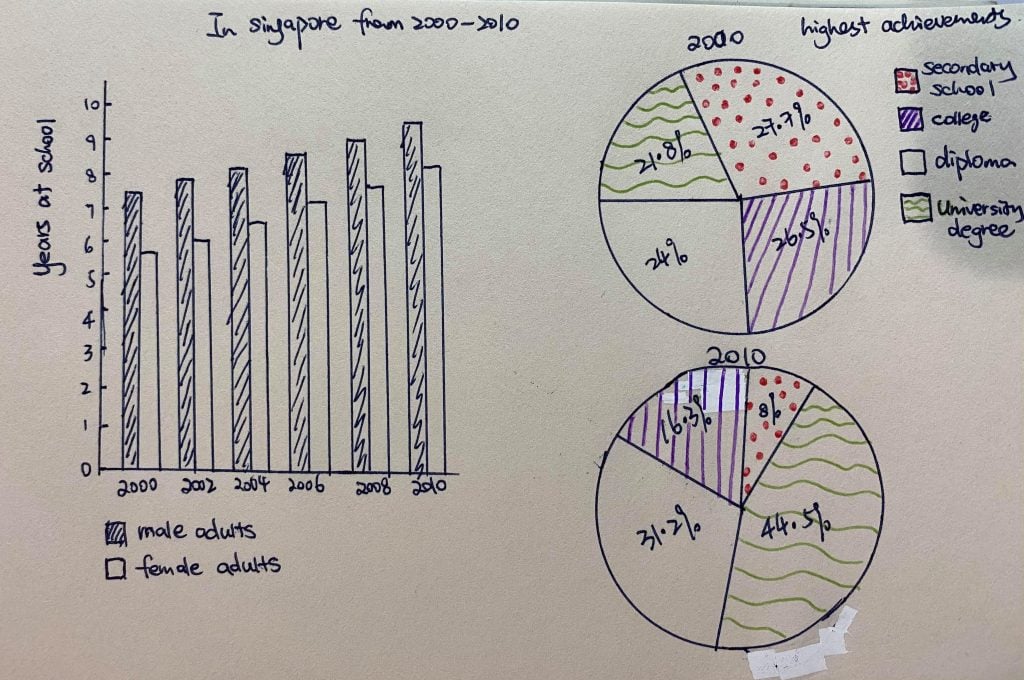
The bar chart records how long students spent in school by gender in two year intervals from 2000 to 2010, while the pie charts break down where they were studying. In general, both males and females saw steady rises in years spent at school, though male figures were always higher. In 2000, there were largely equal proportions for secondary, college, diplomas and university degrees but by 2010 university had more students, largely at the expense of secondary school.
In Singapore in 2000, males spent around 7.5 years in school and females were at 5.5. This difference of 2 years remained nearly identical over the period as the numbers for males rose steadily to over 9 to finish the period and women had narrowed the gap slightly to just under 8 years.
Turning to the types of schooling, in 2000 most students were in secondary school (27.7%) which was 1.2% higher than college, 3.7% more than those studying for diplomas and well above university degrees at 21.8%. By 2010, university degrees had surged to 44.5% and secondary declined to 8%. College students also made up a smaller proportion at 16.3%, while diploma students rose by about a third to 31.2%.
Analysis
1. The bar chart records how long students spent in school by gender in two year intervals from 2000 to 2010, while the pie charts break down where they were studying. 2. In general, both males and females saw steady rises in years spent at school, though male figures were always higher. 3. In 2000, there were largely equal proportions for secondary, college, diplomas and university degrees but by 2010 university had more students, largely at the expense of secondary school.
Make sure that you include the complete trend and some of the overall rankings.
1. In Singapore in 2000, males spent around 7.5 years in school and females were at 5.5. 2. This difference of 2 years remained nearly identical over the period as the numbers for males rose steadily to over 9 to finish the period and women had narrowed the gap slightly to just under 8 years.
Begin with the first chart and include all the data.
Be sure to compare the data and cover the beginning and end of the period.
1. Turning to the types of schooling, in 2000 most students were in secondary school (27.7%) which was 1.2% higher than college, 3.7% more than those studying for diplomas and well above university degrees at 21.8%. 2. By 2010, university degrees had surged to 44.5% and secondary declined to 8%. 3. College students also made up a smaller proportion at 16.3%, while diploma students rose by about a third to 31.2%.
Move on to the pie charts and describe the data.
I worte about the years separately but you could combine the years and write about how they rose from …. to ….
Finish with all the data and double check the accuracy of your data and your general overview.
Vocabulary
What do the words in bold below mean?
The bar chart records how long students spent in school by gender in two year intervals from 2000 to 2010, while the pie charts break down where they were studying. In general, both males and females saw steady rises in years spent at school, though male figures were always higher. In 2000, there were largely equal proportions for secondary, college, diplomas and university degrees but by 2010 university had more students, largely at the expense of secondary school.
In Singapore in 2000, males spent around 7.5 years in school and females were at 5.5. This difference of 2 years remained nearly identicalover the period as the numbers for males rose steadily to over 9 to finish the period and women had narrowed the gap slightly to just under 8 years.
Turning to the types of schooling, in 2000 most students were in secondary school (27.7%) which was 1.2% higher than college, 3.7% more than those studying for diplomas and well above university degrees at 21.8%. By 2010, university degrees had surged to 44.5% and secondary declined to 8%. College students also made up a smaller proportion at 16.3%, while diploma students rose by about a third to 31.2%.
Answers
records details
gender male or female
two year intervals every 2 years, two year gaps
break down are made up of
in general overall
steady rises consistent increases
figures numbers
largely equal proportions mostly the same percentages
secondary high school
college an institute of higher learning
diplomas certificates
university higher education
largely at the expense of mostly because of
spent put time into
difference gap
remained nearly identicalover the period were mostly the same for that time
rose steadily increased consistently
narrowed the gap slightly reduced the difference a little
just under a little less than
turning to the types of schooling considering what kind of school
The bar chart r____________s how long students spent in school by g__________r in t____________________s from 2000 to 2010, while the pie charts b_______________n where they were studying. I______________l, both males and females saw s_______________s in years spent at school, though male f___________s were always higher. In 2000, there were l__________________________s for s________________y, c___________e, d_____________s and u_____________y degrees but by 2010 university had more students, l_______________________f secondary school.
In Singapore in 2000, males s___________t around 7.5 years in school and females were at 5.5. This d______________e of 2 years r___________________________________d as the numbers for males r___________________y to over 9 to finish the period and women had n_____________________________y to j______________r 8 years.
T_______________________________g, in 2000 most students were in secondary school (27.7%) which was 1.2% h________r than college, 3.7% more than those studying for diplomas and w__________e university degrees at 21.8%. By 2010, university degrees had s____________d to 44.5% and secondary d___________d to 8%. College students also m__________p a s______________________n at 16.3%, while diploma students r_______e by about a__________d to 31.2%.
Listening Practice
Learn about Singapore’s schooling system below:
Reading Practice
Read more about the eduation gap between men and women below:
"The highest quality materials anywhere on the internet! Dave improved my writing and vocabulary so much. Really affordable options you don't want to miss out on!"