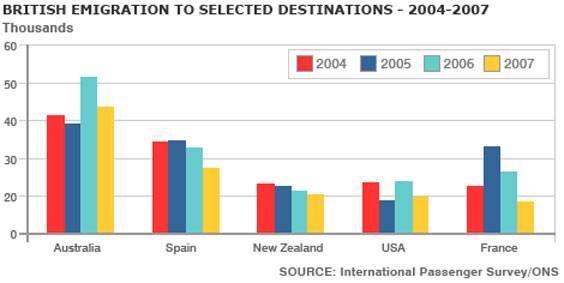
This is an IELTS writing task 1 sample answer essay on the topic of British Emigration to selected destinations from 2004 – 2007 (presented in a bar chart).
For my exclusive sample answer PDFs, sign up for my Patreon here.
Dave
IELTS Task 1 Essay: British Emigration
The bar chart provides information comparing emigration out of the UK to 5 countries. Looking from an overall perspective, it is readily apparent that emigration to Australia was most common throughout the period. Besides Australia, all countries saw decreases in the number of British immigrants.
The countries accepting the most British were Australia and Spain, with the former beginning at over 40,000 in 2004, dipping slightly in 2005, before a surge to over 50,000 in 2006, and a fall back to around 44,000 by the end of the period. In contrast, the latter started at around 34,000, rose imperceptibly the next year, and then declined steadily to finish at under 30,000 in 2007.
The other countries generally remained below 30,000 British emigrants, beginning with New Zealand (falling at steady intervals from 23,000 to 21,000 in 2007) and the USA , which decreased steeply from the same starting point to under 20,000 in 2005, more than recovering to 24,000 and then declining again to 20,000. In France, there was a sharp uptick of 10,000 emigrants to 33,000 in the first year before a precipitous fall to under 20,000, the lowest figure for all nations.
Analysis
1. The bar chart provides information comparing emigration out of the UK to 5 countries. 2. Looking from an overall perspective, it is readily apparent that emigration to Australia was most common throughout the period. 3. Besides Australia, all countries saw decreases in the number of British immigrants.
Make sure everything is covered – aim for a 2 setence overview.
1. The countries accepting the most British were Australia and Spain, with the former beginning at over 40,000 in 2004, dipping slightly in 2005, before a surge to over 50,000 in 2006, and a fall back to around 44,000 by the end of the period. 2. In contrast, the latter started at around 34,000, rose imperceptibly the next year, and then declined steadily to finish at under 30,000 in 2007.
Begin to include the data.
Compare different countries to each other.
1. The other countries generally remained below 30,000 British emigrants, beginning with New Zealand (falling at steady intervals from 23,000 to 21,000 in 2007) and the USA , which decreased steeply from the same starting point to under 20,000 in 2005, more than recovering to 24,000 and then declining again to 20,000. 2. In France, there was a sharp uptick of 10,000 emigrants to 33,000 in the first year before a precipitous fall to under 20,000, the lowest figure for all nations.
Describe the rest of the data.
Make sure all countries have been covered in full.
Vocabulary
What do the words in bold below mean?
The bar chart provides information comparing emigration out of the UK to 5 countries. Looking from an overall perspective, it is readily apparent that emigration to Australia was most commonthroughout the period. Besides Australia, all countries saw decreases in the number of British immigrants.
The countries accepting the most British were Australia and Spain, with the former beginning at over 40,000 in 2004, dipping slightly in 2005, before a surge to over 50,000 in 2006, and a fall back to around 44,000 by the end of the period. In contrast, the latter started at around 34,000, rose imperceptibly the next year, and then declined steadily to finish at under 30,000 in 2007.
The other countries generally remained below 30,000 British emigrants, beginning with New Zealand (falling at steady intervals from 23,000 to 21,000 in 2007) and the USA , which decreased steeply from the same starting point to under 20,000 in 2005, more than recovering to 24,000 and then declining again to 20,000. In France, there was a sharp uptick of 10,000 emigrants to 33,000 in the first year before a precipitous fall to under 20,000, the lowest figure for all nations.
Answers
provides information illustrates
emigration leaving to live in another country
looking from an overall perspective, it is readily apparent that overall
most common happened the most
throughout the period over the whole graph time period
besides also
saw underwent
immigrants people who have left their country
accepting allowing in
with first of all
former country mentioned before
dipping slightly falling a little
surge increase a lot
fall back decrease
by the end of the period by 2007
in contrast in comparison
latter country mentioned second
imperceptibly barely noticeably
declined steadily decreased at steady intervals
finish done, complete
generally remained below overall was under
beginning with starting with
falling at steady intervals decreasing steadily
decreased steeply fell quickly
more than recovering getting back to the numbers from before and more
declining again decreasing a second time
sharp uptick increase quickly
precipitous fall steep decrease
lowest figure for all nations low point for all countries
The bar chart p________________________n comparing e______________n out of the UK to 5 countries. L____________________________________________________________t emigration to Australia was m_________________nt_____________________d. B_________s Australia, all countries s___w decreases in the number of British i________________s.
The countries a_____________g the most British were Australia and Spain, w______h the f_________r beginning at over 40,000 in 2004, d________________y in 2005, before a s________e to over 50,000 in 2006, and a f__________k to around 44,000 b__________________________d. I____________t, the l_________r started at around 34,000, rose i___________________y the next year, and then d_____________________y to f__________h at under 30,000 in 2007.
The other countries g______________________w 30,000 British emigrants, b______________________h New Zealand (f___________________________s from 23,000 to 21,000 in 2007) and the USA , which d_____________________y from the same starting point to under 20,000 in 2005, m_______________________g to 24,000 and then d___________________n to 20,000. In France, there was a s________________k of 10,000 emigrants to 33,000 in the first year before a p___________________l to under 20,000, the l____________________________s.
Listening Practice
Learn about immigration to Britain here:
Reading Practice
Learn more about migration trends on the BBC here:
This is an IELTS writing task 2 sample answer essay on the difficulty of young and old people communicating when they live in different places.
A bit of a strange question…
For my exclusive PDFs, sign up for my Patreon here.
Dave
IELTS Essay: Communication between Young and Old People
In some places, young people find it difficult to communicate with older people.
Why is this?
What are the solutions?
In many countries, there is a communication rift between the older and younger generations. This is a natural phenomenon and the solution is for both sides to compromise.
The old and young often cannot communicate well because of major differences in perspective. It is natural that older people will have a more mature outlook and younger people be more radical in their views. A good example of this would be in Vietnam where the older generation holds very conservative, traditional views related to familial structures, careers, and social values that conflict with the more modern, progressive positions of the younger generation. Young people have heard the traditional arguments for years and want to rebel, often out of naivety. Older people have the benefit of experience and and feel young people should follow their advice. This basic antagonism underlies poor communication between the generations.
The best solutions all rely on compromise. Young people ought to accept that their lack of life experience puts them at a disadvantage in understanding the world. Many of their opinions are premature and will evolve over time. This implies that they should make greater efforts to understand the counsel of their elders. Their elders, in turn, must realise that their experiences are a small sample size from a unique time period. If, for example, they had to struggle to earn a living and raise a family, they must concede this only a single instance that cannot be simplistically generalised. Moreover, times have changed and what was sound advice in the past, may be largely irrelevant today.
In conclusion, the old and young are in different life stages and naturally have contrasting mindsets and the best solutions require a self-reflective modesty from both demographics. In this way, they will be able to learn more from each other.
Analysis
1. In many countries, there is a communication rift between the older and younger generations. 2. This is a natural phenomenon and the solution is for both sides to compromise.
Paraphrase the overall essay topic.
Clearly answer both questions. Read more about two-part questions here.
1. The old and young often cannot communicate well because of major differences in perspective. 2. It is natural that older people will have a more mature outlook and younger people be more radical in their views. 3. A good example of this would be in Vietnam where the older generation holds very conservative, traditional views related to familial structures, careers, and social values that conflict with the more modern, progressive positions of the younger generation. 4. Young people have heard the traditional arguments for years and want to rebel, often out of naivety. 5. Older people have the benefit of experience and and feel young people should follow their advice. 6. This basic antagonism underlies poor communication between the generations.
Write a clear topic sentence with your main idea at the end.
Develop your main idea.
Give a specific example.
Develop the example.
Continue developing it and don’t switch to a new main idea.
Conclude the paragraph.
1. The best solutions all rely on compromise. 2. Young people ought to accept that their lack of life experience puts them at a disadvantage in understanding the world. 3. Many of their opinions are premature and will evolve over time. 4. This implies that they should make greater efforts to understand the counsel of their elders. 5. Their elders, in turn, must realise that their experiences are a small sample size from a unique time period. 6. If, for example, they had to struggle to earn a living and raise a family, they must concede this only a single instance that cannot be simplistically generalised. 7. Moreover, times have changed and what was sound advice in the past, may be largely irrelevant today.
Write another topic sentence with a clear main idea at the end.
Explain your main idea or begin talking about your first solution.
Vary your long and short sentences.
Draw conclusions from your examples.
Switch to your other solution.
Develop your solution.
Finish developing it fully.
1. In conclusion, the old and young are in different life stages and naturally have contrasting mindsets and the best solutions require a self-reflective modesty from both demographics. 2. In this way, they will be able to learn more from each other.
Summarise your main ideas and repeat your answers.
Add a final thought/detail. Read more about conclusions here.
Vocabulary
What do the words in bold below mean?
In many countries, there is a communication rift between the older and younger generations. This is a natural phenomenon and the solution is for both sides to compromise.
The old and young often cannot communicate well because of major differences in perspective. It is natural that older people will have a more mature outlook and younger people be more radical in their views. A good example of this would be in Vietnam where the older generation holds very conservative, traditional views related to familial structures, careers, and social values that conflict with the more modern, progressive positions of the younger generation. Young people have heard the traditional arguments for years and want to rebel, often out of naivety. Older people have the benefit of experience and and feel young people should follow their advice. This basic antagonism underlies poor communication between the generations.
The best solutions all rely on compromise. Young people ought to accept that their lack of life experienceputs them at a disadvantage in understanding the world. Many of their opinions are premature and will evolve over time. This implies that they should make greater efforts to understand the counsel of their elders. Their elders, in turn, must realise that their experiences are a small sample size from a unique time period. If, for example, they had to struggle to earn a living and raise a family, they must concede this only a single instance that cannot be simplistically generalised. Moreover, times have changed and what was sound advice in the past, may be largely irrelevant today.
In conclusion, the old and young are in different life stages and naturally have contrasting mindsets and the best solutions require a self-reflective modesty from both demographics. In this way, they will be able to learn more from each other.
Answers
communication rift breakdowns in talking to each other
natural phenomenon happens normally
compromise meet in the middle
major differences in perspective contrasting viewpoints
mature outlook more reasonable viewpoints
radical extreme
views opinions
holds very conservative have traditional opinions
traditional views conservative opinions
familial structures family types
conflict with disagree with
modern new
progressive positions modern views
rebel fight against
naivety inexperienced
benefit of experience can lean on past experiences
follow their advice listen to
basic antagonism underlies conflict at the base of
accept concede
lack of life experienceputs them at a disadvantage not having many experiences makes their positions weaker
premature young, not ready
evolve change and get better
implies means
make greater efforts try more
realise understand
small sample size didn’t happen many times
unique time period that time in history
struggle to earn a living have a tough time making money
concede accept
simplistically generalised reductively applied to everyone
In many countries, there is a c________________________t between the older and younger generations. This is a n______________________n and the solution is for both sides to c_____________e.
The old and young often cannot communicate well because of m______________________________e. It is natural that older people will have a more m___________________k and younger people be more r___________l in their v_______s. A good example of this would be in Vietnam where the older generation h__________________________e, t______________________s related to f_________________________s, careers, and social values that c_______________________h the more m__________n, p_________________________s of the younger generation. Young people have heard the traditional arguments for years and want to r________l, often out of n_________y. Older people have the b___________________________e and and feel young people should f_________________________e. This b___________________________s poor communication between the generations.
The best solutions all rely on compromise. Young people ought to a_________t that their l__________________________________________________e in understanding the world. Many of their opinions are p____________e and will e__________e over time. This i__________s that they should m________________________s to understand the counsel of their elders. Their elders, in turn, must r___________e that their experiences are a s_____________________e from a u_______________________d. If, for example, they had to s____________________________g and raise a family, they must c___________e this only a single instance that cannot be s_______________________________d. Moreover, times have changed and what was s__________________e in the past, may be l_____________________________y.
In conclusion, the old and young are in d________________________s and naturally have c_________________________s and the best solutions require a s_________________________________y from both d___________________s. In this way, they will be able to learn more from each other.
This is an IELTS writing task 2 sample answer essay on the topic of technological devices from the real IELTS exam.
Make sure you don’t miss out on my exclusive sample answer PDFs by signing up for my Patreon for as little as $1 here.
Dave
IELTS Essay: Technological Devices
Many people think technological devices such as smart phones, tablets and mobile phones bring more disadvantages than advantages.
To what extent do you agree or disagree?
The availability of new technologies to the average citizen in the form of consumer electronics brings with it both advantages and disadvantages. In my opinion, though these devices are convenient, their use is a negative overall given the impact on mental health.
Proponents of phones and tablets can point to the all but limitless functionality they provide. It is possible, just by owning a small, affordable device that fits in your pocket, to instantly capture video, take photos, send emails, check social media, make phone calls, watch movies, listen to music, play games and use a wide variety of productivity applications. There is no arguing with the near miraculous achievements found in smartphones and tablets. Used properly, these save time and widen the possible outlets for self-expression and creativity. An amateur film-maker, for example, can shoot and edit digital video directly on their phone, add in sound effects and post it easily to a website like YouTube.
Nonetheless, the potential of phones is hindered by their corrosive effect. It is almost impossible to use a phone as a tool to enhance creativity and productivity because it is also home to applications designed to prey on the weaknesses of the human psyche. Companies like Facebook tap into a natural human desire for affirmation and trigger addictive dopamine bursts as rewards for posting selfies. Those not addicted to social media, may find themselves wasting hours playing videogames, receiving roughly the same chemical incentive. Over time, users become dependent on unhealthy habits that humans have not had time to evolve counters for and the ostensible convenience of these handheld devices becomes an excuse, rather than a reason, to own one.
In conclusion, phones and tablets open up new possibilities but their abuse has led to a generation of dependent users. It is up to individuals, not organisation and governments, to limit their screen time to preserve their mental well-being.
Analysis
1. The availability of new technologies to the average citizen in the form of consumer electronics brings with it both advantages and disadvantages. 2. In my opinion, though these devices are convenient, their use is a negative overall given the impact on mental health.
Paraphrase the overall essay topic.
Write a clear opinion and include your main ideas if possible. Read more about introductions here.
1. Proponents of phones and tablets can point to the all but limitless functionality they provide. 2. It is possible, just by owning a small, affordable device that fits in your pocket, to instantly capture video, take photos, send emails, check social media, make phone calls, watch movies, listen to music, play games and use a wide variety of productivity applications. 3. There is no arguing with the near miraculous achievements found in smartphones and tablets. 4. Used properly, these save time and widen the possible outlets for self-expression and creativity. 5. An amateur film-maker, for example, can shoot and edit digital video directly on their phone, add in sound effects and post it easily to a website like YouTube.
Write a topic sentence with a clear main idea at the end.
Use specific details to support your main idea.
Vary long and short sentences.
State the results to keep developing.
Write a specific example for further support.
1. Nonetheless, the potential of phones is hindered by their corrosive effect. 2. It is almost impossible to use a phone as a tool to enhance creativity and productivity because it is also home to applications designed to prey on the weaknesses of the human psyche. 3. Companies like Facebook tap into a natural human desire for affirmation and trigger addictive dopamine bursts as rewards for posting selfies. 4. Those not addicted to social media, may find themselves wasting hours playing videogames, receiving roughly the same chemical incentive. 5. Over time, users become dependent on unhealthy habits that humans have not had time to evolve counters for and the ostensible convenience of these handheld devices becomes an excuse, rather than a reason, to own one.
Continue developing it by considering all the effects.
Conclude with a strong statement.
1. In conclusion, phones and tablets open up new possibilities but their abuse has led to a generation of dependent users. 2. It is up to individuals, not organisation and governments, to limit their screen time to preserve their mental well-being.
Summarise your main ideas and repeat your opinion.
Add in a final thought/detail. Read more about conclusions here.
Vocabulary
What do the words in bold below mean?
The availability of new technologies to the average citizenin the form of consumer electronics brings with it both advantages and disadvantages. In my opinion, though these devices are convenient, their use is a negative overallgiven the impact on mental health.
Proponents of phones and tablets can point to the all but limitless functionality they provide. It is possible, just by owning a small, affordable device that fits in your pocket, to instantly capture video, take photos, send emails, check social media, make phone calls, watch movies, listen to music, play games and use a wide variety of productivity applications. There is no arguing with the near miraculous achievementsfound in smartphones and tablets. Used properly, these save time and widen the possible outlets for self-expression and creativity. An amateur film-maker, for example, can shoot and edit digital videodirectly on their phone, add in sound effects and post it easily to a website like YouTube.
Nonetheless, the potential of phones is hindered by their corrosive effect. It is almost impossible to use a phone as a tool to enhance creativity and productivity because it is also home to applications designed to prey on the weaknesses of the human psyche. Companies like Facebook tap into a natural human desire for affirmation and trigger addictive dopamine bursts as rewards for posting selfies. Those not addicted to social media, may find themselves wasting hours playing videogames, receiving roughly the same chemical incentive. Over time, users become dependent on unhealthy habits that humans have not had time to evolve counters for and the ostensible convenience of these handheld devices becomes an excuse, rather than a reason, to own one.
In conclusion, phones and tablets open up new possibilities but their abuse has led to a generation of dependent users. It is up to individuals, not organisation and governments, to limit their screen time to preserve their mental well-being.
Answers
availability can be used now
new technologies more advanced tech
average citizen normal person
in the form of manifested in
consumer electronics phones, tablets, etc.
brings with it also includes
convenient easy to use, helpful
negative overallgiven not good on the whole because
mental health psychological state
proponents supporters
point to argue
all but almost
limitless functionality unlimited uses
affordable cheap
fits in your pocket can be put in your pocket, can be carried
instantly capture video right away shoots videos
wide variety of productivity applications many types of programs for saving time
there is no arguing with it is indisputable
near miraculous achievements almost impossible successes
found in on
used properly not abused
save time more efficient
widen the possible outlets increase the avenues for
self-expression expressing yourself
creativity art
amateur film-maker not professional movie maker
edit digital videodirectly work on videos right after shooting on their phones
add in sound effects put in sounds
post it share it online
hindered by slowed by
corrosive effect impact that hurts
enhance creativity make one more creative
home to has
designed to prey on made to take advantage of
weaknesses drawbacks
human psyche psychology
tap into exploit
natural human desire part of human nature
affirmation reassurance
trigger addictive dopamine bursts make you feel happy
posting selfies putting up pictures you took of yourself
addicted can’t stop using
wasting hours not using time well
receiving roughly getting abotu the same
chemical incentive bursts of happiness
dependent rely on
unhealthy habits not good for you
evolve counters for find ways to defend oneself from
ostensible convenience seemingly good for you
handheld devices phones, tablets
excuse a reason for doing something
rather than a reason instead of a real cause
open up new possibilities allows for new opportunities
The a_____________y of n_____________________s to the a_____________ni_________________f c_____________________s b______________t both advantages and disadvantages. In my opinion, though these devices are c_____________t, their use is a n________________lg_______n the impact on m______________h.
P_____________s of phones and tablets can p_________o the a_______t l______________________y they provide. It is possible, just by owning a small, a____________e device that f__________________t, to i_____________________o, take photos, send emails, check social media, make phone calls, watch movies, listen to music, play games and use a w______________________________________s. T_____________________h the n________________________________sf____________n smartphones and tablets. U________________y, these s____________e and w_____________________s for s______________________n and c___________y. An a____________________r, for example, can shoot and e____________________y on their phone, a______________________s and p_________t easily to a website like YouTube.
Nonetheless, the potential of phones is h____________y their c___________________t. It is almost impossible to use a phone as a tool to e_____________________y and productivity because it is also h__________o applications d__________________________n the w_____________s of the h___________________e. Companies like Facebook t_________o a n_______________________e for a______________n and t_______________________________s as rewards for p_____________s. Those not a____________d to social media, may find themselves w_________________s playing videogames, r____________________y the same c___________________e. Over time, users become d_______________t on u__________________s that humans have not had time to e__________________r and the o_______________________e of these h__________________s becomes an e__________e, r____________________n, to own one.
In conclusion, phones and tablets o_______________________s but their a________e has led to a g______________n of dependent users. It is u____o individuals, not organisation and governments, to l_________t their s__________e to p__________e their m________________g.
Listening Practice
Listen below about the effects of social media on your brain:
Reading Practice
Read below about the effects of mobile phones on teenagers:
This is an IELTS writing task 2 sample answer essay on the topic of crime and whether it is a product of nature or nurture.
These kinds of topics are really common on IELTS so it is good practice for you to read my sample answer below.
If you don’t want to miss out on any of my exclusive PDFs, sign up for my Patreon for as little as $1 here.
Dave
IELTS Essay: Crime and Human Nature
Many researchers believe that we can now study the behaviour of children to see if they will grow up to be criminals, while others disagree.
To what extent do you think crime is determined by genetics?
Is it possible to stop children from growing up to be criminals?
There are many psychologists today who believe that crime comes from inborn, genetic characteristics. In my opinion, genetics play a small role in criminal behaviour and it is much more sensible to combat crime by looking to family circumstances.
Those who believe strongly in the role of genetics in determining future behaviour can point to case examples and hard data. It is very common for the children of violent criminals to display some degree of abnormal behaviour as children and later in life. Scientists can ground their theories of crime by mapping the genetic code of an individual and then identifying similarities between the family members of criminals. However, their results may uncover some genetic factors but it is much more likely that a child raised by a criminal will simply have a poor upbringing and social factors will explain their anti-social behaviour. This is supported by recent research into developmental psychology showing the physical changes that occur in brain formation as a result of upbringing.
Therefore, it is largely possible to prevent most crime by taking an active, positive role in childcare. A good counter-example of this comes from the case studies of serials killers. Without exception, all serial killers came from abusive, broken homes. The physical and sexual abuse present in their childhood, later manifested itself in their compulsions to exert power over others. Naturally, this does not mean that abuse necessarily leads to crime, as many others overcome their difficult backgrounds to become well-adjusted adults. It does, however, imply a large proportion of criminal behaviour can be prevented by a supportive family environment. Knowing that they are loved and accepted by their parents, will make children less likely to seek attention through bad behaviour or abuse drugs to cope with their problems, both of which are early indicators of possible criminality.
In conclusion, though nature may be a marginal factor in criminal psychology, I believe that emphasis on the social environment is the real key to fighting crime. It is therefore important to invest in social services, education, and child welfare programs.
Analysis
1. There are many psychologists today who believe that crime comes from inborn, genetic characteristics. 2. In my opinion, genetics play a small role in criminal behaviour and it is much more sensible to combat crime by looking to family circumstances.
Paraphrase the overall essay topic.
Write a clear opinion. Read more about writing your introduction here.
1. Those who believe strongly in the role of genetics in determining future behaviour can point to case examples and hard data. 2. It is very common for the children of violent criminals to display some degree of abnormal behaviour as children and later in life. 3. Scientists can ground their theories of crime by mapping the genetic code of an individual and then identifying similarities between the family members of criminals. 4. However, their results may uncover some genetic factors but it is much more likely that a child raised by a criminal will simply have a poor upbringing and social factors will explain their anti-social behaviour. 5. This is supported by recent research into developmental psychology showing the physical changes that occur in brain formation as a result of upbringing.
Write a clear topic sentence with your main idea at the end.
Explain your main idea.
Support it with research if possible.
Here I weaken the argument mentioned before.
I make my exact position on the first question totally clear.
1. Therefore, it is largely possible to prevent most crime by taking an active, positive role in childcare. 2. A good counter-example of this comes from the case studies of serials killers. 3. Without exception, all serial killers came from abusive, broken homes. 4. The physical and sexual abuse present in their childhood, later manifested itself in their compulsions to exert power over others. 5. Naturally, this does not mean that abuse necessarily leads to crime, as many others overcome their difficult backgrounds to become well-adjusted adults. 6. It does, however, imply a large proportion of criminal behaviour can be prevented by a supportive family environment. 7. Knowing that they are loved and accepted by their parents, will make children less likely to seek attention through bad behaviour or abuse drugs to cope with their problems, both of which are early indicators of possible criminality.
Develop your main idea with an example or counter-example.
Explain the example.
Keep developing the same example fully.
Weaken your example if necessary.
Draw conclusions from your example.
Draw out further conclusions to finish the paragraph.
1. In conclusion, though nature may be a marginal factor in criminal psychology, I believe that emphasis on the social environment is the real key to fighting crime. 2. It is therefore important to invest in social services, education, and child welfare programs.
Repeat your opinion and summarise your main ideas.
Add a final thought/detail.
Vocabulary
What do the words in bold below mean?
There are many psychologists today who believe that crime comes from inborn, genetic characteristics. In my opinion, genetics play a small role in criminal behaviour and it is much more sensible to combat crime by looking to family circumstances.
Those who believe strongly in the role of genetics in determining future behaviour can point to case examples and hard data. It is very common for the children of violent criminals to display some degree of abnormal behaviour as children and later in life. Scientists can ground their theories of crime by mapping the genetic code of an individual and then identifying similarities between the family members of criminals. However, their results may uncover some genetic factors but it is much more likely that a child raised by a criminal will simply have a poor upbringing and social factors will explain their anti-social behaviour. This is supported by recent research into developmental psychology showing the physical changes that occur in brain formation as a result of upbringing.
Therefore, it is largely possible to prevent most crime by taking an active, positive role in childcare. A good counter-example of this comes from the case studies of serials killers. Without exception, all serial killers came from abusive, broken homes. The physical and sexual abuse present in their childhood, later manifested itself in their compulsions to exert power over others. Naturally, this does not mean that abuse necessarily leads to crime, as many others overcome their difficult backgrounds to become well-adjusted adults. It does, however, imply a large proportion of criminal behaviour can be prevented by a supportive family environment. Knowing that they are loved and accepted by their parents, will make children less likely to seek attention through bad behaviour or abuse drugs to cope with their problems, both of which are early indicators of possible criminality.
In conclusion, though nature may be a marginal factor in criminal psychology, I believe that emphasis on the social environment is the real key to fighting crime. It is therefore important to invest in social services, education, and child welfare programs.
Answers
inborn gentic, passed down
genetic characteristics qualities from your ancestors
play a small role not much of an impact
sensible makes sense
combat crime fight crime
looking to family circumstances considering upbringing
determining future behaviour causing how they behave later
point to argue
case examples real world instances
hard data numbers, research
violent criminals people who hurt others
display show
abnormal behaviour deviant actions
later in life as they get older
ground their theories find evidence for what they think
mapping the genetic code DNA mapping
identifying similarities finding what is the same
uncover some genetic factors find DNA evidence
poor upbringing raised in a bad family
social factors what comes from parents, society
explain show the reason for
anti-social behaviour not acting within the bounds of society
supported by recent research evidence from studies
developmental psychology the study of how minds develop
physical changes differences in the body
brain formation how the brain develops
upbringing being raised
largely mostly
prevent most crime stop a lot of crime
active not passive
positive role big part in
childcare taking care of kids
good counter-example instance that shows the opposite
comes from result from
case studies examples
serials killers people who kill multiple people
without exception all follow this rule
abusive being hurt
broken homes unhappy families
physical related to the body
sexual abuse being hurt/used in a sexual way
later manifested afterwards takes the form of
compulsions uncontrollable desires
exert power over others hurt other people
Naturally obviously
necessarily leads to will always cause
overcome be better than
difficult backgrounds tough upbringing
well-adjusted adults normal people
imply suggest
large proportion a lot of
prevented stopped
supportive family environment good family
accepted not rejected
less likely probably not going to happen
seek attention want people to engage with them
abuse drugs to cope with their problems take drugs to feel better
early indicators signals
possible criminality potential criminal behaviour
nature genetics
marginal factor not that important
emphasis focus on
social environment family and society
real key crucial part
fighting crime combatting crime
invest give money to
social services welfare programs to help people in need
There are many psychologists today who believe that crime comes from i_________n, g_____________________________s. In my opinion, genetics p________________e in criminal behaviour and it is much more s___________e to c________________e by l______________________________s.
Those who believe strongly in the role of genetics in d____________________________r can p____________________s and h___________a. It is very common for the children of v___________________s to d_________y some degree of a___________________________r as children and l__________e. Scientists can g_______________________s of crime by m__________________________e of an individual and then i_______________________s between the family members of criminals. However, their results may u__________________________s but it is much more likely that a child raised by a criminal will simply have a p__________________g and s__________________s will e_____________n their a__________________________r. This is s__________________________h into d______________________________y showing the p____________________s that occur in b___________________n as a result of u______________g.
Therefore, it is l__________y possible to p_______________________e by taking an a________e, p___________________e in c____________e. A g_______________________e of this c___________m the c______________s of s_______________s. W______________________n, all serial killers came from a__________e, b______________s. The p___________l and s___________e present in their childhood, l_________________d itself in their c________________s to e_______________________________s. N___________y, this does not mean that abuse n_____________________o crime, as many others o____________e their d______________________s to become w____________________s. It does, however, i_________y a l___________________n of criminal behaviour can be p___________d by a s____________________________t. Knowing that they are loved and a____________d by their parents, will make children l____________y to s__________________n through bad behaviour or a___________________________s, both of which are e________________s of p___________________________y.
In conclusion, though n__________e may be a m_________________r in criminal psychology, I believe that e____________s on the s_______________________t is the r_________y to f_________________e. It is therefore important to i_______t in s___________________s, education, and c_______________________s.
This is an IELTS writing task 2 sample answer essay on the topic of whether or not the whole family should take part in raising children.
Don’t miss out on any of my exclusive PDFs by signing up here for my Patreon.
Dave
IELTS Essay: Whole Family Raising Children
It is better for children if the whole family including aunts, uncles and so on are involved in a child’s upbringing, rather than just their parents.
To what extent do you agree or disagree?
Many today feel that is important for the entire extended family to play a role in child-rearing, while others feel that parents are sufficient. In my opinion, the whole family should be part of the process.
Those who doubt the value of the whole family in raising children often point out the potentially negative influence of particular relatives. In an ideal world, each family member would impart their own unique, mature perspectives in the interests of raising a well-rounded child. In practice, many relatives are more likely to serve as bad examples or contradict the efforts of the parents. The best case scenario with such individuals is confusion and in more extreme cases it could lead to developmental problems. There is even the possibility that a close relative is engaging in physical or mental abuse of a child without the parent’s awareness.
Nonetheless, the instances above are exceptions that can be dealt with on a case-by-case basis; in most families extra help lessens the burden on parents. A good example of this would be in countries with very tight-knit families such as in Asia and South America. There it is very common for aunts, uncles and the extended family to lend a hand with raising children. The main benefits of this are for parents and children. Parents get a much needed break from looking after their kids. Children benefit from the undivided attention of their relatives. When they come back home, their mother and father are also more likely to feel recharged and fully engaged in parenting duties having had some time to themselves.
In conclusion, though there are rare situations where the whole family raising a child can be a negative, it is important for parents to receive support from relatives. Parents should strive to have this familial environment in order to raise well-adjusted adults.
Analysis
1. Many today feel that is important for the entire extended family to play a role in child-rearing, while others feel that parents are sufficient. 2. In my opinion, the whole family should be part of the process.
Paraphrase the overall essay topic.
Write a clear opinion. Read more about introductions here.
1. Those who doubt the value of the whole family in raising children often point out the potentially negative influence of particular relatives. 2. In an ideal world, each family member would impart their own unique, mature perspectives in the interests of raising a well-rounded child. 3. In practice, many relatives are more likely to serve as bad examples or contradict the efforts of the parents. 4. The best case scenario with such individuals is confusion and in more extreme cases it could lead to developmental problems. 5. There is even the possibility that a close relative is engaging in physical or mental abuse of a child without the parent’s awareness.
Develop your main idea or explain it if necessary.
Continue to develop the same main idea.
State the possible results – keep your claims weak.
State further results to continue developing your idea.
1. Nonetheless, the instances above are exceptions that can be dealt with on a case-by-case basis; in most families extra help lessens the burden on parents. 2. A good example of this would be in countries with very tight-knit families such as in Asia and South America. 3. There it is very common for aunts, uncles and the extended family to lend a hand with raising children. 4. The main benefits of this are for parents and children. 5. Parents get a much needed break from looking after their kids. 6. Children benefit from the undivided attention of their relatives. 7. When they come back home, their mother and father are also more likely to feel recharged and fully engaged in parenting duties having had some time to themselves.
Write another topic sentence with a clear main idea at the end.
Start a specific example as soon as possible.
Develop the exam.
State the results of the example.
Keep developing the same example.
State the results on everyone involved.
Conclude with a strong statement.
1. In conclusion, though there are rare situations where the whole family raising a child can be a negative, it is important for parents to receive support from relatives. 2. Parents should strive to have this familial environment in order to raise well-adjusted adults.
Summarise your main ideas and repeat your opinion.
Add a final thought or detail at the end. Read more about writing a conclusion here.
Vocabulary
What do the words in bold below mean?
Many today feel that is important for the entire extended family to play a role in child-rearing, while others feel that parents are sufficient. In my opinion, the whole family should be part of the process.
Those who doubt the value of the whole family in raising children often point out the potentially negative influence of particular relatives. In an ideal world, each family member would impart their own unique, mature perspectives in the interests of raising a well-rounded child. In practice, many relatives are more likely to serve as bad examples or contradict the efforts of the parents. The best case scenario with such individuals is confusion and in more extreme cases it could lead to developmental problems. There is even the possibility that a close relative is engaging in physical or mental abuse of a child without the parent’s awareness.
Nonetheless, the instances above are exceptions that can be dealt with on a case-by-case basis; in most families extra help lessens the burden on parents. A good example of this would be in countries with very tight-knit families such as in Asia and South America. There it is very common for aunts, uncles and the extended family to lend a hand with raising children. The main benefits of this are for parents and children. Parents get a much needed break from looking after their kids. Children benefit from the undivided attention of their relatives. When they come back home, their mother and father are also more likely to feel recharged and fully engaged in parenting duties having had some time to themselves.
In conclusion, though there are rare situations where the whole family raising a child can be a negative, it is important for parents to receive support from relatives. Parents should strive to have this familial environment in order to raise well-adjusted adults.
Answers
entire extended family uncles, aunts, cousins, etc.
play a role help with
child-rearing raising a child
sufficient enough
whole family entire family
part of the process play a role in
doubt question
value believe to be important
point out argue
potentially negative influence possibly hurt
particular relatives certain family members
in an ideal world in a perfect world
impart give/influence
unique individual
mature perspectives adult views
the interests of for others
well-rounded child kid with diverse interests
in practice in reality
serve as bad examples not good examples
contradict go against
efforts attempts
best case scenario the dream situation
confusion misunderstanding
more extreme cases worst case scenarios
developmental problems mental issues
possibility chance
close relative family member that knows them well
engaging in physical or mental abuse hurting, neglecting, abusing
without the parent’s awareness the mother/father not knowing
nonetheless regardless
exceptions cases outside the norm
dealt with handled
case-by-case basis situation to situation
lessens the burden on parents helps parents get by
Many today feel that is important for the e____________________y to p___________e in c________________g, while others feel that parents are s_____________t. In my opinion, the w_____________y should be p_____________s.
Those who d________t the v________e of the whole family in raising children often p____________t the p___________________________e of p______________________s. I_________________d, each family member would i___________t their own u__________e, m________________________s in t_____________________f raising a w_____________________d. I______________e, many relatives are more likely to s___________________s or c_____________t the e__________s of the parents. The b___________________o with such individuals is c_____________n and in m_____________________s it could lead to d__________________________s. There is even the p______________y that a c__________________e is e__________________________________e of a child w_________________________________s.
N_____________s, the instances above are e_____________s that can be d____________________h on a c_____________________s; in most families extra help l___________________________s. A good example of this would be in countries with very t______________________s such as in Asia and South America. There it is very common for aunts, uncles and the extended family to l______________d with raising children. The main benefits of this are for parents and children. Parents get a m___________________k from l___________________r their kids. Children b_____________t from the u______________________n of their relatives. When they come back home, their mother and father are also more likely to feel r____________d and fully e__________d in p____________________s having had some t__________________s.
In conclusion, though there are r_______________s where the whole family raising a child can be a negative, it is important for parents to r____________________t from relatives. Parents should s_________e to have this f______________________t in order to raise w_____________________s.
Listening Practice
Listen about some rules of Japanese parenting below:
Reading Practice
Read more about the topic of family here from The Atlantic:
"The highest quality materials anywhere on the internet! Dave improved my writing and vocabulary so much. Really affordable options you don't want to miss out on!"