This is an IELTS writing task 2 sample answer essay on the topic of arts and education funding from the real exam.
Sign up for my Patreon so you don’t miss out on my exclusive essay PDFs.
Dave
IELTS Essay: Arts & Education Funding
The government should lower the budget on the arts in order to allocate more money to education.
To what extent do you agree?
Due to the limits of national budgets, many today are fiercely debating the proper level of funding for the arts and education. While some argue that the arts have important historic value, I side with those who recognize the societal value of education.
On the one hand, many insist that the arts are an important reminder of national history. A good example of this would be the countless paintings of historic events and key figures that became prominent and fashionable during the Renaissance. These pictures now deepen not only our understanding of those events but also the psychology and values of the individuals producing and becoming patrons of art at that time. It is therefore likely that art made today will also give important clues to future generations as to the history and character of their ancestors.
On the other hand, education is the key for the progress of a nation. This can be most clearly seen in developing countries. After World War II, for instance, South Korea’s economy was decimated and there were few pathways to a stable nation. The government invested massively in education and the result is some of the most important companies in the world were founded ranging from Samsung to LG to Hyundai. These companies contribute to the economy and have greatly raised the standard of living for all citizens. I believe efforts to fund education like the one detailed above have a clear and tangible impact.
In conclusion, art is important for its value in terms of history but education is by far more important for its economic effects. Governments should strike some balance but prioritise education.
Analysis
1. Due to the limits national budgets, many today are fiercely debating the proper level of funding for the arts and education. 2. While some argue that the arts have important historic value, I side with those who recognize the societal value of education.
Paraphrase the overall essay topic.
Write a clear opinion. Learn more about introductions here.
1. On the one hand, many insist that the arts are an important reminder of national history. 2. A good example of this would be the countless paintings of historic events and key figures that became prominent and fashionable during the Renaissance. 3. These pictures now deepen not only our understanding of those events but also the psychology and values of the individuals producing and becoming patrons of art at that time. 4. It is therefore likely that art made today will also give important clues to future generations as to the history and character of their ancestors.
Write a topic sentence with a clear main idea at the end.
Begin a specific example.
Develop the example.
Draw conclusions or generalise from your example.
1. On the other hand, education is the key for the progress of a nation. This can be most clearly seen in developing countries. 2. After World War II, for instance, South Korea’s economy was decimated and there were few pathways to a stable nation. 3. The government invested massively in education and the result is some of the most important companies in the world were founded ranging from Samsung to LG to Hyundai. 4. These companies contribute to the economy and have greatly raised the standard of living for all citizens. 5. I believe efforts to fund education like the one detailed above have a clear and tangible impact.
Write another topic sentence with a clear main idea at the end.
Begin another specific example.
Develop it and don’t switch to a new example.
State the results.
Conclude with a strong statement.
1. In conclusion, art is important for its value in terms of history but education is by far more important for its economic effects. 2. Governments should strike some balance but prioritise education.
Repeat your main ideas and your opinion.
Include a final thought/detail. Read more about conclusions here.
Vocabulary
What do the words in bold below mean?
Due to the limits of national budgets, many today are fiercely debating the proper level of funding for the arts and education. While some argue that the arts have important historic value, I side with those who recognize the societal value of education.
On the one hand, many insist that the arts are an important reminder of national history. A good example of this would be the countless paintings of historic events and key figures that became prominent and fashionable during the Renaissance. These pictures now deepen not only our understanding of those events but also the psychology and values of the individuals producing and becoming patrons of art at that time. It is therefore likely that art made today will also give important clues to future generations as to the history and character of their ancestors.
On the other hand, education is the key for the progress of a nation. This can be most clearly seen in developing countries. After World War II, for instance, South Korea’s economy was decimated and there were few pathways to a stable nation. The government invested massively in education and the result is some of the most important companies in the world were founded ranging from Samsung to LG to Hyundai. These companies contribute to the economy and have greatly raised the standard of living for all citizens. I believe efforts to fund education like the one detailed above have a clear and tangible impact.
In conclusion, art is important for its value in terms of history but education is by far more important for its economic effects. Governments should strike some balance but prioritise education.
Answers
limits of national budgets constraints of money available
fiercely debating hotly arguing about
proper level of funding correct amount of money
important historic value key to understanding the past
side with agree with
recognize understand
societal value of education importance of schools
insist feel strongly about
reminder makes one remember
national history history of a country
countless paintings of historic events many pictures of events from the past
key figures important people
prominent common
fashionable in vogue
Renaissance period of artistic and scientific growth in Europe around the 1500s
deepen understand more
psychology how people think
becoming patrons of contributing money for
clues hints
future generations people in the future, our grandchildren, etc.
character personality
ancestors people who came before us
progress how the world gets better
most clearly seen obvious in
decimated destroyed
pathways means
stable nation prosperous country
invested massively put a lot of money into
ranging from including
contribute give to
raised the standard of living for all citizens make life better for all
Due to l_____________________________s, many today are f________________g the p__________________________g for the arts and education. While some argue that the arts have i__________________________e, I s_______________h those who r_____________e the s____________________________n.
On the one hand, many i_________t that the arts are an important r__________r of n________________y. A good example of this would be the c_______________________________s and k____________________s that became p________________t and f_______________e during the R______________e. These pictures now d___________n not only our understanding of those events but also the p_____________y and values of the individuals producing and b____________________f art at that time. It is therefore likely that art made today will also give important c_______s to f___________________s as to the history and c_____________r of their a_____________s.
On the other hand, education is the key for the p___________s of a nation. This can be m_________________n in developing countries. After World War II, for instance, South Korea’s economy was d______________d and there were few p____________s to a s______________n. The government i_________________y in education and the result is some of the most important companies in the world were founded r_________________m Samsung to LG to Hyundai. These companies c________________e to the economy and have greatly r___________________________________s. I believe e__________s to fund education like the one d_______________e have a c_________________________t.
In conclusion, art is important for its value in terms of history but education is by far more important for its economic effects. Governments should s____________________e but p______________e education.
This is an IELTS writing task 1 sample answer essay featuring a bar chart on the topic of education.
For more complete PDF essays, check out my Patreon here.
Dave
IELTS Task 1 Essay: Bar Chart (Education)
The chart below gives information about levels of education by age range in the UK in 2010.
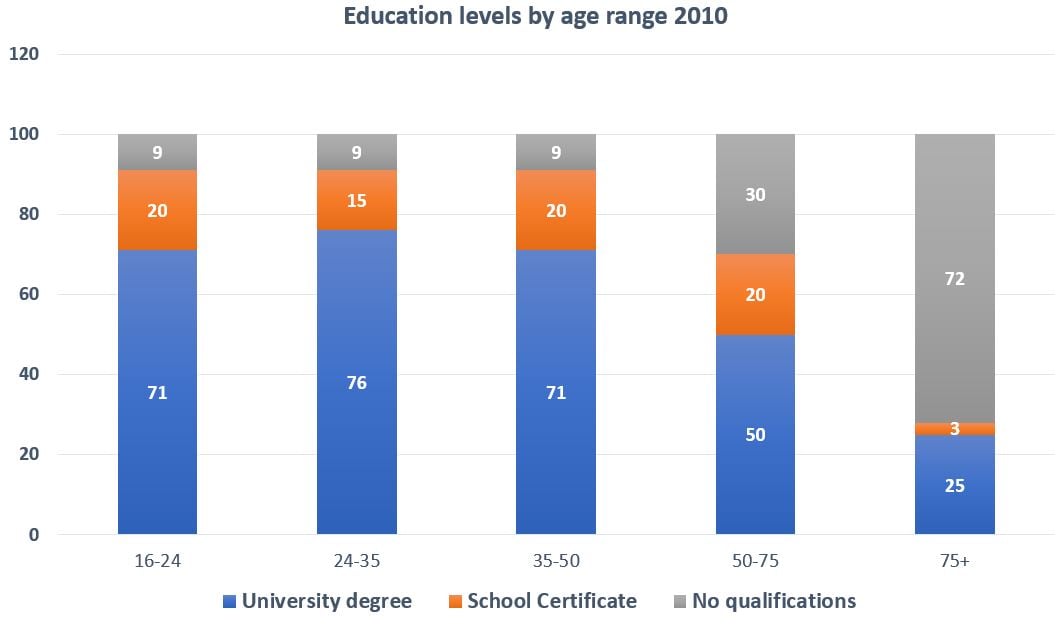
The chart details age demographics as they relate to levels of education in the UK in 2010. Looking from an overall perspective, it is readily apparent that older people, particularly in the oldest age bracket, tended to have no or fewer qualifications.
Looking first of all at younger people, precisely 27% of individuals from ages 16-50 had no qualifications. Breaking that down further, 20% of the 16-24 and 35-50 groups had school certification and 71% had university degrees. For ages 24-35, the numbers are slightly different with 76% having graduated university and 15% with a school certification.
Turning to the older demographics, for those aged 50-75, 50% had a university degree, 20% a school certificate and 30% no qualification. This figure expanded to 72% for people over 75, with just 3% having earned a school certificate and 25% a university degree.
Analysis
1. The chart details age demographics as they relate to levels of education in the UK in 2010. 2. Looking from an overall perspective, it is readily apparent that older people, particularly in the oldest age bracket, tended to have no or fewer qualifications.
Paraphrase what the graph shows.
Write a general overview that fully covers all areas.
1. Looking first of all at younger people, precisely 27% of individuals from ages 16-50 had no qualifications. 2. Breaking that down further, 20% of the 16-24 and 35-50 groups had school certification and 71% had university degrees. 3. For ages 24-35, the numbers are slightly different with 76% having graduated university and 15% with a school certification.
Begin to describe the data.
Make sure that you include all data.
And try to compare as much as possible.
1. Turning to the older demographics, for those aged 50-75, 50% had a university degree, 20% a school certificate and 30% no qualification. 2. This figure expanded to 72% for people over 75, with just 3% having earned a school certificate and 25% a university degree.
Group together the other age groups and write about them.
Finish with all the data and double check to make sure it is accurate.
Vocabulary
What do the words in bold below mean?
The chart details age demographics as they relate to levels of education in the UK in 2010. Looking from an overall perspective, it is readily apparent that older people, particularly in the oldest age bracket, tended to have no or fewer qualifications.
Looking first of all at younger people, precisely 27% of individuals from ages 16-50 had no qualifications. Breaking that down further, 20% of the 16-24 and 35-50 groups had school certification and 71% had unviersity degrees. For ages 24-35, the numbers are slightly different with 76% having graduated university and 15% with a school certification.
Turning to the older demographics, for those aged 50-75, 50% had a university degree, 20% a school certificate and 30% no qualification. This figure expanded to 72% for people over 75, with just 3% having earned a school certificate and 25% a university degree.
Answers
age demographics age groups
relate to have to do with
looking from an overall perspective, it is readily apparent that overall
age bracket age groups
tended to usually
qualifications degrees, certifications
looking first of all at beginning with
breaking that down further looking more deeply/closely
school certification a degree or paper from a school
The chart details a___________________s as they r___________o levels of education in the UK in 2010. L_________________________________________________t older people, particularly in the oldest a___________t, t___________o have no or fewer q_____________s.
L______________________t younger people, precisely 27% of individuals from ages 16-50 had no qualifications. B_________________________r, 20% of the 16-24 and 35-50 groups have s_______________________n and 71% have unviersity degrees. For ages 24-35, the numbers are s____________________t with 76% having g______________________y and 15% w____h a school certification.
T_______________o the older demographics, for those aged 50-75, 50% have a university degree, 20% a school certificate and 30% no qualification. This figure e____________d to 72% for people over 75, with just 3% having e__________d a school certificate and 25% a university degree.
This is an IELTS writing task 2 sample answer essay on the topic of the elderly and education from the real IELTS exam.
These are really common topics that could come up on your test.
If you want my exclusive IELTS PDFs, you can sign up for them here.
Dave
IELTS Essay: The Elderly and Education
Some people think governments should care more about elderly while others think they should focus on investing in education for younger people.
Discuss both views and give your own opinion.
There are many today who believe that it is more important to prioritise education for younger people over looking after the elderly. In my opinion, this makes utilitarian sense but ignores more important justifications.
Those who argue in favour of education can easily draw on the tangible benefits. Some nations have gone so far as to suggest that education is the most important national priority and deserves the greatest allocation of resources. This was famously the case in countries like Japan, South Korea, and Finland decades ago and its efficacy has been evidenced by the growth of innovative industries and progressively rising standards of living. The conclusions from those countries is simple: money spent on education not only contributes to producing jobs in the short-term and stimulating the consumer economy, but the results years later of a well-educated populace will benefit political participation, the economy, safety, and a host of other areas.
Nonetheless, investment on education has peaked and care for the elderly is a sadly neglected area. No one would suggest drastically slashing education budgets, but some resources ought to be diverted to the people who contributed most to present living stangards. Past generations often had to work longer hours at more difficult jobs to build the modern infrastructure and political and economic systems now taken for granted. As these people age, many of them struggle with paying the bills if they do not have a supportive, financially stable family. They might not be able to work anymore so it therefore falls to the government to find ways of taking care of them ranging from retirement homes to monthly checks for living expenses to being aware of how policy changes might affect older people.
In conclusion, education is crucial but it is more important to keep in mind the debt owed to the elderly and take good care of them. Governments must of course balance a multitude of priorities but old people should not slip down the list.
Analysis
1. There are many today who believe that it is more important to prioritise education for younger people over looking after the elderly. 2. In my opinion, this makes utilitarian sense but ignores more important justifications.
Paraphrase the overall essay topic.
Write a clear opinion. Learn more about conclusions here.
1. Those who argue in favour of education can easily draw on the tangible benefits. 2. Some nations have gone so far as to suggest that education is the most important national priority and deserves the greatest allocation of resources. 3. This was famously the case in countries like Japan, South Korea, and Finland decades ago and its efficacy has been evidenced by the growth of innovative industries and progressively rising standards of living. 4. The conclusions from those countries is simple: money spent on education not only contributes to producing jobs in the short-term and stimulating the consumer economy, but the results years later of a well-education populace will benefit political participation, the economy, safety, and a host of other areas.
Write a topic sentence with a clear main idea at the end.
Explain your main idea.
Use specific examples to develop your main idea.
State the full results of your example.
1. Nonetheless, investment on education has peaked and care for the elderly is a sadly neglected area. 2. No one would suggest drastically slashing education budgets, but some resources ought to be diverted to the people who contributed most to present living stangards. 3. Past generations often had to work longer hours at more difficult jobs to build the modern infrastructure and political and economic systems now taken for granted. 4. As these people age, many of them struggle with paying the bills if they do not have a supportive, financially stable family. 5. They might not be able to work anymore so it therefore falls to the government to find ways of taking care of them ranging from retirement homes to monthly checks for living expenses to being aware of how policy changes might affect older people.
Write another topic sentence with another clear main idea at the end.
Explain or begin developing the main idea.
Be as specific as possible supporting your main idea.
Don’t switch to new main idea.
Conclude with a strong statement and specific ideas.
1. In conclusion, education is crucial but it is more important to keep in mind the debt owed to the elderly and take good care of them. 2. Governments must of course balance a multitude of priorities but old people should not slip down the list.
Repeat your opinion summarise your main ideas.
Add a final thought/detail. Read more about conclusions here.
Vocabulary
What do the words in bold below mean?
There are many today who believe that it is more important to prioritise education for younger people over looking after the elderly. In my opinion, this makes utilitarian sense but ignores more important justifications.
Those who argue in favour of education can easily draw on the tangible benefits. Some nations have gone so far as to suggest that education is the most important national priority and deserves the greatest allocation of resources. This was famously the case in countries like Japan, South Korea, and Finland decades ago and its efficacy has been evidenced by the growth of innovative industries and progressively rising standards of living. The conclusions from those countries is simple: money spent on education not only contributes to producing jobs in the short-term and stimulating the consumer economy, but the results years later of a well-educated populace will benefit political participation, the economy, safety, and a host of other areas.
Nonetheless, investment on education has peaked and care for the elderly is a sadly neglected area. No one would suggest drastically slashing education budgets, but some resources ought to be diverted to the people who contributed most to present living stangards. Past generations often had to work longer hours at more difficult jobs to build the modern infrastructure and political and economic systems now taken for granted. As these people age, many of them struggle with paying the bills if they do not have a supportive, financially stable family. They might not be able to work anymore so it therefore falls to the government to find ways of taking care of them ranging from retirement homes to monthly checks for living expenses to being aware of how policy changes might affect older people.
In conclusion, education is crucial but it is more important to keep in mind the debt owed to the elderly and take good care of them. Governments must of course balance a multitude of priorities but old people should not slip down the list.
Answers
prioritise focus on
looking after taking care of
utilitarian sense just caring about what it pragmatic
ignores not pay attention to
justifications reasons for
argue in favour of support
easily draw on can point out
tangible benefits real advantages
gone so far as to taken to the extreme of
most important national priority crucial for the country
deserves should get
greatest allocation of resources most money for
famously the case well known example
decades ago more than 10 years ago
efficacy effectiveness
innovative industries companies that develop new products
progressively rising standards of living life getting better and better
not only not limited to
short-term not far in the future
stimulating the consumer economy selling more products
well-educated populace smart citizens
political participation voting
safety lack of crime
a host of many
nonetheless regardless
peaked reached a high point
sadly neglected area unfortunately neglected/forgotten
drastically slashing education budgets cutting money for schools a lot
ought should
diverted taken to another area
contributed most give the most
past generations older people
modern infrastructure buildings, roads, etc.
political related to politics and voting
economic systems how the economy works
taken for granted not appreciated
struggle fight with
supportive helpful
financially stable family family with money
falls to must be responsible for
find ways locate methods
retirement homes places for old people to live
monthly checks for living expenses retirement fund
aware knkow about
policy changes reforms
crucial very important
keep in mind be mindful of
debt owed responsible
take good care of them look after well
balance keep both in mind
multitude of priorities many areas to consider
slip down the list be forgotten, become less important
There are many today who believe that it is more important to p___________e education for younger people over l___________r the elderly. In my opinion, this makes u________________e but i__________s more important j_______________s.
Those who a_________________f education can e_______________n the t____________________s. Some nations have g________________o suggest that education is the m____________________y and d___________s the g___________________________s. This was f_________________e in countries like Japan, South Korea, and Finland d____________o and its e_________y has been evidenced by the growth of i____________________s and p____________________________g. The conclusions from those countries is simple: money spent on education n_________y contributes to producing jobs in the s___________m and s______________________________y, but the results years later of a w_______________________e will benefit p__________________________n, the economy, s_________y, and a___________f other areas.
N______________s, investment on education has p_________d and care for the elderly is a s______________________a. No one would suggest d__________________________________s, but some resources o__________t to be d_____________d to the people who c__________________t to present living stangards. P_________________s often had to work longer hours at more difficult jobs to build the m________________________e and p___________l and e_________________s now t___________________d. As these people age, many of them s______________e with paying the bills if they do not have a s_______________e, f_____________________y. They might not be able to work anymore so it therefore f___________o the government to f______________s of taking care of them ranging from r_________________s to m_____________________s to being a_________e of how p________________s might affect older people.
In conclusion, education is c__________l but it is more important to k______________d the d____________d to the elderly and t_______________________m. Governments must of course b____________e a m______________________s but old people should not s______________________t.
Listening Practice
Learn what it is like to be old in Japan:
Reading Practice
Read the following article about education as a social ladder here:
This is an IELTS writing task 2 sample answer essay from the real IELTS exam on the topic of taxing sugar.
It is really, really similar to a question a few months ago about the government taxing unhealthy foods that you can read here.
Be sure to sign up for my Patreon here so that you don’t miss out on any of my exclusive PDFs.
Dave
IELTS Essay: Taxing Sugar
Governments in many countries have recently introduced special taxes on foods and beverages with high levels of sugar. Some think these taxes are a good idea while others disagree.
Discuss both views and give you own opinion.
Many believe that new taxes on sugary products are beneficial for the public while others feel they impinge on individual freedoms. In my opinion, despite the drawbacks, the benefits to health justify these regulations.
Those who oppose such laws point out the limits placed on less affluent customers. The wealthy can still afford to buy sugary foods and drinks as the taxes are small enough. However, poorer individuals will find that an extra few dollars for a soda or candy bar is prohibitively expensive. They will rightly feel the right to make choices about their own health and the foods they like has been restricted by government. Consumers buying sugary foods and drinks are already well aware of the associated health risks; they have simply decided to value short-term gratification over long-term health.
Nonetheless, freedom and safety will always be in conflict and this change is unequivocally for the public good. Sugar has been shown in studies to be more harmful that fatty foods and is one of the driving factors behind a variety of conditions ranging from obesity to diabetes to, allegedly, cancer. Soda companies like Coca Cola and candy manufacturers like Nestle have tapped into a basic human desire for sweets to attract customers and build their brands. Because they were allowed free latitude in the past, the only solution now is draconian taxes that can begin to slowly dissuade people from sugary products and eventually break down their dependence to a healthy, moderate level.
In conclusion, though there are class issues associated with taxing sugar, these are outweighed by their benefits to public health. Governments around the world ought to adopt some variation of these important reforms.
Analysis
1. Many believe that new taxes on sugary products are beneficial for the public while others feel they impinge on individual freedoms. 2. In my opinion, despite the drawbacks, the benefits to health justify these regulations.
Paraphrase the overall essay topic.
Write a clear opinion. Read more about introductions here.
1. Those who oppose such laws point out the limits placed on less affluent customers. 2. The wealthy can still afford to buy sugary foods and drinks as the taxes are small enough. 3. However, poorer individuals will find that an extra few dollars for a soda or candy bar is prohibitively expensive. 4. They will rightly feel the right to make choices about their own health and the foods they like has been restricted by government. 5. Consumers buying sugary foods and drinks are already well aware of the associated health risks; they have simply decided to value short-term gratification over long-term health.
Write a topic sentence with a clear main idea at the end.
Develop your main idea.
Continue to develop by stating further results.
Don’t swich to a new main idea.
Summarise your argument for the paragraph.
1. Nonetheless, freedom and safety will always be in conflict and this change is unequivocally for the public good. 2. Sugar has been shown in studies to be more harmful that fatty foods and is one of the driving factors behind a variety of conditions ranging from obesity to diabetes to, allegedly, cancer. 3. Soda companies like Coca Cola and candy manufacturers like Nestle have tapped into a basic human desire for sweets to attract customers and build their brands. 4. Because they were allowed free latitude in the past, the only solution now is draconian taxes that can begin to slowly dissuade people from sugary products and eventually break down their dependence to a healthy, moderate level.
Write another topic sentence with a new main idea at the end.
Use studies to support your ideas when possible.
Develop your idea with specific, real examples.
Add as much detail as you can.
1. In conclusion, though there are class issues associated with taxing sugar, these are outweighed by their benefits to public health. 2. Governments around the world ought to adopt some variation of these important reforms.
Summarise your main ideas and repeat your opinion.
Add a final thought. Read more about conclusions here.
Vocabulary
What do the words in bold below mean?
Many believe that new taxes on sugary products are beneficial for the public while others feel they impinge on individual freedoms. In my opinion, despite the drawbacks, the benefits to health justify these regulations.
Those who oppose such laws point out the limits placed onless affluent customers. The wealthy can still afford to buy sugary foods and drinks as the taxes are small enough. However, poorer individuals will find that an extra few dollars for a soda or candy bar is prohibitively expensive. They will rightly feel the right to make choices about their own health and the foods they like has been restricted by government. Consumers buying sugary foods and drinks are already well aware of the associated health risks; they have simply decided to value short-term gratification over long-term health.
Nonetheless, freedom and safety will always be in conflict and this change is unequivocally for the public good. Sugar has been shown in studies to be more harmful that fatty foods and is one of the driving factors behind a variety of conditions ranging from obesity to diabetes to, allegedly, cancer. Soda companies like Coca Cola and candy manufacturers like Nestle have tapped into a basic human desire for sweets to attract customers and build their brands. Because they were allowed free latitude in the past, the only solution now is draconian taxes that can begin to slowly dissuade people from sugary products and eventually break down their dependence to a healthy, moderate level.
In conclusion, though there are class issues associated with taxing sugar, these are outweighed by their benefits to public health. Governments around the world ought to adopt some variation of these important reforms.
Answers
taxes money paid to the government
sugary products cupcakes, cakes, candy, etc.
beneficial good
the public citizens, all people
impinge limit
individual freedoms what individuals are permitted to do
despite the drawbacks regardless of the negatives
justify give reason for
regulations keep in check
oppose go against
point out argue
limits placed on restrictions on
less affluent customers poor people
afford can buy
small enough not too big
find realise
extra few dollars some more money
prohibitively expensive too much to be able to buy
rightly correctly
restricted by government limited by law
consumers people who buy, customers
associated health risks related health problems
value short-term gratification over long-term health only care about the present moment
in conflict not in agreement
unequivocally undoubtedly
public good for the benefit of all
fatty foods foods high in fat like pizza, burgers, etc.
Many believe that new t_____s on s__________________s are b___________l for t_____________c while others feel they i__________e on i____________________s. In my opinion, d______________________s, the benefits to health j________y these r______________s.
Those who o__________e such laws p_________t the l_________________nl___________________________s. The wealthy can still a______d to buy sugary foods and drinks as the taxes are s____________h. However, poorer individuals will f_____d that an e_____________s for a soda or candy bar is p____________________e. They will r_________y feel the right to make choices about their own health and the foods they like has been r________________________t. C___________s buying sugary foods and drinks are already well aware of the a______________________s; they have simply decided to v_______________________________________________h.
Nonetheless, freedom and safety will always be i____________t and this change is u____________________y for the p___________d. Sugar has been shown in studies to be more harmful that f___________s and is one of the d________________s behind a v____________________s ranging from o________y to d__________s to, a__________y, cancer. Soda companies like Coca Cola and candy m__________________s like Nestle have t____________o a basic human desire for sweets to a_____________________s and b_________________s. Because they were allowed f_______________e in the past, the only solution now is d________________n taxes that can begin to s_____________________e people from sugary products and eventually b____________n their d______________e to a healthy, m___________________l.
In conclusion, though there are c_____________s associated with taxing sugar, these are o_____________d by their benefits to p_____________h. Governments around the world o________t to a___________________n of these i_______________________s.
Listening Practice
Learn here about a family that quit sugar for a month:
Reading Practice
In contrast, learn about some popular baked goods below:
This is an IELTS writing task 2 sample answer essay on the topic of cars and damaging the environment.
Sign up for my Patreon.com/HowtodoIELTS so that you don’t miss out on my exclusive PDF essays as well!
Dave
IELTS Essay: Cars Damaging the Environment
The manufacturing and use of cars damages the environment but their popularity is increasing.
Why is this?
How could this be controlled?
Even though both production and car use increase pollution, the auto industry continues to expand. This is because developing nations now have greater disposable income and governments can limit the resultant environmental damage through regulation.
The main cause underlying an increasing numbers of cars is growth in developing countries. Ownership in developed countries peaked decades ago and many European nations in particular are now adopting greener modes of transport. However, in developing nations, cars are seen as a status symbol that boost self-esteem and serve a practical travel purpose. Coupled with increased per capita GDP, the boom in car ownership is unsurprising. For example, a growing middle class in Vietnam has driven up purchases of foreign automobiles dramatically over the last decade. The demand is so great that last year a Vietnamese company introduced the first domestically produced car. This same trend is replicated around the world in developing countries.
The most impactful response is from the government. Consumers will continue to buy cars but the government has control over a range of possible environmental protective measures. For example, there could be stricter laws related to emission standards. This would cut down on the average amount of pollution from individual cars and collectively make a huge difference. Another measure would be to discourage car ownership by taxing cars heavily and improving the quality of public transportation. A good example of this would also be in Vietnam where there is a 200% tax on cars and the government is building the world’s most expensive subway system in Ho Chi Minh City. Individuals are unlikely to change their behaviour en masse so it falls to policymakers to dissuade citizens through proactive reforms and policies.
In conclusion, more cars can be explained by rising incomes globally and pragmatic solutions come from government regulation. If taken seriously, the heavy environmental toll of cars can be curbed.
Analysis
1. Even though both production and car use increase pollution, the auto industry continues to expand. 2. This is because developing nations now have greater disposable income and governments can limit the resultant environmental damage through regulation.
Paraphrase the overall essay topic.
Answer both questions clearly. Learn more about introductions here and two part question structure here.
1. The main cause underlying an increasing numbers of cars is growth in developing countries. 2. Ownership in developed countries peaked decades ago and many European nations in particular are now adopting greener modes of transport. 3. However, in developing nations, cars are seen as a status symbol that boost self-esteem and serve a practical travel purpose. 4. Coupled with increased per capita GDP, the boom in car ownership is unsurprising. 5. For example, a growing middle class in Vietnam has driven up purchases of foreign automobiles dramatically over the last decade. 6. The demand is so great that last year a Vietnamese company introduced the first domestically produced car. 7. This same trend is replicated around the world in developing countries.
Write a clear topic sentence with your main idea at the end.
Explain or give the background for your idea.
Add in specific detail and don’t switch to a new idea.
Include more specific supporting information.
Give a specific example.
Develop the example.
Generalise to other countries.
1. The most impactful response is from the government. 2. Consumers will continue to buy cars but the government has control over a range of possible environmental protective measures. 3. For example, there could be stricter laws related to emission standards. 4. This would cut down on the average amount of pollution from individual cars and collectively make a huge difference. 5. Another measure would be to discourage car ownership by taxing cars heavily and improving the quality of public transportation. 6. A good example of this would also be in Vietnam where there is a 200% tax on cars and the government is building the world’s most expensive subway system in Ho Chi Minh City. 7. Individuals are unlikely to change their behaviour en masse so it falls to policymakers to dissuade citizens through proactive reforms and policies.
Write another topic sentence with a new main idea at the end.
Explain your main idea.
Begin a specific example.
Develop the example.
Include another solution.
Develop that solution with a specific example if possible.
Conclude with a strong general statement.
1. In conclusion, more cars can be explained by rising incomes globally and pragmatic solutions come from government regulation. 2. If taken seriously, the heavy environmental toll of cars can be curbed.
Summarise your main ideas.
Add a final thought. Read more about conclusions here.
Vocabulary
What do the words in bold below mean?
Even though both production and car use increase pollution, the auto industry continues to expand. This is because developing nations now have greater disposable income and governments can limit the resultant environmental damage through regulation.
The main cause underlying an increasing numbers of cars is growth in developing countries. Ownership in developed countries peaked decades ago and many European nations in particular are now adopting greener modes of transport. However, in developing nations, cars are seen as a status symbol that boost self-esteem and serve a practical travel purpose. Coupled with increased per capita GDP, the boom in car ownership is unsurprising. For example, a growing middle class in Vietnam has driven up purchases of foreign automobiles dramatically over the last decade. The demand is so great that last year a Vietnamese company introduced the first domestically produced car. This same trend is replicated around the world in developing countries.
The most impactful response is from the government. Consumers will continue to buy cars but the government has control over a range of possibleenvironmental protective measures. For example, there could be stricter laws related to emission standards. This would cut down on the average amount of pollution from individual cars and collectively make a huge difference. Another measure would be to discourage car ownership by taxing cars heavily and improving the quality of public transportation. A good example of this would also be in Vietnam where there is a 200% tax on cars and the government is building the world’s most expensive subway system in Ho Chi Minh City. Individuals are unlikely to change their behaviour en masseso it falls topolicymakers to dissuade citizens through proactive reforms and policies.
In conclusion, more cars can be explained by rising incomes globally and pragmatic solutions come from government regulation. If taken seriously, the heavy environmental toll of cars can be curbed.
Answers
even though despite
production manufacturing
auto industry making cars
expand grow bigger
greater disposable income more money to spend
limit constrain
resultant environmental damage increasing climate change, polluting the environment
regulation limiting
underlying foundational
ownership have a car
peaked decades ago reach a high point a long time ago
in particular especially
adopting greener modes of transport using more environmentally friendly options
status symbol show-off
boost self-esteem feel better about yourself
serve a practical travel purpose useful
coupled with combine with
per capita GDP average income
boom increase
unsurprising no shock
growing middle class more people with money
driven up increased
dramatically substantially
demand desire
introduced premiered
domestically produced car not a foreign car
trend pattern
replicated repeated
impactful response most effective solution
consumers buyers
control over can regulate
range of possibleenvironmental protective measures many ways to protect the environment
stricter laws better regulations
emission standards how clean a car is
cut down on reduce
average amount how much is used per person
collectively all together
huge difference big impact
measure action
discourage car ownership dissuade people from buying cars
heavily a lot
200% tax pay doble
subway system underground
en masseall together
falls topolicymakers responsibility of government
dissuade discourage
proactive reforms take an active role in changing
policies laws
explained shown
globally around the world
pragmatic solutions practical countermeasures
government regulation laws
if taken seriously done well
heavy environmental toll hurts the environment a lot
E______________h both p______________n and car use increase pollution, the a______________y continues to e__________d. This is because developing nations now have g___________________________e and governments can l______t the r__________________________________e through r___________n.
The main cause u_____________g an increasing numbers of cars is growth in developing countries. O_____________p in developed countries p_____________________o and many European nations i______________r are now a_______________________________________t. However, in developing nations, cars are seen as a s_______________l that b______________m and s_______________________________________e. C_______________h increased p_______________________P, the b_______m in car ownership is u______________g. For example, a g_______________________s in Vietnam has d_____________p purchases of foreign automobiles d______________y over the last decade. The d___________d is so great that last year a Vietnamese company i_______________d the first d________________________r. This same t________d is r_______________d around the world in developing countries.
The most i_______________________e is from the government. C_____________s will continue to buy cars but the government has c_____________r a r_________________________________________________s. For example, there could be s_____________s related to e______________________s. This would c________________________n the a_____________________t of pollution from individual cars and c_________________y make a h__________________e. Another m_____________e would be to d______________________p by taxing cars h_____________y and improving the quality of public transportation. A good example of this would also be in Vietnam where there is a 2_____________x on cars and the government is building the world’s most expensive s____________________m in Ho Chi Minh City. Individuals are unlikely to change their behaviour e__________eso it f____________________s to d____________e citizens through p_____________________s and p_______________s.
In conclusion, more cars can be e______________d by rising incomes g___________y and p_____________________s come from g__________________________n. I____________________y, the h___________________________l of cars can be c__________d.
Listening Practice
Watch the video below to understand the idea of a carbon footprint:
And a related speaking test here:
Reading Practice
Learn more about the environmental impact of cars below:
"The highest quality materials anywhere on the internet! Dave improved my writing and vocabulary so much. Really affordable options you don't want to miss out on!"