This is an IELTS writing task 2 sample answer essay on the topic of restaurants from the real IELTS exam.
Don’t miss out on my exclusive PDFs by signing up for my Patreon here.
Dave
IELTS Essay: Restaurants & Food Waste
In many countries, people throw away a lot of food from restaurants and shops.
Why do you think people waste food in this way?
What can be done to reduce the amount of food thrown away?
Food waste is a growing global problem. It happens because people often buy more than they need and the best countermeasure would be to cut down on portion sizes.
Food waste is mainly a result of individuals ordering or purchasing too much food. Many people order extra when dining out to ensure they are not hungry at the end of the meal. Humans are a planning and predicting animal and this is a natural instinct. The same drive partly explains purchasing too much food at the supermarket but there are other possible sources. For example, ambitious shoppers intending to cook a variety of dishes during the week, may buy a lot of healthy fruits and vegetables. If they are busy or cannot summon the initiative, the produce will spoil within a few days and they will have to throw it out and make other plans.
The solution is to reduce the amount of food people eat. A reinforcing cycle of over-eating by obese consumers can lead to greater food waste. People order or buy more than they need and stuff themselves at every meal. Over time, this becomes an ingrained habit and they purchase increasingly greater quantities of food, some of which will naturally go bad or be thrown out if they cannot finish it. A good counter-example to this practice would be in France, which is famed for smaller portion sizes. Food waste is dramatically lower in France simply because people eat modest meals and are therefore more likely to eat all their food. This could be replicated in other nations if governments reformed school meals and took other key steps.
In conclusion, food waste has deep psychological roots and the best solution is for individuals to reduce the size of their average meal. A shift like this will require a concerted effort from both ordinary citizens and health officials.
Analysis
1. Food waste is a growing global problem. 2. It happens because people often buy more than they need and the best countermeasure would be to cut down on portion sizes.
Paraphrase the overall essay topic.
Answer both of the questions directly. Read more about introductions here.
1. Food waste is mainly a result of individuals ordering or purchasing too much food. 2. Many people order extra when dining out to ensure they are not hungry at the end of the meal. 3. Humans are a planning and predicting animal and this is a natural instinct. 4. The same drive partly explains purchasing too much food at the supermarket but there are other possible sources. 5. For example, ambitious shoppers intending to cook a variety of dishes during the week, may buy a lot of healthy fruits and vegetables. 6. If they are busy or cannot summon the initiative, the produce will spoil within a few days and they will have to throw it out and make other plans.
Write a clear topic sentence with the main idea at the end.
Explain or develop your main idea.
Continue to explain and vary your long and short sentences.
Keep developing it more deeply.
Use examples to support your ideas.
Conclude with the fully results of the example.
1. The solution is to reduce the amount of food people eat. 2. A reinforcing cycle of over-eating by obese consumers can lead to greater food waste. 3. People order or buy more than they need and stuff themselves at every meal. 4. Over time, this becomes an ingrained habit and they purchase increasingly greater quantities of food, some of which will naturally go bad or be thrown out if they cannot finish it. 5. A good counter-example to this practice would be in France, which is famed for smaller portion sizes. 6. Food waste is dramatically lower in France simply because people eat modest meals and are therefore more likely to eat all their food. 7. This could be replicated in other nations if governments reformed school meals and took other key steps.
Answer the other question directly with a new main idea.
Begin your solution.
Here I give background for my solution.
I give further background here.
Here I use an example to show a possible solution.
Develop the example.
Conclude with a strong statement.
1. In conclusion, food waste has deep psychological roots and the best solution is for individuals to reduce the size of their average meal. 2. A shift like this will require a concerted effort from both ordinary citizens and health officials.
Repeat your answers to both questions.
Add a final thought – read more about conclusions here.
Vocabulary
What do the words in bold below mean?
Food waste is a growing global problem. It happens because people often buy more than they need and the best countermeasure would be to cut downon portion sizes.
Food waste is mainly a result of individuals ordering or purchasing too much food. Many people order extra when dining out to ensure they are not hungry at the end of the meal. Humans are a planning and predicting animal and this is a natural instinct. The same drive partly explains purchasing too much food at the supermarket but there are other possible sources. For example, ambitious shoppersintending to cook a variety of dishes during the week, may buy a lot of healthy fruits and vegetables. If they are busy or cannot summon the initiative, the produce will spoil within a few days and they will have to throw it out and make other plans.
The solution is to reduce the amount of food people eat. A reinforcing cycle of over-eating by obese consumers can lead to greater food waste. People order or buy more than they need and stuff themselves at every meal. Over time, this becomes an ingrained habit and they purchase increasingly greater quantities of food, some of which will naturally go bad or be thrown out if they cannot finish it. A good counter-example to this practice would be in France, which is famed for smaller portion sizes. Food waste is dramatically lower in France simply because people eat modest meals and are therefore more likely to eat all their food. This could be replicated in other nations if governments reformed school meals and took other key steps.
In conclusion, food waste has deep psychological roots and the best solution is for individuals to reduce the size of their average meal. A shift like this will require a concerted effort from both ordinary citizens and health officials.
Answers
growing global problem increasing issue around the world
countermeasure solution
cut downon portion sizes eat less food
mainly mostly
ensure make sure
natural instinct predisposed towards
drive partly explains desire somewhat illustrates
ambitious shoppersintending people buying more than they can eat/prepare wanting to
summon the initiative work up the effort to
produce fruit and veggies
spoil go bad
throw it out put in the trash
make other plans do something else
reinforcing cycle feedback loop
over-eating eating too much
obese consumers fat people
stuff themselves eat too much
over time gradually
ingrained habit accustomed to it
increasingly greater quantities of food larger and larger portion sizes
naturally go bad inevitably spoil
thrown out put in the trash
finish eat all
counter-example example of the opposite case
practice behaviour
smaller portion sizes less food per meal
dramatically lower much less
modest smaller
replicated repeated
reformed school meals changed what kids eat at school
Food waste is a g______________________m. It happens because people often buy more than they need and the best c____________________e would be to c____________________________s.
Food waste is m__________y a result of individuals ordering or purchasing too much food. Many people order extra when dining out to e_______e they are not hungry at the end of the meal. Humans are a planning and predicting animal and this is a n____________________t. The same d_________________________s purchasing too much food at the supermarket but there are other possible sources. For example, a______________________________g to cook a variety of dishes during the week, may buy a lot of healthy fruits and vegetables. If they are busy or cannot s_________________________e, the p____________e will s______l within a few days and they will have to t_______________t and m_________________s.
The solution is to reduce the amount of food people eat. A r_________________e of o______________g by o_________________s can lead to greater food waste. People order or buy more than they need and s_______________________s at every meal. O___________e, this becomes an i____________________t and they purchase i__________________________________d, some of which will n________________d or be t______________t if they cannot f_________h it. A good c__________________e to this p___________e would be in France, which is famed for s__________________________s. Food waste is d______________________r in France simply because people eat m_________t meals and are therefore more likely to eat all their food. This could be r____________d in other nations if governments r____________________s and t______________________s.
In conclusion, food waste has d_________________________s and the best solution is for individuals to reduce the size of their a_________________l. A s______t like this will require a c_________________t from both o__________________s and h__________________s.
This is an IELTS writing task 1 sample answer essay line graph about the demand for steel.
Don’t miss out on any of my exclusive PDF sample answers by signing up for my Patreon here or my online courses here and my writing corrections here.
IELTS Task 1 Essay: Line Graph (Steel)
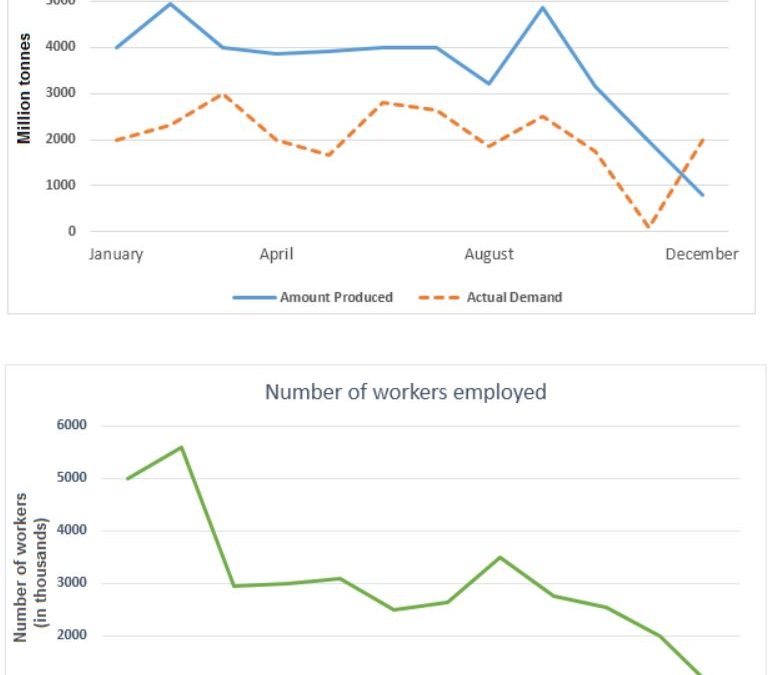
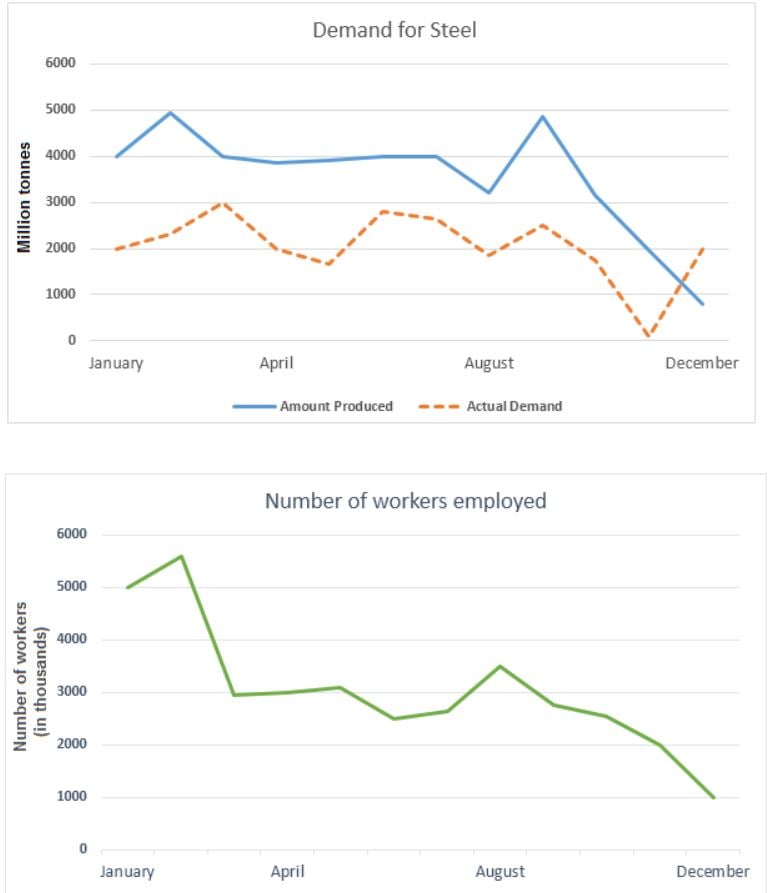
The line charts give information about the demand for steel and number of workers employed in a country from January to December.
The charts detail demand for steel and the number of workers employed in a given country over a one year period. Looking from an overall perspective, it is readily apparent that both demand and employment fluctuated but followed similar downwards trends. By the end of the period, actual demand had overtaken production.
In the first 2 months of the year, workers (6,000), steel production (5,000) and actual demand (3,000) peaked. From there, the number of workers fell steeply to 3,000 in March and was flat through April, while production dropped below 4,000 tonnes and remained stable to July. Actual demand also decreased, though it fluctuated between 2 and 3,000 tonnes through September, before plummeting to 0 in November and recovering to 2,000 in December.
This end of year pattern was largely mirrored by both production and employment as the former crashed from a second peak of nearly 5,000 in July to under 1,000 by the end of the period (with no recovery). Employment numbers rose to 3,500 in August and had steadily subsided to 1,000 by the end of the year.
Analysis
1. The charts detail demand for steel and the number of workers employed in a given country over a one year period. 2. Looking from an overall perspective, it is readily apparent that both demand and employment fluctuated but followed similar downwards trends. By the end of the period, actual demand had overtaken production.
Paraphrase what the graph shows.
Write a general overview including all categories and the fully trend.
Aim for 2 sentences for your overview. Read more about overviews here.
1. In the first 2 months of the year, workers (6,000), steel production (5,000) and actual demand (3,000) peaked. 2. From there, the number of workers fell steeply to 3,000 in March and was flat through April, while production dropped below 4,000 tonnes and remained stable to July. 3. Actual demand also decreased, though it fluctuated between 2 and 3,000 tonnes through September, before plummeting to 0 in November and recovering to 2,000 in December.
Begin to compare and describe the data.
Group as much data as possible.
Compare the different lines and incluse as much data as you can.
1. This end of year pattern was largely mirrored by both production and employment as the former crashed from a second peak of nearly 5,000 in July to under 1,000 by the end of the period (with no recovery). 2. Employment numbers rose to 3,500 in August and had steadily subsided to 1,000 by the end of the year.
Make sure all areas are fully covered.
And that the end points are clear.
Vocabulary
What do the words in bold below mean?
The charts detail demand for steel and the number of workers employed in a given country over a one year period. Looking from an overall perspective, it is readily apparent that both demand and employment fluctuated but followed similar downwards trends. By the end of the period, actual demand had overtaken production.
In the first 2 months of the year, workers (6,000), steel production (5,000) and actual demand (3,000) peaked. From there, the number of workers fell steeply to 3,000 in March and was flat through April, while production dropped below 4,000 tonnes and remained stable to July. Actual demand also decreased, though it fluctuated between 2 and 3,000 tonnes through September, before plummeting to 0 in November and recovering to 2,000 in December.
This end of year pattern was largely mirrored by both production and employment as the former crashed from a second peak of nearly 5,000 in July to under 1,000 by the end of the period (with no recovery). Employment numbers rose to 3,500 in August and had steadily subsided to 1,000 by the end of the year.
Answers
demand need
a given country a random nation
looking from an overall perspective, it is readily apparent that overall
followed similar downwards trends had almost the same pattern of decreasing
by the end of the period at the end
overtaken become greater than
in the first 2 months of the year January, February
The charts detail d_________d for steel and the number of workers employed in a______________y over a one year period. L________________________________________________________t both demand and employment fluctuated but f_______________________________s. B____________________________d, actual demand had o_________________n production.
I________________________________r, workers (6,000), steel production (5,000) and actual demand (3,000) p_________d. F__________e, the number of workers f_____________y to 3,000 in March and was f____t through April, while production d__________________w 4,000 tonnes and r___________________e to July. Actual demand also decreased, though it fluctuated between 2 and 3,000 tonnes t_____________________r, before p_______________g to 0 in November and r______________g to 2,000 in December.
This end of year p___________n was l_________________d by both production and employment as the f__________________d from a second peak of nearly 5,000 in July to under 1,000 by the end of the period (with n_______________y). Employment numbers rose to 3,500 in August and had s_____________________d to 1,000 by the end of the year.
Listening Practice
If you’re interested, learn about the history of iron and steel below:
This is an IELTS writing task 2 sample answer essay on the topic of demand for oil and gas and whether or not we should exploit remote areas of the Earth.
It’s a good one to practice with because topics related to the environment, economics, and natural resources are common on IELTS.
Attention: if you are enjoying my free essays, please consider supporting me and sharing with your friends about my Patreon here (and getting access to additional, exclusive materials and Ebooks!).
Dave
IELTS Essay: Oil and Gas
The global demand for oil and gas is increasing. Some believe that we should therefore encourage the exploitation of remote areas.
Do the advantages of this outweigh the disadvantages?
Many today believe that growing demand for fossil fuels justifies the continued exploitation of remote natural landscapes. In my opinion, the advantages of this are enough to warrant its expansion.
The disadvantages all relate to environmental conservation. Firstly, there have been cases of disastrous oil spills spoiling untouched natural preserves. This occurred more than a decage ago in an isolated part of Alaska and resulted in the deaths of thousands of rare species and long-lasting damage to the ecosystem. Secondly, fossil fuel exploitation in general should not be encouraged at a time when the Earth is facing a potentially cataclysmic reckoning with the effects of climate change. The last untouched areas of the planet should be left in peace and not greedily consumed to feed a problem that is growing more dangerous daily.
On the other hand, the advantages of drilling for oil and gas in less populated regions relate to economics and safety. Many countries, particularly developing ones, are reliant on oil and gas to prop up their economies. Losing the revenue from these industries would not only affect the companies themselves but they would pay fewer taxes and employ fewer people, who would then contribute less to the consumer economy. The second justification is safety. Companies will continue to drill for oil and gas but if they do it in residential areas there is the potential for human contamination, especially when it comes to more dangerous practices such as fracking. By limiting drilling to remote regions, the human population is safely protected from the risk of spills and increased air pollution.
In conclusion, the environmental risks do not outweigh the benefits to the economy and the citizenry that accrue from remote oil and gas exploitation. There should be protocols to protect the environment but these must be balanced against humanity’s precedence over nature.
Analysis
1. Many today believe that growing demand for fossil fuels justifies the continued exploitation of remote natural landscapes. 2. In my opinion, the advantages of this are enough to warrant its expansion.
Paraphrase the overall essay topic.
Give a clear opinion. Read more about introductions here.
1. The disadvantages all relate to environmental conservation. 2. Firstly, there have been cases of disastrous oil spills spoiling untouched natural preserves. 3. This occurred more than a decage ago in an isolated part of Alaska and resulted in the deaths of thousands of rare species and long-lasting damage to the ecosystem. 4. Secondly, fossil fuel exploitation in general should not be encouraged at a time when the Earth is facing a potentially cataclysmic reckoning with the effects of climate change. 5. The last untouched areas of the planet should be left in peace and not greedily consumed to feed a problem that is growing more dangerous daily.
Write a topic sentence with a clear main idea at the end.
This question asks about advantages and disadvantages (plural) so begin writing about one disadvantage.
Develop it fully.
Switch to the second disadvantage.
Develop that one full as well.
1. On the other hand, the advantages of drilling for oil and gas in less populated regions relate to economics and safety. 2. Many countries, particularly developing ones, are reliant on oil and gas to prop up their economies. 3. Losing the revenue from these industries would not only affect the companies themselves but they would pay fewer taxes and employ fewer people, who would then contribute less to the consumer economy. 4. The second justification is safety. Companies will continue to drill for oil and gas but if they do it in residential areas there is the potential for human contamination, especially when it comes to more dangerous practices such as fracking. 5. By limiting drilling to remote regions, the human population is safely protected from the risk of spills and increased air pollution.
Write a new topic sentence with a new main idea at the end.
Explain the main idea or begin an example.
Develop it fully by stating the results.
Move on to your second advantage.
Develop it as fully as possible.
1. In conclusion, the environmental risks do not outweigh the benefits to the economy and the citizenry that accrue from remote oil and gas exploitation. 2. There should be protocols to protect the environment but these must be balanced against humanity’s precedence over nature.
Summarise your main ideas and repeat your opinion.
Add in a final thought or extra detail. Read more about conclusions here.
Vocabulary
What do the words in bold below mean?
Many today believe that growing demand for fossil fuelsjustifies the continued exploitation of remote natural landscapes. In my opinion, the advantages of this are enough to warrant its expansion.
The disadvantages all relate to environmental conservation. Firstly, there have been cases of disastrous oil spills spoiling untouched natural preserves. This occurred more than a decage ago in an isolated part of Alaska and resulted in the deaths of thousands of rare species and long-lasting damage to the ecosystem. Secondly, fossil fuel exploitation in general should not be encouraged at a time when the Earth is facing a potentially cataclysmic reckoning with the effects of climate change. The last untouched areas of the planet should be left in peace and not greedily consumed to feed a problem that is growing more dangerous daily.
On the other hand, the advantages of drilling for oil and gas in less populated regions relate to economics and safety. Many countries, particularly developing ones, are reliant on oil and gas to prop up their economies. Losing the revenue from these industries would not only affect the companies themselves but they would pay fewer taxes and employ fewer people, who would then contribute less to the consumer economy. The second justification is safety. Companies will continue to drill for oil and gas but if they do it in residential areas there is the potential for human contamination, especially when it comes to more dangerous practices such as fracking. By limiting drilling to remote regions, the human population is safely protected from the risk of spills and increased air pollution.
In conclusion, the environmental risks do not outweigh the benefits to the economy and the citizenry that accrue from remote oil and gas exploitation. There should be protocols to protect the environment but these must be balanced against humanity’s precedence over nature.
Answers
growing demand more need for
fossil fuelsjustifies oil and gas are good reason to
continued exploitation more and more taking advantage of
remote natural landscapes far away from civilisation locations
warrant justify
expansion doing more of something
environmental conservation protecting the environment
cases examples
disastrous oil spills really bad environmental problems
Many today believe that g________________d for f____________________s the c_________________________n of r__________________________s. In my opinion, the advantages of this are enough to w_____________t its e_____________n.
The disadvantages all relate to e______________________n. Firstly, there have been c_____s of d______________________s s_________________________________s. This o__________d more than a decage ago in an i____________t of Alaska and r___________n the deaths of thousands of r_____________s and l______________________e to the e___________m. Secondly, fossil fuel exploitation in general should not be encouraged a______________n the Earth is facing a p________________________________g with the effects of c__________________e. The l_____________________s of the planet should be l______________________e and not g____________________d to f______d a problem that is g_________________________y.
O_______________________d, the advantages of drilling for oil and gas in l________________________________s relate to economics and safety. Many countries, particularly developing ones, are r___________t on oil and gas to p___________p their economies. L__________________e from these industries would not only affect the companies themselves but they would pay fewer taxes and employ fewer people, who would then c____________________________________y. The second j______________n is safety. Companies will continue to d_____l for oil and gas but if they do it in r_____________________s there is the p___________l for human c________________n, especially when it comes to more d_________________s such as f_____________g. By l___________g drilling to r______________s, the human population is s_______________d from the r____k of spills and increased air pollution.
In conclusion, the environmental risks do not o____________h the benefits to the economy and the c____________y that a_________e from remote oil and gas exploitation. There should be p____________s to protect the environment but these must be b________________t humanity’s p___________________r nature.
This is an IELTS writing task 2 sample answer essay on the topic of international cooperation from the real IELTS exam.
Attention: if you are enjoying my free essays, please consider supporting me and sharing with your friends about my Patreon here (and getting access to additional, exclusive materials and Ebooks!).
Dave
IELTS Essay: International Cooperation
Many today feel that most urgent problems can only be solved by international cooperation.
To what extent do you agree or disagree?
There are those who claim that we can only solve pressing global issues today if countries work in concert. In my opinion, international cooperation holds some promise but it is difficult to align the priorities of self-interested nations.
Proponents argue that global issues require active participation from all countries. The best, most recent example of this is climate change. Threats to the environment are becoming more dire annually and this affects every nation on Earth equally. Therefore, the best solutions involve signing international accords. These agreements force nations to abide by certain regulations and meet benchmarks in order to form a cohesive, global policy that can mitigate and reverse the effects of climate change. If many governments are unwilling to commit, it is unlikely that individual nations will then have the desire to make drastic changes and very little might be done to curb an imminent global catastrophe.
However, the accords mentioned above have been notorious failures as each nation has its own individual priorities. Many developed nations that already have well-developed green industries and eco-friendly policies in place are happy to sign agreements that benefit both the Earth and their own financial interests. Other nations, chiefly in the Middle East where their economies are reliant on fossil fuel production and in developing countries where the economic consequences would be dire, are less enthusiastic. Many poorer countries can also justly argue that they contributed little to the current climate problems in the past so it is unfair to hinder their development now. This applies for issues outside climate change as nations will always be in conflict and international cooperation is therefore an impractical solution to important problems.
In conclusion, though the entire planet working in tandem would be an ideal approach, it will typically fail due to competing interests. It is more important that countries act on their own or with like-minded nations and not push for global reforms.
Analysis
1. There are those who claim that we can only solve pressing global issues today if countries work in concert. 2. In my opinion, international cooperation holds some promise but it is difficult to align the priorities of self-interested nations.
Paraphrase the overall essay topic.
Write a clear opinion. Read more about writing introductions here.
1. Proponents argue that global issues require active participation from all countries. 2. The best, most recent example of this is climate change. 3. Threats to the environment are becoming more dire annually and this affects every nation on Earth equally. 4. Therefore, the best solutions involve signing international accords. 5. These agreements force nations to abide by certain regulations and meet benchmarks in order to form a cohesive, global policy that can mitigate and reverse the effects of climate change. 6. If many governments are unwilling to commit, it is unlikely that individual nations will then have the desire to make drastic changes and very little might be done to curb an imminent global catastrophe.
Write a clear topic sentence with your main idea at the end.
Begin a specific example.
Develop your example.
State the results to keep developing it.
Don’t switch to a new example – keep developing the same one.
State your final conclusions.
1. However, the accords mentioned above have been notorious failures as each nation has its own individual priorities. 2. Many developed nations that already have well-developed green industries and eco-friendly policies in place are happy to sign agreements that benefit both the Earth and their own financial interests. 3. Other nations, chiefly in the Middle East where their economies are reliant on fossil fuel production and in developing countries where the economic consequences would be dire, are less enthusiastic. 4. Many poorer countries can also justly argue that they contributed little to the current climate problems in the past so it is unfair to hinder their development now. 5. This applies for issues outside climate change as nations will always be in conflict and international cooperation is therefore an impractical solution to important problems.
Write another topic sentence with a new main idea at the end.
Explain your main idea.
Give specific examples as I do here.
Develop those examples as full as possible.
Generalise to other situations if your example was very specific.
1. In conclusion, though the entire planet working in tandem would be an ideal approach, it will typically fail due to competing interests. 2. It is more important that countries act on their own or with like-minded nations and not push for global reforms.
Summarise your main ideas and repeat your opinion.
Include a final thought/detail.
Vocabulary
What do the words in bold below mean?
There are those who claim that we can only solve pressing global issues today if countries work in concert. In my opinion, international cooperation holds some promise but it is difficult to align the priorities of self-interested nations.
Proponents argue that global issues require active participation from all countries. The best, most recent example of this is climate change. Threats to the environment are becoming moredire annually and this affects every nation on Earth equally. Therefore, the best solutions involve signing international accords. These agreements force nations to abide by certain regulations and meet benchmarks in order to form a cohesive, global policy that can mitigate and reverse the effects of climate change. If many governments are unwilling to commit, it is unlikely that individual nations will then have the desire to make drastic changes and very little might be done to curb an imminent global catastrophe.
However, the accords mentioned above have been notorious failures as each nation has its own individual priorities. Many developed nations that already have well-developed green industries and eco-friendlypolicies in place are happy to sign agreements that benefit both the Earth and their own financial interests. Other nations, chiefly in the Middle East where their economies are reliant on fossil fuel production and in developing countries where the economic consequences would be dire, are less enthusiastic. Many poorer countries can also justly argue that they contributed little to the current climate problems in the past so it is unfair to hinder their development now. This applies for issues outside climate change as nations will always be in conflict and international cooperation is therefore an impractical solution to important problems.
In conclusion, though the entire planet working in tandem would be an ideal approach, it will typically fail due to competing interests. It is more important that countries act on their own or with like-minded nations and not push for global reforms.
Answers
claim argue
solve pressing global issues fix problems affecting the whole world
in concert working together
international cooperation globally working together
holds some promise might work
align get on the same page
priorities what they value
self-interested nations selfish countries
proponents advocates
active participation committing fully
climate change global warming
threats potential dangers
becoming moredire annually getting more serious every year
signing international accords agreeing to global pacts
agreements pacts, accords
abide by follow
regulations rules
meet benchmarks reach goals
cohesive unified
global policy plan for the whole Earth
mitigate lessen
reverse fix
commit choose to participate
drastic changes big reforms
curb slow down
imminent global catastrophe coming soon big problems
notorious failures famously haven’t worked
individual priorities their own interests
well-developed green industries solar, wind, electric, etc.
eco-friendlypolicies in place already have clean energy laws
financial interests invested in
reliant depend on
fossil fuel production oil and gas
economic consequences hurt their economy
dire very bad
less enthusiastic not excited for
justly argue rightly claim
contributed little don’t give much
hinder their development hold back their progress
applies is the case for
conflict not in agreement
impractical solution won’t work
entire completely
working in tandem working together
ideal approach perfect solution
competing interests in conflict
like-minded nations countries that think the same way
push for global reforms try to make changes the whole world follows
There are those who c_______m that we can only s___________________________s today if countries work i____________t. In my opinion, i_____________________n h_______________________e but it is difficult to a_______n the p_____________s of s______________________s.
P________________s argue that global issues require a_____________________n from all countries. The best, most recent example of this is c________________e. T__________s to the environment are b___________________________y and this affects every nation on Earth equally. Therefore, the best solutions involve s_______________________s. These a__________________s force nations to a____________y certain r_____________s and m_____________________s in order to form a c____________e, g_______________y that can m___________e and r__________e the effects of climate change. If many governments are unwilling to c____________t, it is unlikely that individual nations will then have the desire to make d_______________s and very little might be done to c_____b an i________________________e.
However, the accords mentioned above have been n__________________s as each nation has its own i_____________________s. Many developed nations that already have w_____________________________s and e_____________________________e are happy to sign agreements that benefit both the Earth and their own f____________________s. Other nations, chiefly in the Middle East where their economies are r___________t on f_______________________n and in developing countries where the e________________________s would be d____e, are l_____________________c. Many poorer countries can also j____________e that they c_________________e to the current climate problems in the past so it is unfair to h______________________t now. This a__________s for issues outside climate change as nations will always be in c___________t and international cooperation is therefore an i_____________________n to important problems.
In conclusion, though the e________e planet w________________m would be an i_______________h, it will typically fail due to c___________________s. It is more important that countries act on their own or with l____________________s and not p_____________________s.
Listening Practice
Learn below about how the United Nations work – a potential good example in your writing:
Reading Practice
Read more about failed talks related to climate change from The New York Times below:
This is an IELTS writing task 2 sample answer essay on the topic of fast food becoming cheaper and more available and the advantages/disadvantages.
There is one element to this question that makes it a bit tricky.
It asks for advantageS and disadvantageS – plural.
That means you must have 2 per paragraph and still development them fully.
Read below to see how I solved this problem.
Dave
Check out my sample answer PDFs here on Patreon too.Learn about all my products here.
IELTS Essay: Fast Food
In many countries, fast food is becoming cheaper and more widely available.
Do the disadvantages of this outweigh the advantages?
Many today are of the belief that the ubiquity of fast food provides enough enjoyment and economic positives to outweigh its impact on public health. In my opinion, the disadvantages related to health make this a negative development.
Those supporting the fast food industry typically point to the pleasure consumers derive and the employment it provides. There is little to argue about in terms of enjoyment. Fast food is affordable and tastes good. That explains its popularity and makes it accessible for people from even the lowest socioeconomic backgrounds. Moreover, there are obvious economic benefits. Companies like McDonald’s, Burger King, Baskin Robbins, and Domino’s Pizza are some of the largest employers globally. Their economic contributions extend beyond providing poorly paid jobs as they are taxed and thereby strengthen the federal budgets of both developing and developed nations.
Nonetheless, fast food has a huge impact in the health sector. Most tangibly, this concerns to obesity. Studies have shown that obesity rates soar in countries where fast food has become entrenched in the local market. The best known example of this is in the United States, where obesity is reaching epidemic proportions. Related and often symptomatic drawbacks include cardiovascular disease, diabetes, and high blood pressure. Foods high in fat, sugar, and overprocessed ingredients have been proven to exacerbate these conditions, with heart disease now the single greatest cause of death around the world. This cannot be blamed entirely on fast food but there are very few healthy options on most fast food menus and the majority of companies specialise in quintessentially unhealthy foods like deep fried chicken, cheeseburgers, pizzas, and tacos.
In conclusion, despite the boons for enjoyment and the economy, fast food is a negative taken as a whole given its impact on well-being. It is therefore important to regulate fast food companies to curb their influence.
Analysis
1. Many today are of the belief that the ubiquity of fast food provides enough enjoyment and economic positives to outweigh its impact on public health. 2. In my opinion, the disadvantages related to health make this a negative development.
Paraphrase the overall topic.
Write a clear opinion. Read more about introductions here.
1. Those supporting the fast food industry typically point to the pleasure consumers derive and the employment it provides. 2. There is little to argue about in terms of enjoyment. 3. Fast food is affordable and tastes good. 4. That explains its popularity and makes it accessible for people from even the lowest socioeconomic backgrounds. 5. Moreover, there are obvious economic benefits. 6. Companies like McDonald’s, Burger King, Baskin Robbins, and Domino’s Pizza are some of the largest employers globally. 7. Their economic contributions extend beyond providing poorly paid jobs as they are taxed and thereby strengthen the federal budgets of both developing and developed nations.
Write a clear topic sentence with your main idea at the end.
This question asks for advantages/disadvantages so make sure that you switch to a second main idea.
Develop the second main idea as fully as possible.
1. Nonetheless, fast food has a huge impact in the health sector. 2. Most tangibly, this concerns to obesity. 3. Studies have shown that obesity rates soar in countries where fast food has become entrenched in the local market. 4. The best known example of this is in the United States, where obesity is reaching epidemic proportions. 5. Related and often symptomatic drawbacks include cardiovascular disease, diabetes, and high blood pressure. 6. Foods high in fat, sugar, and overprocessed ingredients have been proven to exacerbate these conditions, with heart disease now the single greatest cause of death around the world. 7. This cannot be blamed entirely on fast food but there are very few healthy options on most fast food menus and the majority of companies specialise in quintessentially unhealthy foods like deep fried chicken, cheeseburgers, pizzas, and tacos.
Write another simple topic sentence with a new main idea.
Explain your main idea.
Develop your main idea – using studies/research are a good way to start.
Give a specific example.
Use specific details to develop your example.
Switch to a related or similar disadvantage.
This paragraph is longer because it is the idea I agree with.
1. In conclusion, despite the boons for enjoyment and the economy, fast food is a negative taken as a whole given its impact on well-being. 2. It is therefore important to regulate fast food companies to curb their influence.
Summarise your main ideas and repeat your opinion.
Add a final thought/detail. Read more about conclusions here.
Vocabulary
What do the words in bold below mean?
Many today are of the belief that the ubiquity of fast food provides enough enjoyment and economic positives to outweigh its impact on public health. In my opinion, the disadvantages related to health make this a negative development.
Those supporting the fast food industry typically point to the pleasure consumers derive and the employment it provides. There is little to argue about in terms of enjoyment. Fast food is affordable and tastes good. That explains its popularity and makes it accessible for people from even the lowest socioeconomic backgrounds. Moreover, there are obvious economic benefits. Companies like McDonald’s, Burger King, Baskin Robbins, and Domino’s Pizza are some of the largest employers globally. Their economic contributions extend beyond providing poorly paid jobs as they are taxed and thereby strengthen the federal budgets of both developing and developed nations.
Nonetheless, fast food has a huge impact in the health sector. Most tangibly, this concerns to obesity. Studies have shown that obesity rates soar in countries where fast food has become entrenched in the local market. The best known example of this is in the United States, where obesity is reaching epidemic proportions. Related and often symptomatic drawbacks include cardiovascular disease, diabetes, and high blood pressure. Foods high in fat, sugar, and overprocessed ingredients have been proven to exacerbate these conditions, with heart disease now the single greatest cause of death around the world. This cannot be blamed entirely on fast food but there are very few healthy options on most fast food menus and the majority of companies specialise in quintessentially unhealthy foods like deep fried chicken, cheeseburgers, pizzas, and tacos.
In conclusion, despite the boons for enjoyment and the economy, fast food is a negative taken as a wholegiven its impact on well-being. It is therefore important to regulate fast food companies to curb their influence.
Answers
of the belief believe
ubiquity common
enjoyment like a lot
economic positives helps the economy
outweigh stronger than
public health wellness of most people
related to concern
supporting arguing for
typically point to usually cite
pleasure consumers derive joy people get from
employment jobs
provides create
little to argue about not much to disagree about
in terms of as it relates to
affordable cheap
explains a reason for
accessible can get
lowest socioeconomic backgrounds poor people
are some of the are among the
globally around the world
economic contributions extend beyond money they generate also includes
taxed pay money to the government
strengthen make stronger
federal budgets money the government has to spend
developing poorer countries
developed nations rich countries
health sector health
most tangibly most obviously and clearly
concerns relate to
obesity being very fat
studies have shown research indicates
obesity rates soar more people become fat
entrenched become a strong part of
local market economy
the best known example of this is clearest instance is
reaching epidemic proportions becoming an emergency
symptomatic drawbacks resultant disadvantages
cardiovascular disease heart disease
diabetes a condition related to eating too much sugary food
high blood pressure heart conditions
foods high in fat food with a lot of fat in them
overprocessed ingredients foods being manufactured repeatedly
exacerbate make worse
heart disease heart conditions
single greatest cause of death around the world #1 killer
blamed entirely 100% at fault for
healthy options healthy alternatives
specialise focus on
quintessentially unhealthy definitively unhealthy
boons advantages
taken as a wholegiven considered overall considering
Many today are o___________f that the u___________y of fast food provides enough e_____________t and e_______________s to o_________h its impact on p_______________h. In my opinion, the disadvantages r______________o health make this a negative development.
Those s_____________g the fast food industry t_______________o the p_________________________e and the e___________t it p__________s. There is l_____________________t i_______________f enjoyment. Fast food is a_____________e and tastes good. That e___________s its popularity and makes it a____________e for people from even the l___________________________s. Moreover, there are obvious economic benefits. Companies like McDonald’s, Burger King, Baskin Robbins, and Domino’s Pizza a____________________e largest employers g____________y. Their e_____________________________________d providing poorly paid jobs as they are t_________d and thereby s_____________n the f_______________s of both d_______________g and d_________________s.
Nonetheless, fast food has a huge impact in the h______________r. M_________________y, this c___________s to o___________y. S_______________n that o__________________r in countries where fast food has become e_____________d in the l_______________t. T_____________________________s in the United States, where obesity is r_____________________________s. Related and often s_______________________s include c____________________e, d_____________s, and h_________________e. F__________________t, sugar, and o__________________________s have been proven to e________________e these conditions, with h___________________e now the s_____________________________________d. This cannot be b_________________y on fast food but there are very few h_________________s on most fast food menus and the majority of companies s_____________e in q________________________y foods like deep fried chicken, cheeseburgers, pizzas, and tacos.
In conclusion, despite the b_________s for enjoyment and the economy, fast food is a negative t______________________n its impact on w__________g. It is therefore important to r___________e fast food companies to c______b their i_________________e.
Listening Practice
Learn more about fast food from around the world below:
Reading Practice
Read some interesting articles from Vice on fast food:
"The highest quality materials anywhere on the internet! Dave improved my writing and vocabulary so much. Really affordable options you don't want to miss out on!"