These days consumers are faced with an increasing amount of advertising from various companies.
To what extent do you think consumers are influenced by advertising?
What measures should be taken to protect them?
Advertising has become an increasingly pervasive and, arguably, compelling presence in the modern world. In my opinion, marketing greatly influences the average consumer and there should strict regulations in place to ensure it does not become overly invasive and manipulative.
Shoppers are persuaded by advertising because it exploits vulnerabilities in human psychology. For decades, advertising agencies have been researching and refining their approaches. Over this time, key tenets have been established that maximize the money spent on marketing. These principles include the so-called “fear of missing out,” social proofing, and various ways of raising brand awareness. For instance, many companies will offer limited-time deals such as the famous “Black Friday” sales in the United States. The best evidence of the effectiveness of these techniques is that corporations continue to employ them and advertising is the single wealthiest industry in the world.
In order to guarantee advertising does not pose a threat to society at large, it should be strictly regulated by the state. A standout example of this relates to health. Companies that manufacture products that are naturally addictive to humans, such as junk foods high in sugar, fat, and carbohydrates, often aim their advertisements at the most vulnerable segments of society including children and obese individuals. Governments can play a key role at this stage by legislating that certain audience segments cannot be targeted. This would likely include preventing companies from accessing private information about online users and from directing their marketing budget towards locations near schools and playgrounds.
In conclusion, advertising is an effective practice and must be stringently regulated by the federal government. These laws will only become more essential in the future as marketing becomes more sophisticated.
Analysis
1. Advertising has become an increasingly pervasive and, arguably, compelling presence in the modern world. 2. In my opinion, marketing greatly influences the average consumer and there should strict regulations in place to ensure it does not become overly invasive and manipulative.
Paraphrase the overall essay topic.
Write a clear opinion. Read more about introductions here.
1. Shoppers are persuaded by advertising because it exploits vulnerabilities in human psychology. 2. For decades, advertising agencies have been researching and refining their approaches. 3. Over this time, key tenets have been established that maximize the money spent on marketing. 4. These principles include the so-called “fear of missing out,” social proofing, and various ways of raising brand awareness. 5. For instance, many companies will offer limited-time deals such as the famous “Black Friday” sales in the United States. 6. The best evidence of the effectiveness of these techniques is that corporations continue to employ them and advertising is the single wealthiest industry in the world.
Write a topic sentence with a clear main idea at the end.
Explain your main idea.
Develop it with specific or hypothetical examples.
Keep developing it fully.
You can sometimes include the counterpoint here too.
Finish strong.
1. In order to guarantee advertising does not pose a threat to society at large, it should be strictly regulated by the state. 2. A standout example of this relates to health. 3. Companies that manufacture products that are naturally addictive to humans, such as junk foods high in sugar, fat, and carbohydrates, often aim their advertisements at the most vulnerable segments of society including children and obese individuals. 4. Governments can play a key role at this stage by legislating that certain audience segments cannot be targeted. 5. This would likely include preventing companies from accessing private information about online users and from directing their marketing budget towards locations near schools and playgrounds.
Write a new topic sentence with a new main idea at the end.
Explain your new main idea.
Include specific details and examples.
Add as much information as you can and make sure it links logically.
Continue your development.
1. In conclusion, advertising is an effective practice and must be stringently regulated by the federal government. 2. These laws will only become more essential in the future as marketing becomes more sophisticated.
Summarise your main ideas.
Include a final thought. Read more about conclusions here.
Vocabulary
What do the words in bold below mean?Make some notes on paper to aid memory and then check below.
Advertising has become an increasingly pervasive and, arguably, compelling presencein the modern world. In my opinion, marketing greatly influences the average consumer and there should strict regulations in place to ensure it does not become overly invasive and manipulative.
Shoppers are persuaded by advertising because it exploits vulnerabilities in human psychology. For decades, advertising agencies have been researching and refining their approaches. Over this time, key tenets have been established that maximize the money spent on marketing. These principles include the so-called “fear of missing out,” social proofing, and various ways of raising brand awareness. For instance, many companies will offer limited-time deals such as the famous “Black Friday” sales in the United States. The best evidence of the effectiveness of these techniques is that corporations continue to employ them and advertising is the single wealthiest industry in the world.
In order to guarantee advertising does not pose a threat to society at large, it should be strictly regulated by the state. A standout example of this relates to health. Companies that manufacture products that are naturally addictive to humans, such as junk foods high in sugar, fat, and carbohydrates, often aim their advertisements at the most vulnerable segments of society including children and obese individuals. Governments can play a key role at this stage by legislating that certain audience segments cannot be targeted. This would likely include preventing companies from accessing private information about online users and from directing their marketing budget towards locations near schools and playgrounds.
In conclusion, advertising is an effective practice and must be stringently regulated by the federal government. These laws will only become more essential in the future as marketing becomes more sophisticated.
Answers
For extra practice, write an antonym (opposite word) on a piece of paper to help you remember the new vocabulary:
increasingly pervasive more and more common
arguably it can be argued that, maybe
compelling presencein the modern world persuasive effect today
marketing greatly influences the average consumer advertising impacts people a lot
strict regulations in place clear laws enacted
ensure make sure
overly invasive and manipulative taking too much advantage of
persuaded convinced by, compelled to
exploits vulnerabilities take advantage of weaknesses
human psychology how people think
For decades for many years
advertising agencies marketing firms
researching finding out about
refining perfecting
approaches ways
Over this time this period
key tenets foundational principles
established created
maximize used to the fullest
principles core ideas
so-called alleged
“fear of missing out” being afraid you won’t get something
social proofing similar to word of mouth
various ways of raising brand awareness different methods to build up a company
offer limited-time deals temporary discounts
famous “Black Friday” sales well-known sales after Thanksgiving
The best evidence of the effectiveness of these techniques the clearest illustration that this works
corporations companies
employ use
single wealthiest industry in the world richest field
In order to guarantee so that it is sure that
pose a threat to society at large present risk to all people
strictly regulated by the state controlled by governments
A standout example of this relates to health a good instance of this concerns medicine
manufacture products sell items
naturally addictive make you crave them
junk foods high in sugar, fat, and carbohydrates unhealthy foods with unhealthy ingredients
most vulnerable segments of society weakest parts of the world
obese overweight
play a key role at this stage are crucial then
legislating making laws about
certain audience segments some groups of people
targeted try to sell to
preventing companies from accessing private information about online users stopping corporations from keeping info about your online habits
directing their marketing budget towards locations using their advertising money in places
playgrounds where kids play
effective practice works
stringently regulated strong laws controlling them
I recommend getting a pencil and piece of paper because that aids memory. Then write down the missing vocabulary from my sample answer in your notebook:
Advertising has become an i____________________________e and, a____________y, c__________________________________________d. In my opinion, m___________________________________________r and there should s__________________e to e________e it does not become o____________________________________e.
Shoppers are p______________d by advertising because it e______________________________s in h__________________y. F_______________s, a________________________s have been r_______________g and r____________g their a_______________s. O___________________e, k________________s have been e________________d that m_____________e the money spent on marketing. These p_______________s include the s_______________d “f__________________________t,” s______________________g, and v____________________________________________s. For instance, many companies will o____________________s such as the f________________________________s in the United States. T_____________________________________________________________s is that c__________________s continue to e__________y them and advertising is the s______________________________________________d.
I____________________e advertising does not p___________________________________________e, it should be s_______________________________________e. A_____________________________________________h. Companies that m_______________________________s that are n_____________________e to humans, such as j_________________________________________s, often aim their advertisements at the m_____________________________________y including children and o______e individuals. Governments can p________________________e by l____________g that c_________________________________s cannot be t____________d. This would likely include p______________________________________________________________s and from d______________________________________________________s near schools and p_______________s.
In conclusion, advertising is an e_____________________e and must be s_________________________d by the f_____________________________t. These laws will only become more e____________l in the future as marketing becomes more s_________________d.
Listening Practice
Learn more about this topic by watching from YouTube below and practice with these activities:
This is an IELTS writing task 1 sample answer essay on the topic of the process of making smoked fish.
Please consider supporting my efforts to creative high quality IELTS materials for students around the world by signing up for my Patreon (and so you won’t miss out on any of my exclusive IELTS Ebooks)!
Dave
IELTS Essay Task 1: Smoked Fish Process
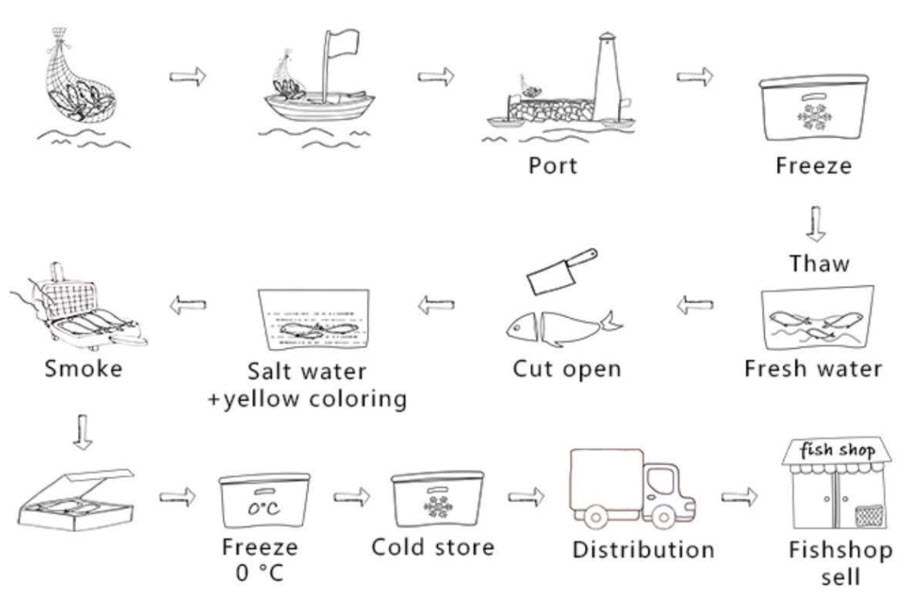
The diagram details the process of making smoked fish.
Summarise the information by selecting and reporting the main features, and make comparisons where relevant.
The process details the steps by which smoked fish is produced. Looking from an overall perspective, it is readily apparent that smoking fish can be divided into 3 main stages beginning with catching and transportation, followed by storage and processing, and finally further storage and transportation to fish shops for retail.
The process commences when fish are caught in nets and then transported by boat to a port. From this point, they are frozen and then later undergo a thawing process in fresh water. The next stage is to slice open the fish and put them in a salt water solution that also contains some amount of yellow coloring. Following this, the actual smoking takes place.
After smoking, the fish are packaged in boxes and frozen at zero degrees centigrade in larger containers. They are finally grouped into cold storage bins and distributed by truck to shops to sell to consumers.
Analysis
1. The process details the steps by which smoked fish is produced. 2. Looking from an overall perspective, it is readily apparent that smoking fish can be divided into 3 main stages beginning with catching and transportation, followed by storage and processing, and finally further storage and transportation to fish shops for retail.
Paraphrase what the process shows.
Write a clear overview summarising the major groups. Read here about overviews for processes.
1. The process commences when fish are caught in nets and then transported by boat to a port. 2. From this point, they are frozen and then later undergo a thawing process in fresh water. 3. The next stage is to slice open the fish and put them in a salt water solution that also contains some amount of yellow coloring. 4. Following this, the actual smoking takes place.
Begin writing about the details of the process.
This one is tricky to get up to the word count (no longer required on IELTS) so try to make it a little wordy.
Include every step in the process.
Vary short and long sentences.
1. After smoking, the fish are packaged in boxes and frozen at zero degrees centigrade in larger containers. 2. They are finally grouped into cold storage bins and distributed by truck to shops to sell to consumers.
Write about the rest of the process – include everything!
Try to paraphrase some of the words from process as well.
Vocabulary
What do the words in bold below mean?Take some notes on a piece of paper to aid your memory:
The process details the steps by whichsmoked fish is produced. Looking from an overall perspective, it is readily apparent that smoking fish can be divided into 3 main stages beginning with catching and transportation, followed by storage and processing, and finally further storage and transportation to fish shops for retail.
The process commences when fish are caught in nets and then transported by boat to a port. From this point, they are frozen and then later undergo a thawing process in fresh water. The next stage is to slice open the fish and put them in a salt water solution that also contains some amount of yellow coloring. Following this, the actual smoking takes place.
After smoking, the fish are packaged in boxes and frozen at zero degrees centigrade in larger containers. They are finally grouped into cold storage bins and distributed by truck to shops to sell to consumers.
Answers
Try practicing with the vocabulary below by writing an antonym/opposite word on a piece of paper (or just thinking of one):
The process details the steps by whichsmoked fishproduced the diagram shows the ways fish is made into smoked fish
Looking from an overall perspective, it is readily apparent that overall
can be divided into 3 main stages can be grouped into 3 big groups
beginning with catching and transportation starting with finding and taking to
followed by storage and processing after that keeping and making
finally further storage lastly keeping again
transportation sending to a place
fish shops places where fish are sold
retail for sale in shops
process commences diagram starts
caught in nets fishermen catch them
transported by boat to a port sent by ships to the docks where ships are
From this point starting here
frozen turned to ice
then later undergo a thawing process in fresh water after that the ice melts in water without salt
The next stage is to slice open the fish the fish are then cut open
put them in a salt water solution place in water with salt
contains some amount of yellow coloring has some yellow chemical in it
Following this after this
actual smoking takes place the real cooking happens
After next
packaged in boxes and frozen at zero degrees centigrade in larger containers put in containers at 0C and then bigger ones
finally grouped into cold storage bins lastly put into boxes that are very cold
T___________________________________________________________h is p_________d. L_________________________________________________________________t smoking fish c_______________________________________s b___________________________________n, f_______________________________________g, and f__________________________e and t__________________n to f_____________s for r_____l.
The p_____________________s when fish are c________________s and then t_____________________t. F______________t, they are f____n and t_______________________________________________r. T_______________________________h and p______________________________n that also c______________________________________g. F___________________s, the a____________________________e.
A______r smoking, the fish are p_________________________________________________________________s. They are f______________________________________________s and d______________________k to shops to sell to c___________s.
Listening Practice
Listen to the related topic below and practice with these activities:
Many governments think that economic progress is their most important goal. Some people, however, think that other types of progress are equally important for a country.
Discuss both these views and give your own opinion.
Many today have made the argument that governments are overly focused on economic development to the detriment of more valuable areas of progress. In my opinion, though economic progress is often the catalyst for different forms of growth, the other areas are at least equally as important.
Supporters of economic progress point out its importance for individuals and societies generally. A thriving economy allows the average citizen to increase their quality of life in various ways. Individuals who are provided good jobs and lucrative opportunities are able to afford better healthcare, own a home potentially, purchase luxuries, and take holidays. In the aggregate, all these minor additions combine to ground a satisfied and happy life, though they are naturally not absolute guarantees. The clearest evidence of the value of this approach is that voters in democratic nations like the United States typically base their decisions primarily on economic factors.
However, economics is the basis for other areas of progress. This relates to education, standards of living, infrastructure, and, most importantly in the 21st century, the environment. In past centuries, individuals could be forgiven for considering economics to be the most important duty of governments. Today, the possibility that the Earth will face cataclysmic changes in the next century has dramatically shifted that calculus. Most researchers agree that overpopulation and the manufacturing and consumption of consumer goods are greatly exacerbating climate change and may lead to seismic disruptions for all life on Earth. Therefore, simply prioritizing the economic causes of a degrading environment would be short-sighted.
In conclusion, though economics is the basic foundation of modern civil societies, governments today should not neglect equally as crucial aspects such as the environment. The economy is means for enacting other reforms, not an end in itself.
Analysis
1. Many today have made the argument that governments are overly focused on economic development to the detriment of more valuable areas of progress. 2. In my opinion, though economic progress is often the catalyst for different forms of growth, the other areas are at least equally as important.
Paraphrase the overall essay topic.
Write a clear opinion. Read more about introductions here.
1. Supporters of economic progress point out its importance for individuals and societies generally. 2. A thriving economy allows the average citizen to increase their quality of life in various ways. 3. Individuals who are provided good jobs and lucrative opportunities are able to afford better healthcare, own a home potentially, purchase luxuries, and take holidays. 4. In the aggregate, all these minor additions combine to ground a satisfied and happy life, though they are naturally not absolute guarantees. 5. The clearest evidence of the value of this approach is that voters in democratic nations like the United States typically base their decisions primarily on economic factors.
Write a topic sentence with a clear main idea at the end.
Explain your main idea.
Develop it with specific or hypothetical examples.
Keep developing it fully.
You can sometimes include the counterpoint here too.
1. However, economics is the basis for other areas of progress. 2. This relates to education, standards of living, infrastructure, and, most importantly in the 21st century, the environment. 3. In past centuries, individuals could be forgiven for considering economics to be the most important duty of governments. 4. Today, the possibility that the Earth will face cataclysmic changes in the next century has dramatically shifted that calculus. 5. Most researchers agree that overpopulation and the manufacturing and consumption of consumer goods are greatly exacerbating climate change and may lead to seismic disruptions for all life on Earth. 6. Therefore, simply prioritizing the economic causes of a degrading environment would be short-sighted.
Write a new topic sentence with a new main idea at the end.
Explain your new main idea.
Include specific details and examples.
Add as much information as you can and make sure it links logically.
Continue your development.
Finish strong.
1. In conclusion, though economics is the basic foundation of modern civil societies, governments today should not neglect equally as crucial aspects such as the environment. 2. The economy is means for enacting other reforms, not an end in itself.
Summarise your main ideas.
Include a final thought. Read more about conclusions here.
Vocabulary
What do the words in bold below mean?Make some notes on paper to aid memory and then check below.
Many today have made the argument that governments are overly focusedon economic development to the detriment of more valuable areas of progress. In my opinion, though economic progress is often the catalyst fordifferent forms of growth, the other areas are at least equally as important.
Supporters of economic progress point out its importance for individuals and societies generally. A thriving economy allows the average citizen to increase their quality of life in various ways. Individuals who are provided good jobs and lucrative opportunities are able to afford better healthcare, own a home potentially, purchase luxuries, and take holidays. In the aggregate, all these minor additions combine to ground a satisfied and happy life, though they are naturally not absolute guarantees.The clearest evidence of the value of this approach is that voters in democratic nations like the United States typically base their decisions primarily on economic factors.
However, economics is the basis for other areas of progress. This relates to education, standards of living, infrastructure, and, most importantly in the 21st century, the environment. In past centuries, individuals could be forgiven for considering economics to be the most important duty of governments. Today, the possibility that the Earth will face cataclysmic changes in the next century has dramatically shifted that calculus. Most researchers agree that overpopulation and the manufacturing and consumption of consumer goods are greatly exacerbating climate change and may lead to seismic disruptions for all life on Earth. Therefore, simply prioritizing the economic causes of a degrading environment would be short-sighted.
In conclusion, though economics is the basic foundation of modern civil societies, governments today should not neglect equally as crucial aspects such as the environment. The economy is means for enacting other reforms, not an end in itself.
Answers
For extra practice, write an antonym (opposite word) on a piece of paper to help you remember the new vocabulary:
Many today have made the argument some today point out that
overly focusedon economic development to the detriment of care too much about money and that hurts
more valuable areas of progress places that are more important to develop
though economic progress is often the catalyst fordifferent forms of growth despite the fact economics is the reason that other areas can develop typically
other areas are at least equally as important they are of the same importance
Supporters of economic progress point out those in favor of finance argue
importance value
generally overall
A thriving economy allows the average citizen to a good economy lets normal people
increase their quality of life in various ways improve standards of living a variety of aspects
provided given
lucrative opportunities good chances
afford better healthcare go to better hospitals
own a home potentially buy a house possible
purchase luxuries buy nice things
take holidays go on vacation
In the aggregate combined
all these minor additions combine to ground a satisfied and happy life these little factors add up to be the basis of happiness
naturally not absolute guarantees of course don’t mean it will happen 100%
The clearest evidence of the value of this approach is that the best support for this way of thinking is
voters in democratic nations like the United States residents in countries like the USA
typically base their decisions primarily on economic factors usually vote because of how the economy is doing
basis foundation
relates to concerns
infrastructure buildings, roads, schools, etc.
most importantly in the 21st century crucially today
In past centuries in the past
individuals could be forgiven for considering it was understandable to think
most important duty of governments the main responsibility
face cataclysmic changes in the next century things might get really bad over the next 100 years
dramatically shifted that calculus greatly changes one’s way of thinking about it
overpopulation too many people
manufacturing and consumption of consumer goods using products
greatly exacerbating climate change making global warming worse
may lead to seismic disruptions for all life on Earth can greatly hurt all animals and plants
simply merely
economic causes financial roots
degrading environment worsening nature
short-sighted not long-term thinking
the basic foundation of modern civil societies the basis of the world today
should not neglect equally as crucial aspects ought to not forget about other key areas
such as the environment including nature
The economy is means for enacting other reforms economics is a way to achieve other things
not an end in itself not just to be pursued for its own purpose
I recommend getting a pencil and piece of paper because that aids memory. Then write down the missing vocabulary from my sample answer in your notebook:
M__________________________________t that governments are o_______________________________n e______________________________________f m_________________________s. In my opinion, t______________________________________rd______________________________h, the o______________________________________________t.
S__________________________________________t its i______________e for individuals and societies g__________y. A____________________________________________________o i___________________________________s. Individuals who are p__________d good jobs and l_______________________s are able to a________________________e, o____________________________y, p____________________s, and t____________s. I_______________e, a______________________________________o g_______________________________e, though they are n___________________________s.T___________________________________________________t v______________________________________s t___________________________________________s.
However, economics is the b_______s for other areas of progress. This r________o education, standards of living, i_________________e, and, m_____________________________y, the environment. I_______________s, i___________________________________________________g economics to be the m____________________________s. Today, the possibility that the Earth will f___________________________________y has d_________________________s. Most researchers agree that o_______________n and the m_____________________________________s are g_______________________________e and m_____________________________________________h. Therefore, s______y prioritizing the e___________________s of a d_______________________t would be s___________d.
In conclusion, though economics is t__________________________________________s, governments today s___________________________________________________________t. T____________________________________________s, n____________________________f.
Listening Practice
Learn more about this topic by watching from YouTube below and practice with these activities:
"The highest quality materials anywhere on the internet! Dave improved my writing and vocabulary so much. Really affordable options you don't want to miss out on!"