IELTS Writing Task 1 Sample Answer Essay IELTS Cambridge 15: Tourists Visiting a Caribbean Island
The graph below shows the number of tourists visiting a particular Caribbean island between 2010 and 2017. Summarise the information by selecting and reporting the main features, and make comparisons where relevant.
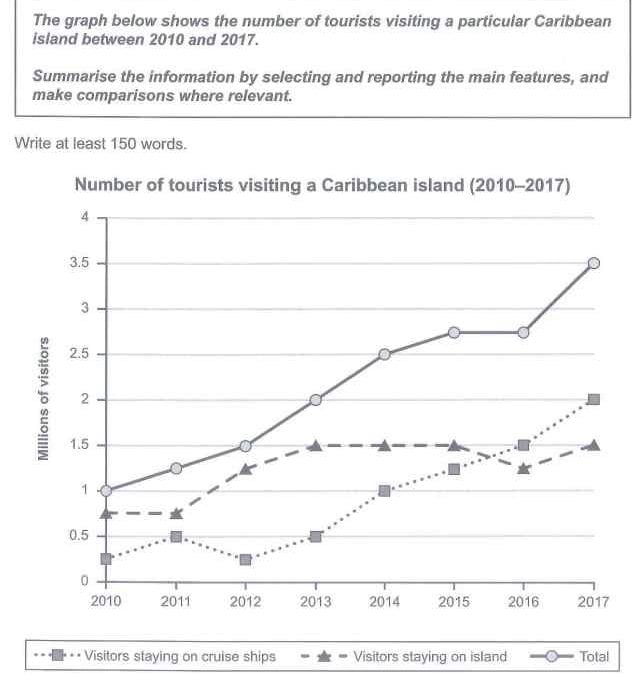
The line graph details the total number of tourists, as well as where they stayed, going to a given Caribbean island from 2010 to 2017. Overall, total tourists rose considerably, and those staying on cruise ships increased in particular, overtaking staying on the island itself, which underwent a more moderate increase.
Visitors residing on the island during their travels began the period at about .75 million, about 500,000 above those on cruise ships. From there, the numbers for the former climbed quickly to 1.5 million by 2013, a full million higher than the latter at the same time. Then those on the island were relatively steady until the end of the time surveyed, while cruise ship passengers rose steadily, surpassing the former figure midway through 2015 and reaching a peak in 2017 of 2 million.
The progressive patterns for visitors on cruise ships and the island were reflected in substantial gains for overall visitors, which started at 1 million in 2010, grew consistently to 2.7 million in 2015 before plateauing through 2016 and then increasing sharply to 3.5 million by the end of the period.
Analysis
1. The line graph details the total number of tourists, as well as where they stayed, going to a given Caribbean island from 2010 to 2017. 2. Overall, total tourists rose considerably, and those staying on cruise ships increased in particular, overtaking staying on the island itself, which underwent a more moderate increase.
1. Visitors residing on the island during their travels began the period at about .75 million, about 500,000 above those on cruise ships. 2. From there, the numbers for the former climbed quickly to 1.5 million by 2013, a full million higher than the latter at the same time. 3. Then those on the island were relatively steady until the end of the time surveyed, while cruise ship passengers rose steadily, surpassing the former figure midway through 2015 and reaching a peak in 2017 of 2 million.
Begin to describe the data. Always compare.
You don’t need all the data but focus on important changes/growth/falls.
Follow both to the end of the period, comparing them throughout.
1. The progressive patterns for visitors on cruise ships and the island were reflected in substantial gains for overall visitors, which started at 1 million in 2010, grew consistently to 2.7 million in 2015 before plateauing through 2016 and then increasing sharply to 3.5 million by the end of the period.
Don’t forget to write about the overall numbers as well!
Vocabulary
What do the words in bold below mean?
The line graph details the total number of tourists, as well as where they stayed, going to a given Caribbean island from 2010 to 2017. Overall, total tourists rose considerably, and those staying on cruise ships increased in particular, overtaking staying on the island itself, which underwent a more moderate increase.
Visitors residing on the island during their travels began the period at about .75 million, about 500,000 above those on cruise ships. From there, the numbers for the former climbed quickly to 1.5 million by 2013, a full million higher than the latter at the same time. Then those on the island were relatively steady until the end of the time surveyed, while cruise ship passengers rose steadily, surpassing the former figure midway through 2015 and reaching a peak in 2017 of 2 million.
The progressive patterns for visitors on cruise ships and the island were reflected in substantial gains for overall visitors, which started at 1 million in 2010, grew consistently to 2.7 million in 2015 before plateauing through 2016 and then increasing sharply to 3.5 million by the end of the period.
Answers
details illustrates
as well as and
given Caribbean island some island in the Caribbean such as Jamaice or Haiti
rose considerably increased a lot
staying on cruise ships remaining on luxury liner cruises
in particular especially
overtaking surpassing
underwent a more moderate increase experienced a smaller rise
residing living on
during their travels when they were travelling
former climbed quickly mentioned before area rose fast
The line graph d________s the total number of tourists, a___________s where they stayed, going to a g__________________________d from 2010 to 2017. Overall, total tourists r____________________y, and those s__________________________s increased i____________________r, o__________________g staying on the island itself, which u______________________________________e.
Visitors r_____________g on the island d______________________s began the period at about .75 million, about 500,000 above those on cruise ships. From there, the numbers for the f___________________________y to 1.5 million by 2013, a full million h_____________n t_______________r a______________________e. Then those on the island were r____________________y until the e___________________________d, while cruise ship p_________________s rose steadily, s___________________g the f____________________e m__________________h 2015 and r____________________k in 2017 of 2 million.
The p______________________s for visitors on cruise ships and the island were r________________d in s___________________s for overall visitors, which started at 1 million in 2010, g_____________________y to 2.7 million in 2015 before p___________________g through 2016 and then i_____________________y to 3.5 million by the end of the period.
Listen and check:
Listening Practice
Learn about the world’s most expensive cruise ship below:
Some people say that advertising is extremely successful at persuading us to buy things. Other people think that advertising is so common that we no longer pay attention to it.
Discuss both these views and give your own opinion.
IELTS Cambridge 15
There are those who would argue that advertising has become so pervasive, it hardly has any effect anymore. In my opinion, while people have developed habits to ignore ads, they still achieve their desired effect on the whole.
The main argument against the power of ads is they can be avoided. Online advertising is a good example of this. Users rarely click on or even glance at a website’s combination of pop-up ads, banners, mailing list requests, and auto-playing video ads. These have become so common that consumers have developed the unconscious practice of skipping ads on YouTube, quickly closing pop-ups and scrolling past in-page advertising. Advertisers have tried to counter this by making their marketing less conspicuous, as with ads that resemble real posts on social media sites like Instagram, but their sheer frequency means they can be easily identified and do not stand out.
However, despite the best efforts of users, advertisements are still effective. Most people ignore most ads most of the time. This is something that advertisers expect and build into their marketing budgets. These days marketing is the major source of earnings for the largest companies in the world, including Facebook and Google, because of more sophisticated targeted ads. Savvy marketers can sort through demographics and cross-test content for different audiences until they hone in on the most efficient advertising solutions. They can then replicate these ads and invest more money into the well-performing ones, with the financial justification coming from clicks and sales conversions. Advertising today, in reality, is far more effective than at any point in the past because of the raw data available to target potential consumers and the concrete feedback on succcessful ads.
In conclusion, despite the best efforts of ordinary citizens to circumvent advertising, technological innovations have given marketers more power than ever before. This portends badly for future generations and it is important that lawmakers enact regulations on marketers.
Analysis
1. There are those who would argue that advertising has become so pervasive, it hardly has any effect anymore. 2. In my opinion, while people have developed habits to ignore ads, they still achieve their desired effect on the whole.
Paraphrase the overall essay topic.
Give a clear overall opinion.
1. The main argument against the power of ads is they can be avoided. 2. Online advertising is a good example of this. 3. Users rarely click on or even glance at a website’s combination of pop-up ads, banners, mailing list requests, and auto-playing video ads. 4. These have become so common that consumers have developed the unconscious practice of skipping ads on YouTube, quickly closing pop-ups and scrolling past in-page advertising. 5. Advertisers have tried to counter this by making their marketing less conspicuous, as with ads that resemble real posts on social media sites like Instagram, but their sheer frequency means they can be easily identified and do not stand out.
Write a clear topic sentence with your main idea at the end.
Explain your main idea. You can vary long and short sentences.
Support it with specific details.
The more specific the better.
Make sure that you relate it back to the overall essay topic of ads being everywhere and therefore less effective.
1. However, despite the best efforts of users, advertisements are still effective. 2. Most people ignore most ads most of the time. 3. This is something that advertisers expect and build into their marketing budgets. 4. These days markeing is the major source of earnings for the largest companies in the world, including Facebook and Google, because of more sophisticated targeted ads. 5. Savvy marketers can sort through demographics and cross-test content for different audiences until they hone in on the most efficient advertising solutions. 6. They can then replicate these ads and invest more money into the well-performing ones, with the financial justification coming from clicks and sales conversions. 7. Advertising today, in reality, is far more effective than at any point in the past because of the raw data available to target potential consumers and the concrete feedback on succcessful ads.
Write another topic sentence with a clear main idea at the end.
Explain your main idea.
Continue to develop your main idea.
Use specific examples and real companies if possible.
Draw out the results from your examples.
Continue to develop with specific ideas.
Conclude with a strong sentence. This paragraph can be a little longer because it is the idea that you agree with.
1. In conclusion, despite the best efforts of ordinary citizens to circumvent advertising, technological innovations have given marketers more power than ever before. 2. This portends badly for future generations and it is important that lawmakers enact regulations on marketers.
Summarise your main ideas and repeat your opinion.
Add final thought/detail to get full marks from the IELTS examiner.
Vocabulary
What do the words in bold below mean?
There are those who would argue that advertising has become so pervasive, it hardly has any effect anymore. In my opinion, while people have developed habits to ignore ads, they still achieve their desired effect on the whole.
The main argument against the power of ads is they can be avoided. Online advertising is a good example of this. Users rarely click on or even glance at a website’s combination of pop-up ads, banners, mailing list requests, and auto-playing video ads. These have become so common that consumers have developed the unconscious practice of skipping ads on YouTube, quickly closing pop-ups and scrolling past in-page advertising. Advertisers have tried to counter this by making their marketing less conspicuous, as with ads that resemble real posts on social media sites like Instagram, but their sheer frequency means they can be easily identified and do not stand out.
However, despite the best efforts of users, advertisements are still effective. Most people ignore most ads most of the time. This is something that advertisers expect and build into their marketing budgets. These days marketing is the major source of earnings for the largest companies in the world, including Facebook and Google, because of more sophisticated targeted ads. Savvy marketers can sort through demographics and cross-test content for different audiences until they hone in on the most efficient advertisingsolutions. They can then replicate these ads and invest more money into the well-performing ones, with the financial justification coming from clicks and sales conversions. Advertising today, in reality, is far more effective than at any point in the past because of the raw data available to target potential consumers and the concrete feedback on succcessful ads.
In conclusion, despite the best efforts of ordinary citizens to circumvent advertising, technological innovations have given marketers more power than ever before. This portends badly for future generations and it is important that lawmakers enact regulations on marketers.
Answers
pervasive common
hardly barely
developed habits become accustomed to
ignore not pay attention to
desired effect what they want to happen
on the whole overall
avoided ignore
rarely click on don’t often open
glance at look at
combination mix
pop-up ads advertisements that appear on websites
banners ads on the sides and tops of websites
mailing list requests asking for your email
auto-playing video ads ads that play automatically
consumers customers
unconscious practice ingrained habit
skipping ads not watching ads
quickly closing pop-ups x-ing out of ads
scrolling past in-page advertising not looking at ads
counter fight against
less conspicuous not as obvious
resemble look like
sheer frequency great amount of
easily identified can be recongnised
stand out clear
despite the best efforts of regardless of trying
most of the time usually
expect anticipate
build into accoutn for
marketing budgets money for ads
these days nowadays
major source of earnings where they make most money
more sophisticated targeted ads complicated ways of sending out ads
savvy marketers smart advertisers
sort through demographics analyse groups of people
cross-test content send different content to different people to see if it works
audiences potential customer base
hone in on focus on
efficient advertisingsolutions good ways to advertise
replicate reproduce
well-performing ones ads that are working
financial justification makes sense because they make money
clicks opening ads
sales conversions finalising a purchase
in reality in fact
far more effective work better
any point in the past any time before
raw data available amount of information they have
target potential consumers send ads to specific groups/people
concrete feedback on succcessful ads clear results from their ads
ordinary citizens normal people
circumvent avoid
innovations new ideas
more power than ever before most effective now
portends badly looks bad for the future
lawmakers enact regulations politicians make laws about
There are those who would argue that advertising has become so p_______________e, it h__________y has any effect anymore. In my opinion, while people have d_____________________s to i___________e ads, they still achieve their d________________t o__________________e.
The main argument against the power of ads is they can be a_____________d. Online advertising is a good example of this. Users r__________________n or even g_______________t a website’s c_______________n of p________________s, b______________s, m_____________________s, and a__________________________s. These have become so common that c________________s have developed the u_______________________e of s_________________s on YouTube, q________________________s and s____________________________________________g. Advertisers have tried to c_____________r this by making their marketing l________________________s, as with ads that r________________e real posts on social media sites like Instagram, but their s______________________y means they can be e_____________________d and do not s_______________t.
However, d__________________________f users, advertisements are still effective. Most people ignore most ads m____________________e. This is something that advertisers e__________t and b____________o their m_______________________s. T______________s marketing is the m________________________s for the largest companies in the world, including Facebook and Google, because of m________________________________s. S__________________________s can s___________________________s and c______________________t for different a_______________s until they h_________________n the most e____________________________s. They can then r_______________e these ads and invest more money into the w________________________________s, with the f_______________________n coming from c__________s and s__________________________s. Advertising today, i___________________y, is f_____________________e than at a_______________________t because of the r______________________e to t__________________________s and the c__________________________________s.
In conclusion, despite the best efforts of o_____________________s to c____________________t advertising, technological i__________________s have given marketers m_____________________________e. This p___________________y for future generations and it is important that l_____________________________s on marketers.
IELTS Writing Task 1 Sample Answer Essay Cambridge 15: Coffee and Tea Buying and Drinking Habits
The chart below shows the results of a survey about people’s coffee and tea buying and drinking habits in five Australian cities.
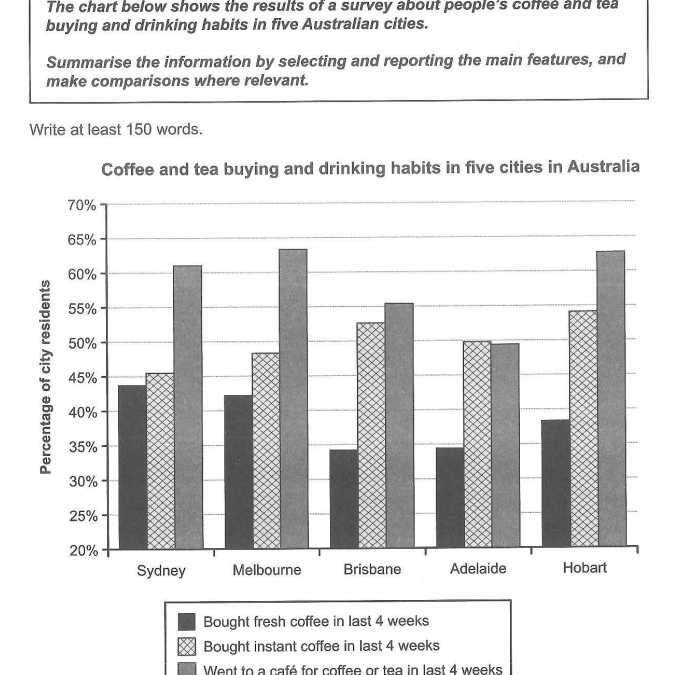
The bar chart details drinking habits in 5 Australian cities as they relate to coffee and tea over the last 4 weeks. Overall, more than half the population in all cities except Adelaide went to a cafe for coffee or tea, while buying instant coffee was also popular and buying fresh coffee generally less common.
Looking first of all at going to cafes, it was most characteristic of Melbourne and Hobart at 64% and 63%, respectively. Sydney was comparably high at just over 60%, followed by Brisbane at over 55%, and finally Adelaide at under 50%. Adelaide was the only city where people bought more instant coffee by a slight margin (50%). In Hobart, instant coffee purchases stood at 54%, ahead of Brisbane at 52%, Melbourne at 48% and lastly Sydney (just over 45%).
Stocking up on fresh coffee was below 45% for all cities. It was most common in Sydney (44%) and Melbourne (42%). Hobart was next at 39%, and Adelaide and Brisbane were much lower and nearly level at around 34%.
Analysis
1. The bar chart details drinking habits in 5 Australian cities as they relate to coffee and tea over the last 4 weeks. 2. Overall, more than half the population in all cities except Adelaide went to a cafe for coffee or tea, while buying instant coffee was also popular and buying fresh coffee generally less common.
Paraphrase the overall essay topic.
Write a general overview including all categories. Learn more about your overview here.
1.Looking first of all at going to cafes, it was most characteristic of Melbourne and Hobart at 64% and 63%, respectively. 2. Sydney was comparably high at just over 60%, followed by Brisbane at over 55%, and finally Adelaide at under 50%. 3. Adelaide was the only city where people bought more instant coffee by a slight margin (50%). 4. In Hobart, instant coffee purchases stood at 54%, ahead of Brisbane at 52%, Melbourne at 48% and lastly Sydney (just over 45%).
Begin writing about the data. I start with the highest areas but you can start with any part.
Include all the data.
Compare with any exceptions.
Continue with the data – don’t miss any areas!
1. Stocking up on fresh coffee was below 45% for all cities. 2. It was most common in Sydney (44%) and Melbourne (42%). 3. Hobart was next at 39%, and Adelaide and Brisbane were much lower and nearly level at around 34%.
Move on to the next category.
Always compare and group the data.
Conclude with all the data.
Vocabulary
What do the words in bold below mean?
The bar chart details drinking habits in 5 Australian cities as they relate to coffee and tea over the last 4 weeks. Overall, more than half the population in all cities except Adelaide went to a cafe for coffee or tea, while buying instant coffee was also popular and buying fresh coffee generally less common.
Looking first of all at going to cafes, it was most characteristic of Melbourne and Hobart at 64% and 63%, respectively. Sydney was comparably high at just over 60%, followed by Brisbane at over 55%, and finally Adelaide at under 50%. Adelaide was the only city where people bought more instant coffee by a slight margin (50%). In Hobart, instant coffee purchases stood at 54%, ahead of Brisbane at 52%, Melbourne at 48% and lastly Sydney (just over 45%).
Stocking up on fresh coffee was below 45% for all cities. It was most common in Sydney (44%) and Melbourne (42%). Hobart was next at 39%, and Adelaide and Brisbane were much lower and nearly level at around 34%.
The bar chart details d___________________s in 5 Australian cities as they r____________o coffee and tea over the last 4 weeks. Overall, m________________f the population in all cities except Adelaide went to a cafe for coffee or tea, while buying i__________________e was also popular and buying fresh coffee g_______________________n.
L__________________________t going to cafes, it was m____________________________f Melbourne and Hobart at 64% and 63%, r_________________y. Sydney was c___________________h at just over 60%, f______________________y Brisbane at o_______r 55%, and f_________y Adelaide at u_________r 50%. Adelaide was the only city where people bought more instant coffee by a s________________n (50%). In Hobart, instant coffee purchases s___________t 54%, a___________f Brisbane at 52%, Melbourne at 48% and l_________y Sydney (j___________r 45%).
S_________________p on fresh coffee was b__________w 45% for all cities. It was most common in Sydney (44%) and Melbourne (42%). Hobart was next at 39%, and Adelaide and Brisbane were m______________r and n____________l at a______________d 34%.
Listen and check:
Listening Practice
Learn if you are drinking coffee the right way below:
Reading Practice
Read here from a medical website about the health benefits and risks of coffee:
IELTS Writing Task 2 Sample Answer Essay: Full Time University Students
Full-time university students spend a lot of time studying. Some say they should do other activities too.
To what extent do you agree or disagree?
Some today feel that university students should focus completely on their studies, while others feel it is important to have a diverse range of interests and activities. In my opinion, extracurriculars are a key part of the university experience.
Those who advocate students dedicating themselves solely to academics can point out the singular learning opportunity. An undergraduate is typically paying large sums of money, burdening themselves with student debt in most cases, in order to become an expert in a given field. This is the only period in life they will have to study a single, chosen subject without the pressures of work. Freedom from a job allows them to invest fully in academics and learn the theories and skills that will form the basis of their entire professional career. Some would argue that there is little value in diluting this experience by taking on other responsibilities.
Nonetheless, outside activities are also an important element of higher education. There are countless examples of successful individuals who joined a comedy or art club unrelated to their major and later ended up working in that field. Even those who do not receive such tangible rewards from their extracurriculars can learn a lot. For example, a student may opt to become involved with a local charity, university initiative or work a part-time job. These will all be formative experiences and may be more memorable and useful for them than the subject they study. Many graduates today switch career paths soon after university regardless, so the respective value of these other activities will increase as they look back on their college experience and recognise what was truly instrumental in their development.
In conclusion, though university is a once-in-a-lifetime opportunity to focus on a single subject, I believe finding activities outside the classroom also has value. Students should prioritise academics but not ignore the full breadth of learning experiences on offer.
Analysis
1. Some today feel that university students should focus completely on their studies, while others feel it is important to have a diverse range of interests and activities. 2. In my opinion, extracurriculars are a key part of the university experience.
Paraphrase the topic for the essay.
State your opinion clearly.
1. Those who advocate students dedicating themselves solely to academics can point out the singular learning opportunity. 2. An undergraduate is typically paying large sums of money, burdening themselves with student debt in most cases, in order to become an expert in a given field. 3. This is the only period in life they will have to study a single, chosen subject without the pressures of work. 4. Freedom from a job allows them to invest fully in academics and learn the theories and skills that will form the basis of their entire professional career. 5. Some would argue that there is little value in diluting this experience by taking on other responsibilities.
Write a clear topic sentence with your main idea at the end.
Begin to develop your main idea.
Continue developing the same idea with supporting ideas.
Be as specific as possible.
Conclude the paragraph. I don’t agree with this side so the paragraph is a little shorter.
1. Nonetheless, outside activities are also an important element of higher education. 2. There are countless examples of successful individuals who joined a comedy or art club unrelated to their major and later ended up working in that field. 3. Even those who do not receive such tangible rewards from their extracurriculars can learn a lot. 4. For example, a student may opt to become involved with a local charity, university initiative or work a part-time job. 5. These will all be formative experiences and may be more memorable and useful for them than the subject they study. 6. Many graduates today switch career paths soon after university regardless, so the respective value of these other activities will increase as they look back on their college experience and recognise what was truly instrumental in their development.
Write another topic sentence with a new main idea.
Explain your main idea or begin developing it.
Make sure that your ideas flow neatly together.
Give an example if possible. Here I use a hypothetical example.
Explain your example.
Conclude with a strong statement explaining the full results.
1. In conclusion, though university is a once-in-a-lifetime opportunity to focus on a single subject, I believe finding activities outside the classroom also has value. 2. Students should prioritise academics but not ignore the full breadth of learning experiences on offer.
Summarise your main ideas and repeat your opinion.
Add a final thought/extra detail for full marks from the examiner.
Vocabulary
What do the words in bold below mean?
Some today feel that university students should focus completely on their studies, while others feel it is important to have a diverse range of interests and activities. In my opinion, extracurriculars are a key part of the university experience.
Those who advocate students dedicating themselves solely to academics can point out the singular learning opportunity. An undergraduate is typically paying large sums of money, burdening themselves with student debt in most cases, in order to become an expert in a given field. This is the only period in life they will have to study a single, chosen subject without the pressures of work. Freedom from a job allows them to invest fully in academics and learn the theories and skills that will form the basis of their entire professional career. Some would argue that there is little value in diluting this experience by taking on other responsibilities.
Nonetheless, outside activities are also an important element of higher education. There are countless examples of successful individuals who joined a comedy or art club unrelated to their major and later ended up working in that field. Even those who do not receive such tangible rewards from their extracurriculars can learn a lot. For example, a student may opt to become involved with a local charity, university initiative or work a part-time job. These will all be formative experiences and may be more memorable and useful for them than the subject they study. Many graduates today switch career paths soon after university regardless, so the respective value of these other activities will increase as they look back on their college experience and recognise what was truly instrumental in their development.
In conclusion, though university is a once-in-a-lifetime opportunity to focus on a single subject, I believe finding activities outside the classroom also has value. Students should prioritise academics but not ignore the full breadth of learning experiences on offer.
Answers
focus completely pay attention to totally
diverse range lots of different
extracurriculars outside academics
key part essential element of
advocate support
dedicating committing
solely only
point out argue
singular learning opportunity only chance to learn about
undergraduate first four years of university
sums amounts
burdening stuck under
student debt money you must pay back after graduation
a given field whatever calling they choose
period in life time in their life
pressures of work feeling stressed or burdened by work
invest fully commit to completely
theories ideas
skills practical skills
form the basis make up the foundation for
entire professional career whole working time
little value not much importance
diluting watering down, making weaker
taking on committing to
nonetheless regardless
important element key part
higher education university/college
countless examples many instances
unrelated to their major nothing to do with what they studied
ended up finally/in the end
tangible rewards actually getting something out of
opt choose
local charity nearby community organisation
university initiative uni program
part-time job hourly paid work
formative experiences shaping life experiences
memorable unforgettable
switch career paths change jobs
regardless nonetheless
respective belonging to the specific area mentioned
look back on remember
recognise identify
truly instrumental actually important
once-in-a-lifetime opportunity chance that only happens one time
Some today feel that university students should f____________________y on their studies, while others feel it is important to have a d_____________________e of interests and activities. In my opinion, e____________________s are a k___________t of the university experience.
Those who a_____________e students d________________g themselves s___________y to academics can p_______________t the s____________________________y. An u__________________e is typically paying large s________s of money, b_________________g themselves with s_______________t in most cases, in order to become an expert in a________________________d. This is the only p________________e they will have to study a single, chosen subject without the p____________________k. Freedom from a job allows them to i__________________y in academics and learn the t_______________s and s_______s that will f__________________s of their e__________________________r. Some would argue that there is l____________________e in d______________g this experience by t________________n other responsibilities.
N_________________s, outside activities are also an i_____________________t of h______________________n. There are c___________________s of successful individuals who joined a comedy or art club u______________________r and later e______________p working in that field. Even those who do not receive such t______________________s from their extracurriculars can learn a lot. For example, a student may o___t to become involved with a l_________________y, u_____________________e or work a p_________________b. These will all be f__________________________s and may be more m________________e and useful for them than the subject they study. Many graduates today s_______________________s soon after university r__________________s, so the r__________________e value of these other activities will increase as they l______________________n their college experience and r________________e what was t__________________________l in their development.
In conclusion, though university is a o______________________________y to focus on a single subject, I believe finding activities outside the classroom also has value. Students should p________________e academics but not i_____________e the f__________________h of learning experiences o_____________r.
Listen and check:
Listening Practice
Watch here the day in the life of a student at a university in Japan with lots of good vocabulary in it:
Reading Practice
Read from the Yale Tribune about the benefits of working while in school:
IELTS Writing Task 2 Sample Answer Essay Cambridge 15: Owning or Renting a Home
In some countries, owning a home rather than renting one is very important for people.
Why might this be the case?
Do you think this is a positive or negative situation?
Cambridge IELTS 15
Many people today value owning their own home over renting. In my opinion, this is part of a natural human desire for security and prestige but it contains risks.
The source of this desire is a need for stability and respect. An individual who does not own their own home must pay rent to a landlord. This hangs over them and necessitates maintaining a job with a steady salary and balancing rent against other living expenses. Once a person owns their own home, they are then able to spend their money more freely and consider different employment without the fear of becoming homeless. Moreover, having a home lends an air of respectability. Only the wealthy are able buy a house and most homeowners take pride in the size and condition of their home as a sign of their social standing.
Nonetheless, home ownership is a negative trend as it forces unrealistic expectations on millions. Most people live in city apartments with rents and are not capable of buying a house. The pressure to buy one is likely to engender feelings of inadequacy and resentment towards the upper classes. This famously fueled the sub-prime mortgage scandals of the early 2000s in the United States when millions borrowed more than they could afford to buy homes, then defaulted on their payments and lost a lifetime of investment. Had these same people opted to rent, they would have saved more money and could have invested in other forms of capital such as the stock market.
In conclusion, owning a home is innately desirable but in the end causes more harm than good due to the pressure it places on individuals. Many people have learned this lesson and home ownership may begin to decline in the future.
Word Count: 293
Analysis
1. Many people today value owning their own home over renting. 2. In my opinion, this is part of a natural human desire for security and prestige but it contains risks.
Paraphrase the overall essay topic.
Write a clear opinion – choose a side and don’t sit in the middle or you risk a band 5 for task achievement.
1. The source of this desire is a need for stability and respect. 2. An individual who does not own their own home must pay rent to a landlord. 3. This hangs over them and necessitates maintaining a job with a steady salary and balancing rent against other living expenses. 4. Once a person owns their own home, they are then able to spend their money more freely and consider different employment without the fear of becoming homeless. 5. Moreover, having a home lends an air of respectability. 6. Only the wealthy are able buy a house and most homeowners take pride in the size and condition of their home as a sign of their social standing.
Write a topic sentence with a clear main idea at the end.
Here I use a hypothetical example to develop my main idea.
Continue the example.
Use specific ideas to support your argument.
If you have a second main idea, switch over to it.
Develop your second main idea fully.
1. Nonetheless, home ownership is a negative trend as it forces unrealistic expectations on millions. 2. Most people live in city apartments with rents and are not capable of buying a house. 3. The pressure to buy one is likely to engender feelings of inadequacy and resentment towards the upper classes. 4. This famously fueled the sub-prime mortgage scandals of the early 2000s in the United States when millions borrowed more than they could afford to buy homes, then defaulted on their payments and lost a lifetime of investment. 5. Had these same people opted to rent, they would have saved more money and could have invested in other forms of capital such as the stock market.
Write another topic sentence with a new main idea.
Explain your main idea.
Develop it with a logical argument or an example.
Use specific examples.
State the conclusions/results of your example.
1. In conclusion, owning a home is innately desirable but in the end causes more harm than good due to the pressure it places on individuals. 2. Many people have learned this lesson and home ownership may begin to decline in the future.
Repeat your opinion and summarise your main ideas.
Finish summarising and add a final thought for full marks from the IELTS examiner.
Vocabulary
What do the words in bold below mean?
Many people today value owning their own home over renting. In my opinion, this is part of a natural human desire for security and prestige but it contains risks.
The source of this desire is a need for stability and respect. An individual who does not own their own home must pay rent to a landlord. This hangs over them and necessitates maintaining a job with a steady salary and balancing rent against other living expenses. Once a person owns their own home, they are then able to spend their money more freely and consider different employment without the fear of becoming homeless. Moreover, having a home lends an air of respectability. Only the wealthy are able buy a house and most homeowners take pride in the size and condition of their home as a sign of their social standing.
Nonetheless, home ownership is a negative trend as it forces unrealistic expectations on millions. Most people live in city apartments with rents and are not capable of buying a house. The pressure to buy one is likely to engender feelings of inadequacy and resentment towards the upper classes. This famously fueled the sub-prime mortgage scandals of the early 2000s in the United States when millions borrowed more than they could afford to buy homes, then defaulted on their payments and lost a lifetime of investment. Had these same people opted to rent, they would have saved more money and could have invested in other forms of capital such as the stock market.
In conclusion, owning a home is innately desirable but in the end causes more harm than good due to the pressure it places on individuals. Many people have learned this lesson and home ownership may begin to decline in the future.
Answers
renting paying monthly for
part of a piece of
natural human desire inherent to what people want
security safety
prestige respect/admiration
contains risks is dangerous
stability secure
respect admiration
pay rent give monthly money for
hangs over them oppresses them
necessitates maintaining a job must stay employed
steady salary consistent money each month
balancing moderating
living expenses money spent on food, travel, entertainment, etc.
spend their money more freely buy whatever they want
consider think about
homeless living on the streets
lends an air of respectability makes one seem important
homeowners people who have a house
pride self-esteem
condition how things are
sign signal, representation
social standing how others view you
forces unrealistic expectations makes people try to live up an image
city apartments apartment blocks
not capable can’t
engender feelings make them feel
inadequacy feeling not good enough
resentment antipathy towards
upper classes rich people
famously fueled notoriously was the source of
sub-prime mortgage scandals people not being able to pay for their homes
early 2000s 2000-2010
borrowed took money they have to pay back later
afford be able to buy
defaulted were not able to pay back
lifetime of investment entire life of putting money into
Many people today value owning their own home over r___________g. In my opinion, this is p_________f a n______________________e for s___________y and p___________e but it c_________________s.
The source of this desire is a need for s_____________y and r____________t. An individual who does not own their own home must p___________t to a landlord. This h___________________m and n_____________________________b with a s___________________y and b_____________g rent against other l__________________________s. Once a person owns their own home, they are then able to s_________________________________y and c_____________r different employment without the fear of becoming h_____________s. Moreover, having a home l________________________________________y. Only the wealthy are able buy a house and most h_______________________s take p_________e in the size and c___________________n of their home as a s________n of their s_______________________g.
Nonetheless, home ownership is a negative trend as it f________________________________s on millions. Most people live in c____________________________s with rents and are n_________________e of buying a house. The pressure to buy one is likely to e____________________s of i_____________________y and r________________t towards the u_________________s. This f__________________d the s____________________________s of the e__________________s in the United States when millions b_________________d more than they could a____________d to buy homes, then d________________d on their payments and lost a l_______________________t. Had these same people opted to rent, they would have saved more money and could have i_________________d in other forms of c_______________l such as the s___________________t.
In conclusion, owning a home is i_______________________e but i__________________d causes m_________________________d due to the pressure it places on individuals. Many people have learned this lesson and home ownership may begin to d_____________e in the future.
Listen and check:
Listening Practice
Learn about the 2008 financial crisis below:
Reading Practice
Read below about why millenials can’t afford to buy homes:
"The highest quality materials anywhere on the internet! Dave improved my writing and vocabulary so much. Really affordable options you don't want to miss out on!"