This is an IELTS writing task 2 sample answer essay on the topic of learning the languages and customs of another country from the real IELTS exam.
Be sure to sign up for my Patreon if you are interested in more sample answers.
Dave
IELTS Writing Task 2 Sample Answer Essay: Learning Languages and Customs
Some think that students must travel to another country in order to learn its language and customs. To what extent do you agree or disagree?
Real Past IELTS Exam
Many believe that in order to become immersed in another language and culture it is important to travel to the country in question. I agree generally, though there are certain exceptions depending on the purpose for learning.
Those with an academic interest in a given culture often do not need to travel there. This is particularly true if they are researching an historic period. For example, a scholar learning about Ancient Greece going there today, will only see ruins and a radically different culture. Ancient Greek is no longer even spoken. It would be much more profitable for a student of the Ancients to learn the language fluently on their own and become steeped in their histories and classic literature. The works of Euripides, Sophocles and Herodotus will provide far greater insight into the history, culture, and language of the Ancient Greeks than the few vestiges from thousands of years ago still standing today.
Nonetheless, cases like the one detailed above are rare and most people will benefit greatly from a more immersive experience. The difference between those studying abroad and learning in their own country is illustrative. Students attempting to learn English, for example, will need to be naturally adept at languages to become fluent without living in an English-speaking country. The majority of learners will improve faster when making daily transactions in English and learning in the real world outside the classroom. The cultural advantages are also self-evident. English movies and TV shows are realistic to varying degrees but pale in comparison to having actual foreign friends and experiencing firsthand their traditions and culture.
In conclusion, apart from esoteric academic study, nothing can replace the experience of living in another country. Anyone fully committed to understanding the culture and language of another country must factor in a period of time in residence there.
Analysis
1. Many believe that in order to become immersed in another language and culture it is important to travel to the country in question. 2. I agree generally, though there are certain exceptions depending on the purpose for learning.
Paraphrase the overall topic clearly.
Write your opinion.Read here more about introductions.
1. Those with an academic interest in a given culture often do not need to travel there. 2. This is particularly true if they are researching an historic period. 3. For example, a scholar learning about Ancient Greece going there today, will only see ruins and a radically different culture. 4. Ancient Greek is no longer even spoken. 5. It would be much more profitable for a student of the Ancients to learn the language fluently on their own and become steeped in their histories and classic literature. 6. The works of Euripides, Sophocles and Herodotus will provide far greater insight into the history, culture, and language of the Ancient Greeks than the few vestiges from thousands of years ago still standing today.
Write a topic sentence with a clear main idea at the end.
Explain your main idea or begin and example.
Start to develop your example.
Vary long and short sentences.
Develop the example as fully as possible with specific ideas and results.
Continue developing until the end of the paragraph.
1. Nonetheless, cases like the one detailed above are rare and most people will benefit greatly from a more immersive experience. 2. The difference between those studying abroad and learning in their own country is illustrative. 3. Students attempting to learn English, for example, will need to be naturally adept at languages to become fluent without living in an English-speaking country. 4. The majority of learners will improve faster when making daily transactions in English and learning in the real world outside the classroom. 5. The cultural advantages are also self-evident. English movies and TV shows are realistic to varying degrees but pale in comparison to having actual foreign friends and experiencing firsthand their traditions and culture.
Write another topic sentence with another clear main idea.Read here about main ideas.
Explain your main idea, if necessary.
The more specific and clear your development, the better.
Include as many details as possible.
Finish defending your main idea – don’t switch to a new one!
1. In conclusion, apart from esoteric academic study, nothing can replace the experience of living in another country. 2. Anyone fully committed to understanding the culture and language of another country must factor in a period of time in residence there.
Repeat your opinion and summarise your main ideas.
Add a final thought/detail. Read here about writing a conclusion.
Vocabulary
What do the words in bold below mean?
Many believe that in order to become immersed in another language and culture it is important to travel to the country in question. I agree generally, though there are certain exceptions depending on the purpose for learning.
Those with an academic interest in a given culture often do not need to travel there. This is particularly true if they are researching an historic period. For example, a scholar learning about Ancient Greece going there today, will only see ruins and a radically different culture. Ancient Greek is no longer even spoken. It would be much more profitable for a student of the Ancients to learn the language fluently on their own and become steeped in their histories and classic literature. The works of Euripides, Sophocles and Herodotus will provide far greater insight into the history, culture, and language of the Ancient Greeks than the few vestiges from thousands of years ago still standing today.
Nonetheless, cases like the one detailed above are rare and most people will benefit greatly from a more immersive experience. The difference between those studying abroad and learning in their own country is illustrative. Students attempting to learn English, for example, will need to be naturally adept at languages to become fluent without living in an English-speaking country. The majority of learners will improve faster when making daily transactions in English and learning in the real world outside the classroom. The cultural advantages are also self-evident. English movies and TV shows are realistic to varying degrees but pale in comparison to having actual foreign friends and experiencing firsthand their traditions and culture.
In conclusion, apart from esoteric academic study, nothing can replace the experience of living in another country. Anyone fully committed to understanding the culture and language of another country must factor in a period of time in residence there.
Answers
immersed completely part of
in question relevant here
generally overall
certain exceptions some cases outside the rule
purpose reason
academic interest scholarly interest
a given culture the nation in question
particularly true especially the case
historic period part of history
scholar researcher, student
Ancient Greece the Greeks from thousands of years ago
ruins old buildings, monuments
radically different culture completely different culture
Ancient Greek the language of the Ancient Greeks
profitable benefit more from
Ancients Ancient peoples
on their own by themselves
steeped in immersed in
classic literature old books
works classic literature
provide far greater insight a lot more helpful
vestiges remnants
still standing today not yet gone
nonetheless regardless
cases like the one detailed above examples such as the one just mentioned
rare only sometimes
benefit greatly get a lot out of
more immersive experience more deeply a part of
illustrative shows
naturally adept have a knack for
fluent able to speak well
majority most of
daily transactions paying for things in daily life
Many believe that in order to become i______________d in another language and culture it is important to travel to the country i_______________n. I agree g______________y, though there are c______________________s depending on the p________________e for learning.
Those with an a______________________t in a_____________________e often do not need to travel there. This is p______________________e if they are researching an h_____________________d. For example, a s_____________r learning about A____________________e going there today, will only see r________s and a r_____________________________e. A___________________k is no longer even spoken. It would be much more p_______________e for a student of the A__________________s to learn the language fluently o_______________n and become s__________________n their histories and c____________________e. The w_________s of Euripides, Sophocles and Herodotus will p________________________t into the history, culture, and language of the Ancient Greeks than the few v______________s from thousands of years ago s________________________y.
N_______________s, c____________________________________e are r______e and most people will b___________________y from a m__________________________e. The difference between those studying abroad and learning in their own country is i__________________e. Students attempting to learn English, for example, will need to be n____________________t at languages to become f____________t without living in an English-speaking country. The m____________y of learners will improve faster when making d______________________s in English and learning in the r_________________________________m. The cultural advantages are also s________________________t. English movies and TV shows are r____________________________s but p__________________________o having actual foreign friends and experiencing f______________d their t________________s and culture.
In conclusion, a____________m e___________________________y, n______________________e the experience of living in another country. Anyone f____________________d to understanding the culture and language of another country must f________________n a period of time i_________________e there.
Listen and check:
Listening Practice
Learn here about a day in the life of a student living abroad studying English:
Reading Practice
Learn more immersion from The New York Times here:
The newest IELTS Cambridge 15 book of practice tests and sample answers/essays has just been released and I have some tips, strategies and sample answers to help guide you through it!
There are a lot of students who study with the Cambridge IELTS books the wrong way.
The wrong way is to do practice test after practice test without any other practice.
These practice tests have two purposes:
They help you to feel familiar/comfortable with the exam.
They give you an idea of your current IELTS score and English ability.
You should use them to feel comfortable with the format and understand where your skills are now.
Do not use them to improve your English.
You might improve slightly – learn a few new words – but they are not designed to improve your English.
Some students think that they can just do test after test, book after book and their IELTS score will rise.
Your IELTS score only rises when your English ability rises (and you understanding of the test is good).
Those students are wasting their time and it leads to the feared plateau – staying at the same level for months or years.
If you want to avoid getting stuck in the same trap that gets most students read below for the proper way to use these books and some useful activities that can help your to actually improve your English, save time, and understand IELTS better!
The Right Way to Study with IELTS Cambridge 15
If you just want to have an idea of your score, it is simple: do a timed test.
Do all parts and check your answers for listening and reading.
It is harder to know about your speaking and writing scores (there’s no answer key) so you can sign up for my writing corrections or my online courses to know exactly what your scores are: writing corrections and online courses.
If you just want more sample answers from me at an affordable price, consider supporting me on Patreon.com/howtodoielts
What about if you want to become more comfortable with the IELTS exam?
Then you should do the same thing – do a test but…
You must also take time to analyse the test.
After you finish a listening test, circle the answers you got wrong.
Why did you get them wrong? Couldn’t hear the word? A vocabulary problem? Grammar?
Then listen and read to the tapescript to understand the listening better.
Underline the synonyms/paraphrases and circle the distractors.
Your awareness of IELTS is rising and it will help, for sure, on the real exam!
For reading – do the same. Focus on the questions that you got wrong.
Why did you get them wrong?
Find the synonyms/paraphrases and the little tricks. Work on the most difficult questions over and over.
For writing, check with my sample answers above and do all the practice – do the listening, the vocabulary and so on.
Commit hard to studying one answer until you understand it fully and are ready to move on.
Be sure to review whatever work you did so that you don’t forget a few days later.
Once you figure out your weak areas, it is important to vary the activities you do when studying.
If you do the same activities over and over again then you will just get good at doing the activity – and not really improve your English – you’ll end up stuck at the same English level!
Try some of these activities to avoid that for each skill:
Listening Activities with Cambridge IELTS 15
Focus on a section: Listen to section 1 (or 2 or 3 or 4) of the listening over and over again. The more times you listen, the more your listening improves. Afterwards read the tapescript carefully.
Listen and pause: This will improve your concentration skills when listening. Start to listen and pause the recording every 30 seconds. Predict what they are going to say next then listen and check. Don’t worry about the listening questions. This way you must pay very close and attention and think critically.
Before you listen: Usually you only get 30 seconds before you listen. When practicing, it can be helpful to take more time and try to write down a synonym/paraphrase for all the key words in the questions. Take your time. This activity will help with understanding paraphrasing and understanding how the test works.
Read and summarise: A lot of students struggle with matching heading questions and this activity can really help. After each paragraph take some time to write a title/short summary for the paragraph. Reread and make your summary/title more detailed.
Write your own questions: If you really want to understand IELTS, this is one of the best ways. Write your own questions! Do easy ones first – like fill in the blanks. Then later write harder ones like True/False/Not Given.
Synonyms/Paraphrases: Just like with listening, take some time to just analyse the questions without the reading. Write all the keywords on a separate piece of paper. Then write a synonym/paraphrase for each one. Then do the reading and check if you had anything similar.
For more reading practice, you can learn about reading the news to improve your IELTS score here and the difference between testing and improving your reading here.
WritingActivities with Cambridge IELTS 15
Examples: For most students examples are the key to IELTS writing. Instead of writing a fully sample answer just focus on the important skill and write examples for each question. Make each example 2-3 sentences long, fully developed and specific.
Marking an essay: Look in the back of the book at the sample essays but hide the score and the examiner’s report. Look at the IELTS band descriptors online and try to figure out the score for the essay. Then check with the examiner’s report. You’ll really understand what you need to do after this activity!
Redrafting: A lot of students move on too quickly. Write an essay, get feedback from me, then write it again and again until it is perfect. Then move on to new essays with greater understand.
SpeakingActivities with Cambridge IELTS 15
Stuck on repeat: Try answering the same question but with different answers each time. This will help improve your fluency and focus your mindset on long, detailed answers. You can see an example below:
Focus on pron: Record yourself and then play your answer back for Siri or Google Voice search or Google Docs. If the words do not come out clearly, then you need to work on them more. Keep a list of the toughest words and practice them everyday until they are perfect!
Write your own questions: Just like with reading, write new questions and answer them to understand the test better. For part 1 speaking, write personal questions. For part 2, they can be personal or a little more general. For part 3, they should not be personal questions – write general ones about other people or the world. Practice answers them.
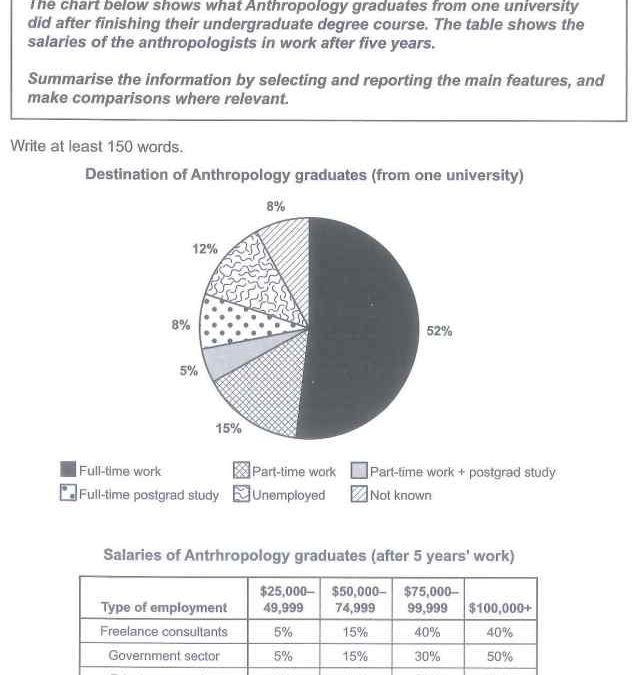
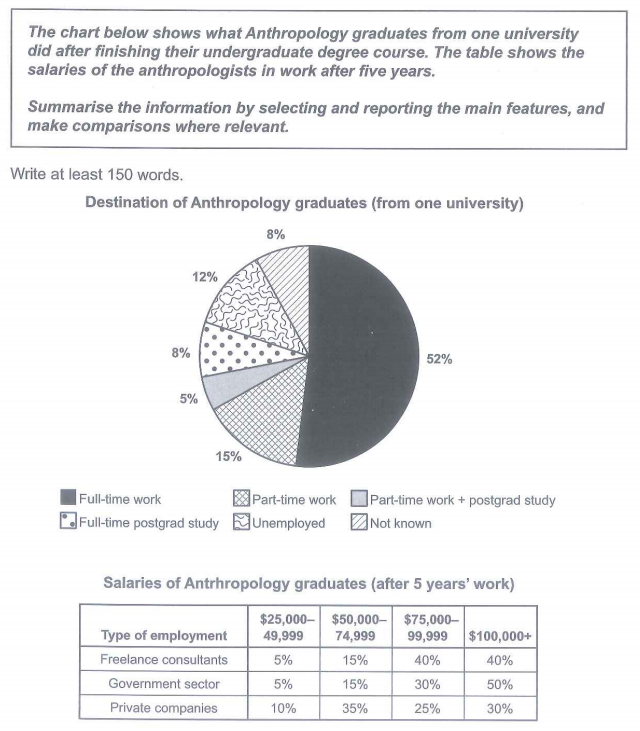
The chart below shows what Anthropology graduates from one university did after finishing their undergraduate degree courses. The table shows the salaries of the anthropologists in work after five years. Summarise the information by selecting and reporting the main features, and make comparisons where relevant.
The pie chart details the initial occupations of Anthropology students after graduation and the table records their salaries following 5 years of work in various sectors. Overall, most graduates took full-time positions, followed by part-time jobs, unemployment, graduate study or unknown, and finally part-time work together with graduate study. The average salaries tended to be much higher for freelance consultants than those working in the government and private companies, though there were many federal workers in the highest salary bracket.
A total of 52% of graduates were employed full-time, compared to 15% for part-time, 12% unemployed, 8% categorised as unknown, 8% pursuing full-time further education, and finally 5% combining part-time work and higher education study.
Turning to the table, freelance consultants were overwhelmingly employed in the upper pay scales at 40% in both $75,000 – $99,999 and $100,000+, with just 20% making between $25,000 and $74,999. Government employees displayed a broadly similar pattern with identical figures at the two lowest pay bands, 30% in the $75,000 to $99,999 range, and 50% earning over a hundred thousand dollars a year. Private industry salaries diverged generally with 10% in the lowest income range, a striking 35% earning $50,000 to $74,999, while 25% and 30% of graduates made $75,000 – $99,999 and $100,000+, respectively.
Analysis
1. The pie chart details the initial occupations of Anthropology students after graduation and the table records their salaries following 5 years of work in various sectors. 2. Overall, most graduates took full-time positions, followed by part-time jobs, unemployment, graduate study or unknown, and finally part-time work together with graduate study. 3. The average salaries tended to be much higher for freelance consultants than those working in the government and private companies, though there were many federal workers in the highest salary bracket.
Paraphrase what the graph and table are about – mention both.
Your overview must cover all categories – that is why it is so long for this graph. Read more about writing a general overview here.
1. A total of 52% of graduates were employed full-time, compared to 15% for part-time, 12% unemployed, 8% categorised as unknown, 8% pursuing full-time further education, and finally 5% combining part-time work and higher education study.
Give all the data for the pie chart.
1. Turning to the table, freelance consultants were overwhelmingly employed in the upper pay scales at 40% in both $75,000 – $99,999 and $100,000+, with just 20% making between $25,000 and $74,999. 2. Government employees displayed a broadly similar pattern with identical figures at the two lowest pay bands, 30% in the $75,000 to $99,999 range, and 50% earning over a hundred thousand dollars a year. 3. Private industry salaries diverged generally with 10% in the lowest income range, a striking 35% earning $50,000 to $74,999, while 25% and 30% of graduates made $75,000 – $99,999 and $100,000+, respectively.
Begin to describe and compare the data for the table.
Try to group the information as much as possible.
Make sure that you cover all areas and all the data.
Vocabulary
What do the words in bold below mean?
The pie chart details the initial occupations of Anthropology students after graduation and the table records their salaries following 5 years of work in various sectors. Overall, most graduates took full-time positions, followed by part-time jobs, unemployment, graduate study or unknown, and finally part-time work together with graduate study. The average salaries tended to be much higher for freelance consultants than those working in the government and private companies, though there were many federal workers in the highest salary bracket.
A total of 52% of graduates were employed full-time, compared to 15% for part-time, 12% unemployed, 8% categorised as unknown, 8% pursuing full-time further education, and finally 5% combining part-time work and higher education study.
Turning to the table, freelance consultants were overwhelmingly employed in the upper pay scales at 40% in both $75,000 – $99,999 and $100,000+, with just 20% making between $25,000 and $74,999. Government employees displayed a broadly similar pattern with identical figures at the two lowest pay bands, 30% in the $75,000 to $99,999 range, and 50% earning over a hundred thousand dollars a year. Private industry salaries diverged generally with 10% in the lowest income range, a striking 35% earning $50,000 to $74,999, while 25% and 30% of graduates made $75,000 – $99,999 and $100,000+, respectively.
Answers
details illustrates
initial occupations first jobs
Anthropology the study of peoples, history, and culture
records details
following after
various sectors different areas
full-time positions 40 hour+ jobs
part-time jobs under 40 hours, hourly paid work
unemployment not having a job
graduate study learning for a masters or PhD
tended to be is usually
freelance consultants advisers
private companies commercial entities
federal related to the government
highest salary bracket those who made the most money
The pie chart d___________s the i______________________s of A_________________y students after graduation and the table r____________s their salaries f________________g 5 years of work in v_________________s. Overall, most graduates took f___________________s, followed by p______________________s, u___________________t, g____________________y or unknown, and finally part-time work together with graduate study. The average salaries t____________________e much higher for f__________________________s than those working in the government and p__________________________s, though there were many f_____________l workers in the h_________________________t.
A total of 52% of graduates were employed full-time, c_________________o 15% for part-time, 12% unemployed, 8% c__________________s unknown, 8% p_________________g full-time further education, and finally 5% c___________________g part-time work and higher education study.
T__________________________e, freelance consultants were o_____________________y employed in the u____________________s at 40% in both $75,000 – $99,999 and $100,000+, with just 20% making between $25,000 and $74,999. Government employees d______________d a b_________________________n with i___________________s at the two l________________________s, 30% in the $75,000 to $99,999 r__________e, and 50% e_____________g over a hundred thousand dollars a year. P____________________y salaries d______________________y with 10% in the lowest income range, a s______________g 35% earning $50,000 to $74,999, while 25% and 30% of graduates made $75,000 – $99,999 and $100,000+, r_________________________y.
Listen and check:
Listening Practice
Learn about anthropology below:
Reading Practice
Browse some recent, new discoveries in anthropology below:
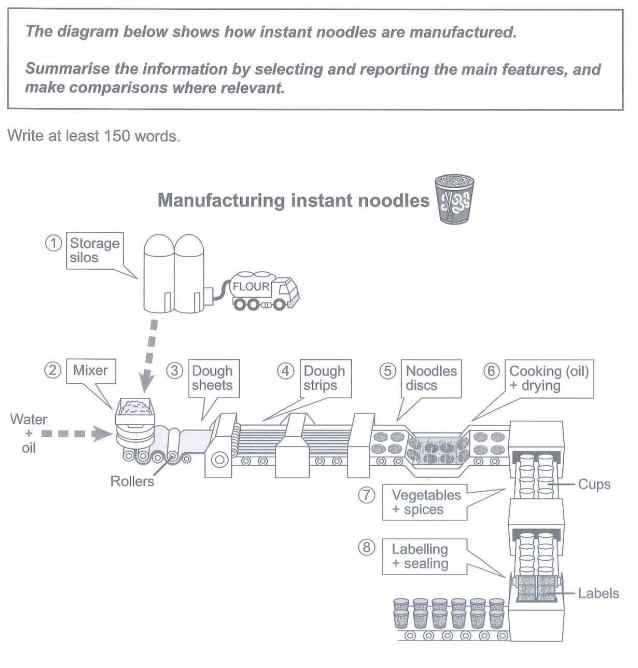
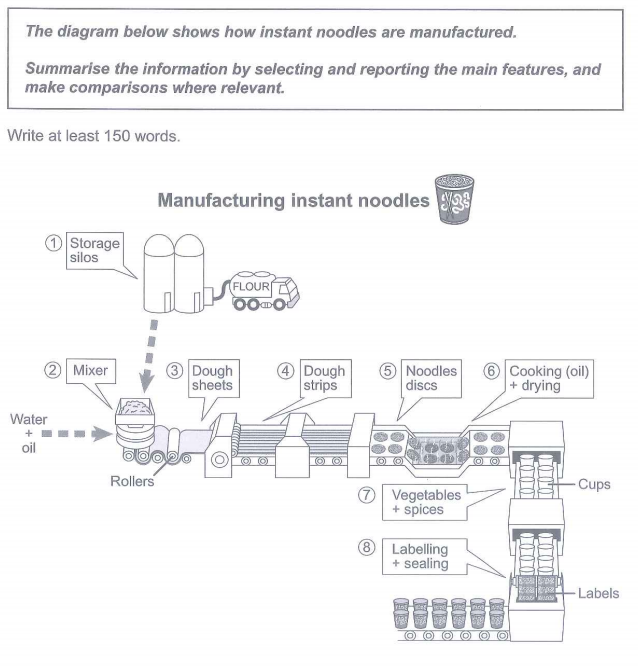
The diagram below shows how instant noodles are manufactured. Summarise the information by selecting and reporting the main features, and make comparisons where relevant.
The picture details the manufacturing process for instant noodles. Overall, this entirely man-made operation can be divided into 4 main stages beginning with storage of raw ingredients, assembling the dry noodles, cooking and finally packaging for later consumption.
Instant noodles start in storage silos where the flour is kept. The flour is transported, along with water and oil from another source, to the mixers and rolled into sheets of dough beginning the assembly line steps. These sheets are cut into strips with factory machinery and then formed into compact ‘Noodles discs’ to be fried in oil, left to dry and ultimately placed in cups along with assorted vegetables and spices.
The final preparation step is to label and seal the contents so that the end product is ready for retail.
Analysis
1. The picture details the manufacturing process for instant noodles. 2. Overall, this entirely man-made operation can be divided into 4 main stages beginning with storage of raw ingredients, assembling the dry noodles, cooking and finally packaging for later consumption.
Paraphrase what the process shows.
Write an overview by dividing it into 3 or 4 main stages. Read more about analysing a process here.
1. Instant noodles start in storage silos where the flour is kept. 2. The flour is transported, along with water and oil from another source, to the mixers and rolled into sheets of dough beginning the assembly line steps. 3. These sheets are cut into strips with factory machinery and then formed into compact ‘Noodles discs’ to be fried in oil, left to dry and ultimately placed in cups along with assorted vegetables and spices.
Begin with the first part of the process.
Use the passive when writing about a process.
Make sure that you include all stages and vary long/short sentences.
1. The final preparation step is to label and seal the contents so that the end product is ready for retail.
Finish writing about all steps.
Vocabulary
What do the words in bold below mean?
The picture details the manufacturing process for instant noodles. Overall, this entirely man-made operation can be divided into 4 main stages beginning with storage of raw ingredients, assembling the dry noodles, cooking and finally packaging for later consumption.
Instant noodles start in storage silos where the flour is kept. The flour is transported, along with water and oil from another source, to the mixers and rolled into sheets of dough beginning the assembly line steps. These sheets are cut intostrips with factory machinery and then formed intocompact ‘Noodles discs’ to be fried in oil, left to dry and ultimately placed in cups along with assorted vegetables and spices.
The final preparation step is to label and seal the contents so that the end product is ready for retail.
Answers
details describes
manufacturing process how it is made in a factory
instant noodles ramen, noodles in a package
entirely man-made operation not a natural process
divided into grouped into
main primary
storage where something is kept
assembling put together
packaging the plastic/paper outside
later consumption to eat afterwards
start begin
storage silos where grains are kept after harvesting
flour ground up grains
another source somewhere else
mixers machines to combine
rolled into sheets of dough combined with water and made into a dough
assembly line steps the production process
cut intostrips sliced into long pieces
factory machinery automated assembly line
formed intocompact made into small
fried in oil cooked in fat/oil
left to dry allowed to become dry
ultimately in the end
placed in cups put in packaging
along with also with
assorted various
final preparation step last stage
label put on the image, logo, nutritional information
The picture d____________s the m__________________________s for i_________________________s. Overall, this e____________________________n can be d________________o 4 m______n stages beginning with s_____________e of raw ingredients, a______________g the dry noodles, cooking and finally p________________g for l______________________n.
Instant noodles s________t in s_________________s where the f_________r is kept. The flour is transported, along with water and oil from a_________________e, to the m____________s and r________________________h beginning the a_________________________s. These sheets are c________________s with f_____________________y and then f____________________t ‘Noodles discs’ to be f________________l, l_________________y and u______________y p_____________s a_____________h a______________d vegetables and spices.
The f___________________________p is to l_________l and s_______l the c_____________s so that the e_________________t is r_________y for r___________l.
Listen and check:
Listening Practice
Watch below more about the process of making instant noodles:
Reading Practice
Read some depressing information about instant noodles below:
This is an IELTS writing task 2 sample answer essay from the IELTS Cambridge 15 book of past exams on the topic of whether or not children can achieve anything if they try hard enough.
Be sure that you check out my exclusive IELTS Ebooks and materials on Patreon here (and recommend a friend if you can!).
In some cultures, children are often told that they can achieve anything if they try hard enough.
What are the advantages and disadvantages of giving children this message?
Cambridge IELTS 15
In many countries, it is common for children to be told anything is possible if they set their mind to it. In my opinion, this can lead to great achievements, but for the majority engenders feelings of inadequacy.
Some people benefit from a positive emphasis on effort and achievement. The best examples of this come from the United States where famously every child is encouraged to pursue their dreams, no matter how aspirational and unrealistic. Those who succeed serve as role models and evidence the efficacy of pushing children to try to achieve anything. For example, the number of successful entrepreneurs and artists who have left their mark globally from the U.S.A is staggering and includes figures like Steve Jobs, Bill Gates, Michael Jackson, Warren Buffet, and Will Smith. These people often give encouraging interviews where they reiterate the importance of having passion and grit to achieve transcendent fame.
However, the cases above are exceptions and considering them the rule only hurts the self-esteem of the general populace. When an individual is told they can accomplish anything through sheer determination and they then fail to become rich and successful, they have no one to blame but themselves. The truth about the connection between effort and achievement is more nuanced than the platitude typically supplied to children. There is a complex interplay between talent, effort, and luck required to produce great achievements and all high-achievers are subject to determining factors beyond simply hard work. Teaching children otherwise sets them up for self-doubt, disillusionment, and delusions of grandeur that will weigh on them throughout adulthood. Hard work is an essential ingredient but supposing it guarantees success will only lead to resentment towards oneself and others.
In conclusion, while teaching children that hard work ensures achievement produces great individuals, overall, it breeds insecurity. Parents ought to instead encourage a positive mindset with less lofty expectations.
Analysis
1. In many countries, it is common for children to be told anything is possible if they set their mind to it. 2. In my opinion, this can lead to great achievements, but for the majority engenders feelings of inadequacy.
Paraphrase the overall essay topic.
Write a clear opinion to answer the essay question.
1. Some people benefit from a positive emphasis on effort and achievement. 2. The best examples of this come from the United States where famously every child is encouraged to pursue their dreams, no matter how aspirational and unrealistic. 3. Those who succeed serve as role models and evidence the efficacy of pushing children to try to achieve anything. 4. For example, the number of successful entrepreneurs and artists who have left their mark globally from the U.S.A is staggering and includes figures like Steve Jobs, Bill Gates, Michael Jackson, Warren Buffet, and Will Smith. 5. These people often give encouraging interviews where they reiterate the importance of having passion and grit to achieve transcendent fame.
Write a topic sentence with a clear main idea at the end.
Begin with an example.
Explain your example if necessary.
Use real people, places, countries, etc. to support your main idea.
State the full results of your example.
1. However, the cases above are exceptions and considering them the rule only hurts the self-esteem of the general populace. 2. When an individual is told they can accomplish anything through sheer determination and they then fail to become rich and successful, they have no one to blame but themselves. 3. The truth about the connection between effort and achievement is more nuanced than the platitude typically supplied to children. 4. There is a complex interplay between talent, effort, and luck required to produce great achievements and all high-achievers are subject to determining factors beyond simply hard work. 5. Teaching children otherwise sets them up for self-doubt, disillusionment, and delusions of grandeur that will weigh on them throughout adulthood. 6. Hard work is an essential ingredient but supposing it guarantees success will only lead to resentment towards oneself and others.
Write another topic sentence with a new main idea at the end.
Explain your main idea.
Continue to develop a logical argument or give an example (I use a hypothetical example here).
Continue to support the same main idea.
State the full results.
Conclude the paragraph with a strong statement.
1. In conclusion, while teaching children that hard work ensures achievement produces great individuals, overall, it breeds insecurity. 2. Parents ought to instead encourage a positive mindset with less lofty expectations.
Summarise your main ideas and repeat your opinion.
Add a final thought/detail to the end to get full marks from the IELTS examiner.
Vocabulary
What do the words in bold below mean?
In many countries, it is common for children to be told anything is possible if they set their mind to it. In my opinion, this can lead to great achievements, but for the majority engenders feelings of inadequacy.
Some people benefit from a positive emphasis on effort and achievement. The best examples of this come from the United States where famously every child is encouraged to pursue their dreams, no matter how aspirational and unrealistic. Those who succeed serve as role models and evidence the efficacy of pushing children to try to achieve anything. For example, the number of successful entrepreneurs and artists who have left their mark globally from the U.S.A is staggering and includes figures like Steve Jobs, Bill Gates, Michael Jackson, Warren Buffet, and Will Smith. These people often give encouraging interviews where they reiterate the importance of having passion and grit to achieve transcendent fame.
However, the cases above are exceptions and considering them the rule only hurts the self-esteem of the general populace. When an individual is told they can accomplish anything through sheer determination and they then fail to become rich and successful, they have no one to blame but themselves. The truth about the connection between effort and achievement is more nuanced than the platitude typically supplied to children. There is a complex interplay between talent, effort, and luck required to produce great achievements and all high-achievers are subject to determining factors beyond simply hard work. Teaching children otherwise sets them up for self-doubt, disillusionment, and delusions of grandeur that will weigh on them throughout adulthood. Hard work is an essential ingredient but supposing it guarantees success will only lead to resentment towards oneself and others.
In conclusion, while teaching children that hard work ensures achievement produces great individuals, overall, it breeds insecurity. Parents ought to instead encourage a positive mindset with less lofty expectations.
Answers
common ubiquitous
anything is possible you can do whatever you want
set their mind to it try to achieve it
great achievements big accomplishments
majority most of
engenders feelings of inadequacy hurt self-esteem
positive emphasis good focus
famously well-known
encouraged told to
pursue their dreams follow their passion
aspirational high goal
unrealistic not likely to happen
serve as role models good examples of
evidence verb for support/evidence
efficacy noun for something that works
pushing encouraging
successful entrepreneurs people who started their own businesses
left their mark globally had an impact on the world
staggering very impressive
figures people
encouraging pushing
reiterate say again
passion what you love
grit determination
transcendent fame really well-known
cases examples
exceptions not common, can’t be generalised
considering them the rule think they are common
self-esteem how you feel about yourself
general populace most people
accomplish achieve
sheer determination pure grit
blame fault
connection link
nuanced complex
platitude simple statement
supplied given to
complex interplay complicated relationship between
produce great achievements accomplish a lot
high-achievers people who accomplish a lot
subject to are vulnerable to
determining factors what makes the difference, decisive
otherwise apart from that
sets them up prepares them for
self-doubt lack of confidence, low self-esteem
disillusionment coming to grips with rewality
delusions of grandeur thinking yourself amazing
weigh on them hold them down
throughout adulthood all their lives
essential ingredient key part
supposing making the assumption that
guarantees success ensures achievement
resentment hate
ensures achievement guarantees success
breeds insecurity makes people feel bad about themselves
In many countries, it is c____________n for children to be told a_________________e if they s_____________________t. In my opinion, this can lead to g_________________________s, but for the m______________y e___________________________y.
Some people benefit from a p_______________________s on effort and achievement. The best examples of this come from the United States where f_______________y every child is e_______________d to p____________________s, no matter how a___________________l and u________________c. Those who succeed s________________________s and e_____________e the e______________y of p______________g children to try to achieve anything. For example, the number of s_______________________________s and artists who have l_________________________y from the U.S.A is s__________________g and includes f______________s like Steve Jobs, Bill Gates, Michael Jackson, Warren Buffet, and Will Smith. These people often give e_______________g interviews where they r______________e the importance of having p______________n and g_____t to achieve t_________________________e.
However, the c_______s above are e_________________s and c______________________e only hurts the s_______________m of the g____________________e. When an individual is told they can a________________h anything through s________________________n and they then fail to become rich and successful, they have no one to b_________e but themselves. The truth about the c_______________n between effort and achievement is more n_____________d than the p_____________e typically s______________d to children. There is a c___________________y between talent, effort, and luck required to p___________________________s and all h________________________s are s______________o d_____________________s beyond simply hard work. Teaching children o_____________e s________________p for s______________t, d_______________________t, and d___________________r that will w________________m t_________________________d. Hard work is an e______________________t but s_____________g it g_________________________s will only lead to r_______________t towards oneself and others.
In conclusion, while teaching children that hard work e__________________________t produces great individuals, overall, it b__________________________y. Parents ought to i_____________________e a p_______________________t with l________________________s.
"The highest quality materials anywhere on the internet! Dave improved my writing and vocabulary so much. Really affordable options you don't want to miss out on!"