This is an IELTS speaking sample/practice test – but you will notice that the style is not exactly like the real IELTS speaking exam that focuses on the topics of meeting places, advertisements, and clothing.
Advanced technology has brought many beneficial changes to the world. However, some old people today struggle with the use of technologies such as mobile phones and the Internet.
How can the elderly benefit from using advanced technologies?
How can the elderly be encouraged to use consumer electronics more often?
The advances made in the field of technology are not shared equally by all age demographics. In my opinion, the elderly in particular could benefit more in terms of convenience and this could be achieved by businesses transitioning to primarily online business models.
Improved capability with consumer electronics engenders a more convenient life. This improvement would be immediately evident when shopping online. During the recent Covid-19 pandemic many older individuals first learned how to place orders for food and other necessities online. Since the pandemic restrictions have eased, many now continue to use these applications to shop for the best prices, remain at home, and be assured of the quality of their purchases. Moreover, smartphones in particular today are essential for remaining in contact with one’s family. Most older people value family relations above all else and would be able to make video calls and message their children and grandchildren if they were more tech-savvy.
In order to achieve this level of convenience, companies should continue to encourage customers to engage online. Older individuals will not be convinced simply by the benefits of technology as many may be stubborn. The Coronavirus pandemic is again an illustrative example as it demonstrated that only when forced to adapt did older people begin to learn the full functionality of their phones. Companies today are already increasingly emphasizing online orders and by phasing out in-person discounts and physical stores they will compel the elderly to adapt to modern conveniences. For instance, hopeful travelers must essentially learn to navigate an airline’s website to book flights these days.
In conclusion, older people can lead easier lives if they utilize developments in technology that companies have already begun to embrace. Naturally, children should also help educate their older parents about these benefits.
Analysis
1. The advances made in the field of technology are not shared equally by all age demographics. 2. In my opinion, the elderly in particular could benefit more in terms of convenience and this could be achieved by businesses transitioning to primarily online business models.
Paraphrase the overall essay topic.
Write a clear opinion. Read more about introductions here.
1. Improved capability with consumer electronics engenders a more convenient life. 2. This improvement would be immediately evident when shopping online. 3. During the recent Covid-19 pandemic many older individuals first learned how to place orders for food and other necessities online. 4. Since the pandemic restrictions have eased, many now continue to use these applications to shop for the best prices, remain at home, and be assured of the quality of their purchases. 5. Moreover, smartphones in particular today are essential for remaining in contact with one’s family. 6. Most older people value family relations above all else and would be able to make video calls and message their children and grandchildren if they were more tech-savvy.
Write a topic sentence with a clear main idea at the end.
Explain your main idea.
Develop it with specific or hypothetical examples.
Keep developing it fully.
Continue with the same idea or add another.
You might add a counterpoint here.
1. In order to achieve this level of convenience, companies should continue to encourage customers to engage online. 2. Older individuals will not be convinced simply by the benefits of technology as many may be stubborn. 3. The Coronavirus pandemic is again an illustrative example as it demonstrated that only when forced to adapt did older people begin to learn the full functionality of their phones. 4. Companies today are already increasingly emphasizing online orders and by phasing out in-person discounts and physical stores they will compel the elderly to adapt to modern conveniences. 5. For instance, hopeful travelers must essentially learn to navigate an airline’s website to book flights these days.
Write a new topic sentence with a new main idea at the end.
Explain your new main idea.
Include specific details and examples.
Add as much information as you can and make sure it links logically.
Continue your development.
1. In conclusion, older people can lead easier lives if they utilize developments in technology that companies have already begun to embrace. 2. Naturally, children should also help educate their older parents about these benefits.
Summarise your main ideas.
Include a final thought. Read more about conclusions here.
Vocabulary
What do the words in bold below mean?Make some notes on paper to aid memory and then check below.
The advances made in the field of technology are not shared equally by all age demographics. In my opinion, the elderly in particular could benefit more in terms of convenience and this could be achieved by businesses transitioning to primarily online business models.
Improved capability with consumer electronics engenders a more convenient life. This improvement would be immediately evident when shopping online. During the recent Covid-19 pandemic many older individuals first learned how to place orders for food and other necessities online. Since the pandemic restrictions have eased, many now continue to use these applications to shop for the best prices, remain at home, and be assured of the quality of their purchases. Moreover, smartphones in particular today are essential for remaining in contact with one’s family. Most older people value family relations above all else and would be able to make video calls and message their children and grandchildren if they were more tech-savvy.
In order to achieve this level of convenience, companies should continue to encourage customers to engage online. Older individuals will not be convinced simply by the benefits of technology as many may be stubborn. The Coronavirus pandemic is again an illustrative example as it demonstrated that only when forced to adapt did older people begin to learn the full functionality of their phones. Companies today are already increasingly emphasizing online orders and by phasing out in-person discounts and physical stores they will compel the elderly to adapt to modern conveniences. For instance, hopeful travelers must essentially learn to navigate an airline’s website to book flights these days.
In conclusion, older people can lead easier lives if they utilize developments in technology that companies have already begun to embrace. Naturally, children should also help educate their older parents about these benefits.
Answers
For extra practice, write an antonym (opposite word) on a piece of paper to help you remember the new vocabulary:
advances made in the field of technology developments related to computers, phones, etc.
not shared equally by all age demographics not everyone gets the same benefits from it
in particular especially
benefit gain an advantage from it
in terms of convenience when it comes to making life easier
could be achieved by businesses transitioning to primarily online business models can be accomplished when companies do more of their selling online
Improved capability with consumer electronics engenders better ability to use phones allows for
improvement getting better
immediately evident clear right away
shopping buying things
During the recent Covid-19 pandemic when the Covid-19 stuff was happening
how to place orders for the way to order online
necessities daily life items
Since the pandemic restrictions have eased as Covid-19 becomes less of an issue
applications apps such as Google Drive, Amazon, etc.
best prices cheapest items
remain at home stay in their house
assured of the quality of their purchases know that the items they buy are good
in particular today especially these days
essential very valuable
remaining in contact with one’s family talking to family members
value family relations above all else care most about their brothers, sisters, kids, parents, etc.
make video calls using Facetime or Messenger
message send texts to
if they were more tech-savvy if better with technology
In order to achieve this level of convenience so that they live easier lives
encourage customers to engage online force people to use the internet
convinced persuaded
stubborn unwilling to change their mind
Coronavirus pandemic Covid-19 situation
illustrative example as it demonstrated good instance because it showed
only when forced to adapt did older people just when they had to did they make changes
full functionality how something is used
increasingly emphasizing more and more focusing on
phasing out in-person discounts not using coupons in real life
physical stores actual locations
compel force
adapt to modern conveniences start using new things
hopeful travelers people who want to go somewhere
essentially basically
navigate an airline’s website use the site for an airline like Delta
I recommend getting a pencil and piece of paper because that aids memory. Then write down the missing vocabulary from my sample answer in your notebook:
The a_______________________________________y are n___________________________________________s. In my opinion, the elderly i______________r could b_________t more i______________________e and this c________________________________________________________________________s.
I_________________________________________s a more convenient life. This i___________________t would be i_____________________t when s__________g online. D_____________________________c many older individuals first learned h______________________________r food and other n____________s online. S____________________________d, many now continue to use these a___________________s to shop for the b____________s, r_____________e, and be a_____________________________________s. Moreover, smartphones i____________________y are e__________l for r____________________________________y. Most older people v___________________________e and would be able to m____________________s and m_________e their children and grandchildren i_________________________y.
I__________________________________________e, companies should continue to e_____________________________________e. Older individuals will not be c_____________d simply by the benefits of technology as many may be s_________n. The C____________________c is again an i________________________________d that o_________________________________e begin to learn the f_________________y of their phones. Companies today are already i____________________g online orders and by p__________________________s and p_______________s they will c___________l the elderly to a____________________s. For instance, h_________________s must e____________y learn to n__________________________e to b____________s these days.
In conclusion, older people c____________________s if they u__________e developments in technology that companies have already begun to e___________e. N__________y, children should also help e__________e their older parents about these benefits.
Listening Practice
Learn more about this topic by watching from YouTube below and practice with these activities:
IELTS General Training Essay: Urban Infrastructure
Some believe that traffic problems in cities can best be resolved by investing in urban infrastructure while others feel there are superior solutions.
Discuss both sides and give your own opinion.
Many policymakers feel that the optimal counter to traffic issues in urban areas is increased funding for infrastructure. In my opinion, though this funding may have a marginal effect, there are other, potentially more impactful, regulations.
Supporters of investment in infrastructure contend it is a direct and pragmatic solution. As cities become larger, they face inevitable traffic problems caused by overcrowding and deteriorating roads. Improving the existing infrastructure can include repaving these roads to reduce accidents and slow driving, building additional public transportation lines for subways, creating biking lanes, widening streets, constructing overpasses, and so on. Combined, the theoretical result of these changes will be an alleviation of current strain on transport systems. However, in practice, in large cities such as New York City, rarely produce any actual difference in traffic conditions as they cannot keep pace with growing populations.
Instead, governments must consider more drastic policies. The first such reform would be to ban or severely limit the use of private vehicles. A good example of this would be in certain European cities that have enacted single day bans or raised taxes on automobile purchases. Since cars occupy the majority of the space on roads, while often only transporting one or two individuals, they are the least efficient and slowest modes of travel. Secondly, governments can subtly shift housing policies to engender dramatic effects. Instead of allowing cities to build upwards, through skyscrapers and tall apartment buildings, they can limit the number of floors on buildings to encourage a more horizontal cityscape. The result of this would be to spread out workplaces and lower congestion levels generally.
In conclusion, there is little doubt that improved infrastructure could alleviate traffic congestion in cities to an extent; however, the best remedy is to pass laws concerning private vehicles and housing. Governments should implement these long-term policies over short-term fixes.
Analysis
1. Many policymakers feel that the optimal counter to traffic issues in urban areas is increased funding for infrastructure. 2. In my opinion, though this funding may have a marginal effect, there are other, potentially more impactful, regulations.
Paraphrase the overall essay topic.
Write a clear opinion. Read more about introductions here.
1. Supporters of investment in infrastructure contend it is a direct and pragmatic solution. 2. As cities become larger, they face inevitable traffic problems caused by overcrowding and deteriorating roads. 3. Improving the existing infrastructure can include repaving these roads to reduce accidents and slow driving, building additional public transportation lines for subways, creating biking lanes, widening streets, constructing overpasses, and so on. 4. Combined, the theoretical result of these changes will be an alleviation of current strain on transport systems. 5. However, in practice, in large cities such as New York City, rarely produce any actual difference in traffic conditions as they cannot keep pace with growing populations.
Write a topic sentence with a clear main idea at the end.
Explain your main idea.
Develop it with specific or hypothetical examples.
Keep developing it fully.
You can sometimes include the counterpoint here too.
1. Instead, governments must consider more drastic policies. 2. The first such reform would be to ban or severely limit the use of private vehicles. 3. A good example of this would be in certain European cities that have enacted single day bans or raised taxes on automobile purchases. 4. Since cars occupy the majority of the space on roads, while often only transporting one or two individuals, they are the least efficient and slowest modes of travel. Secondly, governments can subtly shift housing policies to engender dramatic effects. 5. Instead of allowing cities to build upwards, through skyscrapers and tall apartment buildings, they can limit the number of floors on buildings to encourage a more horizontal cityscape. 6. The result of this would be to spread out workplaces and lower congestion levels generally.
Write a new topic sentence with a new main idea at the end.
Explain your new main idea.
Include specific details and examples.
Add as much information as you can and make sure it links logically.
Continue your development.
Finish the paragraph strong.
1. In conclusion, there is little doubt that improved infrastructure could alleviate traffic congestion in cities to an extent; however, the best remedy is to pass laws concerning private vehicles and housing. 2. Governments should implement these long-term policies over short-term fixes.
Summarise your main ideas.
Include a final thought. Read more about conclusions here.
Vocabulary
What do the words in bold below mean?Make some notes on paper to aid memory and then check below.
Many policymakers feel that the optimal counter to traffic issues in urban areas is increased funding for infrastructure. In my opinion, though this funding may have a marginal effect, there are other, potentially more impactful, regulations.
Supporters of investment in infrastructure contend it is a direct and pragmatic solution. As cities become larger, they face inevitable traffic problems caused by overcrowding and deteriorating roads. Improving the existing infrastructure can include repaving these roads to reduce accidents and slow driving, building additional public transportation lines for subways, creating biking lanes, widening streets, constructing overpasses, and so on. Combined, the theoretical result of these changes will be an alleviation of current strain on transport systems. However, in practice, in large cities such as New York City, rarely produce any actual difference in traffic conditions as they cannot keep pace with growing populations.
Instead, governments must consider more drastic policies. The first such reform would be to ban or severely limit the use of private vehicles. A good example of this would be in certain European cities that have enacted single day bans or raised taxes on automobile purchases. Since cars occupy the majority of the space on roads, while often only transporting one or two individuals, they are the least efficient and slowest modes of travel. Secondly, governments can subtly shift housing policies to engender dramatic effects. Instead of allowing cities to build upwards, through skyscrapers and tall apartment buildings, they can limit the number of floors on buildings to encourage a morehorizontal cityscape. The result of this would be to spread out workplaces and lower congestion levels generally.
In conclusion, there is little doubt that improved infrastructure could alleviate traffic congestion in cities to an extent; however, the best remedy is to pass laws concerning private vehicles and housing. Governments should implement these long-term policies over short-term fixes.
Answers
For extra practice, write an antonym (opposite word) on a piece of paper to help you remember the new vocabulary:
policymakers politicians, the authorities
optimal counter best solution
traffic issues problems related to too many cars
urban areas cities
increased funding for infrastructure more money for buildings
marginal effect small impact
potentially more impactful possibly greater effect
regulations rules and laws
Supporters of investment in people in favor of funding
contend argue
direct straightforward
pragmatic useful
face inevitable traffic problems caused by overcrowding and deteriorating roads have to deal with issues from too many people and streets getting old
Improving the existing infrastructure fixing roads now
repaving putting down new pavement
reduce accidents fewer crashes
slow driving not going fast
building additional public transportation lines for subways adding on metro routes
creating biking lanes making space for bikes to ride
widening increasing
overpasses roads going over other ones
Combined in the aggregate
theoretical result what could happen
alleviation fixing
current strain on transport systems pressure on roads, transport, etc.
in practice in reality
rarely produce doesn’t often happen
actual difference in traffic conditions real change for traffic
keep pace with growing populations match the growth of people living there
Instead rather than
drastic policies strong laws
reform change
ban prohibit
severely limit really contain/stop
private vehicles cars
enacted single day bans or raised taxes on automobile purchases create laws where you can’t drive one day or make cars more expensive
occupy take up space
majority most of
least efficient wastes time and energy
slowest modes of travel not the fastest ways to go
subtly shift housing policies slightly change how much it costs
engender dramatic effects create a big impact
build upwards construct tall apartment buildings
skyscrapers tall buildings
limit contain
encourage a morehorizontal cityscape make the city more spread out
spread out workplaces
lower less than
generally overall
there is little doubt that few would question
alleviate fix
congestion traffic
to an extent to some degree
best remedy optimal fix
pass laws concerning private vehicles and housing make rules related to cars and real estate
implement put in place
long-term policies over short-term fixes think about the future, not just now
I recommend getting a pencil and piece of paper because that aids memory. Then write down the missing vocabulary from my sample answer in your notebook:
Many p___________s feel that the o__________________r to t________________s in u___________s is i_________________________________e. In my opinion, though this funding may have a m____________t, there are other, p_______________________________l, r___________s.
S_____________________________n infrastructure c_________d it is a d_______t and p_____________c solution. As cities become larger, they f_________________________________________________________________s. I_______________________________e can include r____________g these roads to r________________s and s___________g, b____________________________________________________________________s, c______________________s, w________g streets, constructing o______________s, and so on. C____________d, the t__________________________t of these changes will be an a__________________n of c________________________________________s. However, i_____________e, in large cities such as New York City, r_________________e any a______________________________________s as they cannot k______________________________________s.
I__________d, governments must consider more d_____________________s. The first such r_______m would be to b__n or s_______________t the use of p______________s. A good example of this would be in certain European cities that have e__________________________________________________s. Since cars o_______y the m________y of the space on roads, while often only transporting one or two individuals, they are the l_______________t and s__________________________l. Secondly, governments can s________________________s to e___________________________s. Instead of allowing cities to b_____________s, through s___________s and tall apartment buildings, they can l______t the number of floors on buildings to e___________________________________e. The result of this would be to s__________________________s and l_______r congestion levels g_____________y.
In conclusion, t___________________t improved infrastructure could a___________e traffic c___________n in cities t___________t; however, the b_____________y is to p________________________________________________g. Governments should i____________t these l____________________________________________s.
Listening Practice
Learn more about this topic by watching from YouTube below and practice with these activities:
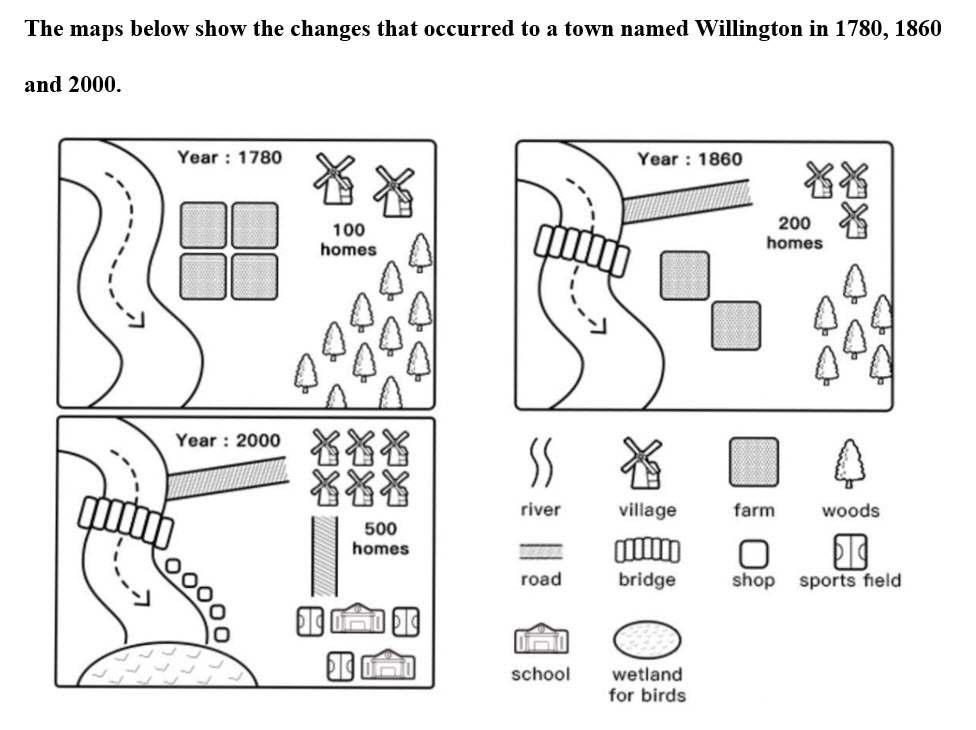
This is an IELTS writing task 1 sample answer essay on the topic of a map of the town of Willington.
Please consider supporting my efforts to creative high quality IELTS materials for students around the world by signing up for my Patreon (and so you won’t miss out on any of my exclusive IELTS Ebooks)!
Dave
IELTS Task 1: Town of Willington
The map details changes that occurred in the town of Willington in the years 1780, 1860, and 2000. Looking from an overall perspective, it is readily apparent that the village became more residential and commercial, including new homes, access roads, a bridge, shops, and areas for recreation and sports at the expense of natural forests and farms. Only the river remained unchanged.
In 1780, there were only 100 homes in Willington and a considerable region to the east and south was occupied by farms and woods. The river ran from north to south alongside the town, a feature that was unaltered by 2000. By 1860, some farms and forest had been removed to allow for a road leading from the river to a residential area that had doubled in size (200 homes) in the northeast. There was also the appearance of a bridge over the river.
In 2000, the number of homes rose to 500 and the farms and forests were entirely cleared. This enabled the construction of two schools, 3 sports fields and numerous shops lining the southern side of the river. The final addition was a large lake at the south end of the river.
Analysis
1. The map details changes that occurred in the town of Willington in the years 1780, 1860, and 2000. 2. Looking from an overall perspective, it is readily apparent that the village became more residential and commercial, including new homes, access roads, a bridge, shops, and areas for recreation and sports at the expense of natural forests and farms. 3. Only the river remained unchanged.
Paraphrase what the map shows.
Write a clear overview summarising the major groups.
You might need a 3rd sentence for your overview.
1. In 1780, there were only 100 homes in Willington and a considerable region to the east and south was occupied by farms and woods. 2. The river ran from north to south alongside the town, a feature that was unaltered by 2000. 3. By 1860, some farms and forest had been removed to allow for a road leading from the river to a residential area that had doubled in size (200 homes) in the northeast. 4. There was also the appearance of a bridge over the river.
Begin writing about the details of the map.
Transition between parts of the map logically.
Include every area on the map.
1. In 2000, the number of homes rose to 500 and the farms and forests were entirely cleared. 2. This enabled the construction of two schools, 3 sports fields and numerous shops lining the southern side of the river. 3. The final addition was a large lake at the south end of the river.
Write about the rest of the map – include everything!
Try to paraphrase some of the words from the map as well.
Add in the last part of the map.
Vocabulary
What do the words in bold below mean?Take some notes on a piece of paper to aid your memory:
The map details changes that occurred in the town of Willington in the years 1780, 1860, and 2000. Looking from an overall perspective, it is readily apparent that the village became more residential and commercial, including new homes, access roads, a bridge, shops, and areas for recreation and sports at the expense of natural forests and farms. Only the river remained unchanged.
In 1780, there were only 100 homes in Willington and a considerable region to the east and south was occupied by farms and woods. The river ran from north to south alongside the town, a feature that was unaltered by 2000. By 1860, some farms and forestry had been removed to allow for a road leading from the river to a residential area that had doubled in size (200 homes) in the northeast. There was also the appearance of a bridge over the river.
In 2000, the number of homes rose to 500 and the farms and forests were entirely cleared. This enabled the construction of two schools, 3 sports fields and numerous shops lining the southern side of the river. The final addition was a large lake at the south end of the river.
Answers
Try practicing with the vocabulary below by writing an antonym/opposite word on a piece of paper (or just thinking of one):
details shows
occurred happened
Looking from an overall perspective, it is readily apparent that overall
village small town
residential place where people can live, houses/homes
commercial related to business
access roads ways to get into a place
bridge a raised street over water or land
areas for recreation places to chill out
at the expense of natural forests removing the woods
farms agricultural areas
remained unchanged stay unaltered
considerable region big area
occupied by taking the place of
woods forests
ran from north to south alongside the town going from the top to the bottom next to the village
feature notable part
unaltered unchanged
forest woods, trees
removed to allow for a taken away so that
leading from the river to a residential area going from a stream to the housing district
doubled 200% increase
appearance how it looks outside
rose to increased to
entirely cleared gotten rid of completely
enabled allowed for
construction building of
lining alongside
southern side of the river bottom part of the water
The map d_______s changes that o________d in the town of Willington in the years 1780, 1860, and 2000. L_____________________________________________________t the v________e became more r_________l and c____________l, including new homes, a___________s, a b_______e, shops, and a__________________n and sports a___________________________s and f_______s. Only the river r______________________d.
In 1780, there were only 100 homes in Willington and a c_______________n to the east and south was o_____________y farms and w_____s. The river r______________________________________n, a f_________e that was u_________d by 2000. By 1860, some farms and f________y had been r__________________a road l___________________________________a that had d______d in size (200 homes) in the northeast. There was also the a_________e of a bridge over the river.
In 2000, the number of homes r______o 500 and the farms and forests were e______________d. This e________d the c_______________n of two schools, 3 sports fields and numerous shops l______g the s_____________________r. T___________________________s a large lake at the s_______d of the river.
Listening Practice
Listen to the related topic below and practice with these activities:
"The highest quality materials anywhere on the internet! Dave improved my writing and vocabulary so much. Really affordable options you don't want to miss out on!"