The maps below shows university sports courts in 1990 and now.
Summarise the information by selecting and reporting the main features, and make comparisons where relevant.
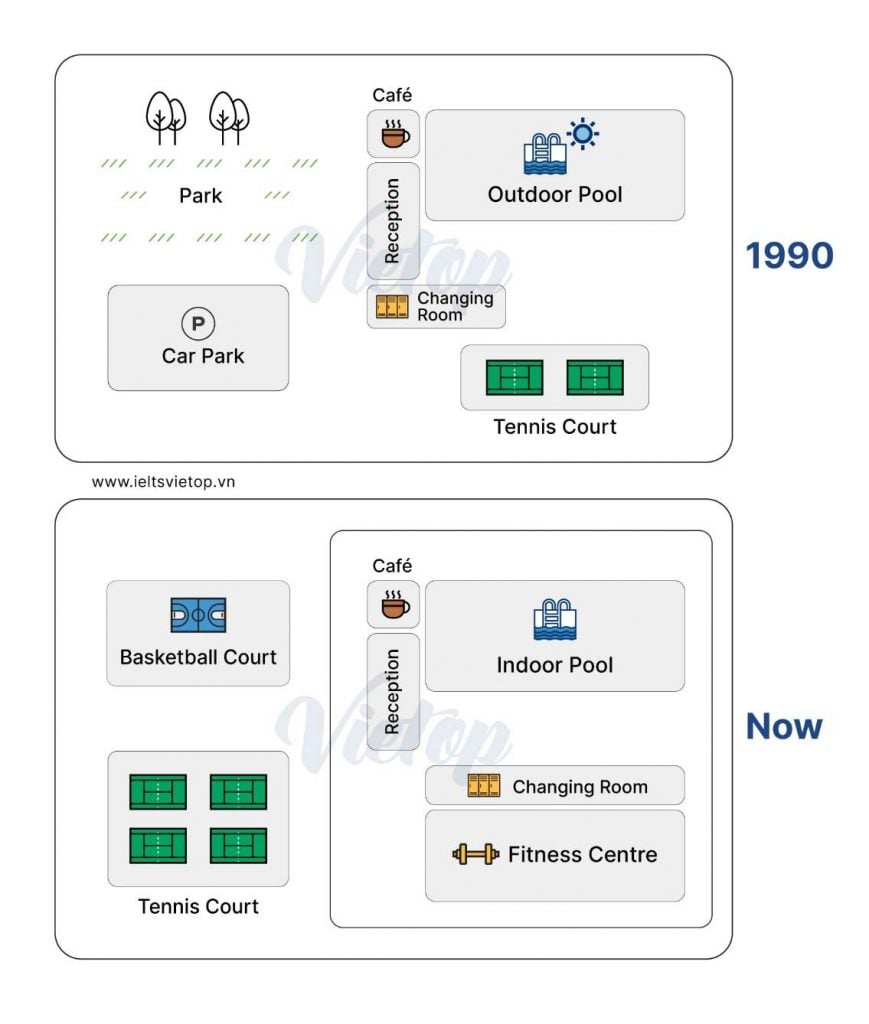
The map describes how a university sports courts area has changed from 1990 to the present day. Looking from an overall perspective, it is readily apparent that the number of total courts for tennis and basketball has increased at the expense of parking and a park, while a formal building with a gym now houses various exercise facilities. These changes allow for more varied activity.
In 1990, on the left side of the map was a park with trees and grass as well as a car park. Today, the park has been replaced by a large basketball court and the car park by 4 tennis courts.
On the right side of the map, a structure to contain the various athletic facilities has been erected with only the indoor pool and reception area in the same position in the new building. The changing room beneath the reception area and pool has been lengthened and moved slightly to the right so as to line up directly above a new, large fitness centre. The fitness centre has replaced two tennis courts, now outside the main building.
Analysis
1. The map describes how a university sports courts area has changed from 1990 to the present day. 2. Looking from an overall perspective, it is readily apparent that the number of total courts for tennis and basketball has increased at the expense of parking and a park, while a formal building with a gym now houses various exercise facilities. 3. These changes allow for more varied activity.
Paraphrase the overall essay topic.
Write a general over for the map.
Include the major changes and group them generally.
1. In 1990, on the left side of the map was a park with trees and grass as well as a car park. 2. Today, the park has been replaced by a large basketball court and the car park by 4 tennis courts.
Begin to describe the changes.
Be sure to compare as much as possible.
1. On the right side of the map, a structure to contain the various athletic facilities has been erected with only the indoor pool and reception area in the same position in the new building. 2. The changing room beneath the reception area and pool has been lengthened and moved slightly to the right so as to line up directly above a new, large fitness centre. 3. The fitness centre has replaced two tennis courts, now outside the main building.
Switch to another part of the map.
Don’t include any opinion and don’t forget any areas.
Nothing should be left out!
Vocabulary
What do the words in bold below mean?Take some notes on a piece of paper to aid your memory:
The map describes how a university sports courts area has changed from 1990 to the present day. Looking from an overall perspective, it is readily apparent that the number of total courts for tennis and basketball has increased at the expense of parking and a park, while a formal building with a gym now houses various exercise facilities. These changes allow for more varied activity.
In 1990, on the left side of the map was a park with trees and grass as well as a car park. Today, the park has been replaced by a large basketball court and the car park by 4 tennis courts.
On the right side of the map, a structure to contain the various athletic facilities has been erected with only the indoor pool and reception area in the same position in the new building. The changing roombeneath the reception area and pool has been lengthened and moved slightly to the rightso as to line up directly above a new, large fitness centre. The fitness centre has replaced two tennis courts, now outside the main building.
Answers
Try to write down or think of an antonym/opposite word for further practice:
describes shows
university sports courts places to play at college
present day right now
Looking from an overall perspective, it is readily apparent that overall
total courts complete number of fields/courts
at the expense of instead of
while although
formal building actual construction
houses various exercise facilities keeps different places inside it
allow for enable
varied activity different hobbies
on the left side of to the left of
as well as and
replaced by in favor of
on the right side of to the right of
structure building
contain kept inside
erected built
indoor inside
reception area place you first walk in
same position unchanged
changing roombeneath place to change your clothes under
lengthened made longer
moved slightly to the right pushed a little to the right
Remember and fill in the blanks. Note it on a piece of paper so you can remember better:
The map d______________s how a u_______________________s area has changed from 1990 to the p___________y. L________________________________________________t the number of t____________s for tennis and basketball has increased a_______________________f parking and a park, w_______e a f_____________g with a gym now h_________________________________s. These changes a___________r more v_____________y.
In 1990, o_________________f the map was a park with trees and grass a_____________s a car park. Today, the park has been r_____________y a large basketball court and the car park by 4 tennis courts.
O___________________f the map, a s_____________e to c__________n the various athletic facilities has been e_______d with only the i_______r pool and r________________a in the s___________n in the new building. The c______________________h the reception area and pool has been l______________d and m______________________________ts____________o l_______________y above a new, large fitness centre. The f____________________e has replaced two tennis courts, now o___________e the main building.
Listening Practice
Listen to the related topic below and practice with these activities
This is an IELTS writing task 2 sample answer essay on the topic of children learning languages and the challenge/difficulty from the real IELTS exam.
Please consider supporting me on Patreon.com/howtodoielts to receive my full, exclusive IELTS Ebooks – you can even sign up for private live lessons with me! My subscription online courses are also available here.
Dave
IELTS Essay: Children Learning Languages
Because many children are not able to learn foreign languages, schools should not force them to learn foreign languages.
To what extent do you agree or disagree?
Some feel that since it is challenging for children to learn a foreign language, schools should not emphasize this subject area. In my opinion, the challenge is the entire justification for supporting second language education.
Critics argue that the majority of children are simply incapable of learning an additional language. The best evidence for this is anecdotal and relates to the increasingly large burden of work placed on young children. Schools in many parts of the world, particularly in high-achieving nations such as South Korea and Japan, are in session for many hours and students learn an array of subjects. They are usually taught English, the world’s lingua franca, and this is especially difficult for speakers of Asian languages, where there is little shared linguistic history. The end result is often that students waste time and may feel discouraged and lack self-esteem.
However, children can learn languages better than adults and the challenge presented is itself an important lesson. If the schools have invested in proper training and use engaging materials then the lessons will not be boring and there is a stronger likelihood of success. Research has shown that language learning is most effective before the age of 7, with pronunciation becoming a stumbling block for older learners who already have fixed vocal formations. Moreover, the difficulty of learning a language encourages children to work harder and expand their ability to learn in creative ways. This applies to all subjects but languages stand out as students must seek novel memorization techniques and view the world from a completely different perspective.
In conclusion, despite the low rates of success in many cases, the impact of attempting to learn a language is itself tremendously beneficial. Schools should therefore continue funding this part of the curriculum.
Analysis
1. Some feel that since it is challenging for children to learn a foreign language, schools should not emphasize this subject area. 2. In my opinion, the challenge is the entire justification for supporting second language education.
Paraphrase the overall essay topic.
Write a clear opinion. Read more about introductions here.
1. Critics argue that the majority of children are simply incapable of learning an additional language. 2. The best evidence for this is anecdotal and relates to the increasingly large burden of work placed on young children. 3. Schools in many parts of the world, particularly in high-achieving nations such as South Korea and Japan, are in session for many hours and students learn an array of subjects. 4. They are usually taught English, the world’s lingua franca, and this is especially difficult for speakers of Asian languages, where there is little shared linguistic history. 5. The end result is often that students waste time and may feel discouraged and lack self-esteem.
Write a topic sentence with a clear main idea at the end.
Explain your main idea.
Develop it with specific or hypothetical examples.
Keep developing it fully.
You can have a second main idea.
1. However, children can learn languages better than adults and the challenge presented is itself an important lesson. 2. If the schools have invested in proper training and use engaging materials then the lessons will not be boring and there is a stronger likelihood of success. 3. Research has shown that language learning is most effective before the age of 7, with pronunciation becoming a stumbling block for older learners who already have fixed vocal formations. 4. Moreover, the difficulty of learning a language encourages children to work harder and expand their ability to learn in creative ways. 5. This applies to all subjects but languages stand out as students must seek novel memorization techniques and view the world from a completely different perspective.
Write a new topic sentence with a new main idea at the end.
Explain your new main idea.
Include specific details and examples.
Add as much information as you can and make sure it links logically.
Develop the example fully.
1. In conclusion, despite the low rates of success in many cases, the impact of attempting to learn a language is itself tremendously beneficial. 2. Schools should therefore continue funding this part of the curriculum.
Summarise your main ideas.
Include a final thought. Read more about conclusions here.
Vocabulary
What do the words in bold below mean?Make some notes on paper to aid memory and then check below.
Some feel that since it is challenging for children to learn a foreign language, schools should not emphasize this subject area. In my opinion, the challenge is the entire justification for supporting second language education.
Critics argue that the majority of children are simply incapable of learning an additional language. The best evidence for this is anecdotal and relates to the increasingly large burden of workplaced on young children. Schools in many parts of the world, particularly in high-achieving nations such as South Korea and Japan, are in session for many hours and students learn an array of subjects. They are usually taught English, the world’s lingua franca, and this is especially difficult for speakers of Asian languages, where there is little shared linguistic history. The end result is often that students waste time and may feel discouraged and lack self-esteem.
However, children can learn languages better than adults and the challenge presented is itself an important lesson. If the schools have invested in proper training and use engaging materials then the lessons will not be boring and there is a stronger likelihood of success. Research has shown that language learning is most effective before the age of 7, with pronunciation becoming a stumbling block for older learners who already have fixed vocal formations. Moreover, the difficulty of learning a language encourages children to work harder and expand their ability to learn in creative ways. This applies to all subjects but languages stand out as students must seek novel memorization techniques and view the world from a completely different perspective.
In conclusion, despite the low rates of successin many cases, the impact of attempting to learn a language is itself tremendously beneficial. Schools should therefore continue funding this part of the curriculum.
Answers
For extra practice, write an antonym (opposite word) on a piece of paper to help you remember the new vocabulary:
since because of
challenging difficulty
foreign language a language from another country
emphasize focus on
subject area what you study at school
entire justification whole reason
supporting second language education giving resources to classes for foreign languages
critics those against it
majority most of
incapable aren’t able to
additional language another tongue
best evidence for this clearest support in this area
anecdotal stories
relates to concerning
increasingly large getting bigger
burden of work pressure from homework
placed on put on
in many parts of the world in numerous countries
particularly in especially in
high-achieving nations countries with good scores
in session operating
array variety
lingua franca common language among non-native speakers
little shared linguistic history not much the same in the past of the languages
end result final outcome
waste time not use time well
discouraged not encouraged
lack self-esteem don’t think highly of yourself
presented shown
invested put money into
proper training good preparation
engaging interesting
stronger likelihood of success better chance of working out
research has shown that studies indicate that
effective useful
pronunciation how well you say words
stumbling block difficulty
fixed vocal formations muscles in your mouth can’t change
encourages engenders
expand move beyond
creative ways new methods
applies relates to
stand out especially
novel memorization techniques new ways of remembering
completely different perspective totally new way of seeing things
I recommend getting a pencil and piece of paper because that aids memory. Then write down the missing vocabulary from my sample answer in your notebook:
Some feel that s______e it is c____________g for children to learn a f________________e, schools should not e_____________e this s________________a. In my opinion, the challenge is the e_______________n for s____________________________n.
C________s argue that the m_________y of children are simply i_____________e of learning an a___________________e. The b__________________s is a____________l and r__________o the i________________________________kp_____________n young children. Schools i____________________d, p_________________n h____________________________s such as South Korea and Japan, are i_____________n for many hours and students learn an a_____y of subjects. They are usually taught English, the world’s l____________________a, and this is especially difficult for speakers of Asian languages, where there is l___________________________y. The e____________t is often that students w__________e and may feel d________________d and l_____________m.
However, children can learn languages better than adults and the challenge p___________d is itself an important lesson. If the schools have i__________d in p____________________g and use e__________g materials then the lessons will not be boring and there is a s____________________________s. R_________________________t language learning is most e_________e before the age of 7, with p_____________n becoming a s_______________k for older learners who already have f_________________________s. Moreover, the difficulty of learning a language e_____________s children to work harder and e___________d their ability to learn in c______________s. This a________s to all subjects but languages s_________t as students must seek n________________________s and view the world from a c_________________________e.
In conclusion, despite the l__________________si_________________s, the i______t of attempting to learn a language is itself t___________________________l. Schools should t______________e continue f_______g this part of the c_____________m.
Listening Practice
Learn more about this topic by watching videos from The New York Times YouTube channel below and practice with these activities:
This is an IELTS writing task 2 sample answer essay on the topic of grades and testing from the real IELTS exam.
The full post along with vocabulary, pronunciation, and practice is only available on my Patreon.com/howtodoielts but you can read the essay here as a bonus first!
Dave
IELTS Essay: Grades and Testing
Some people think that schools should not test and grade students. Others think that grades are important.
Discuss both sides and give your own opinion.
Many believe that schools should test and grade students, while others feel these stressful evaluations can be counter-productive. In my opinion, although testing can be useful, schools could be improved if there were no grades and students could learn with less pressure.
On the one hand, standardized testing allows students to measure their progress. Students and teachers are both able to utilize grades to understand if a student is excelling or struggling in any given subject. For example, in most high schools, students take a test before being placed into a mathematics course. If they excel at math, they will be placed in an advanced class and if their math skills are weaker, they will receive the support they need at a lower level. Over time and through repeated testing, students can move up or down levels and receive relevant practice and individualized learning. This is the basis of most educational systems and facilitates the practical organization of levels.
On the other hand, schools with reduced focus on grades encourage healthier growth. This approach is common in certain progressive European nations like Finland and Norway, which are famous for their de-emphasis on grades. Schools in Finland attempt to foster a positive learning environment where students feel free to make mistakes, play, and develop a lifelong passion for learning. With less anxiety and less of a burden to excel, students can focus on what they care about most and not become overly obsessed with gaining the esteem of their teachers and parents. The result is that Finland has consistently ranked as one of the strongest school systems internationally.
In conclusion, although grades are important for categorization, their elimination would allow students to learn better and flourish. Where possible, schools should seek to focus more on learning and less on testing.
This is an IELTS writing task 2 sample answer essay on the topic of local environmental responsibility from the real IELTS general training exam.
Please consider supporting me on Patreon.com/howtodoielts to receive my full, exclusive IELTS Ebooks – you can even sign up for private live lessons with me! My subscription online courses are also available here.
Dave
IELTS Essay: Local Environmenal Responsibility
Governments should make people responsible for looking after their own local environment.
Do you agree or disagree?
Some would argue that climate change is such a pressing threat that governments should issue mandates to make individuals responsible for protecting the local environment. In my opinion, this might raise environmental awareness, however it is not advisable as other steps are more likely to produce results.
Those who suggest individuals should be compelled to accept responsibility are hoping for a united effort from the general public. The entire reason the Earth faces potential catastrophe is because of over-population and consumer habits. There would be a noticeable improvement if individuals were forced to recycle, clean up litter in their neighborhoods and reduce their carbon footprint by not using private vehicles, single-use plastics, and airplanes. There is the added argument that it is important to instill public duty in the mind of the average person. The government could fix these problems but that would only enable bad behavior from citizens in the same way that an overly permissive parent engenders a spoiled child.
However, the impact from the steps mentioned above would be marginal compared to the regulations governments can enact on various industries. Individuals might not follow the mandates from governments and they would be extremely difficult to enforce in populous nations that value individual liberty such as India, the United States, and Brazil. If governments instead passed laws related to both small and large businesses they could combat global and local issues. Companies that contribute to air and water pollution could be severely fined and the businesses that profit the most from mass consumerism could be forced to institute more environmentally friendly policies. These simple reforms would have tremendous impact.
In conclusion, although this policy would help individuals become more active in their communities, it is more important for governments to enact sweeping regulations on corporations. In this way, the most progress will be made.
Analysis
1. Some would argue that climate change is such a pressing threat that governments should issue mandates to make individuals responsible for protecting the local environment. 2. In my opinion, this might raise environmental awareness, however it is not advisable as other steps are more likely to produce results.
Paraphrase the overall essay topic.
Write a clear opinion. Read more about introductions here.
1. Those who suggest individuals should be compelled to accept responsibility are hoping for a united effort from the general public. 2. The entire reason the Earth faces potential catastrophe is because of over-population and consumer habits. 3. There would be a noticeable improvement if individuals were forced to recycle, clean up litter in their neighborhoods and reduce their carbon footprint by not using private vehicles, single-use plastics, and airplanes. 4. There is the added argument that it is important to instill public duty in the mind of the average person. 5. The government could fix these problems but that would only enable bad behavior from citizens in the same way that an overly permissive parent engenders a spoiled child.
Write a topic sentence with a clear main idea at the end.
Explain your main idea.
Develop it with specific or hypothetical examples.
Keep developing it fully.
You can have a second main idea.
1. However, the impact from the steps mentioned above would be marginal compared to the regulations governments can enact on various industries. 2. Individuals might not follow the mandates from governments and they would be extremely difficult to enforce in populous nations that value individual liberty such as India, the United States, and Brazil. 3. If governments instead passed laws related to both small and large businesses they could combat global and local issues. 4. Companies that contribute to air and water pollution could be severely fined and the businesses that profit the most from mass consumerism could be forced to institute more environmentally friendly policies. 5. These simple reforms would have tremendous impact.
Write a new topic sentence with a new main idea at the end.
Explain your new main idea.
Include specific details and examples.
I don’t usually use personal examples, but I did in this essay.
Develop the example fully.
Finish with a strong statement.
1. In conclusion, although this policy would help individuals become more active in their communities, it is more important for governments to enact sweeping regulations on corporations. 2. In this way, the most progress will be made.
Summarise your main ideas.
Include a final thought. Read more about conclusions here.
Vocabulary
What do the words in bold below mean?Make some notes on paper to aid memory and then check below.
Some would argue that climate change is such a pressing threat that governments should issue mandates to make individuals responsible for protecting the local environment. In my opinion, this might raise environmental awareness, however it is not advisable as other steps are more likely to produce results.
Those who suggest individuals should be compelled to accept responsibility are hoping for a united effort from the general public. The entire reason the Earth faces potential catastrophe is because of over-population and consumer habits. There would be a noticeable improvement if individuals were forced to recycle, clean up litter in their neighborhoods and reduce their carbon footprint by not using private vehicles, single-use plastics, and airplanes. There is the added argument that it is important to instill public duty in the mind of the average person. The government could fix these problems but that would only enable bad behavior from citizens in the same way that an overly permissive parent engenders a spoiled child.
However, the impact from the steps mentioned above would be marginal compared to the regulations governments can enact on various industries. Individuals might not follow the mandates from governments and they would be extremely difficult to enforce in populous nations that value individual liberty such as India, the United States, and Brazil. If governments instead passed laws related to both small and large businesses they could combat global and local issues. Companies that contribute to air and water pollution could be severely fined and the businesses that profit the most from mass consumerism could be forced to institute more environmentally friendly policies. These simple reforms would have tremendous impact.
In conclusion, although this policy would help individuals become more active in their communities, it is more important for governments to enact sweeping regulations on corporations. In this way, the most progress will be made.
Answers
For extra practice, write an antonym (opposite word) on a piece of paper to help you remember the new vocabulary:
argue claim
such a pressing threat that a major risk
issue mandates send out orders
responsible for protecting duty for taking care of
local environment what’s around you
raise environmental awareness know more about the environment
not advisable should not be done
other steps different actions
produce results get things done
suggest say
compelled have to
accept responsibility take on the duty
hoping for ideally
united effort working together
general public people
entire reason whole justification
faces potential catastrophe combats possible harm
over-population too many people
consumer habits what people buy
noticeable improvement clear progress
recycle re-use
clean up litter pick up trash
neighborhoods communities
reduce cut down on
carbon footprint what you produce personally that impacts the environment
private vehicles cars, bikes, etc.
single-use plastics bottles, bags, etc.
added argument additional point
instill public duty engender care for all society
the average person normal resident
problems issues
enable allow for
in the same way that the same as
overly permissive letting them get away with too much
engenders creates
spoiled child kid who is not disciplined
mentioned above detailed before
marginal small
regulations laws
enact pass
various industries different sectors
mandates orders
extremely difficult very hard
enforce make sure it is followed
populous nations countries with many people
value individual liberty care about freedom
instead rather than
related to concerning
combat global fight international
local issues problems from near you
contribute add ot
severely fined have to pay a lot
profit the most get more out of
mass consumerism people buying things
institute put in place
environmentally friendly policies reforms good for nature
I recommend getting a pencil and piece of paper because that aids memory. Then write down the missing vocabulary from my sample answer in your notebook:
Some would a_____e that climate change is s________________________t governments should i________________s to make individuals r________________________g the l__________________t. In my opinion, this might r___________________________s, however it is n_______________e as o_______________s are more likely to p_____________s.
Those who s__________t individuals should be c_______________d to a_____________________y are h______________r a u____________t from the g_______________c. The e____________n the Earth f_________________________e is because of o_____________________n and c__________________s. There would be a n__________________t if individuals were forced to r__________e, c_______________r in their n_________________s and r________e their c_________________t by not using p_________________s, s____________________s, and airplanes. There is the a_________________t that it is important to i______________________y in the mind of t_________________n. The government could fix these p___________s but that would only e_________e bad behavior from citizens i_____________________t an o___________________e parent e____________s a s_____________d.
However, the impact from the steps m__________________e would be m________l compared to the re___________s governments can e______t on v_________________s. Individuals might not follow the m__________s from governments and they would be e__________________t to e__________e in p_______________s that v___________________y such as India, the United States, and Brazil. If governments i_________d passed laws r_________o both small and large businesses they could c________________l and l_____________s. Companies that c____________e to air and water pollution could be s____________d and the businesses that p_________________t from m_______________m could be forced to i__________e more e__________________________________s. These s_______________s would have t__________________t.
In conclusion, although this p_____y would help individuals become more a_____e in their communities, it is more important for governments to enact s___________________s on corporations. In this way, the most p________s will be made.
Listening Practice
Learn more about this topic by watching videos from The New York Times YouTube channel below and practice with these activities:
This is an IELTS writing task 2 sample answer essay on the topic of learning facts and practical skills at school from the real IELTS general training exam.
Please consider supporting me on Patreon.com/howtodoielts to receive my full, exclusive IELTS Ebooks – you can even sign up for private live lessons with me!
This essay is a bit different from all the other hundreds I have written.
This one includes a personal example – that is fine on IELTS though I wouldn’t recommend it to be on the safe side.
Dave
IELTS Essay: Learning Facts & Practical Skills at School
Some people say that at all levels of education, from primary school to university, too much time is spent on learning facts and not enough on learning practical skills.
Do you agree or disagree?
Many concerned parties believe that schools currently place too much emphasis on theory and do not properly cover practical skills. I am in agreement that schools should be focusing less on rote learning of facts.
Proponents of more traditional education limited to accumulating facts argue this forms the basis of shared knowledge in society. An illustrative example of this would be the teaching of national history. Although information such as dates and names is not necessarily important in itself, the fact that the majority of the population shares the same knowledge allows them to connect and communicate more easily. A person who makes a reference to a certain year, event, or figure can communicate instantly and deeply with anyone who recognizes the same information. This extends beyond national boundaries and can also unite disparate cultures.
However, it is more important for students to learn skills with practical import. This can include but does not have to be limited to learning skills like cooking and woodworking, which are not traditional academic subjects. The curriculum could also be broadened to critical thinking skills. For example, when I studied at Bard College, a liberal arts institution in upstate New York, I was initially surprised at the emphasis placed on learning the skill of thinking itself. My past courses in high school were more about memorizing information but my university teachers were wary of simple memorization, facts, and terminology. Instead they sought to break down key concepts related to thinking and instruct students on how to read text closely and think for themselves.
In conclusion, though teaching facts can be useful for social cohesiveness, I believe the value of more useful skills is greater. There must always be a degree of balance but schools should prioritize the latter methodology.
Analysis
1. Many concerned parties believe that schools currently place too much emphasis on theory and do not properly cover practical skills. 2. I am in agreement that schools should be focusing less on rote learning of facts.
Paraphrase the overall essay topic.
Write a clear opinion. Read more about introductions here.
1. Proponents of more traditional education limited to accumulating facts argue this forms the basis of shared knowledge in society. 2. An illustrative example of this would be the teaching of national history. 3. Although information such as dates and names is not necessarily important in itself, the fact that the majority of the population shares the same knowledge allows them to connect and communicate more easily. 4. A person who makes a reference to a certain year, event, or figure can communicate instantly and deeply with anyone who recognizes the same information. 5. This extends beyond national boundaries and can also unite disparate cultures.
Write a topic sentence with a clear main idea at the end.
Explain your main idea.
Develop it with specific or hypothetical examples.
Keep developing it fully.
You can have a second main idea.
1. However, it is more important for students to learn skills with practical import. 2. This can include but does not have to be limited to learning skills like cooking and woodworking, which are not traditional academic subjects. 3. The curriculum could also be broadened to critical thinking skills. 4. For example, when I studied at Bard College, a liberal arts institution in upstate New York, I was initially surprised at the emphasis placed on learning the skill of thinking itself. 5. My past courses in high school were more about memorizing information but my university teachers were wary of simple memorization, facts, and terminology. 6. Instead they sought to break down key concepts related to thinking and instruct students on how to read text closely and think for themselves.
Write a new topic sentence with a new main idea at the end.
Explain your new main idea.
Include specific details and examples.
I don’t usually use personal examples, but I did in this essay.
Develop the example fully.
Finish with a strong statement.
1. In conclusion, though teaching facts can be useful for social cohesiveness, I believe the value of more useful skills is greater. 2. There must always be a degree of balance but schools should prioritize the latter methodology.
Summarise your main ideas.
Include a final thought. Read more about conclusions here.
Vocabulary
What do the words in bold below mean?Make some notes on paper to aid memory and then check below.
Many concerned parties believe that schools currently place too much emphasis on theory and do not properly cover practical skills. I am in agreement that schools should be focusing less on rote learning of facts.
Proponents of more traditional education limited to accumulating facts argue this forms the basis of shared knowledge in society. An illustrative example of this would be the teaching of national history. Although information such as dates and names is not necessarily important in itself, the fact that the majority of the population shares the same knowledge allows them to connect and communicate more easily. A person who makes a reference to a certain year, event, or figure can communicate instantly and deeply with anyone who recognizes the same information. This extends beyond nationalboundaries and can also unite disparate cultures.
However, it is more important for students to learn skills with practical import. This can include but does not have to be limited to learning skills like cooking and woodworking, which are not traditional academic subjects. The curriculum could also be broadened to critical thinking skills. For example, when I studied at Bard College, a liberal arts institution in upstate New York, I was initially surprised at the emphasis placed on learning the skill of thinking itself. My past courses in high school were more about memorizing information but my university teachers were wary of simple memorization, facts, and terminology. Instead they sought to break down key concepts related to thinking and instruct students on how to read text closely and think for themselves.
In conclusion, though teaching facts can be useful for social cohesiveness, I believe the value of more useful skills is greater. There must always be a degree of balance but schools should prioritize the latter methodology.
Answers
For extra practice, write an antonym (opposite word) on a piece of paper to help you remember the new vocabulary:
concerned parties people interested
currently place too much emphasis now focus too much on
theory ideas, concepts, facts
properly cover practical skills do a good job going over real world skills
focusing less not paying as much attention
rote learning memorizing
proponents supporters
traditional education schools, older ways of learning
accumulating facts learning names, dates, etc.
forms makes up
basis foundation
shared knowledge what everyone knows together
an illustrative example of this would be the best instance of this is
national history past of a country
necessarily important in itself
majority most of
connect make contact with
reference mention
event happening
figure person
instantly right away
deeply not superficially
recognizes knows about
extends beyond nationalboundaries internationally
unite disparate cultures bring together different people
practical import useful in life
include have
limited to just about
woodworking making things out of wood
traditional academic subjects science, math, literature, etc.
I recommend getting a pencil and piece of paper because that aids memory. Then write down the missing vocabulary from my sample answer in your notebook:
Many c_____________________s believe that schools c_______________________________________s on t___________y and do not p____________________________s. I am in agreement that schools should be f_______________s on r________________g of facts.
P____________s of more t__________________n limited to a_____________________s argue this f______s the b______s of s____________________________e in society. A_____________________________________________e the teaching of n_________________y. Although information such as dates and names is not n_____________________________f, the fact that the m___________y of the population shares the same knowledge allows them to c__________t and communicate more easily. A person who makes a r__________e to a certain year, e______t, or f________e can communicate i__________y and d________y with anyone who r____________s the same information. This e_____________________________s and can also u___________________________s.
However, it is more important for students to learn skills with p__________________t. This can i_________e but does not have to be l______________o learning skills like cooking and w_____________g, which are not t____________________________s. The c__________m could also be b__________d to c_______________________s. For example, when I studied at Bard College, a l_____________________________n in u_____________________k, I was i____________________d at the emphasis placed on learning the skill of thinking itself. My p______________s in high school were more about m_______________________n but my university teachers were w____y of simple m_____________________n, f_______s, and t___________________y. Instead they s_________t to b_______________________________s related to thinking and i___________t students on how to r_____________________y and think for themselves.
In conclusion, though teaching facts can be u____________l for s____________________s, I believe the value of more useful skills is greater. There must always be a_____________________e but schools should p_____________e the l____________________y.
Listening Practice
Learn more about this topic by watching videos from The New York Times YouTube channel below and practice with these activities:
"The highest quality materials anywhere on the internet! Dave improved my writing and vocabulary so much. Really affordable options you don't want to miss out on!"