This is an IELTS writing task 2 sample answer essay on the topic of violent entertainment (games and movies) from the real general training IELTS exam.
Please consider supporting me on Patreon.com/howtodoielts to receive my exclusive IELTS Ebooks – you can even sign up for private live lessons with me!
Dave
IELTS Essay: Violent Entertainment (Games and Movies)
Movies and computer games containing violence are popular. Some people say they have a negative effect on society and should be censored. Others say they are just harmless relaxation.
Discuss both these views and give your own opinion.
Some feel that violence in entertainment is a root cause of problems in society and should thus be censored. In my opinion, while there is legitimate cause to establish reasonable boundaries, such content has little actual negative impact.
On the one hand, there is a general level of acceptance that gratuitous violence should be restricted. This is particularly the case if films are being broadcast on public channels or it is possible to gain easy access to violent games. In most nations, programming during the daytime has higher thresholds for acceptable content due to fears of influencing impressionable children. The worry is that very young children and teenagers will become desensitized to violence and potentially establish either a confrontational way of interacting or, in extreme cases, a pattern of behavior. Studies have not shown much evidence for these claims however they possess a commonsensical logic.
On the other hand, the majority of individuals have no difficulty distinguishing between fiction and reality. Consumers of violent entertainment are simply passing the time or experiencing a vicarious thrill. There is even the slight chance that by watching violent entertainment, audiences will be dissuaded from such behavior or feel their need for violence has been sufficiently expressed. For instance, an individual who plays violent computer games or is obsessed with horror films, according to research, is no more likely to commit a violent crime or display abnormal behavior. The actual causes of problems in society relate to employment, economics, discrimination, income inequality, and various systemic barriers.
In conclusion, though there are certain levels of violence that should be censored depending on the context, most explicit content ought to be permitted in games and movies. Efforts to heavily censor would be short-sighted and misguided.
Analysis
1. Some feel that violence in entertainment is a root cause of problems in society and should thus be censored. 2. In my opinion, while there is legitimate cause to establish reasonable boundaries, such content has little actual negative impact.
Paraphrase the overall essay topic.
Write a clear opinion. Read more about introductions here.
1. On the one hand, there is a general level of acceptance that gratuitous violence should be restricted. 2. This is particularly the case if films are being broadcast on public channels or it is possible to gain easy access to violent games. 3. In most nations, programming during the daytime has higher thresholds for acceptable content due to fears of influencing impressionable children. 4. The worry is that very young children and teenagers will become desensitized to violence and potentially establish either a confrontational way of interacting or, in extreme cases, a pattern of behavior. 5. Studies have not shown much evidence for these claims however they possess a commonsensical logic.
Write a topic sentence with a clear main idea at the end.
Explain your main idea.
Develop it with specific or hypothetical examples.
Keep developing it fully.
The more support, the higher your task achievement mark!
1. On the other hand, the majority of individuals have no difficulty distinguishing between fiction and reality. 2. Consumers of violent entertainment are simply passing the time or experiencing a vicarious thrill. 3. There is even the slight chance that by watching violent entertainment, audiences will be dissuaded from such behavior or feel their need for violence has been sufficiently expressed. 4. For instance, an individual who plays violent computer games or is obsessed with horror films, according to research, is no more likely to commit a violent crime or display abnormal behavior. 5. The actual causes of problems in society relate to employment, economics, discrimination, income inequality, and various systemic barriers.
Write a new topic sentence with a new main idea at the end.
Explain your new main idea.
Include specific details and examples.
Continue developing it…
as fully as possible!
1. In conclusion, though there are certain levels of violence that should be censored depending on the context, most explicit content ought to be permitted in games and movies. 2. Efforts to heavily censor would be short-sighted and misguided.
Summarise your main ideas.
Include a final thought. Read more about conclusions here.
Vocabulary
What do the words in bold below mean?Make some notes on paper to aid memory and then check below.
Some feel that violence in entertainment is a root cause of problems in society and should thus be censored. In my opinion, while there is legitimate cause to establish reasonable boundaries, such content has little actual negativeimpact.
On the one hand, there is a general level of acceptance that gratuitous violence should be restricted. This is particularly the case if films are being broadcast on public channels or it is possible to gain easy access to violent games. In most nations, programming during the daytime has higher thresholds for acceptable content due to fears of influencing impressionable children. The worry is that very young children and teenagers will become desensitized to violence and potentially establish either a confrontational way of interacting or, in extreme cases, a pattern of behavior. Studies have not shown much evidence for these claims however they possess a commonsensical logic.
On the other hand, the majority of individuals have no difficulty distinguishing between fiction and reality. Consumers of violent entertainment are simply passing the time or experiencing a vicarious thrill. There is even the slight chance that by watching violent entertainment, audiences will be dissuaded from such behavior or feel their need for violence has been sufficiently expressed. For instance, an individual who plays violent computer games or is obsessed with horror films, according to research, is no more likely to commit a violent crime or display abnormalbehavior. The actual causes of problems in society relate toemployment, economics, discrimination, income inequality, and various systemic barriers.
In conclusion, though there are certain levels of violence that should be censored depending on the context, most explicit content ought to be permitted in games and movies. Efforts to heavily censor would be short-sighted and misguided.
Answers
For extra practice, write an antonym (opposite word) on a piece of paper to help you remember the new vocabulary:
violence hitting, killing, hurting, etc.
root cause base reason
censored limited, some areas cut out
while although
legitimate cause real reason
establish reasonable boundaries set clear limits
content what is in shows, games, movies, etc.
little actual negativeimpact doesn’t actually hurt
on the one hand on one side
general level overall amount
acceptance believed in
gratuitous not for any real purpose
restricted contained
particularly the case especially true
broadcast show
public channels TV stations open to all
possible can happen
gain easy access not hard to get
in most nations in many countries
programming what’s on TV
higher thresholds more difficult to meet the standards
acceptable content appopriate stuff
fears worries
influencing impressionable children having an effect on kids
worry fear
desensitized stop being deeply affected by
potentially establish possibly create
confrontational way of interacting aggressive
in extreme cases in rare exceptions
pattern trend
behavior way of acting
claims arguments
possess have
commonsensical logic make sense
on the other hand however
majority most of
no difficulty distinguishing between fiction and reality cant tell apart the real and not real world
consumers people who buy things
passing the time occupying yourself
experiencing going through
vicarious thrill experiencing through others
slight chance small probability
dissuaded not encouraged to do it
sufficiently expressed fully done
obsessed care a lot about
according to research studies have shown
commit do
violent crime murder, etc.
display abnormalbehavior
actual real
relate toemployment concern jobs
economics finances
discrimination prejudice
income inequality people not earning equal amounts of money
various systemic barriers areas of society opposing people
I recommend getting a pencil and piece of paper because that aids memory. Then write down the missing vocabulary from my sample answer in your notebook:
Some feel that v____________e in entertainment is a r_____________e of problems in society and should thus be c______________d. In my opinion, w_____e there is l_________________e to e______________________________s, such c__________t has l__________________________________t.
O_________________d, there is a g_________________l of a____________e that g_____________s violence should be r______________d. This is p____________________e if films are being b______________t on p____________________s or it is p___________e to g________________s to violent games. I__________________s, p_________________g during the daytime has h____________________s for a____________________t due to f_______s of i______________________________n. The w___y is that very young children and teenagers will become d_____________d to violence and p___________________h either a c______________________________g or, i___________________s, a p_________n of b__________r. Studies have not shown much evidence for these claims however they p__________s a c___________________________c.
O__________________d, the m___________y of individuals have n_____________________________________________y. C_______________s of violent entertainment are simply p_____________________e or e__________________g a v________________l. There is even the s___________________e that by watching violent entertainment, audiences will be d_______________d from such behavior or feel their need for violence has been s______________________d. For instance, an individual who plays violent computer games or is o_______________d with horror films, a_____________________________h, is no more likely to c_________t a v_____________e or d_____________________________r. The a____________l causes of problems in society r______________oe_________________t, e____________s, d_______________n, i_____________________________y, and v________________________s.
In conclusion, though there are certain l_______s of violence that should be censored d________________n the c__________t, most e_________t content ought to be p______________d in games and movies. E_________s to h__________y censor would be s_______________d and m__________d.
Listening Practice
Learn more about this topic by watching videos from The New York Times YouTube channel below and practice with these activities:
This is an IELTS writing task 2 sample answer essay on the topic of jobs and whether or not employers should be allowed to ask for personal information from the real general training IELTS exam.
Please consider supporting me on Patreon.com/howtodoielts to receive my exclusive IELTS Ebooks – you can even sign up for private live lessons with me!
Dave
IELTS Essay: Jobs and Personal Information
Employers sometimes ask people applying for jobs for personal information, such as their hobbies and interests, and whether they are married or single. Some people say that this information may be relevant and useful. Others disagree.
Discuss both these views and give your own opinion.
Many are of the opinion that there is little value to the sensitive personal information that employers may inquire about during job interviews. In my opinion, though there are certain logical limits, I believe these questions are generally useful as it helps employers understand candidates better.
On the one hand, applicants may rightly feel these questions can be uncomfortable. An employer who asks questions about family background, sexual orientation, and medical history is certainly violating all ethical bounds. If the candidate feels triggered or uncomfortable, there is the chance an interview could become the catalyst for a mental health setback or result in the candidate deciding not to apply for the position. A hypothetical example of this that shows the potential harm is that if an LGBTQ candidate must continually disclose their orientation, and the environment is very traditional or homophobic, they may find themselves frustrated and feel unfairly discriminated against.
Nonetheless, as long as inquiries are within acceptable limits, these questions aid potential employers in constructing an accurate picture of a potential employee. Naturally, an employee can lie about personal questions if they have a particularly disturbing private life, however, that might itself be of some value. Interviewers likely have experience and can detect the presence of lies and make judgments accordingly. For candidates who answer honestly, the interviewer will be able to compare their responses with past employee performance. For example, there is a strong likelihood that socially competent individuals with lots of friends and active hobbies will be outgoing and morale-boosting additions to a staff.
In conclusion, despite the risks of causing offense, these questions have value in forming a general opinion of a candidate for any given position. Employers should therefore continue asking such questions.
Analysis
1. Many are of the opinion that there is little value to the sensitive personal information that employers may inquire about during job interviews. 2. In my opinion, though there are certain logical limits, I believe these questions are generally useful as it helps employers understand candidates better.
Paraphrase the overall essay topic.
Write a clear opinion. Read more about introductions here.
1. On the one hand, applicants may rightly feel these questions can be uncomfortable. 2. An employer who asks questions about family background, sexual orientation, and medical history is certainly violating all ethical bounds. 3. If the candidate feels triggered or uncomfortable, there is the chance an interview could become the catalyst for a mental health setback or result in the candidate deciding not to apply for the position. 4. A hypothetical example of this that shows the potential harm is that if an LGBTQ candidate must continually disclose their orientation, and the environment is very traditional or homophobic, they may find themselves frustrated and feel unfairly discriminated against.
Write a topic sentence with a clear main idea at the end.
Explain your main idea.
Develop it with specific or hypothetical examples.
Keep developing it fully.
1. Nonetheless, as long as inquiries are within acceptable limits, these questions aid potential employers in constructing an accurate picture of a potential employee. 2. Naturally, an employee can lie about personal questions if they have a particularly disturbing private life, however, that might itself be of some value. 3. Interviewers likely have experience and can detect the presence of lies and make judgments accordingly. 4. For candidates who answer honestly, the interviewer will be able to compare their responses with past employee performance. 5. For example, there is a strong likelihood that socially competent individuals with lots of friends and active hobbies will be outgoing and morale-boosting additions to a staff.
Write a new topic sentence with a new main idea at the end.
Explain your new main idea.
Include specific details and examples.
Continue developing it…
as fully as possible!
1. In conclusion, despite the risks of causing offense, these questions have value in forming a general opinion of a candidate for any given position. 2. Employers should therefore continue asking such questions.
Summarise your main ideas.
Include a final thought. Read more about conclusions here.
Vocabulary
What do the words in bold below mean?Make some notes on paper to aid memory and then check below.
Many are of the opinion that there is little value to the sensitive personal information that employers may inquire about during job interviews. In my opinion, though there are certain logical limits, I believe these questions are generally useful as it helps employers understand candidates better.
On the one hand, applicants may rightly feel these questions can be uncomfortable. An employer who asks questions about family background, sexual orientation, and medical history is certainly violating all ethical bounds. If the candidate feels triggered or uncomfortable, there is the chance an interview could become the catalyst for a mental health setback or result in the candidate deciding not to apply for the position. A hypothetical example of this that shows the potential harm is that if an LGBTQ candidate must continually disclose their orientation, and the environment is very traditional or homophobic, they may find themselves frustrated and feel unfairly discriminatedagainst.
Nonetheless, as long as inquiries are within acceptable limits, these questions aid potential employers in constructing an accurate picture of a potential employee. Naturally, an employee can lie about personal questions if they have a particularly disturbing private life, however, that might itself be of some value. Interviewers likely have experience and can detect the presence of lies and make judgments accordingly. For candidates who answer honestly, the interviewer will be able to compare their responses with past employee performance. For example, there is a strong likelihood that socially competent individuals with lots of friends and active hobbies will be outgoing and morale-boostingadditions to a staff.
In conclusion, despite the risks of causing offense, these questions have value in forming a general opinion of a candidate for any given position. Employers should therefore continue asking such questions.
Answers
For extra practice, write an antonym (opposite word) on a piece of paper to help you remember the new vocabulary:
little value not much importance
sensitive personal information delicate facts about your private life
may inquire might ask
during job interviews when applying for a job
certain logical limits definite reasonable boundaries
generally useful overall valuable
employers companies
candidates people who are applying for jobs
on the one hand on one side
applicants people applying for a job
rightly correctly
uncomfortable not feeling at ease
family background history of your family members
sexual orientation whether you are straight or LGTBQ
I recommend getting a pencil and piece of paper because that aids memory. Then write down the missing vocabulary from my sample answer in your notebook:
Many are of the opinion that there is l________________e to the s________________________n that employers m____________e about d_________________s. In my opinion, though there are c____________________s, I believe these questions are g___________________l as it helps e______________s understand c______________s better.
O____________________d, a_____________s may r________y feel these questions can be u______________e. An employer who asks questions about f__________________d, s_____________________n, and m________________y is c________________g all e_________________s. If the candidate feels t______________d or u_________________e, there is the c_______e an interview could become the c___________t for a m________________k or r________n the candidate deciding not to a_____________________n. A h______________________e of this that shows the p_______________m is that if an L________Q candidate must c______________________e their o______________n, and the e_______________t is very t______________l or h_______________c, they may find themselves f_______________d and feel u______________________t.
N_______________s, as long as i___________s are within a________________s, these questions a___d potential employers in c_______________g an a___________________e of a p______________l employee. N____________y, an employee can lie about personal questions if they have a p______________________________e, however, that might itself be of some value. Interviewers likely have e_______________e and can d_________t the p_____________e of lies and m________________________y. For candidates who answer honestly, the interviewer will be able to c____________e their r_____________s with p_____________________________e. For example, there is a s______________d that s__________________________s with lots of friends and a___________________s will be o___________g and m_________________________s to a s_____f.
In conclusion, d___________e the r_______s of c____________________e, these questions have value in f_______________________________n of a candidate for a___________________n. Employers should t____________e continue asking such questions.
Listening Practice
Learn more about this topic by watching videos from The New York Times YouTube channel below and practice with these activities:
This is an IELTS writing task 2 sample answer essay on the topic of success from the real IELTS general training exam.
Please consider supporting me on Patreon.com/howtodoielts to receive my exclusive IELTS Ebooks – you can even sign up for private live lessons with me!
Dave
IELTS Essay: Success
Some people say that individuals who make a lot of money are the most successful. Others think that those who contribute to society like scientists and teachers are more successful.
Discuss both sides and give your own opinion.
Many would argue that those who contribute significantly to society, such as artists, teachers and scientists, are more successful than the affluent. In my opinion, although earnings can be a sign of success, one’s worldly impact should be held in higher esteem.
On the one hand, wealth allows an individual to enjoy their life to the fullest. It is common in popular culture to elevate values related to altruism, however, most honest individuals would admit that success can be equated with what one can afford. The wealthy can afford the possessions and lifestyle they desire and also have the free time and peace of mind to completely enjoy their leisure. In past centuries, such people were admired as shameless examples of personal enjoyment. Therefore, this financial freedom can be viewed as the strictest and more direct definition of success.
However, money itself does not always engender a feeling of satisfaction in the same way as more active pursuits in life. Many wealthy individuals feel that they have contributed little to society and this diminishes their enjoyment of their gains. Such dissatisfaction is less present in individuals who, as long as they are not living in destitute poverty, pursue meaningful outlets for their energies. For example, renowned scientists throughout history are often not extremely wealthy, yet they are considered great successes due to their contributions and the personal joy they derive from the full exercise of their abilities. This fact can be extended to all other professions that involve determination, creativity, and the growth of one’s influence.
In conclusion, despite the material benefits of wealth, it is clear that one’s ability to shape the world is a surer symbol of success. Every individual and society must locate a balance between these two ideals.
Analysis
1. Many would argue that those who contribute significantly to society, such as artists, teachers and scientists, are more successful than the affluent. 2. In my opinion, although earnings can be a sign of success, one’s worldly impact should be held in higher esteem.
Paraphrase the overall essay topic.
Write a clear opinion. Read more about introductions here.
1. On the one hand, wealth allows an individual to enjoy their life to the fullest. 2. It is common in popular culture to elevate values related to altruism, however, most honest individuals would admit that success can be equated with what one can afford. 3. The wealthy can afford the possessions and lifestyle they desire and also have the free time and peace of mind to completely enjoy their leisure. 4. In past centuries, such people were admired as shameless examples of personal enjoyment. 5. Therefore, this financial freedom can be viewed as the strictest and more direct definition of success.
Write a topic sentence with a clear main idea at the end.
Explain your main idea.
Develop it with specific or hypothetical examples.
Keep developing it fully.
Extend with some short sentences as well.
1. However, money itself does not always engender a feeling of satisfaction in the same way as more active pursuits in life. 2. Many wealthy individuals feel that they have contributed little to society and this diminishes their enjoyment of their gains. 3. Such dissatisfaction is less present in individuals who, as long as they are not living in destitute poverty, pursue meaningful outlets for their energies. 4. For example, renowned scientists throughout history are often not extremely wealthy, yet they are considered great successes due to their contributions and the personal joy they derive from the full exercise of their abilities. 5. This fact can be extended to all other professions that involve determination, creativity, and the growth of one’s influence.
Write a new topic sentence with a new main idea at the end.
Explain your new main idea.
Include specific details and examples.
Continue developing it…
as fully as possible!
1. In conclusion, despite the material benefits of wealth, it is clear that one’s ability to shape the world is a surer symbol of success. 2. Every individual and society must locate a balance between these two ideals.
Summarise your main ideas.
Include a final thought. Read more about conclusions here.
Vocabulary
What do the words in bold below mean?Make some notes on paper to aid memory and then check below.
Many would argue that those who contribute significantly to society, such as artists, teachers and scientists, are more successful than the affluent. In my opinion, although earnings can be a sign of success, one’s worldly impact should be held in higher esteem.
On the one hand, wealth allows an individual to enjoy their life to the fullest. It is common in popular culture to elevate values related to altruism, however, most honest individuals would admit that success can be equated with what one can afford. The wealthy can afford the possessions and lifestyle they desire and also have the free time and peace of mind to completely enjoy their leisure. In past centuries, such people were admired as shameless examples of personal enjoyment. Therefore, this financial freedom can be viewed as the strictest and more direct definition of success.
However, money itself does not always engender a feeling of satisfaction in the same way as more active pursuits in life. Many wealthy individuals feel that they have contributed little to society and this diminishes their enjoyment of their gains. Such dissatisfaction is less present in individuals who, as long as they are not living in destitute poverty, pursue meaningful outlets for their energies. For example, renowned scientists throughout history are often not extremely wealthy, yet they are considered great successes due to their contributions and the personal joy they derive from the full exercise of their abilities. This fact can be extended to all other professions that involve determination, creativity, and the growth of one’s influence.
In conclusion, despite the material benefits of wealth, it is clear that one’s ability to shape the world is a surer symbol of success. Every individual and society must locate a balance between these two ideals.
Answers
For extra practice, write an antonym (opposite word) on a piece of paper to help you remember the new vocabulary:
argue claim
contribute significantly give a lot to
affluent rich
although however
earnings money made
sign of success symbol of achievement
worldly impact effect on everyone
held in higher esteem considered more important
on the one hand firstly
wealth money
enjoy their life to the fullest have a good life
common pervasive
elevate values raised importance
related to concerning
altruism doing things for others
however regardless
honest truthful
admit confide, say
equated made equal
afford be able to pay for
possessions things you have
lifestyle standard of living
desire want
free time spare time
peace of mind not worried
completely totally
leisure free time
in past centuries hundreds of years ago
admired looked upon fondly
shameless examples not feeling bad about themselves role models
personal enjoyment loving for themselves
therefore thus
financial freedom ability to buy things
strictest most severe
direct definition clear description
engender create
satisfaction feeling good about
active pursuits not passive jobs
contributed added to
diminishes gets smaller
gains increases
dissatisfaction not satisfied with
less present not there as much
as long as so far as
destitute poverty very, very poor
pursue meaningful outlets do something important in life
energies attempts, abilities
renowned famous
throughout history for a long time from the past to now
I recommend getting a pencil and piece of paper because that aids memory. Then write down the missing vocabulary from my sample answer in your notebook:
Many would a_____e that those who c__________________________y to society, such as artists, teachers and scientists, are more successful than the a_________t. In my opinion, a__________h e_________s can be a s_________________s, one’s w_____________t should be h_________________m.
O________________d, w_________h allows an individual to e_______________________________t. It is c________n in popular culture to e______________s r____________o a____________m, h_____________r, most h____________t individuals would a_________t that success can be e____________d with what one can a________d. The wealthy can afford the p________________s and l_____________e they d_______e and also have the f___________e and p_______________d to c______________y enjoy their l___________e. I__________________s, such people were a____________d as s_____________________s of p_____________________t. T____________e, this f________________m can be viewed as the s____________t and more d____________________n of success.
However, money itself does not always e_________r a feeling of s_____________n in the same way as more a__________________s in life. Many wealthy individuals feel that they have c_____________d little to society and this d_______________s their enjoyment of their g_______s. Such d__________________n is l____________t in individuals who, a_____________s they are not living in d_________________y, p___________________________s for their e_____________s. For example, r__________d scientists t_________________y are often not extremely wealthy, yet they are c___________d great successes due to their c_____________s and the p________________y they d_______e from the f______________e of their abilities. This fact can be e_____________d to all other p_____________s that involve d________________n, c______________y, and the g__________h of one’s influence.
In conclusion, d________e the m_________________s of wealth, it is clear that one’s ability to s_______e the world is a s_____________l of success. Every individual and society must l________e a b________e between these two i______s.
Listening Practice
Learn more about this topic by watching videos from The New York Times YouTube channel below and practice with these activities:
Which is more important for success: opportunity or hard work?
What defines success for people in your country?
Writing Practice
Practice with the related IELTS essay topic below:
Some think schools should rewards students who have the best academic results, while others think it’s more important to reward students who achieve other types of success (such as sports, music, and good behaviour).
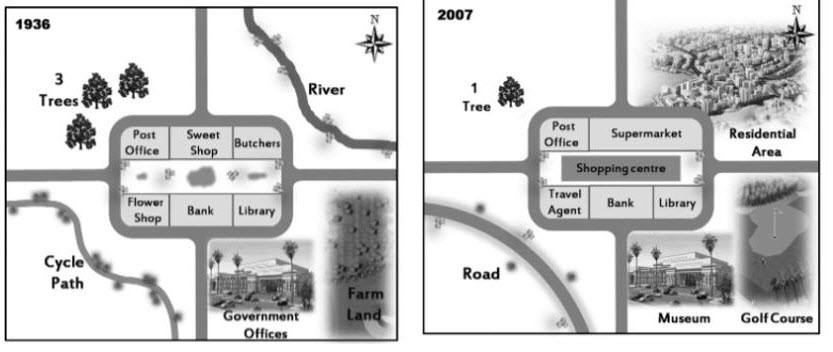
The maps below shows the town of Lynnfield in 1936 and then later in 2007.
Summarise the information by selecting and reporting the main features, and make comparisons where relevant.
The maps detail changes to a town called Lynnfield between 1936 and 2007. Looking from an overall perspective, it is readily apparent that the town became more residential, commercial, and accessible at the expense of natural land, agriculture and smaller shops.
In 1936, to the northwest and northeast of the town were several trees and a river surrounded by untouched land. By 2007, the number of trees had declined and the land around the river became a residential area. To the southwest of the town, a cycling path was turned into a road for cars and on the opposite side of the map a museum and golf course replaced government offices and farm land.
In terms of the center of the town itself, there was a post office, sweet shop and butcher’s in a single row with a lane separating those businesses from the flower shop, bank and library. In 2007, only the bank (slightly expanded in size), library, and post office remained the same. The flower shop had by then been removed in favor of a travel agent, there was a shopping center in the previously unoccupied space between businesses, and the sweet shop and butcher’s were combined and transformed into a large supermarket.
Analysis
1. The maps detail changes to a town called Lynnfield between 1936 and 2007. 2. Looking from an overall perspective, it is readily apparent that the town became more residential, commercial, and accessible at the expense of natural land, agriculture and smaller shops.
Paraphrase the overall essay topic.
Write a general over for the map. Include the major changes and group them generally.
1. In 1936, to the northwest and northeast of the town were several trees and a river surrounded by untouched land. 2. By 2007, the number of trees had declined and the land around the river became a residential area. 3. To the southwest of the town, a cycling path was turned into a road for cars and on the opposite side of the map a museum and golf course replaced government offices and farm land.
Begin to describe the changes.
Be sure to compare as much as possible.
In this one I separated inside and outside the town itself.
1. In terms of the center of the town itself, there was a post office, sweet shop and butcher’s in a single row with a lane separating those businesses from the flower shop, bank and library. 2. In 2007, only the bank (slightly expanded in size), library, and post office remained the same. 3. The flower shop had by then been removed in favor of a travel agent, there was a shopping center in the previously unoccupied space between businesses, and the sweet shop and butcher’s were combined and transformed into a large supermarket.
Switch to another part of the map.
Don’t include any opinion and don’t forget any areas.
Nothing should be left out!
Vocabulary
What do the words in bold below mean?Take some notes on a piece of paper to aid your memory:
detail show
Looking from an overall perspective, it is readily apparent that overall
residential houses, apartments
commercial businesses
accessible can be travelled to easily
expense interest
natural land nature
agriculture farming
smaller shops local businesses
northwest top left
northeast top right
several lots of
surrounded by around
untouched land nature with no developments
declined decreased
to the southwest of the town in the lower left part
cycling path where bikes ride
on the opposite side reversed part
replaced taken the place of
in terms of considering
butcher’s place to buy meat
single row one line
lane separating space keeping apart
slightly expanded in size got a little bigger
remain the same unchanged
removed in favor of taken away so that
previously unoccupied space place where nothing was there before
combined added together
transformed changed
Answers
Try to write down or think of an antonym/opposite word for further practice:
The maps detail changes to a town called Lynnfield between 1936 and 2007. Looking from an overall perspective, it is readily apparent that the town became more residential, commercial, and accessible at the expense of natural land, agriculture and smaller shops.
In 1936, to the northwest and northeast of the town were several trees and a river surrounded by untouched land. By 2007, the number of trees had declined and the land around the river became a residential area. To the southwest of the town, a cycling path was turned into a road for cars and on the opposite side of the map a museum and golf course replaced government offices and farm land.
In terms of the center of the town itself, there was a post office, sweet shop and butcher’s in a single row with a lane separating those businesses from the flower shop, bank and library. In 2007, only the bank (slightly expanded in size), library, and post office remained the same. The flower shop had by then been removed in favor of a travel agent, there was a shopping center in the previously unoccupied space between businesses, and the sweet shop and butcher’s were combined and transformed into a large supermarket.
Remember and fill in the blanks. Note it on a piece of paper so you can remember better:
The maps d_______l changes to a town called Lynnfield between 1936 and 2007. L_________________________________________________t the town became more r_____________l, c_____________l, and a___________e at the e________e of n_________d, a__________e and s__________s.
In 1936, to the n___________t and n___________t of the town were s__________l trees and a river s_______________y u___________________d. By 2007, the number of trees had d_________d and the land around the river became a residential area. T__________________________n, a c____________h was turned into a road for cars and o__________________e of the map a museum and golf course r_________d government offices and farm land.
I____________f the center of the town itself, there was a post office, sweet shop and b__________s in a s___________w with a l________________g those businesses from the flower shop, bank and library. In 2007, only the bank (s___________________________e), library, and post office r_____________e. The flower shop had by then been r_____________________f a travel agent, there was a shopping center in the p_________________________e between businesses, and the sweet shop and butcher’s were c__________d and t_____________d into a large supermarket.
Listening Practice
Listen to the related topic below and practice with these activities
This is an IELTS writing task 2 sample answer essay on the topic of recycling from the real IELTS general training exam.
Please consider supporting me on Patreon.com/howtodoielts to receive my exclusive IELTS Ebooks – you can even sign up for private live lessons with me!
Dave
IELTS Essay: Recycling
Some say that children should be taught at school to recycling and avoid waste. Others say they should learn this at home.
Discuss both views and give your opinion
Many feel that school, rather than the home, is the optimal environment to teach children about recycling and avoiding excessive waste. In my opinion, though schools can provide ideal social pressure, habits instilled at home are more likely to be long-lasting.
Those who would prioritize the duty of schools in this matter point to social factors. At school, students are first exposed to group dynamics and the expectations placed on them by institutions. Later in life, teachers will become bosses and school will become work. Children are especially vulnerable to the social pressures exerted by teachers and peers. For example, most young students will follow school rules without considering the possibility of disobeying. However, there is a likely turning point that will occur later in one’s schooling that may render progress achieved as a child less effective.
In contrast, the behaviors that a child learns at home can help form their identity. For instance, members of a family are likely to have similar tastes in food, entertainment, and various hobbies. Recycling is simply another habit that can be acquired and maintained over years. A child who reflexively recycles from a very young age will probably continue this action as they get older and learn the solid reasoning behind it. There is a chance that for other rules and habits they may rebel and actively work to change their identity but this is unlikely to occur with recycling since it is universally regarded as positive and progressive.
In conclusion, the home is a superior location to build habits related to recycling because schools often fail to instill lifelong behavioral changes. Therefore, a committed approach by parents is paramount to protecting the environment in the future.
Analysis
1. Many feel that school, rather than the home, is the optimal environment to teach children about recycling and avoiding excessive waste. 2. In my opinion, though schools can provide ideal social pressure, habits instilled at home are more likely to be long-lasting.
Paraphrase the overall essay topic.
Write a clear opinion. Read more about introductions here.
1. Those who would prioritize the duty of schools in this matter point to social factors. 2. At school, students are first exposed to group dynamics and the expectations placed on them by institutions. 3. Later in life, teachers will become bosses and school will become work. 4. Children are especially vulnerable to the social pressures exerted by teachers and peers. 5. For example, most young students will follow school rules without considering the possibility of disobeying. 6. However, there is a likely turning point that will occur later in one’s schooling that may render progress achieved as a child less effective.
Write a topic sentence with a clear main idea at the end.
Explain your main idea.
Develop it with specific or hypothetical examples.
Keep developing it fully.
Extend with some short sentences as well.
You can include a concession here!
1. In contrast, the behaviors that a child learns at home can help form their identity. 2. For instance, members of a family are likely to have similar tastes in food, entertainment, and various hobbies. 3. Recycling is simply another habit that can be acquired and maintained over years. 4. A child who reflexively recycles from a very young age will probably continue this action as they get older and learn the solid reasoning behind it. 5. There is a chance that for other rules and habits they may rebel and actively work to change their identity but this is unlikely to occur with recycling since it is universally regarded as positive and progressive.
Write a new topic sentence with a new main idea at the end.
Explain your new main idea.
Include specific details and examples.
Continue developing it…
as fully as possible!
1. In conclusion, the home is a superior location to build habits related to recycling because schools often fail to instill lifelong behavioral changes. 2. Therefore, a committed approach by parents is paramount to protecting the environment in the future.
Summarise your main ideas.
Include a final thought. Read more about conclusions here.
Vocabulary
What do the words in bold below mean?Make some notes on paper to aid memory and then check below.
Many feel that school, rather than the home, is the optimal environment to teach children about recycling and avoiding excessive waste. In my opinion, though schools can provide ideal social pressure, habits instilled at home are more likely to be long-lasting.
Those who would prioritize the duty of schools in this matter point to social factors. At school, students are first exposed to group dynamics and the expectations placed on them by institutions. Later in life, teachers will become bosses and school will become work. Children are especially vulnerable to the social pressuresexerted by teachers and peers. For example, most young students will follow school rules without considering the possibility of disobeying. However, there is a likely turning point that will occur later in one’s schooling that may render progress achieved as a child less effective.
In contrast, the behaviors that a child learns at home can help form their identity. For instance, members of a family are likely to have similar tastes in food, entertainment, and various hobbies. Recycling is simply another habit that can be acquired and maintained over years. A child who reflexively recycles from a very young age will probably continue this action as they get older and learn the solid reasoning behind it. There is a chance that for other rules and habits they may rebel and actively work to change their identity but this is unlikely to occur with recycling since it is universally regarded as positive and progressive.
In conclusion, the home is a superior location to build habits related to recycling because schools often fail to instill lifelong behavioral changes. Therefore, a committed approach by parents is paramount to protecting the environment in the future.
Answers
For extra practice, write an antonym (opposite word) on a piece of paper to help you remember the new vocabulary:
rather than instead of
optimal environment best place
recycling using products again – or putting them in bins so they can be processed and used again
avoiding excessive waste not throwing away too much stuff
provide ideal social pressure feel a lot of stress from others
instilled encouraged
long-lasting doesn’t go away for a while
prioritize make most important
duty responsibility
matter issue
point to highlight
social factors elements rated to people around them
exposed open to
expectations placed on them by institutions wishes put on by schools
later in life as they get older
especially vulnerable to really weak to
social pressures anxiety from people aroung you
exerted by forced by
peers fellow students
follow listen to
considering thinking about
possibility chance
disobeying not following rules
turning point change in thinking
occur happen
schooling going to school
render progress achieved make what they have done
effective works well
in contrast however
form their identity make up their personality
members of a family people in your family
tastes likes
acquired gathered
maintained kept up
reflexively instinctively
continue keep on
learn the solid reasoning behind it realize the justifications for it
rebel fight against
actively work make a big effort to
unlikely not much of a chance
universally regarded as worldwide thought ot
progressive forward-thinking
superior location better place
related to having to do with
fail to instill lifelong behavioral changes not make you follow these actions forever
I recommend getting a pencil and piece of paper because that aids memory. Then write down the missing vocabulary from my sample answer in your notebook:
Many feel that school, r_____________n the home, is the o____________________t to teach children about r_________g and a________________________e. In my opinion, though schools can p___________________________e, habits i_________d at home are more likely to be l___________g.
Those who would p____________e the d___y of schools in this m________r p________o s___________s. At school, students are first e___________d to group dynamics and the e_____________________________________s. L______________e, teachers will become bosses and school will become work. Children are e________________________o the s________________________y teachers and p_______s. For example, most young students will f_______w school rules without c_____________g the p___________y of d_____________g. However, there is a likely t_______________t that will o_________r later in one’s s____________g that may r_____________________________d as a child less e______________e.
I________________t, the behaviors that a child learns at home can help f__________________y. For instance, m______________________y are likely to have similar t________s in food, entertainment, and various hobbies. R___________g is simply another habit that can be a___________d and m______________d over years. A child who r___________y recycles from a very young age will probably c____________e this action as they get older and l________________________________t. There is a chance that for other rules and habits they may r________l and a______________k to change their identity but this is u____________y to occur with recycling since it is u__________________y r______________s positive and p________________e.
In conclusion, the home is a s___________n to build habits r__________o recycling because schools often f____________________________________________s. T____________e, a c_________________h by parents is p__________t to p____________g the environment in the future.
Listening Practice
Learn more about this topic by watching videos from The New York Times YouTube channel below and practice with these activities:
How do you react when you see litter on the streets?
Do you recycle?
How do you help keep the streets tidy?
What would you do if someone else dropped some litter?
Writing Practice
Practice with the related IELTS essay topic below:
Some people say that the main environmental problem of our time is the loss of particular species of plants and animals. Others say that there are more important environmental problems.
Discuss both these views and give your own opinion.
"The highest quality materials anywhere on the internet! Dave improved my writing and vocabulary so much. Really affordable options you don't want to miss out on!"