by Dave | Mar 5, 2018 | Sample Answers
This is the IELTS Writing Task 2 from March 3rd on the topic of banning plastic bags.
It’s a topical issue because cities and nations all around the world have been enacting laws related to this in recent years.
Read on for a sample answer from a former examiner, analysis, vocabulary practice and some handwritten notes!
For more, check out our other sample answers here: IELTS Sample Answers.
Dave
Sample Answer
Plastic shopping bags are used widely and cause many environmental problems. Some people say they should be banned.
To what extent do you agree or disagree?
No one would deny that the plastic bags used in supermarkets and shops have a negative effect on the environment because they do not degrade and end up as litter in our cities or oceans. However, the replacements for plastic bags also carry significant environmental risks. That is why I think plastic bags should not be banned.
The main environmental side effect related to plastic bags is that they pollute both the land and water. An insignificant percentage of people may reuse or recycle plastic bags, but most ultimately litter or throw them in the trash. If they are thrown in the trash, plastic bags will wind up in the ever-increasing number of landfills and contribute to soil pollution. The ones that are simply tossed in the street clog drains in cities and eventually find their way to the sea and entangle marine life. This is why many feel that plastic bags should be banned.
Despite the advantages of banning plastic bags, the solutions for plastic bags are worse than the original problem. Most people who advocate banning plastic bags suggest paper bags (which are biodegradable) or reusable bags that are typically made from cotton or plastic. Both of these replacements are flawed. Paper bags require us to continue clearing forests and also carry a large carbon footprint. Reusable bags are plagued by similar problems. Independent studies have shown that the production of cotton and reusable plastic causes more harm to the environment than disposable plastic bags. Coupled with the fact that reusable bags are more difficult to recycle, their overall effect on the environment is worse.
I do not think overly simplistic restrictions on plastic bags would have the desired positive effect. Rather than thoughtlessly banning them, policy makers should come up with a policy that balances the materials we use for bags in order to produce an overall positive impact on the environment.
Sample Answer Analysis
1. No one would deny that the plastic bags used in supermarkets and shops have a negative effect on the environment because they do not degrade and end up as litter in our cities or oceans. 2. However, the replacements for plastic bags also carry significant environmental risks. 3. That is why I think plastic bags should not be banned.
1. The first sentence simply restates what the general topic is – banning plastic bags. It also includes my main idea for why they should be banned.
2. The second sentence gives the other main idea – why they should not be banned.
3. The third sentence is my opinion – they should not be banned.
1. The main environmental side effect related to plastic bags is that they pollute both the land and water. 2. An insignificant percentage of people may reuse or recycle plastic bags, but most ultimately litter or throw them in the trash. 3. If they are thrown in the trash, plastic bags will wind up in the ever-increasing number of landfills and contribute to soil pollution. 4. The ones that are simply tossed in the street clog drains in cities and eventually find their way to the sea and entangle marine life. 5. This is why many feel that plastic bags should be banned.
1. The first sentence is a topic sentence that includes my main idea for the whole paragraph (the main problem is pollution for land and water).
2. The second sentence explains my main idea by saying that most plastic bags are either littered or thrown in the trash.
3. The third sentence explains what happens when they are thrown in the trash and the impact on land.
4. The fourth sentence explains the second problem – that the bags that are littered end up in the ocean.
5. The fifth sentence summarizes that these are the reasons plastic bags should be banned.
1. Despite the advantages of banning plastic bags, the solutions for plastic bags are worse than the original problem. 2. Most people who advocate banning plastic bags suggest paper bags (which are biodegradable) or reusable bags that are typically made from cotton or plastic. 3. Both of these replacements are flawed. 4. Paper bags require us to continue clearing forests and also carry a large carbon footprint. 5. Reusable bags are plagued by similar problems. 6. Independent studies have shown that the production of cotton and reusable plastic causes more harm to the environment than disposable plastic bags. 7. Coupled with the fact that reusable bags are more difficult to recycle, their overall effect on the environment is worse.
1. The first sentence is a topic sentence that includes my main idea for the whole paragraph (replacing plastic bags is worse than having them).
2. The second sentence explains my opinion by saying that advocates of banning plastic bags usually recommend paper or reusable cotton bags.
3. The third sentence supports my opinion by saying that both solutions are flawed.
4. The fourth sentence supports my main idea by explaining that paper bags also have a negative environmental impact.
5. The fifth sentence shifts to why reusable bags are also not a good solution.
6. The sixth sentence adds that reusable bags are more difficult to recycle and this makes them worse than single-use plastic bags.
7. State the overall impact to finish the paragraph.
1. I do not think overly simplistic restrictions on plastic bags would have the desired positive effect. 2. Rather than thoughtlessly banning them, policy makers should come up with a policy that balances the materials we use for bags in order to produce an overall positive impact on the environment.
1. The first sentence restates the main ideas from the sample answer as well as my overall opinion. Make sure you have an overall opinion because the question directly asks you whether or not you agree than plastic bags should be banned.
2. The second sentence adds an extra detail (saying that governments should focus on a more balanced policy rather than a ban) that is needed to get above a Band 7 for Task Achievement according to some, but not all, examiners.
Vocabulary Analysis and Practice
I have highlighted some of the key vocabulary from the sample answer.
Before looking at the definition let’s do some practice!
Answer the following questions about everything in bold:
1. Is it a noun/verb/adjective/adverb? Is it a collocation? A noun-verb collocation? Or verb-noun?
2. What does it mean?
3. Can you think of a synonym?
No one would deny that the plastic bags used in supermarkets and shops have a negative effect on the environment because they do not degrade and end up as litter in our cities or oceans. However, the replacements for plastic bags also carry significant environmental risks. That is why I think plastic bags should not be banned.
The main environmental side effect related to plastic bags is that they pollute both the land and water. An insignificant percentage of people may reuse or recycle plastic bags, but most ultimately litter or throw them in the trash. If they are thrown in the trash, plastic bags will wind up in the ever-increasing number of landfills and contribute to soil pollution. The ones that are simply tossed in the street clog drains in cities and eventually find their way to the sea and entangle marine life. This is why many feel that plastic bags should be banned.
Despite the advantages of banning plastic bags, the solutions for plastic bags are worse than the original problem. Most people who advocate banning plastic bags suggest paper bags (which are biodegradable) or reusable bags that are typically made from cotton or plastic. Both of these replacements are flawed. Paper bags require us to continue clearing forests and also carry a large carbon footprint. Reusable bags are plagued by similar problems. Independent studies have shown that the production of cotton and reusable plastic causes more harm to the environment than disposable plastic bags. Coupled with the fact that reusable bags are more difficult to recycle, their overall effect on the environment is worse.
I do not think overly simplistic restrictions on plastic bags would have the desired positive effect. Rather than thoughtlessly banning them, policy makers should come up with a policy that balances the materials we use for bags in order to produce an overall positive impact on the environment.
Vocabulary Definitions
negative effect (n): causes something bad to happen
degrade (v): something can fall apart, materials like paper and foods can decay
end up (phrasal verb): winds end or finally becomes
litter (n/v): trash that we throw on the street rather than in bins
significant environmental risks (n): big potential problems for the environment
side effect (n): impact or effect that is not intended but happens anyway
insignificant percentage (n): small %
reuse (v): can be used again and again
wind up (phrasal verb): ends up or finally becomes
ever-increasing (adj): continues to increase all the time
landfills (n): big holes in the ground where trash is stored
contribute to (v): adds to or helps make up
clog drains (v): block drains where water flows when it rains
entangle (v): get stuck
original problem (n): the problem from the beginning
advocate (v): support or suggest
biodegradable (adj): fancier way of saying degradable
reusable bags (n): bags that can be used more than once
typically (adv): usually or normally
flawed (adj): not perfect, has mistakes or drawbacks
clearing forests (v): cutting down forests
carbon footprint (n): the amount of carbon dioxide released into the atmosphere
plagued (v): cause trouble to or upset by
independent studies (n): research conducted by outside groups
coupled (v): combined
overall effect (n): the total impact
overly simplistic (adj): too simple
thoughtlessly (adv): without a thought
policy makers (n): the people who make laws, members of government
come up with (phrasal verb): create or imagine
balances (v): to make something equal
produce (v): create or make
Plastic Bag Articles
The plastic bags ban will greatly disadvantage the poor
Plastic Bag Videos
Example Notes
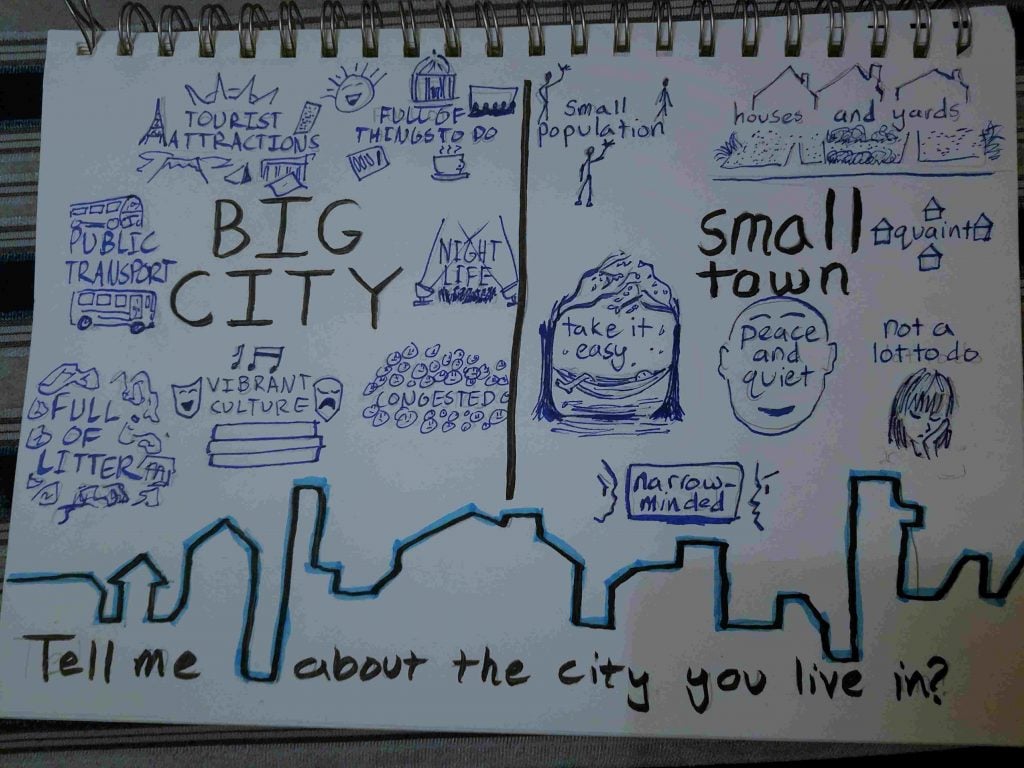
Here are some notes I made about plastic bags (check out more on our Instagram page)!

Now it’s Your Turn! Comment below on our IELTS Sample Answer:
Do you think plastic bags should be banned? Or should we start using more of them?
by Dave | Feb 27, 2018 | IELTS FAQ
This is a question I see A LOT on online groups, and there seems to be a lot of misinformation about it. Some students suggest that taking your test with one is easier than the other. The short answer is there is NO difference between taking your test with British Council or with IDP. Check out this article for a longer explanation of why they are the same.
Dave
Who owns IELTS?
IELTS is owned by Cambridge English Language Assessment, British Council and IDP. Cambridge writes the test and British Council and IDP deliver the test. All three organisations work together as one company to make sure the test is the same in all countries, regardless of whether you book your test through British Council or IDP.
Are British Council and IDP Examiners the Same?
For writing and speaking the examiners at BC and IDP have been given exactly the same training, they ask the same questions, they use the same marking criteria and they will be monitored regularly using the same system to make sure they are following the same standards. In fact some examiners work for IDP and British Council in the same town or city. So this is clear evidence that it’s the same.

Are the BC and IDP Reading and Listening Exams Scored the Same?
For the reading and listening exams, local staff mark the same tests following the same answer keys from Cambridge. So, again this is the same for BC and IDP.
In Conclusion
So it’s pretty damn clear that the exam is exactly the same. If anyone tells you that taking your test with IDP or BC is better because you will get a higher score then they are telling you a porkie. But if you have any real evidence that supports this then please message us.
by Dave | Feb 23, 2018 | How To
It’s very important to study and practice all the different Task 1 types so you can be fully prepared for your exam, including an IELTS Writing Task 1 Process.
A lot of IELTS students (and teachers & books) focus too much on charts and tables, and not enough on other types such as maps and processes.
Recently, process diagrams have been appearing more and more in the IELTS Writing exam. In this post we look at how to analyse a process carefully including the kind of process, how many steps and main stages, and knowing what is happening at each step.
Dave
The Kind of Process
The process diagram below is based on a real IELTS exam from Jan 2018, and shows how orange juice is made. Click here for a sample answer for this question with line by line analysis.
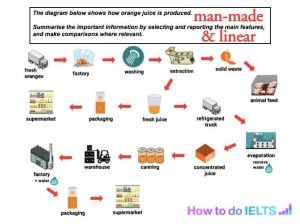
As you can see I’ve written on the top of the diagram (in red), to help me remember two important points:
-
It’s a man-made process, which means it is carried out by people, compared to a natural process (e.g. the salmon life cycle below).
-
It’s a linear process. This means it starts and finishes in different places. It doesn’t repeat itself. In a cyclical process (salmon life cycle below), at the end of the process it goes back to the beginning – it repeats.

Steps and Stages
After confirming the kind of process, you should identify (find) how many steps there are, and categorise them logically into main stages.
Count and Order the Steps Logically
The first task is easy – just follow the process logically (following the arrows) and number them as you go (see my example below). From this it’s clear to see that there are a total of 17 steps.
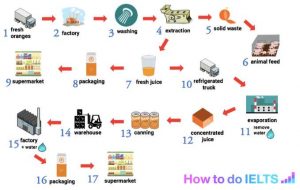
Remember to number the steps logically so that it follows the process (following the arrows), which helps you to see the process and its main stages. Compare my numbering above with the one below.
The 2nd example also shows 17 steps but I numbered them left to right, which is not as helpful for analysing the diagram.

Divide the Steps into Stages
Similar to other Task 1 question types, if you want a band 7 or above for Task Achievement you need a clear overview that summarises the whole diagram. For a process diagram, this means the examiner wants you to divide the process into main stages.
This is tricky (difficult) as there is often more than one possible way. Choose whichever way you think is logical, and draw lines on the diagram to help you analyse and remember the stages.
In the first example (see below), I have divided the process into three main stages. This is logical because it matches the three main industrial processes in three different factory locations:
-
Purple: (Extraction) – producing & delivering fresh juice to supermarkets (and its by-product to farms).
-
Blue: (Evaporation) – creating concentrated juice for storage.
-
Pink: (Rehydration) – producing reconstituted orange juice for supermarkets.
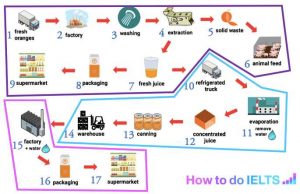
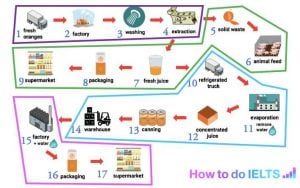
Alternatively, you could break the process down into four main stages (see below). Again I have used lines to help me analyse and remember:
-
Purple: (Extraction) – processing fresh juice and its by-product
-
Green: (Delivery) – the fresh juice is taken to supermarkets, and the solid waste to farms
-
Blue: (Evaporation) – creating concentrated juice for storage.
-
Pink: (Rehydration) – producing reconstituted orange juice for supermarkets.
Analyse Every Step – What, Where, How, Why
You need to analyse every step of the process and identify what kind of step it is, and therefore what is happening to the oranges at each step. For example:
-
Does it show an activity? (e.g. packaging) or a product? (e.g. fresh juice)
-
Is it a main industrial activity? (e.g. evaporation, extraction, rehydration)
-
Is it preparation for a main industrial activity? (e.g. washing)
-
Does it involve a break in the process? (e.g. storage)
-
Does it involve transportation? (being taken from one factory to another, or to a warehouse or shop)
-
Does it involve packaging? (e.g. canning)
-
Is something being added or removed? (e.g. water in evaporation / rehydration)
-
Does it involve a by-product of the main process? (e.g. producing animal feed from solid waste)
-
Is it labelled? (e.g. rehydration doesn’t have the word. It just says factory + water)
Now it’s your turn! Put your answers in the comments.
Using my notes write some sentences to describe this process.
Check your ideas with my model answer here.
by Dave | Feb 23, 2018 | Sample Answers
This sample answer is based on a real IELTS Writing Task 1 question from Jan 2018. But there is so much more in this post than just a sample answer. Aren’t you guys lucky? I’ve also included:
-
A quick analysis of the question – check here for more detailed analysis.
-
Line by line analysis of the sample answer.
-
Useful Vocabulary from the sample answer and links to practice games and exercises.
-
Cool topic-related links about all things orangey.
As well as our Task 1 sample answers, check out our Task 2 sample essays here: IELTS Writing Task 2 Sample Answers.
You can also subscribe to our YouTube Channel for some IELTS Speaking Sample Answers: HowtodoIELTS YouTube.
Dave
Question Analysis
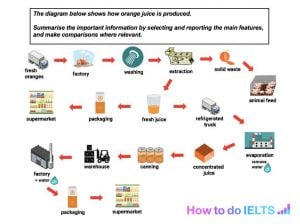
Looking at the diagram above, you can see the question focuses on how fresh and reconstituted orange juice is produced. An exciting topic!
If you need more help with analysing this process, check out my recent post on how to identify the kind of process, how to divide the process into its main stages, and how to recognise what is happening at every step.
I suggest making notes on the diagram in the exam, in order to number the steps and divide them logically into main stages. Your question paper should end up looking something like this:
Sample Answer
The diagram illustrates the linear process of producing fresh and concentrated orange juice for the purposes of selling in supermarkets. There are total of 17 steps which can be organised into three main stages. These include producing and delivering fresh orange juice to supermarkets, processing the fresh juice to create concentrated juice for storage, and finally producing reconstituted orange juice which is then sold to the general public.
The process commences with fresh oranges being delivered to a factory, where the raw product is washed and juice is extracted with excess solid waste being used as animal feed. At this point in the process the fresh juice is either delivered in refrigerated trucks for evaporation or packaged and transported to supermarkets for selling to customers. Evaporation is carried out at a separate facility, removing water and resulting in the production of concentrated orange juice, which is subsequently canned and stored in a warehouse. As required, the orange concentrate is then processed in a third and final plant, where it is mixed with water in order to produce reconstituted orange juice, which is then packaged and ultimately delivered to supermarkets.
Analysis
Firstly, it’s important to note that this answer has clear paragraphing.
The first paragraph contains an introductory sentence and the overview. The second paragraph presents the detailed figures.
Although in IELTS Writing Task 1, paragraphing isn’t mentioned in the band descriptors below band 8, it is still a good idea to use paragraphs to organise your writing as it makes it more logical.
This helps the examiner to read your answer, and that is always a good thing!
Paragraph 1: Introduction and Overview
The diagram illustrates the linear process of producing fresh and concentrated orange juice for the purposes of selling in supermarkets. There are total of 17 steps which can be organised into three main stages. These include producing and delivering fresh orange juice to supermarkets, processing the fresh juice to create concentrated juice for storage, and finally producing reconstituted orange juice which is then sold to the general public.
-
The first sentence introduces the process, by paraphrasing (not copying) the question.
-
The second sentence begins the overview of the process by confirming the number of steps and main stages.
-
The third sentence completes the overview by summarising the whole process by identifying the three main stages.
Paragraph 2: Detailed Figures
The process commences with fresh oranges being delivered to a factory, where the raw product is washed and juice is extracted with excess solid waste being used as animal feed. At this point in the process the fresh juice is either delivered in refrigerated trucks for evaporation or packaged and transported to supermarkets for selling to customers. Evaporation is carried out at a separate facility, removing water and resulting in the production of concentrated orange juice, which is subsequently canned and stored in a warehouse. As required, the orange concentrate is then processed in a third and final plant, where it is mixed with water in order to produce reconstituted orange juice, which is then packaged and ultimately delivered to supermarkets.
-
The first sentence begins the description of the detail of the process by describing the first six steps.
-
The second sentence describes steps 7-10.
-
The third sentence describes steps 11-14.
-
The fourth sentence completes the detailed description of the process by describing steps 15-17. No conclusion is required for Task 1 writing.
Useful Vocabulary (see Quizlet link below for practice activities)
a diagram (n) – a picture
illustrates (v) – shows
a linear process (n) – a process happening in a line
fresh (adj) – recently picked or prepared
concentrated (adj) – made stronger by removing water
purpose (n) – a reason for doing something
reconstituted (adj) – to add water to something
raw (adJ) – not cooked or processed
extraction (n) – to remove something
excess (n) – too much
solid waste (n) – leftover hard material (not a liquid or gas)
animal feed (n) – food for animals
evaporation (n) – remove water by heating
a facility (n) – a place with a special purpose
packaged (v) – to put in a packet or box for selling
transported (v) – to be moved from one place to another
delivered (v) – to be transported to the end user or customer
subsequently (adv) – after something else happened
a plant (n) – a factory
ultimately (adv) – finally
FREE Online Vocabulary Practice
I’ve prepared some practice games and vocab exercises on Quizlet for these words taken from the sample answer. Quizlet is a really fun and convenient way to learn and practice vocab and it’s free!
Try it out, and use it whenever you have a spare few minutes.
If you need more help using Quizlet, check out this video lesson (starts from 34m36s).

Check out Quizlet for great online vocabulary activities for free!
Learn more about everything Orange! – Related Articles and Videos
Check out these links for fun and interesting videos and articles about all things orange!

Find out why Donald Trump is so orange.
by Dave | Feb 16, 2018 | IELTS FAQ, IELTS Listening, IELTS Reading
This is a question that students and friends ask me all the time on our Facebook and our Instagram. When watching a movie or TV show or YouTube video: ‘Should I watch it with English subtitles? Subtitles in my language? Or no subtitles at all?’
‘Just watching and learning is most important,’ I say to avoid thinking about the question. But there are actually good reasons for trying all 3 methods.
But let’s look at the reasons for all 3, based on 10 years of teaching experience and IELTS examining!
And head over to our YouTube Channel to practice if you have time!
Dave

Should you subtitle when learning English?
Why English Subtitles are Good
The main reason that it is good to use the English subtitles is that your listening ability is probably not as good as your reading ability.
By watching and reading the subtitles you will be able to match together what the characters are saying with the actual words.
Not only that but the images and story will make some of the vocabulary clearer.
This is very similar to the way that you learned your native language as a kid.
But there is one big difference – as a kid you learned without subtitles and your listening and speaking probably improved faster than your reading and writing.
The big drawback to this approach is related to your listening and pronunciation.
Your listening may get worse because you may become dependent on the subtitles and not improve your listening. This might not happen, but if it does, you could end up with poor listening skills.
Your pronunciation could also get worse. That’s because in English words are not always said the way they are spelled. We don’t say ‘Sit down’ as two separate words – we say ‘Si-down,’ we don’t even pronounce the ‘b’ in ‘comb’ or the ‘k’ in ‘knight’!
Reading the subtitles may focus you too much on the spelling and hurt your pronunciation.
In conclusion, watching with English subtitles is good for improving your language skills (vocabulary, grammar, etc.) but it may hurt your listening and pronunciation.
Why Native Language Subtitles are Good
I have a lot of friends who swear by this method.
One teacher I know, who spoke completely fluent English despite only beginning to learn at age 12, used to watch cartoons in English and figure out from the subtitles in Romanian what the words meant.
There is also a lot of good research to suggest this can be effective.
It works because a clever and active listener can link together the meaning they already understand from the subtitles.
This is supported by research that shows one of the best and most memorable ways to learn English is by making comparisons between your native language and English.
However, there are two very serious drawbacks.
The first one is what happens in the majority of cases: people just read the subtitles in their language and mostly ignore the English. Lots of people even turn down the volume and just read the screen!
The second one is that it encourages you to translate from English back to your language.
This might later hurt your listening comprehension: instead of listening and understanding you will listen, translate and understand.
If you carry over this habit to speaking and writing it will also slow you down. You don’t want to be translating every single word when speaking or writing – it should flow out more naturally.
This might not happen – but you must be very active practicing with the vocabulary that you learn to make sure you don’t end up like an old slow smartphone that takes 5 minutes just to load up Google!
Why No Subtitles at all are Good
This is the way that you learned your native language.
You listened to your parents, friends and teachers. You watched TV shows and movies without subtitles.
This is the most natural way to learn English.
When you learn this way, your pronunciation will be good because you only focus on the sounds, never the spelling of the words.
You will develop excellent listening skills because there will be no help from the subtitles.
However, because this way requires you to be completely independent, it is also much harder.
For a long time it will be confusing and difficult (maybe too difficult!) and you might give up.
Only use this method alone if you are already confident with English, you have lots of free time or you enjoy challenges.

Aristotle said this.
How to Combine Different Ways of Using Subtitles
Aristotle’s quote means that the best method is not at either extreme, but somewhere in the middle – moderation in all things.
Jumping in without any subs at all is a huge challenge – you might give up.
Using just one approach has advantages but also disadvantages. You will end up with one skill – listening or vocabulary – stronger than the other.
You should combine the approaches to make sure that your skills are well-rounded – moderation in all things.
Here are some ideas for how to combine these approaches (all Netflix programming has subtitles and you can also check out this YouTube playlist I made! (be sure to hit the CC button for some of them to turn on the subs!)):
-
No Sound: Try watching a video on YouTube or Netflix with no sound first. Pay attention to the body language. Try to guess what they are saying. Write down some ideas. Then listen. Take some notes of words they said. Then watch with subtitles and check again. Then watch again with no sound and no subtitles and try to remember what they said. Keep trying variations of this until you know the whole scene by heart!
-
Native Language First: Watch with subtitles in your native language first so that the meaning is clear. Then make notes on some of the English words used. Try to rewrite the whole thing in English. Keep watching until you fully understand the English.
-
Eng Subs First: Watch it with English subtitles first. How much can you understand? Make notes in two columns: things you understand and things you don’t understand. Watch it a couple of times with English subtitles and try to move everything into the understand column. Then watch it with your native language subtitles and again try to move everything to the understand column.
-
No Subs First: Watch it without any subtitles. Write down the things you can and can’t understand. Keep watching it until you understand as much as possible. Then put on the English subtitles and keep watching it. Finally, use your native language subtitles to understand it totally. Watch it from the beginning with no subs again and see the progress you have made!
-
Switching Throughout: The above 4 ideas work best with short videos that you watch repeatedly. That might be boring. Watch a whole show or movie. But don’t just use one technique. Keep your brain active by changing it up: sometimes no subs, sometimes native language subs and sometimes English subs. Try to enjoy it as well!
-
Review, Review, Review: All the above ideas will work – my personal guarantee as a teacher and former IELTS examiner. But the most important thing to make real progress is to review. Studying without reviewing is like working out once a week – you won’t see a big difference. Drag yourself back to the gym to exercise again and again and you’ll get stronger. Review the same scenes, movies and shows over and over again until you are confident you understand everything. Then begin to practice using the language you learned. That is the essence of language learning – now stop reading this and just go do it!
