This is an IELTS writing task 2 sample answer essay on the topic of advertising to children from the real exam.
Please consider supporting me on Patreon.com/howtodoielts to receive my full, exclusive IELTS Ebooks!
Dave
IELTS Essay: Advertising to Children
In some countries, there has been an increase in the number of advertisements which try to persuade children to buy snacks, toys, and other goods. Parents often claim that these ads are unfair.
Discuss both views and give your opinion.
Some are of the opinion that it is unethical to advertise to children. In my opinion, although at certain ages these advertisements should be permitted, in general children are too vulnerable a segment of the population.
Those who argue in favor of advertising to children point out it is not necessarily unfair. There are situations when even these proponents would concede advertising is exploitive, such as when there are commercials for cereals with high sugar content during cartoon shows. However, this is only a single instance. Many children, especially as they get older, are capable of thinking rationally, controlling their need for instant gratification, and would therefore like to be informed about new products they are interested in. If a child who is 10 years old sees an advertisement for a water park or sporting event, they might convince their parents to enjoy a fun, outdoors activity.
Nonetheless, most children are negatively impacted by advertisements as they lack self-control. Adults are more capable of inhibiting their desires while children are not experienced enough and their cognitive development does not allow for higher-order reasoning. For instance, if a young child sees an advertisement for alcohol or a violent videogame, there is a strong likelihood they will want to try it. Even if they do not actually get an opportunity to use an age-inappropriate product, the appeal of these products has already been deeply implanted. Recent research supports the contention that habits and impressions formed in early childhood are harder to leave behind later in life.
In conclusion, despite the feasibility of certain advertisements for older children, most marketing directed at impressionable children should be banned. This will be a difficult process to manage but many countries have undertaken it already.
Analysis
1. Some are of the opinion that it is unethical to advertise to children. 2. In my opinion, although at certain ages these advertisements should be permitted, in general children are too vulnerable a segment of the population.
Paraphrase the overall essay topic.
Write a clear opinion. Read more about introductions here.
1. Those who argue in favor of advertising to children point out it is not necessarily unfair. 2. There are situations when even these proponents would concede advertising is exploitive, such as when there are commercials for cereals with high sugar content during cartoon shows. 3. However, this is only a single instance. 4. Many children, especially as they get older, are capable of thinking rationally, controlling their need for instant gratification, and would therefore like to be informed about new products they are interested in. 5. If a child who is 10 years old sees an advertisement for a water park or sporting event, they might convince their parents to enjoy a fun, outdoors activity.
Write a topic sentence with a clear main idea at the end.
Explain your main idea.
Develop it with specific or hypothetical examples.
Keep developing it fully.
Finish development.
1. Nonetheless, most children are negatively impacted by advertisements as they lack self-control. 2. Adults are more capable of inhibiting their desires while children are not experienced enough and their cognitive development does not allow for higher-order reasoning. 3. For instance, if a young child sees an advertisement for alcohol or a violent videogame, there is a strong likelihood they will want to try it. 4. Even if they do not actually get an opportunity to use an age-inappropriate product, the appeal of these products has already been deeply implanted. 5. Recent research supports the contention that habits and impressions formed in early childhood are harder to leave behind later in life.
Write a new topic sentence with a new main idea at the end.
Explain your new main idea.
Include specific details and examples.
Add as much information as you can and make sure it links logically.
Develop the example fully.
1. In conclusion, despite the feasibility of certain advertisements for older children, most marketing directed at impressionable children should be banned. 2. This will be a difficult process to manage but many countries have undertaken it already.
Summarise your main ideas.
Include a final thought. Read more about conclusions here.
Vocabulary
What do the words in bold below mean?Make some notes on paper to aid memory and then check below.
Some are of the opinion that it is unethical to advertise to children. In my opinion, although at certain ages these advertisements should be permitted, in general children are too vulnerable a segment of the population.
Those who argue in favor of advertising to children point out it is not necessarily unfair. There are situations when even these proponents would concede advertising is exploitive, such as when there are commercials for cereals with high sugar content during cartoon shows. However, this is only a single instance. Many children, especially as they get older, are capable of thinking rationally, controlling their need for instant gratification, and would therefore like to be informed about new products they are interested in. If a child who is 10 years old sees an advertisement for a water park or sporting event, they might convince their parents to enjoy a fun, outdoors activity.
Nonetheless, most children are negatively impacted by advertisements as they lack self-control. Adults are more capable of inhibiting their desires while children are not experienced enough and their cognitive development does not allowfor higher-order reasoning. For instance, if a young child sees an advertisement for alcohol or a violent videogame, there is a strong likelihood they will want to try it. Even if they do not actually get an opportunity to use an age-inappropriate product, the appeal of these products has already been deeply implanted. Recent research supports the contention that habits and impressions formed in early childhood are harder to leave behind later in life.
In conclusion, despite the feasibility of certain advertisements for older children, most marketing directed at impressionable children should be banned. This will be a difficult process to manage but many countries have undertaken it already.
Answers
For extra practice, write an antonym (opposite word) on a piece of paper to help you remember the new vocabulary:
some are of the opinion that certain people think
unethical not moral, immoral
certain ages particular times in life
permitted allowed
in general overall
vulnerable susceptible
segment part
those who argue in favor of people who support
point out argue
not necessarily unfair don’t have to be unethical
situations contexts
proponents those in favor of
concede admit
exploitive take advantage of
commercials ads on TV
cereals breakfast food
high sugar content too sweet
cartoon shows animated TV programming
single instance one example
especially in particular
capable are able to
rationally reasonably
controlling in charge of
instant gratification just wanting pleasure right away
therefore thus
informed know about
interested in care about
water park place to go on slides and other water rides
sporting event matches, games
convince persuade
outdoors outside
nonetheless still
negatively impacted badly hurt
lack self-control can’t control their own desires, impulses
capable able to
inhibiting controlling
desires what you want to do
not experienced enough too immature
cognitive development how the brain develops
allowfor higher-order reasoning can think critically
strong likelihood good chance of
opportunity chance
age-inappropriate not suitable for that age
appeal desire
deeply implanted becomes a part of you
recent research supports the contention new studies also say that
habits actions you do over a long time
impressions formed in early childhood things you remember from when you are young
leave behind later in life forget about as you get older
despite regardless of
feasibility how possible it is
marketing directed at impressionable ads taking advantage of vulnerable
banned not permitted
difficult process to manage hard to actually implement
I recommend getting a pencil and piece of paper because that aids memory. Then write down the missing vocabulary from my sample answer in your notebook:
S______________________________t it is u_________l to advertise to children. In my opinion, although at c_____________s these advertisements should be p_____________d, i________l children are too v___________e a s________t of the population.
T________________________________f advertising to children p______________t it is n________________________r. There are s____________s when even these p____________s would c__________e advertising is e___________e, such as when there are c_______________s for c_________s with h_________________________t during c_____________s. However, this is only a s___________________e. Many children, e________y as they get older, are c__________e of thinking r_______________y, c___________g their need for i__________________n, and would t____________e like to be i______________d about new products they are i_______________n. If a child who is 10 years old sees an advertisement for a w______________k or s_____________t, they might c_______e their parents to enjoy a fun, o________s activity.
N_____________s, most children are n__________________d by advertisements as they l______________l. Adults are more c__________e of i_________g their d_______s while children are n______________________h and their c_______________________t does not a____________________________g. For instance, if a young child sees an advertisement for alcohol or a violent videogame, there is a s__________________d they will want to try it. Even if they do not actually get an o_____________y to use an a_____________________e product, the a________l of these products has already been d________________d. R____________________________________n that h______s and i__________________________________d are harder to l______________________________________e.
In conclusion, d_______e the f_____________y of certain advertisements for older children, most m____________________________________e children should be b________d. This will be a d________________________________e but many countries have u___________n it already.
Listening Practice
Learn more about this topic by watching from YouTube below and practice with these activities:
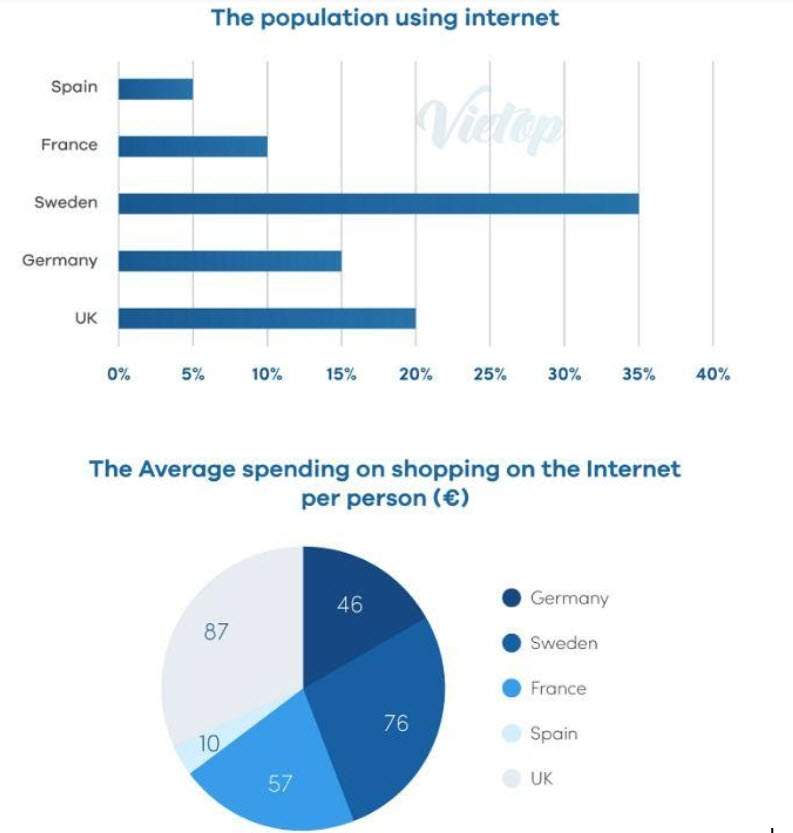
The bar chart details the percentage of internet users according to nation and the pie chart delineates how much individuals from those same countries spent on average shopping online. Looking from an overall perspective, it is readily apparent that Sweden had by far the largest proportion of the population using the internet followed by the UK, German, France, and Spain. There were slight differences in terms of spending as the UK spent the most over Sweden, France, Germany and then Spain, which had a marginal figure overall.
Considering the table firstly, Swedish citizens used the internet most often at 35%. This figure was nearly double the United Kingdom (20%) and each subsequent nation was 5% lower with Germany at 15%, France at 10%, and Spain at 5%.
For spending, the UK had the highest figure (Є87), slightly above Sweden at Є76. There was a large drop to France at Є57 and Germany at Є46. Spain trailed the other nations considerably and residents spent just Є10 per person on average.
Analysis
1. The bar chart details the percentage of internet users according to nation and the pie chart delineates how much individuals from those same countries spent on average shopping online. 2. Looking from an overall perspective, it is readily apparent that Sweden had by far the largest proportion of the population using the internet followed by the UK, German, France, and Spain. 3. There were slight differences in terms of spending as the UK spent the most over Sweden, France, Germany and then Spain, which had a marginal figure overall.
Paraphrase what the table shows.
Write a clear overview summarising the differences.
You might need another sentence for your overview.
1. Considering the table firstly, Swedish citizens used the internet most often at 35%. 2. This figure was nearly double the United Kingdom (20%) and each subsequent nation was 5% lower with Germany at 15%, France at 10%, and Spain at 5%.
Begin writing about the data for the first categories.
Make sure you compare as much as possible.
1. For spending, the UK had the highest figure (Є87), slightly above Sweden at Є76. 2. There was a large drop to France at Є57 and Germany at Є46. 3. Spain trailed the other nations considerably and residents spent just Є10 per person on average.
Write about the final, other parts of the graph – include everything!
Compare the categories.
Don’t leave anything out!
Vocabulary
What do the words in bold below mean?Take some notes on a piece of paper to aid your memory:
The bar chart details the percentage of internet users according to nation and the pie chart delineates how much individuals from those same countries spent on average shopping online. Looking from an overall perspective, it is readily apparent that Sweden had by far the largest proportion of the population using the internet followed by the UK, German, France, and Spain. There were slight differences in terms of spending as the UK spent the most over Sweden, France, Germany and then Spain, which had a marginal figure overall.
Considering the table firstly, Swedish citizens used the internet most often at 35%. This figure was nearly double the United Kingdom (20%) and each subsequent nation was 5% lower with Germany at 15%, France at 10%, and Spain at 5%.
For spending, the UK had the highest figure (Є87), slightly above Sweden at Є76. There was a large drop to France at Є57 and Germany at Є46. Spain trailed the other nations considerably and residents spent just Є10 per person on average.
Answers
Try to write down or think of an antonym/opposite word for further practice:
details hows
percentage %
internet users people online
according to as it relates to
delineates describes
spent on average shopping online the normal amount of money used to buy items on the internet
Looking from an overall perspective, it is readily apparent that overall
Remember and fill in the blanks. Note it on a piece of paper so you can remember better:
The bar chart d_________s the p____________e of i____________s a_______________o nation and the pie chart d_________s how much individuals from those same countries s_________________________e. L________________________________________________t Sweden had b_______r the largest p___________n of the population using the internet f_____________y the UK, German, France, and Spain. There were s_________________s i______________f spending as the UK spent the most over Sweden, France, Germany and then Spain, which had a m____________________l.
C____________g the table firstly, Swedish citizens used the internet most often at 35%. This figure was n______________e the United Kingdom (20%) and each s______________t nation was 5% l_______r with Germany at 15%, France at 10%, and Spain at 5%.
For spending, the UK had the h_______________e (Є87), s_______________e Sweden at Є76. There was a l___________p to France at Є57 and Germany at Є46. Spain t________d the other nations c_______________y and r___________s spent just Є10 p______________n on average.
Listening Practice
Listen to the related topic below and practice with these activities:
This is an IELTS writing task 2 sample answer essay on the topic of cyclists from the real exam.
Please consider supporting me on Patreon.com/howtodoielts to receive my full, exclusive IELTS Ebooks!
Dave
IELTS Essay: Cyclists
Some experts say for road safety cyclists should pass a test before being allowed on public roads.
To what extent do you agree or disagree?
There have been recent calls for mandatory tests for cyclists before they are permitted on public motorways. In my opinion, though this proposal must be managed properly it is advisable.
Detractors argue this reform is essentially a complex method of fixing a problem that does not exist. Riding a bike is a fairly simple skill that most people learn as children. It is unclear at what age such a test and license should be logistically required. The extra paperwork and bureaucracy would make it a negative for both cyclists and those charged with enforcing this law. If passed, there is also the strong likelihood that it would be tokenistic. Cyclists might be able to pass a basic written test and demonstrate the ability to ride a bike but that would not ensure they will actually be safe riders.
However, in my opinion, there exists a need since most cyclists are not particularly cognizant of the hierarchy of vehicles. In most cities, cyclists are considered a menace or an annoyance and increase the odds of accidents. Many cyclists feel they are essentially the same as cars and weave into traffic where cars and motorbikes traveling at faster speeds rightly belong. If there was better education and a law that required cyclists to learn unwritten rules of etiquette, this would greatly enhance road conditions for motorists and pedestrians. For instance, in certain European nations, cyclists must apply for licenses and this has created a culture where bicycles fit into the flow of traffic more seamlessly.
In conclusion, although there are significant practical hurdles, I believe requiring cyclists to apply for licenses addresses a key public road issue. Governments should therefore enact this or a similar regulation.
Analysis
1. There have been recent calls for mandatory tests for cyclists before they are permitted on public motorways. 2. In my opinion, though this proposal must be managed properly it is advisable.
Paraphrase the overall essay topic.
Write a clear opinion. Read more about introductions here.
1. Detractors argue this reform is essentially a complex method of fixing a problem that does not exist. 2. Riding a bike is a fairly simple skill that most people learn as children. 3. It is unclear at what age such a test and license should be logistically required. 4. The extra paperwork and bureaucracy would make it a negative for both cyclists and those charged with enforcing this law. 5. If passed, there is also the strong likelihood that it would be tokenistic. 6. Cyclists might be able to pass a basic written test and demonstrate the ability to ride a bike but that would not ensure they will actually be safe riders.
Write a topic sentence with a clear main idea at the end.
Explain your main idea.
Develop it with specific or hypothetical examples.
Keep developing it fully.
Finish development.
Make sure you have dealt with all points in the topic.
1. However, in my opinion, there exists a need since most cyclists are not particularly cognizant of the hierarchy of vehicles. 2. In most cities, cyclists are considered a menace or an annoyance and increase the odds of accidents. 3. Many cyclists feel they are essentially the same as cars and weave into traffic where cars and motorbikes traveling at faster speeds rightly belong. 4. If there was better education and a law that required cyclists to learn unwritten rules of etiquette, this would greatly enhance road conditions for motorists and pedestrians. 5. For instance, in certain European nations, cyclists must apply for licenses and this has created a culture where bicycles fit into the flow of traffic more seamlessly.
Write a new topic sentence with a new main idea at the end.
Explain your new main idea.
Include specific details and examples.
Add as much information as you can and make sure it links logically.
Develop the example fully.
1. In conclusion, although there are significant practical hurdles, I believe requiring cyclists to apply for licenses addresses a key public road issue. 2. Governments should therefore enact this or a similar regulation.
Summarise your main ideas.
Include a final thought. Read more about conclusions here.
Vocabulary
What do the words in bold below mean?Make some notes on paper to aid memory and then check below.
There have been recent calls for mandatory tests for cyclists before they are permitted on public motorways. In my opinion, though this proposal must be managedproperly it is advisable.
Detractors argue this reform is essentially a complex method of fixing a problem that does not exist. Riding a bike is a fairly simple skill that most people learn as children. It is unclear at what age such a test and license should be logistically required. The extra paperwork and bureaucracy would make it a negative for both cyclists and those charged with enforcing this law. If passed, there is also the strong likelihood that it would be tokenistic. Cyclists might be able to pass a basic written test and demonstrate the ability to ride a bike but that would not ensure they will actually be safe riders.
However, in my opinion, there exists a need since most cyclists are not particularly cognizant of the hierarchy of vehicles. In most cities, cyclists are considered a menace or an annoyance and increase the odds of accidents. Many cyclists feel they are essentially the same as cars and weave into traffic where cars and motorbikes traveling at faster speedsrightly belong. If there was better education and a law that required cyclists to learn unwritten rules of etiquette, this would greatly enhance road conditions for motorists and pedestrians. For instance, in certain European nations, cyclists must apply for licenses and this has created a culture where bicycles fit into the flow of trafficmore seamlessly.
In conclusion, although there are significant practical hurdles, I believe requiring cyclists to apply for licenses addresses a key public road issue. Governments should thereforeenact this or a similar regulation.
Answers
For extra practice, write an antonym (opposite word) on a piece of paper to help you remember the new vocabulary:
recent calls people have been asking for now
mandatory tests required exams
cyclists people who ride bicycles
permitted allowed
public motorways roads and streets
proposal idea
managedproperly dealt with well
advisable good idea
detractors argue people against this claim
reform change
essentially basically
complex method complicated way
fixing making better
exist be in the real world
fairly simple skill basic ability
unclear fuzzy
license permit
logistically pragmatically
extra paperwork more forms
bureaucracy government agencies processing papers, red tape
negative not positive
charged with enforcing must make sure the law is upheld
strong likelihood good chance
tokenistic not really effective
pass a basic written test get good enough marks on an exam
demonstrate show
ensure make sure of
safe riders good cyclists
exists is present
particularly cognizant definitely aware of
hierarchy of vehicles order of importance of cars, bikes, etc.
considered thought about
menace problem
annoyance something that annoys you
increase the odds of accidents there is a better chance of people being hurt
essentially basically
weave combine
traffic cars on the road
traveling at faster speeds going more quickly
rightly belong definitely should be there
unwritten rules of etiquette how to drive well and behave
greatly enhance road conditions make it better to drive
motorists people who drive
pedestrians people walking around
apply put in an application
culture how people behave together
fit into the flow of trafficmore seamlessly blend better with other vehicles
significant practical hurdles big problems to overcome to make it work
I recommend getting a pencil and piece of paper because that aids memory. Then write down the missing vocabulary from my sample answer in your notebook:
There have been r_____________s for m___________________s for c_________s before they are p_____________d on p_______________s. In my opinion, though this p_____________l must be m___________________y it is a________e.
D___________________e this r______m is e_____________y a c________________d of f_________g a problem that does not e______t. Riding a bike is a f___________________l that most people learn as children. It is u________r at what age such a test and l________e should be l____________y required. The e____________________k and b______________y would make it a n_______e for both cyclists and those c_________________________g this law. If passed, there is also the s_________________________d that it would be t_____________c. Cyclists might be able to p__________________________t and d_________________e the ability to ride a bike but that would not e________e they will actually be s___________s.
However, in my opinion, there e______s a need since most cyclists are not p_______________________t of the h_____________________s. In most cities, cyclists are c___________d a m_________e or an a____________e and i____________________________________s. Many cyclists feel they are e____________y the same as cars and w_______e into t________c where cars and motorbikes t____________________________sr_______________g. If there was better education and a law that required cyclists to learn u_____________________e, this would g__________________________s for m__________s and p___________s. For instance, in certain European nations, cyclists must a______y for licenses and this has created a c_________e where bicycles f________________________________________y.
In conclusion, although there are s_________________________s, I believe requiring cyclists to apply for licenses a________s a k_____________________e. Governments should t__________________t this or a similar r______________n.
Listening Practice
Learn more about this topic by watching from YouTube below and practice with these activities:
This is an IELTS writing task 2 sample answer essay on the topic of working life and job security from the general training IELTS exam.
Please consider supporting me on Patreon.com/howtodoielts to receive my full, exclusive IELTS Ebooks!
Dave
IELTS Essay: Working Life and Job Security
Some people say that individuals should change jobs during their working life often while others believe that doing the same job has advantages to individuals, companies, and society.
Discuss both views and give your opinion.
Many are of the opinion that it is preferable for individuals, corporations and society more generally for workers to remain in the same position long-term. Although such a contention has transparent benefits, I am largely in disagreement.
Those who argue against employment mobility point out how it can facilitate consistent progress for all parties involved. Firstly, companies are the most likely to profit since they will not have to hire and train new employees and will be able to cultivate a positive company ethos. As companies flourish, it necessarily follows that individuals will be able to gain promotions and raises. This will enable a higher standard of living. Finally, society itself will benefit as the private and public world can achieve a balanced system of mutual benefits. There is then less likelihood of unemployment and civil unrest.
However, I would argue the opportunities that individuals may miss by not changing jobs are more significant. A worker who is unhappy in their job has the power to improve the situation. For instance, if a person is under-utilized and underpaid in their current position, they could apply for a new job or move to a new sector. If the move is successful, they will not regret their decision and if not they can always apply for another job. In the aggregate, citizens finding more satisfying jobs and taking full advantage of their latent abilities will lead to a happier society. This will in turn grow the economy and corporations are likely to be more productive with an engaged workforce.
In conclusion, the tangible impact of remaining in a single job does not outweigh the potential gain for individuals, and society by extension, when seeking a varied career path. There are exceptions to this but most workers should be willing to switch jobs when possible.
Analysis
1. Many are of the opinion that it is preferable for individuals, corporations and society more generally for workers to remain in the same position long-term. 2. Although such a contention has transparent benefits, I am largely in disagreement.
Paraphrase the overall essay topic.
Write a clear opinion. Read more about introductions here.
1. Those who argue against employment mobility point out how it can facilitate consistent progress for all parties involved. 2. Firstly, companies are the most likely to profit since they will not have to hire and train new employees and will be able to cultivate a positive company ethos. 3. As companies flourish, it necessarily follows that individuals will be able to gain promotions and raises. 4. This will enable a higher standard of living. 5. Finally, society itself will benefit as the private and public world can achieve a balanced system of mutual benefits. 6. There is then less likelihood of unemployment and civil unrest.
Write a topic sentence with a clear main idea at the end.
Explain your main idea.
Develop it with specific or hypothetical examples.
Keep developing it fully.
Finish development.
Make sure you have dealt with all points in the topic.
1. However, I would argue the opportunities that individuals may miss by not changing jobs are more significant. 2. A worker who is unhappy in their job has the power to improve the situation. 3. For instance, if a person is under-utilized and underpaid in their current position, they could apply for a new job or move to a new sector. 4. If the move is successful, they will not regret their decision and if not they can always apply for another job. 5. In the aggregate, citizens finding more satisfying jobs and taking full advantage of their latent abilities will lead to a happier society. 6. This will in turn grow the economy and corporations are likely to be more productive with an engaged workforce.
Write a new topic sentence with a new main idea at the end.
Explain your new main idea.
Include specific details and examples.
Add as much information as you can and make sure it links logically.
Develop the example fully.
Finish the paragraph strong.
1. In conclusion, the tangible impact of remaining in a single job does not outweigh the potential gain for individuals, and society by extension, when seeking a varied career path. 2. There are exceptions to this but most workers should be willing to switch jobs when possible.
Summarise your main ideas.
Include a final thought. Read more about conclusions here.
Vocabulary
What do the words in bold below mean?Make some notes on paper to aid memory and then check below.
Many are of the opinion that it is preferable for individuals, corporations and society more generally for workers to remain in the same position long-term. Although such a contention has transparent benefits, I am largely in disagreement.
Those who argue against employment mobility point out how it can facilitate consistent progress for all parties involved. Firstly, companies are the most likely to profit since they will not have to hire and train new employees and will be able to cultivate a positive company ethos. As companies flourish, it necessarily follows that individuals will be able to gain promotions and raises. This will enable a higher standard of living. Finally, society itself will benefit as the private and public world can achieve a balanced system of mutual benefits. There is then less likelihood of unemployment and civil unrest.
However, I would argue the opportunities that individuals may miss by not changing jobs are more significant. A worker who is unhappy in their job has the power to improve the situation. For instance, if a person is under-utilized and underpaid in their current position, they could apply for a new job or move to a new sector. If the move is successful, they will not regret their decision and if not they can always apply for another job. In the aggregate, citizens finding more satisfying jobs and taking full advantage of their latent abilities will lead to a happier society. This will in turn grow the economy and corporations are likely to be more productive with an engaged workforce.
In conclusion, the tangible impact of remaining in a single job does not outweigh the potential gain for individuals, and society by extension, when seeking a varied career path. There are exceptions to this but most workers should be willing to switch jobs when possible.
Answers
For extra practice, write an antonym (opposite word) on a piece of paper to help you remember the new vocabulary:
preferable better
individuals people
corporations companies
society more generally all people in country
workers employees
remain stay
position long-term job for a long time
although however
contention belief
transparent benefits clear advantages
largely mostly
those who argue against people who disagree with
employment mobility changing jobs
point out argue
facilitate consistent progress enable continued growth
parties involved groups, people engaged with this
hire give a job
train teach about
cultivate help grow
positive company ethos good environment
flourish do really well
necessarily follows of necessity causes
gain promotions get a new job
raises increases
enable allow for
higher standard of living better quality of life
private and public personal and society
achieve a balanced system of mutual benefits good social order
I recommend getting a pencil and piece of paper because that aids memory. Then write down the missing vocabulary from my sample answer in your notebook:
Many are of the opinion that it is p____________e for i___________s, c__________s and s______________________y for w_________s to r________n in the same p_________________m. A__________h such a c________n has t_________________s, I am l_______y in disagreement.
T________________________________t e___________________y p____________t how it can f___________e c__________________s for all p_______________d. Firstly, companies are the most likely to profit since they will not have to h____e and t______n new employees and will be able to c__________e a p___________________s. As companies f________h, it n____________s that individuals will be able to g___________________s and r________s. This will e_______e a h________________g. Finally, society itself will benefit as the p__________________c world can a_________________________________________s. There is then less l___________d of u____________t and c____________t.
However, I would argue the o_______________s that individuals may miss by not changing jobs are more s___________t. A worker who is unhappy in their job has the power to i___________________n. For instance, if a person is u________d and u__________d in their c________t position, they could apply for a new job or move to a n__________r. If the move is successful, they will not r________t their decision and if not they can always apply for another job. I______________e, c_______s finding more s____________g jobs and t____________________e of their l_____________s will lead to a happier society. This will i________n grow the economy and corporations are likely to be more p___________e with an e___________________e.
In conclusion, the t______________t of remaining in a single job does not o________h the p_________l gain for individuals, and society b__________n, when s___________________________h. There are e________s to this but most workers should be w_______g to s______h jobs w_____________e.
Listening Practice
Learn more about this topic by watching from YouTube below and practice with these activities:
This is an IELTS writing task 2 sample answer essay on the topic of supermarkets.
Please consider supporting me on Patreon.com/howtodoielts to receive my full, exclusive IELTS Ebooks!
Dave
IELTS Essay: Supermarkets
Many supermarkets are selling more and more products that are imported from other countries instead of selling food that is locally sourced.
What are the reasons for this?
Is this a positive or negative development?
Some feel that supermarkets today sell too many imported products compared to the number of locally produced ones. In my opinion, this is a result of changes in consumer tastes and it is a negative overall.
The main cause behind this phenomenon is an exponential shift among consumers. Over the last century advances in sea and air transport have allowed supermarkets to import products from all over the world. As a result, an individual living in New England can try exotic fruits like mangos and pomegranates that cannot normally be grown in a four season climate. Once a person tries a new food and enjoys it, they are more likely to sample other new fruits and vegetables. They then recommend those foods to others and shifts in taste quickly become mainstream and irreversible.
This change is negative as it hurts local farmers and the environment. Local producers must now compete with large companies that source products such as bananas at lower prices and undercut farmers. Consumers naturally buy the cheaper products and the result is that local farmers often cannot survive without government subsidies or must close their operations. Moreover, this development leads to greater consumption of fossil fuels. Imported products allow consumers to shop out of season, for example eating asparagus year round, but this requires shipping products globally and increasing the burning of fossil fuels involved in transportation.
In conclusion, though supermarkets now enable shoppers to have more varied palates, this poses tremendous risks for local producers and the environment. Therefore, tariffs on imports should be high.
Analysis
1. Some feel that supermarkets today sell too many imported products compared to the number of locally produced ones. 2. In my opinion, this is a result of changes in consumer tastes and it is a negative overall.
Paraphrase the overall essay topic.
Write a clear opinion. Read more about introductions here.
1. The main cause behind this phenomenon is an exponential shift among consumers. 2. Over the last century advances in sea and air transport have allowed supermarkets to import products from all over the world. 3. As a result, an individual living in New England can try exotic fruits like mangos and pomegranates that cannot normally be grown in a four season climate. 4. Once a person tries a new food and enjoys it, they are more likely to sample other new fruits and vegetables. 5. They then recommend those foods to others and shifts in taste quickly become mainstream and irreversible.
Write a topic sentence with a clear main idea at the end.
Explain your main idea.
Develop it with specific or hypothetical examples.
Keep developing it fully.
Finish development.
1. This change is negative as it hurts local farmers and the environment. 2. Local producers must now compete with large companies that source products such as bananas at lower prices and undercut farmers. 3. Consumers naturally buy the cheaper products and the result is that local farmers often cannot survive without government subsidies or must close their operations. 4. Moreover, this development leads to greater consumption of fossil fuels. 5. Imported products allow consumers to shop out of season, for example eating asparagus year round, but this requires shipping products globally and increasing the burning of fossil fuels involved in transportation.
Write a new topic sentence with a new main idea at the end.
Explain your new main idea.
Include specific details and examples.
Add as much information as you can and make sure it links logically.
Develop the example fully.
1. In conclusion, though supermarkets now enable shoppers to have more varied palates, this poses tremendous risks for local producers and the environment. 2. Therefore, tariffs on imports should be high.
Summarise your main ideas.
Include a final thought. Read more about conclusions here.
Vocabulary
What do the words in bold below mean?Make some notes on paper to aid memory and then check below.
Some feel that supermarkets today sell too many imported productscompared to the number of locally produced ones. In my opinion, this is a result of changes in consumer tastes and it is a negative overall.
The main cause behind this phenomenon is an exponential shift among consumers. Over the last century advances in sea and air transport have allowed supermarkets to import products from all over the world. As a result, an individual living in New England can try exotic fruits like mangos and pomegranates that cannot normally be grown in a four season climate. Once a person tries a new food and enjoys it, they are more likely to sample other new fruits and vegetables. They then recommend those foods to others and shifts in taste quickly become mainstream and irreversible.
This change is negative as it hurts local farmers and the environment. Local producers must now compete with large companies that source products such as bananas at lower prices and undercut farmers. Consumers naturally buy the cheaper products and the result is that local farmers often cannot survive without government subsidies or must close their operations. Moreover, this development leads to greater consumption of fossil fuels. Imported products allow consumers to shop out of season, for example eating asparagus year round, but this requires shipping products globally and increasing the burning of fossil fuels involved in transportation.
In conclusion, though supermarkets now enable shoppers to have more varied palates, this poses tremendous risks for local producers and the environment. Therefore, tariffs on imports should be high.
Answers
For extra practice, write an antonym (opposite word) on a piece of paper to help you remember the new vocabulary:
supermarkets places where food is sold
imported products foods from other countries
compared to in contrast to
locally produced ones ones made nearby
result consequence
consumer tastes what people like to eat
negative overall bad in general
main cause primary source
phenomenon development
exponential shift getting bigger and bigger change
consumers people who buy things
over the last century the last 100 years
advances new developments
sea and air transport boats and planes
import products from all over the world bring in foods from other countries
as a result the consequence is that
New England New York and nearby states
try exotic fruits eat foods from other countries
normally be grown usually can be produced
four season climate spring, summer, fall, and winter
sample eat
recommend tell others to have
mainstream popular
irreversible can’t be changed
hurts local farmers not good for growers in that country
compete fight with, sell against
source origin
undercut farmers offer lower prices than farmers
naturally of course
survive live
government subsidies state money
close their operations go out of business
development change
greater consumption of fossil fuels using more oil and gas
out of season not grown now
year round the whole year
requires shipping products globally must send out products around the world
burning of fossil fuels involved in transportation using oil and gas to send products
I recommend getting a pencil and piece of paper because that aids memory. Then write down the missing vocabulary from my sample answer in your notebook:
Some feel that s______________s today sell too many i__________________sc_____________o the number of l_________________s. In my opinion, this is a r______t of changes in c________________s and it is a n_________________l.
The m_____________e behind this p________________n is an e__________________t among c_____________s. O___________________________y a__________s in s____________________t have allowed supermarkets to i__________________________d. A__________t, an individual living in N__________d can t_____________s like mangos and pomegranates that cannot n______________n in a f______________e. Once a person tries a new food and enjoys it, they are more likely to s_________e other new fruits and vegetables. They then r_____________d those foods to others and shifts in taste quickly become m_________m and i____________e.
This change is negative as it h_______________s and the environment. Local producers must now c__________e with large companies that s______e products such as bananas at lower prices and u________________s. Consumers n__________y buy the cheaper products and the result is that local farmers often cannot s_________e without g________________s or must c__________________s. Moreover, this d________________t leads to g_______________________________s. Imported products allow consumers to shop o_______________n, for example eating asparagus y_____________d, but this r______________________y and increasing the b_____________________________________________n.
In conclusion, though supermarkets now e_______e shoppers to have more v___________s, this p_______________________s for local producers and the environment. Therefore, t______s on imports should be high.
Listening Practice
Learn more about this topic by watching from YouTube below and practice with these activities:
"The highest quality materials anywhere on the internet! Dave improved my writing and vocabulary so much. Really affordable options you don't want to miss out on!"