This is an IELTS writing task 1 sample answer essay on the topic of a combine pie chart and table featuring populations in Australia.
Find all the most recent task 1 topics here and my full IELTS Ebooks here.
Dave
IELTS Essay: Combined Pie Chart and Table
The table and pie chart illustrate populations in Australia according to different nationalities and areas. Summarize the information by selecting and reporting the main features and make comparisons where relevant.
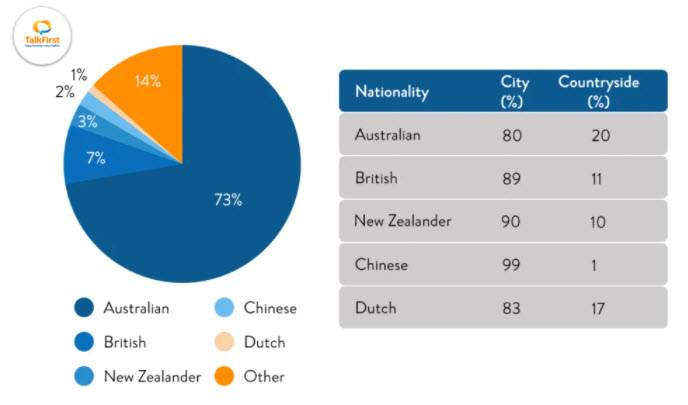
The pie chart and table detail population figures in Australia and if residents tended to live in rural or urban areas. Looking from an overall perspective, it is readily apparent that the vast majority of the population is Australian, followed by sizeable numbers for other and British nationals, and more marginal figures for New Zealanders, Chinese, and the Dutch. All demographics live overwhelmingly in cities, especially individuals from China.
The pie chart indicates that 73% of the Australian population is made up of Australians themselves. This figure is followed distantly by other at 14%, residents from Great Britain at 7%, New Zealanders at 3%, Chinese at 2%, and people from the Netherlands at just 1%.
In terms of livings areas, Australians are most likely to live outside cities, though 80% still live in urban environments. Similarly, 83% of the Dutch live in cities and 17% in the countryside. British and New Zealand residents display nearly identical proportions with around 90% in cities. Finally, the Chinese live predominately in the cities (99%).
Analysis
1. The pie chart and table detail population figures in Australia and if residents tended to live in rural or urban areas. 2. Looking from an overall perspective, it is readily apparent that the vast majority of the population is Australian, followed by sizeable numbers for other and British nationals, and more marginal figures for New Zealanders, Chinese, and the Dutch. 3. All demographics live overwhelmingly in cities, especially individuals from China.
Paraphrase what the table shows.
Write a clear overview summarising the differences.
You might need another sentence for your overview.
1. The pie chart indicates that 73% of the Australian population is made up of Australians themselves. 2. This figure is followed distantly by other at 14%, residents from Great Britain at 7%, New Zealanders at 3%, Chinese at 2%, and people from the Netherlands at just 1%.
Begin writing about the data for the first categories.
Make sure you compare as much as possible.
Don’t leave anything out!
1. In terms of livings areas, Australians are most likely to live outside cities, though 80% still live in urban environments. 2. Similarly, 83% of the Dutch live in cities and 17% in the countryside. 3. British and New Zealand residents display nearly identical proportions with around 90% in cities. 4. Finally, the Chinese live predominately in the cities (99%).
Write about the final, other parts of the graph – include everything!
Compare the categories.
Group categories together too.
Have some short, simple sentences to help your grammar score.
Vocabulary
What do the words in bold below mean?Take some notes on a piece of paper to aid your memory:
The pie chart and table detail population figures in Australia and if residents tended to live in rural or urban areas. Looking from an overall perspective, it is readily apparent that the vast majority of the population is Australian, followed by sizeable numbers for other and British nationals, and more marginal figures for New Zealanders, Chinese, and the Dutch. All demographics live overwhelmingly in cities, especially individuals from China.
The pie chart indicates that 73% of the Australian population is made up of Australians themselves. This figure is followed distantly by other at 14%, residents from Great Britain at 7%, New Zealanders at 3%, Chinese at 2%, and people from the Netherlands at just 1%.
In terms of livings areas, Australians are most likely to live outside cities, though 80% still live in urban environments. Similarly, 83% of the Dutch live in cities and 17% in the countryside. British and New Zealand residents display nearly identical proportions with around 90% in cities. Finally, the Chinese live predominately in the cities (99%).
Answers
Try to write down or think of an antonym/opposite word for further practice:
detail population figures show how many people live there
residents tended people living there usually
rural in the countryside
urban areas in cities
Looking from an overall perspective, it is readily apparent that overall
vast majority most of
followed by after that
sizeable numbers for a lot for
marginal figures smaller figures
demographics groups of people
overwhelmingly mostly
especially in particular
indicates shows
made up of constituted by
followed distantly a lot further behind
Great Britain England
Netherlands where the Dutch are from
just only
in terms of livings areas when it comes to where they live
Remember and fill in the blanks. Note it on a piece of paper so you can remember better:
The pie chart and table d____________________________s in Australia and if r_________________d to live in r_____l or u___________s. L_____________________________________________t the v_____________y of the population is Australian, f_____________y s______________________r other and British nationals, and more m_______________s for New Zealanders, Chinese, and the Dutch. All d_____________s live o_____________y in cities, e________y individuals from China.
The pie chart i__________s that 73% of the Australian population is m____________f Australians themselves. This figure is f___________________y by other at 14%, residents from G_____________n at 7%, New Zealanders at 3%, Chinese at 2%, and people from the N______________s at j___t 1%.
I_________________________s, Australians are most likely to live o__________e cities, though 80% still live in u____________________s. S_________y, 83% of the Dutch live in cities and 17% in the countryside. British and New Zealand residents d____________y n_________y i__________l p_________s with a________d 90% in cities. Finally, the Chinese live p________________y in the cities (99%).
Listening Practice
Listen to the related topic below and practice with these activities:
Some people believe that violent media directly results in violent behavior.
To what extent do you agree or disagree?
Here is a preview (the introduction from my essay):
Some argue that violent media serves as a direct catalyst for violent actions in society. In my opinion, although there are examples to support this viewpoint, it is largely untrue due to other contextual factors.
This is an IELTS writing task 2 sample answer essay on the topic of young people spending time at shopping malls from the real IELTS exam.
Please consider supporting me on Patreon.com/howtodoielts to receive my full, exclusive IELTS Ebooks – you can even sign up for private live lessons with me!
Dave
IELTS Essay: Young People and Shopping Malls
Today, many young people spend too much of their free time at shopping malls. This can be considered negative for young people and society generally.
To what extent do you agree or disagree with this statement?
In certain countries, it has becoming increasingly common for young people to spend their free time at malls and this is often viewed as a negative. In my opinion, though there are more productive activities, it should be considered a positive overall given the most likely alternatives.
Proponents of this statement point out that malls are typically not a productive use of one’s time. A person who goes to a mall is likely shopping, watching a movie, hanging out idly with friends, eating from a fast food establishment, or engaging in another similarly passive activity. A better use of time could involve playing sports, reading a book, creating art, or working. The rise of malls globally beginning in the 1980s signaled a period when younger individuals strayed from healthy activities and took part in more socially and personally subversive pastimes.
However, the fears detailed above are overblown compared to other free time activities. These days, most young people who are free spend an outsized proportion of their time doing truly unhealthy, passive activities. These largely center around technology and include wasting time on social media, taking pictures, playing online games, chatting online, streaming movies and videos, and using the internet. The mall is now actually a better use of one’s time since it likely will involve in-person socializing, precisely the domain that is most at risk for younger generations and society today.
In conclusion, though time spent at malls is not the ideal activity for a younger person, it is preferable to a more passive lifestyle and should therefore not be condemned. It is likely, however, that malls will continue to decline in popularity in the future so this concern will become less relevant.
Analysis
1. In certain countries, it has becoming increasingly common for young people to spend their free time at malls and this is often viewed as a negative. 2. In my opinion, though there are more productive activities, it should be considered a positive overall given the most likely alternatives.
Paraphrase the overall essay topic.
Write a clear opinion. Read more about introductions here.
1. Proponents of this statement point out that malls are typically not a productive use of one’s time. 2. A person who goes to a mall is likely shopping, watching a movie, hanging out idly with friends, eating from a fast food establishment, or engaging in another similarly passive activity. 3. A better use of time could involve playing sports, reading a book, creating art, or working. 4. The rise of malls globally beginning in the 1980s signaled a period when younger individuals strayed from healthy activities and took part in more socially and personally subversive pastimes.
Write a topic sentence with a clear main idea at the end.
Explain your main idea.
Develop it with specific or hypothetical examples.
Keep developing it fully.
1. However, the fears detailed above are overblown compared to other free time activities. 2. These days, most young people who are free spend an outsized proportion of their time doing truly unhealthy, passive activities. 3. These largely center around technology and include wasting time on social media, taking pictures, playing online games, chatting online, streaming movies and videos, and using the internet. 4. The mall is now actually a better use of one’s time since it likely will involve in-person socializing, precisely the domain that is most at risk for younger generations and society today.
Write a new topic sentence with a new main idea at the end.
Explain your new main idea.
Include specific details and examples.
Add as much information as you can and make sure it links logically.
1. In conclusion, though time spent at malls is not the ideal activity for a younger person, it is preferable to a more passive lifestyle and should therefore not be condemned. 2. It is likely, however, that malls will continue to decline in popularity in the future so this concern will become less relevant.
Summarise your main ideas.
Include a final thought. Read more about conclusions here.
Vocabulary
What do the words in bold below mean?Make some notes on paper to aid memory and then check below.
In certain countries, it has becoming increasingly common for young people to spend their free time at malls and this is often viewed as a negative. In my opinion, though there are more productive activities, it should be considered a positive overall given themost likely alternatives.
Proponents of this statement point out that malls are typically not a productive use of one’s time. A person who goes to a mall is likely shopping, watching a movie, hanging out idly with friends, eating from a fast food establishment, or engaging in another similarly passive activity. A better use of time could involve playing sports, reading a book, creating art, or working. The rise of malls globally beginning in the 1980s signaled a period when younger individuals strayed from healthy activities and took part in more socially and personally subversive pastimes.
However, the fears detailed above are overblown compared to other free time activities. These days, most young people who are free spend an outsized proportion of their time doing truly unhealthy, passive activities. These largely center around technology and include wasting time on social media, taking pictures, playing online games, chatting online, streaming movies and videos, and using the internet. The mall is now actually a better use of one’s time since it likely will involve in-person socializing, precisely the domain that is most at risk for younger generations and society today.
In conclusion, though time spent at malls is not the ideal activity for a younger person, it is preferable to a more passive lifestyle and should therefore not be condemned. It is likely, however, that malls will continue to decline in popularity in the future so this concern will become less relevant.
Answers
For extra practice, write an antonym (opposite word) on a piece of paper to help you remember the new vocabulary:
certain countries some nations
increasingly common happens more and more
malls shopping centers
often viewed as a negative usually considered bad
productive activities useful uses of your time
considered thought of
positive overall good in general
given themost likely alternatives considering what will probably happen instead
proponents supporters
statement point out statement argue
typically usually
productive use good use
shopping buying things
hanging out idly with friends just spending time with friends
fast food establishment fast food restaurants
engaging in doing
similarly passive activity not very active pastime
involve have to do with
rise increase
globally all over the world
signaled was a mark of
period time
strayed gone off the path to
took part in participated in
socially with others
personally relating to individuals
subversive pastimes undermining uses of time
fears detailed above threats explained before
overblown comparedto emphasized too much relative to
outsized proportion too much emphasis
truly really
passive not active
largely center around mostly has to do with
wasting time not good use of free time
social media Facebook, Instagram, TikTok, etc.
streaming movies watching shows online, Netflix
actually in fact
likely probably
involve in-person socializing will be hanging around with friends
I recommend getting a pencil and piece of paper because that aids memory. Then write down the missing vocabulary from my sample answer in your notebook:
In c__________________s, it has becoming i___________________n for young people to spend their free time at m____s and this is o________________________e. In my opinion, though there are more p______________________s, it should be c_____________d a p_________________l g_____________________________s.
P___________-s of this s____________t p___________t that malls are t__________y not a p_____________e of one’s time. A person who goes to a mall is likely s___________g, watching a movie, h___________________________s, eating from a f____________________________t, or e____________n another s___________________________y. A better use of time could i_________e playing sports, reading a book, creating art, or working. The r____e of malls g_______y beginning in the 1980s s__________d a p________d when younger individuals s___________d from healthy activities and t_______________n more s_________y and p______________________________s.
However, the f_________________e are o______________n c________d to other free time activities. These days, most young people who are free spend an o__________________n of their time doing t_____y unhealthy, p____e activities. These l________________________d technology and include w____________e on s__________a, taking pictures, playing online games, chatting online, s_______________s and videos, and using the internet. The mall is now a___________y a better use of one’s time since it l_______y will i_________e i____________________g, p___________y the d_________n that is m____________k for y___________________s and society today.
In conclusion, though time spent at malls is not the i_______l activity for a younger person, it is p_________e to a more passive l________e and should therefore not be c__________d. It is likely, however, that malls will continue to d_______e in p____________y in the future so this c_______n will become l_______________t.
Listening Practice
Learn more about this topic by watching videos from The New York Times YouTube channel below and practice with these activities:
This is an IELTS writing task 2 sample answer essay on the topic of moving to rural areas from the real IELTS general training exam.
Please consider supporting me on Patreon.com/howtodoielts to receive my full, exclusive IELTS Ebooks – you can even sign up for private live lessons with me!
Dave
IELTS Essay: Moving to Rural Areas
In many cities, problems related to overpopulation are becoming more common. Some governments are now encouraging businesses and individuals to move out of cities to rural areas.
Do the advantages of this trend outweigh the disadvantages?
Certain governments are now incentivizing moving to rural areas due to issues concerning overpopulation in cities. In my opinion, despite the temporary disadvantages this presents for standards of living and economics, it is a long-term positive for environmental justifications.
Detractors argue these initiatives can harm businesses and residents. Firstly, this is related to living standards. Residents of cities typically enjoy better medical care, employment opportunities, and entertainment options. For instance, a person who moves from New York City to upstate New York is likely to recognize an immediate decline in their daily quality of life. Secondly, there may be significant economic issues. Cities tend to be the economic centers of any given state or nation. By reducing the concentration of industry in urban areas, there is some likelihood that innovation will be negatively impacted as the pool of potentially competent employees disperses.
Supporters would claim that these drawbacks are justified by benefits for the natural world. The current threat of cities is that they concentrate populations, increase pollution from private vehicles, and inevitably create urban sprawl. These issues can be curbed if people live in smaller communities over a wider area. Residents will then be more likely to care about their immediate surroundings. Furthermore, over time the reduced density of both employers and employees will allow the authorities to better treat waste and manage pollution issues. This is evidenced by the better environmental conditions in countries with fewer large metropolises.
In conclusion, there may be problems related to quality of life and finance, but the advantages for the environment make this an advisable strategy. Governments should continue promoting any such relevant policies.
Analysis
1. Certain governments are now incentivizing moving to rural areas due to issues concerning overpopulation in cities. 2. In my opinion, despite the temporary disadvantages this presents for standards of living and economics, it is a long-term positive for environmental justifications.
Paraphrase the overall essay topic.
Write a clear opinion. Read more about introductions here.
1. Detractors argue these initiatives can harm businesses and residents. 2. Firstly, this is related to living standards. 3. Residents of cities typically enjoy better medical care, employment opportunities, and entertainment options. 4. For instance, a person who moves from New York City to upstate New York is likely to recognize an immediate decline in their daily quality of life. 5. Secondly, there may be significant economic issues. 6. Cities tend to be the economic centers of any given state or nation. 7. By reducing the concentration of industry in urban areas, there is some likelihood that innovation will be negatively impacted as the pool of potentially competent employees disperses.
Write a topic sentence with a clear main idea at the end.
Explain your main idea.
Develop it with specific or hypothetical examples.
Keep developing it fully.
Vary long and short senteces.
More detail is better.
Finish strong.
1. Supporters would claim that these drawbacks are justified by benefits for the natural world. 2. The current threat of cities is that they concentrate populations, increase pollution from private vehicles, and inevitably create urban sprawl. 3. These issues can be curbed if people live in smaller communities over a wider area. 4. Residents will then be more likely to care about their immediate surroundings. 5. Furthermore, over time the reduced density of both employers and employees will allow the authorities to better treat waste and manage pollution issues. 6. This is evidenced by the better environmental conditions in countries with fewer large metropolises.
Write a new topic sentence with a new main idea at the end.
Explain your new main idea.
Include specific details and examples.
Add as much information as you can and make sure it links logically.
Develop the example fully.
1. In conclusion, there may be problems related to quality of life and finance, but the advantages for the environment make this an advisable strategy. 2. Governments should continue promoting any such relevant policies.
Summarise your main ideas.
Include a final thought. Read more about conclusions here.
Vocabulary
What do the words in bold below mean?Make some notes on paper to aid memory and then check below.
Certain governments are now incentivizing moving to rural areasdue to issues concerning overpopulation in cities. In my opinion, despite the temporary disadvantages this presents for standards of living and economics, it is a long-term positive for environmental justifications.
Detractors argue these initiatives can harm businesses and residents. Firstly, this is related to living standards. Residents of cities typically enjoy better medical care, employment opportunities, and entertainment options. For instance, a person who moves from New York City to upstate New York is likely to recognize an immediate decline in their daily quality of life. Secondly, there may be significant economic issues. Cities tend to be the economic centers of any given state or nation. By reducing the concentration of industry in urban areas, there is some likelihood that innovation will be negatively impacted as the pool of potentially competent employees disperses.
Supporters would claim that these drawbacks are justified by benefits for the natural world. The current threat of cities is that they concentrate populations, increase pollution from private vehicles, and inevitably create urban sprawl. These issues can be curbed if people live in smaller communities over a wider area. Residents will then be more likely to care about their immediate surroundings. Furthermore, over time the reduced density of both employers and employees will allow the authorities to better treat waste and manage pollution issues. This is evidenced by the better environmental conditions in countries with fewer large metropolises.
In conclusion, there may be problems related to quality of life and finance, but the advantages for the environment make this an advisable strategy. Governments should continue promoting any such relevant policies.
Answers
For extra practice, write an antonym (opposite word) on a piece of paper to help you remember the new vocabulary:
certain governments some states, countries
incentivizing encouraging
rural areas the countryside
due to because of
issues problems
concerning relating to
overpopulation too many people
despite regardless of
temporary disadvantages not permanent negatives
presents shows
standards of living how well people live
economics finances
long-term positive good later in time
environmental justifications reasons that are good for nature
detractors argue those against it claim
initiatives efforts
harm hurt
residents people living these
related to concerning
living standards how well people live, quality of life
typically usually
medical care hospitals, doctors, etc.
employment opportunities chances for jobs
entertainment options choices related to clubs, movies, etc.
for instance for example
upstate further up in the state
recognize notice
immediate decline sudden drop
daily quality of life how people life day to day
significant economic issues major financial problems
tend to be are usually
economic centers financial hubs
any given a random
nation country
reducing depleting
concentration combined, dense
likelihood how likely it is to happen
innovation new ideas
negatively impacted effected badly
pool group
potentially possibly
competent capable
employees workers
disperses spreads out
supporters those in favor of
claim argue
drawbacks negatives
benefits advantages
natural world nature, the environment
current threat risks now
increase pollution more harm to the environment
private vehicles cars, etc.
inevitably will of course
urban sprawl cities spreading out
curbed slowed down
smaller communities not big cities
over a wider area further out
immediate surroundings right nearby, the neighborhood
I recommend getting a pencil and piece of paper because that aids memory. Then write down the missing vocabulary from my sample answer in your notebook:
C_______________________s are now i_____________g moving to r____________sd________o i______s c___________g o_______________n in cities. In my opinion, d_________e the t_______________________s this p_________s for s_________________g and e____________________s, it is a l_________________e for e________________________s.
D________________e these i____________s can h____m businesses and r__________s. Firstly, this is r__________o l_______________s. Residents of cities t___________y enjoy better m____________e, e________________________s, and e___________________s. F____________e, a person who moves from New York City to u________e New York is likely to r__________e an i__________________e in their d__________________e. Secondly, there may be s___________________________s. Cities t______e the e_____________________s of a______________n state or n_______n. By r__________g the c_____________n of industry in urban areas, there is some l______________d that i____________n will be n______________________d as the p______l of p_______________________________________s.
S___________s would c_____m that these d____________s are justified by b________s for the n____________d. The c_______________t of cities is that they concentrate populations, i_________________n from p________________s, and i____________y create u______________l. These issues can be c______d if people live in s_____________________s o________________a. Residents will then be more likely to care about their i_________________________s. F__________e, o____________e the r________________y of both employers and employees will a_________w the a_________s to b_________e and m_____________s. This is e_______d by the better environmental c___________s in countries with f____________________s.
In conclusion, there may be problems related to quality of life and f__________e, but the advantages for the environment make this an a___________________y. Governments should continue p___________g any such r__________________s.
Listening Practice
Learn more about this topic by watching videos from The New York Times YouTube channel below and practice with these activities:
This is an IELTS writing task 1 sample answer essay on the topic of international students in Canada and the USA from the real IELTS exam.
Find all the most recent task 1 topics here and my full IELTS Ebooks here.
Dave
IELTS Essay Task 1: International Students in Canada and the USA
The table displays the data for international students studying in Canada and the United States in 2002 and 2003. Looking from an overall perspective, it is readily apparent that figures increased for all countries except those going to the United States from India. Moreover, there were significantly more international students in the United States, though overall growth was higher in Canada.
In 2002 in Canada there were 5,400 international students from China, a data point that rose by 45% to 7,850 the next year. In contrast, in the USA this number rose just 6% to reach 116,600. There were more students from India studying in the US both years (200,000 in 2002 and 182,000 in 2003, a -9% decrease) while in Canada there were fewer despite a 35% surge (2,100 and 2,835 for each year).
In Canada, the number of American students rose by 9% from 5,000 to 5,450 and in the US, Canadian students grew by a comparable 7% to 33,170. Finally, the total number of international students in all of Canada increased 17%, a growth of more than 11,000, to 70,004 while in the United States this figure climbed just 2%, ending at 592,230.
Analysis
1. The table displays the data for international students studying in Canada and the United States in 2002 and 2003. 2. Looking from an overall perspective, it is readily apparent that figures increased for all countries except those going to the United States from India. 3. Moreover, there were significantly more international students in the United States, though overall growth was higher in Canada.
Paraphrase what the table shows.
Write a clear overview summarising the differences.
You might need another sentence for your overview.
1. In 2002 in Canada there were 5,400 international students from China, a data point that rose by 45% to 7,850 the next year. 2. In contrast, in the USA this number rose just 6% to reach 116,600. 3. There were more students from India studying in the US both years (200,000 in 2002 and 182,000 in 2003, a -9% decrease) while in Canada there were fewer despite a 35% surge (2,100 and 2,835 for each year).
Begin writing about the data for the first categories.
Make sure you compare as much as possible.
Don’t leave anything out!
1. In Canada, the number of American students rose by 9% from 5,000 to 5,450 and in the US, Canadian students grew by a comparable 7% to 33,170. 2. Finally, the total number of international students in all of Canada increased 17%, a growth of more than 11,000, to 70,004 while in the United States this figure climbed just 2%, ending at 592,230.
Write about the final, other parts of the graph – include everything!
Compare the categories.
Vocabulary
What do the words in bold below mean?Take some notes on a piece of paper to aid your memory:
The table displays the data for international students studying in Canada and the United States in 2002 and 2003. Looking from an overall perspective, it is readily apparent thatfigures increased for all countries except those going to the United States from India. Moreover, there were significantly more international students in the United States, though overall growth was higher in Canada.
In 2002 in Canada there were 5,400 international students from China, a data point that rose by 45% to 7,850 the next year. In contrast, in the USA this number rose just 6% to reach 116,600. There were more students from India studying in the US both years (200,000 in 2002 and 182,000 in 2003, a -9% decrease) while in Canada there were fewer despite a 35% surge (2,100 and 2,835 for each year).
In Canada, the number of American students rose by 9% from 5,000 to 5,450 and in the US, Canadian students grew by a comparable 7% to 33,170. Finally, the total number of international students in all of Canada increased 17%, a growth of more than 11,000, to 70,004 while in the United States this figure climbed just 2%, ending at 592,230.
Answers
Try to write down or think of an antonym/opposite word for further practice:
displays shows
data numbers, figures
international students people studying from other countries, studying abroad
Looking from an overall perspective, it is readily apparent thatfigures overall
Remember and fill in the blanks. Note it on a piece of paper so you can remember better:
The table d_________s the d____a for i__________________s studying in Canada and the United States in 2002 and 2003. L____________________________________________________tf__________s increased for all countries e________t those going to the United States from India. M________r, there were s_____________y more international students in the United States, though o____________h was higher in Canada.
In 2002 in Canada there were 5,400 international students from China, a d____________t that r___e by 45% to 7,850 the next year. I____________t, in the USA this n________r rose just 6% to r______h 116,600. There were more students from India studying in the US both years (200,000 in 2002 and 182,000 in 2003, a -9% decrease) w____e in Canada there were f_______r d_________e a 35% s______e (2,100 and 2,835 for e__________r).
In Canada, the number of American students r___e by 9% from 5,000 to 5,450 and in the US, Canadian students grew by a c__________e 7% to 33,170. Finally, the t___________r of international students in a_________a increased 17%, a growth of more than 11,000, to 70,004 while in the United States this figure c_________d just 2%, e_____g at 592,230.
Listening Practice
Listen to the related topic below and practice with these activities:
"The highest quality materials anywhere on the internet! Dave improved my writing and vocabulary so much. Really affordable options you don't want to miss out on!"