This is an IELTS writing task 2 sample answer essay on the topic of shops from the real IELTS general training exam.
Please consider supporting me on Patreon.com/howtodoielts to receive my exclusive IELTS Ebooks – you can even sign up for private live lessons with me!
Dave
IELTS Essay: Shops
There is little difference in the shops now operating in various nations. Some people think this is positive development,while other believe it is negative.
Discuss both views and give your own opinion.
Many people believe that increasing ubiquity in terms of the selection of products in shops is a positive trend. In my opinion, this is a advantageous for convenience, however its wider implications make it a negative overall.
On the positive side, this development guarantees a consistent customer experience. An individual who is traveling abroad, for example, can go into most major convenience stores and find the same basic necessities they would expect in their home country. The products themselves are also more consistent. Since they are manufactured and distributed globally, food products have the same safety standards and tastes and household items are similarly likely to be safe and effective. In contrast, a shop with completely different products, many of which may have been produced locally, complicates the decision-making process for shoppers.
Nonetheless, there is also the risk that corporations will become powerful monopolies. The first implication of this would be that many local shops are likely to go out of business. The local owners of such shops will then be forced to find less desirable work. Replicated globally, this means that profits that were previously directed towards millions of local shop owners are now being funneled to a select number of companies and their shareholders. As these companies become larger and more powerful, it is easier for them to enter new markets, lower prices to dominate the competition, and then establish an unhealthy monopoly.
In conclusion, despite the wide range of consistent options available for consumers, the rise of corporate power is damaging generally. It is therefore important for individual nations to curb this trend when possible.
Analysis
1. Many people believe that increasing ubiquity in terms of the selection of products in shops is a positive trend. 2. In my opinion, this is a advantageous for convenience, however its wider implications make it a negative overall.
Paraphrase the overall essay topic.
Write a clear opinion. Read more about introductions here.
1. On the positive side, this development guarantees a consistent customer experience. 2. An individual who is traveling abroad, for example, can go into most major convenience stores and find the same basic necessities they would expect in their home country. 3. The products themselves are also more consistent. 4. Since they are manufactured and distributed globally, food products have the same safety standards and tastes and household items are similarly likely to be safe and effective. 5. In contrast, a shop with completely different products, many of which may have been produced locally, complicates the decision-making process for shoppers.
Write a topic sentence with a clear main idea at the end.
Explain your main idea.
Develop it with specific or hypothetical examples.
Keep developing it fully.
State the results of your ideas.
1. Nonetheless, there is also the risk that corporations will become powerful monopolies. 2. The first implication of this would be that many local shops are likely to go out of business. 3. The local owners of such shops will then be forced to find less desirable work. 4. Replicated globally, this means that profits that were previously directed towards millions of local shop owners are now being funneled to a select number of companies and their shareholders. 5. As these companies become larger and more powerful, it is easier for them to enter new markets, lower prices to dominate the competition, and then establish an unhealthy monopoly.
Write a new topic sentence with a new main idea at the end.
Explain your new main idea.
Include specific details and examples.
Continue developing it…
as fully as possible!
1. In conclusion, despite the wide range of consistent options available for consumers, the rise of corporate power is damaging generally. 2. It is therefore important for individual nations to curb this trend when possible.
Summarise your main ideas.
Include a final thought. Read more about conclusions here.
Vocabulary
What do the words in bold below mean?Make some notes on paper to aid memory and then check below.
Many people believe that increasing ubiquity in terms of the selection of products in shops is a positive trend. In my opinion, this is a advantageous for convenience, however its wider implications make it a negative overall.
On the positive side, this development guarantees a consistent customer experience. An individual who is traveling abroad, for example, can go into most major convenience stores and find the same basic necessities they would expect in their home country. The products themselves are also more consistent. Since they are manufactured and distributed globally, food products have the same safety standards and tastes and household items are similarly likely to be safe and effective. In contrast, a shop with completely different products, many of which may have been produced locally, complicates the decision-making process for shoppers.
Nonetheless, there is also the risk that corporations will become powerful monopolies. The first implication of this would be that many local shops are likely to go out of business. The local owners of such shops will then be forced to find less desirable work. Replicated globally, this means that profits that were previously directed towards millions of local shop owners are now being funneled to a select number of companies and their shareholders. As these companies become larger and more powerful, it is easier for them to enter new markets, lower prices to dominate the competition, and then establish an unhealthy monopoly.
In conclusion, despite the wide range of consistent optionsavailable for consumers, the rise of corporate power is damaging generally. It is therefore important for individual nations to curb this trend when possible.
Answers
For extra practice, write an antonym (opposite word) on a piece of paper to help you remember the new vocabulary:
increasing ubiquity more and more common
in terms of when it comes to
selection choice
products items in a shop
trend pattern
advantageous good
convenience easy
wider implications bigger results
negative overall bad in general
on the positive side the good part is that
development guarantees change makes sure that
consistent customer experience the same products, services available all the time
traveling abroad going to other countries
most major convenience stores 7-Eleven, Circle K, etc.
basic necessities normal items like toilet paper, toothpaste, etc.
expect can predict
home country where you are from
consistent the same all the time
manufactured made
distributed globally sent around the world
safety standards how dangerous they are
tastes how a food product is
household items products you can use at home
similarly likely also probably
effective works well
in contrast however
completely totally
produced locally made in your country
complicates harder to decide
decision-making process thinking about what to buy
shoppers customers
nonetheless regardless
risk threat
powerful monopolies companies that control all of an industry
implication result
local shops shops in your country
go out of business can’t stay open
local owners small businesses
forced have to
less desirable work jobs that are not as good
replicated globallyreproduced around the world
profits money earned
previously directed towards in the past sent to
funneled directed toward
select number some people
shareholders people who own companies
enter new markets get into new countries
dominate take over
competition fighting between companies
establish build
unhealthy monopoly complete control
wide range lots of different types
consistent optionsavailable the same products on sale
I recommend getting a pencil and piece of paper because that aids memory. Then write down the missing vocabulary from my sample answer in your notebook:
Many people believe that i_______________________y i_______________f the s___________n of p____________s in shops is a positive t_______d. In my opinion, this is a a_______________s for c________________e, however its w____________________s make it a n_________________l.
O_______________________e, this d__________________________s a c_________________________________e. An individual who is t____________________d, for example, can go into m______________________________s and find the same b________________s they would e________t in their h______________y. The products themselves are also more c_____________t. Since they are m_______________d and d______________________y, food products have the same s___________________s and t_________s and h____________________s are s___________________y to be safe and e___________e. I_____________t, a shop with c_____________y different products, many of which may have been p___________________y, c_________________s the d_________________________s for s__________s.
N______________s, there is also the r____k that corporations will become p_______________________s. The first i_____________n of this would be that many l____________s are likely to g___________________s. The l_____________s of such shops will then be f________d to find l______________________k. R________________________y, this means that p_________s that were p____________________________s millions of local shop owners are now being f_____________d to a s_______________r of companies and their s______________s. As these companies become larger and more powerful, it is easier for them to e___________________s, lower prices to d___________e the c_______________n, and then e______________h an u____________________y.
In conclusion, despite the w____________e of c________________________e for consumers, the r____e of c__________________r is d____________________y. It is therefore important for i_____________________s to c____b this trend w________________e.
Listening Practice
Learn more about this topic by watching videos from The New York Times YouTube channel below and practice with these activities:
This is an IELTS writing task 2 sample answer essay on the topic of whether or the government should support artists from the real IELTS exam.
It’s a really strange question, to be honest! Read below to see how I handled it….
Please consider supporting me on Patreon.com/howtodoielts to receive my exclusive IELTS Ebooks – you can even sign up for private live lessons with me!
Dave
IELTS Essay: Government Support for Artists
Some people think that governments should give financial support to creative artists such as painters and musicians. Others believe that artists should be funded by alternative sources.
Discuss both views and give your own opinion.
Many believe that artists are entitled to federal financial assistance, while others feel that they should seek different sources of revenue. In my opinion, in certain cases government aid is justified but for the majority, supplying their own income is a catalyst to create quality artwork.
Proponents of this policy argue that it can free artists to be more creative. If an artist is concerned about paying their rent and buying groceries, they will have less time and energy to dedicate to their artwork. Even more importantly, financial considerations will influence their work. Many painters, writers, and musicians are more likely to produce commercially viable artworks rather than artistically honest ones. There have been numerous examples in the past, such as during the Renaissance when painters, sculptors and architects received patronage from the government or wealthy citizens and artistic expression flourished. However, these instances are distant exceptions and most artists now operate in commercial fields.
The main reason this reform is unnecessary is that artists derive benefits from independence. An artist who must sell his or her artworks is motivated to strive for greater works. For example, an artist may begin creating specialized artworks and fail to find an audience. They might then modify their approach and still maintain a high degree of artistic integrity. This interplay with market forces can result in a better product. Noteworthy examples of this include the boom of the film industry in the twentieth century, the rise of stand-up comedians recently, and great works of literature that find large audiences such as the Harry Potter franchise.
In conclusion, despite notable instances of the success of government assistance, artists benefit from self-reliance. This will of course require them to carefully balance artistic and commercial considerations.
Analysis
1. Many believe that artists are entitled to federal financial assistance, while others feel that they should seek different sources of revenue. 2. In my opinion, in certain cases government aid is justified but for the majority, supplying their own income is a catalyst to create quality artwork.
Paraphrase the overall essay topic.
Write a clear opinion. Read more about introductions here.
1. Proponents of this policy argue that it can free artists to be more creative. 2. If an artist is concerned about paying their rent and buying groceries, they will have less time and energy to dedicate to their artwork. 3. Even more importantly, financial considerations will influence their work. 4. Many painters, writers, and musicians are more likely to produce commercially viable artworks rather than artistically honest ones. 5. There have been numerous examples in the past, such as during the Renaissance when painters, sculptors and architects received patronage from the government or wealthy citizens and artistic expression flourished. 6. However, these instances are distant exceptions and most artists now operate in commercial fields.
Write a topic sentence with a clear main idea at the end.
Explain your main idea.
Develop it with specific or hypothetical examples.
Keep developing it fully.
Extend with some long sentences as well.
Finish this main idea.
1. The main reason this reform is unnecessary is that artists derive benefits from independence. 2. An artist who must sell his or her artworks is motivated to strive for greater works. 3. For example, an artist may begin creating specialized artworks and fail to find an audience. 4. They might then modify their approach and still maintain a high degree of artistic integrity. 5. This interplay with market forces can result in a better product. 6. Noteworthy examples of this include the boom of the film industry in the twentieth century, the rise of stand-up comedians recently, and great works of literature that find large audiences such as the Harry Potter franchise.
Write a new topic sentence with a new main idea at the end.
Explain your new main idea.
Include specific details and examples.
Continue developing it…
as fully as possible!
This paragraph can be longer.
1. In conclusion, despite notable instances of the success of government assistance, artists benefit from self-reliance. 2. This will of course require them to carefully balance artistic and commercial considerations.
Summarise your main ideas.
Include a final thought. Read more about conclusions here.
Vocabulary
What do the words in bold below mean?Make some notes on paper to aid memory and then check below.
Many believe that artists are entitled to federal financial assistance, while others feel that they should seek different sources of revenue. In my opinion, in certain cases government aid is justified but for the majority, supplying their own income is a catalyst to create quality artwork.
Proponents of this policy argue that it can free artists to be more creative. If an artist is concerned about paying their rent and buying groceries, they will have less time and energy to dedicate to their artwork. Even more importantly, financial considerations will influence their work. Many painters, writers, and musicians are more likely to produce commercially viable artworksrather than artistically honest ones. There have been numerous examples in the past, such as during the Renaissance when painters, sculptors and architects received patronage from the government or wealthy citizens and artistic expression flourished. However, these instances are distant exceptions and most artists now operate in commercial fields.
The main reason this reform is unnecessary is that artists derive benefits from independence. An artist who must sell his or her artworks is motivated to strive for greater works. For example, an artist may begin creating specialized artworks and fail to find an audience. They might then modify their approach and still maintain a high degree of artistic integrity. This interplay with market forces can result in a better product. Noteworthy examples of this include the boom of the film industry in the twentieth century, the rise of stand-up comedians recently, and great works of literature that find large audiences such as the Harry Potter franchise.
In conclusion, despite notable instances of the success of government assistance, artists benefit from self-reliance. This will of course require them to carefully balance artistic and commercial considerations.
Answers
For extra practice, write an antonym (opposite word) on a piece of paper to help you remember the new vocabulary:
entitled deserve it
federal financial assistance government money
seek look for
sources of revenue ways of making money
in certain cases sometimes
government aid money from the federal government
justified should be this way
majority most of
supplying giving
income money
catalyst source of
create quality artwork good works of art
proponents supporters
policy argue change claim
free artists allow artists
concerned worried about
paying their rent affording housing
buying groceries shop for food
dedicate focus fully on
even more importantly much more crucial is
financial considerations monetary factors
influence effect
produce commercially viable artworks make art that can be sold
rather than instead of
honest truthful
numerous examples many instances
during while
Renaissance period in Europe when art and science flourished
sculptors people who make statues
architects received patronage designers of buildings got money
artistic expression flourished art was really good
instances examples
distant exceptions long time ago instances
operate work
commercial fields in jobs
unnecessary not needed
derive benefits get advantages
independence on their own
strive try hard for
specialized artworks niche art
fail can’t do
audience people who watch/listen/read
modify change
approach method
maintain keep up
high degree of artistic integrity honest works of art
I recommend getting a pencil and piece of paper because that aids memory. Then write down the missing vocabulary from my sample answer in your notebook:
Many believe that artists are e_________d to f________________________e, while others feel that they should s_____k different s_________________e. In my opinion, i_______________s g________________d is j___________d but for the m__________y, s____________g their own i_________e is a c__________t to c_________________k.
P______________s of this p______________e that it can f___________s to be more creative. If an artist is c__________d about p______________t and b_____________s, they will have less time and energy to d__________e to their artwork. E_______________________y, f_________________________s will i___________e their work. Many painters, writers, and musicians are more likely to p________________________________sr_____________n artistically h________t ones. There have been n_______________s in the past, such as d____________g the R_______________e when painters, s__________s and a___________________________e from the government or wealthy citizens and a_____________________________d. However, these i______________s are d_____________________s and most artists now o___________e in c_________________s.
The main reason this reform is u_________________y is that artists d_________________s from i__________________e. An artist who must sell his or her artworks is motivated to s_________e for greater works. For example, an artist may begin creating s__________________s and f_____l to find an a____________e. They might then m___________y their a____________h and still m____________n a h__________________________y. This i__________y with m_________________s can r__________n a better product. N___________________s of this include the b______m of the f_________________y in the t_________________y, the rise of s_____________________s recently, and g__________________________e that f__________________s such as the Harry Potter f___________e.
In conclusion, despite n__________________s of the success of government assistance, artists benefit from s_____________e. This will of course require them to c_______________________c and c______________l considerations.
Listening Practice
Learn more about this topic by watching videos from The New York Times YouTube channel below and practice with these activities:
This is an IELTS writing task 2 sample answer essay on the topic of whether or not it is easier to have a healthy lifestyle in the countryside or in a city from the real IELTS general training exam.
Please consider supporting me on Patreon.com/howtodoielts to receive my exclusive IELTS Ebooks – you can even sign up for private live lessons with me!
Dave
IELTS Essay: Healthy Lifestyles in the Countryside
Many people believe that it is easier to have a healthy lifestyle in the countryside. Other believe that there are health benefits to living in cities.
Discuss both views and give your own opinion.
Some feel that the countryside is more conducive to a healthy lifestyle than the city. Though cities offer modern hospitals, I am in agreement with this sentiment as the countryside encourages greater activity.
Those who believe cities are healthier point out the access to superior medical care. In most cities, it is possible to find a variety of hospitals specializing in subdivisions of medicine and staffed with the best professionals. This is a result of urban populations, the demand for care, and the earning potential of cities. In contrast, in the countryside, there are fewer hospitals, with less modern facilities located further apart. An individual with a chronic health problem would naturally prefer to be in closer proximity to their primary healthcare provider. Similarly, in the event of an emergency such as a car accident or heart attack, being in the city guarantees a higher chance of receiving quality care.
Nonetheless, the situations above are exceptional and most individuals benefit more from an active life in the countryside. Cities residents are becoming increasingly sedentary and passive as the internet and services such as food delivery applications enable less activity. In the countryside, individuals are more likely to walk to school, spend time with friends outdoors, play a variety of sports, and work a more physically demanding job. All these small instances of activity combined over the span of days, months, and years contribute to better overall conditioning and health. This applies to physical and mental health since those outside of cities are less likely to be dependent on technology and suffer from concomitant anxiety disorders.
In conclusion, despite the modern medical facilities present in cities, the less passive living in the countryside makes it healthier generally. Individuals who prioritize health should strongly consider living outside of an urban area.
Analysis
1. Some feel that the countryside is more conducive to a healthy lifestyle than the city. 2. Though cities offer modern hospitals, I am in agreement with this sentiment as the countryside encourages greater activity.
Paraphrase the overall essay topic.
Write a clear opinion. Read more about introductions here.
1. Those who believe cities are healthier point out the access to superior medical care. 2. In most cities, it is possible to find a variety of hospitals specializing in subdivisions of medicine and staffed with the best professionals. 3. This is a result of urban populations, the demand for care, and the earning potential of cities. 4. In contrast, in the countryside, there are fewer hospitals, with less modern facilities located further apart. 5. An individual with a chronic health problem would naturally prefer to be in closer proximity to their primary healthcare provider. 6. Similarly, in the event of an emergency such as a car accident or heart attack, being in the city guarantees a higher chance of receiving quality care.
Write a topic sentence with a clear main idea at the end.
Explain your main idea.
Develop it with specific or hypothetical examples.
Keep developing it fully.
State the results of your ideas.
You can add a concession at the end.
1. Nonetheless, the situations above are exceptional and most individuals benefit more from an active life in the countryside. 2. Cities residents are becoming increasingly sedentary and passive as the internet and services such as food delivery applications enable less activity. 3. In the countryside, individuals are more likely to walk to school, spend time with friends outdoors, play a variety of sports, and work a more physically demanding job. 4. All these small instances of activity combined over the span of days, months, and years contribute to better overall conditioning and health. 5. This applies to physical and mental health since those outside of cities are less likely to be dependent on technology and suffer from concomitant anxiety disorders.
Write a new topic sentence with a new main idea at the end.
Explain your new main idea.
Include specific details and examples.
Continue developing it…
as fully as possible!
1. In conclusion, despite the modern medical facilities present in cities, the less passive living in the countryside makes it healthier generally. 2. Individuals who prioritize health should strongly consider living outside of an urban area.
Summarise your main ideas.
Include a final thought. Read more about conclusions here.
Vocabulary
What do the words in bold below mean?Make some notes on paper to aid memory and then check below.
Some feel that the countryside is more conducive to a healthy lifestyle than the city. Though cities offer modern hospitals, I am in agreement with this sentiment as the countryside encourages greater activity.
Those who believe cities are healthier point out the access to superior medical care. In most cities, it is possible to find a variety of hospitals specializing in subdivisions of medicine and staffed with the best professionals. This is a result ofurban populations, the demand for care, and the earning potential of cities. In contrast, in the countryside, there are fewer hospitals, with less modern facilitieslocated further apart. An individual with a chronic health problem would naturally prefer to be in closer proximity to their primary healthcare provider. Similarly, in the event of an emergency such as a car accident or heart attack, being in the city guarantees a higher chance of receiving quality care.
Nonetheless, the situations above are exceptional and most individuals benefit more from an active life in the countryside. Cities residents are becoming increasingly sedentary and passive as the internet and services such as food delivery applications enable less activity. In the countryside, individuals are more likely to walk to school, spend time with friends outdoors, play a variety of sports, and work a more physically demanding job. All these small instances of activity combined over the span of days, months, and years contribute to better overall conditioning and health. This applies to physical and mental health since those outside of cities are less likely to be dependent on technology and suffer from concomitant anxiety disorders.
In conclusion, despite the modern medical facilities present in cities, the less passive living in the countryside makes it healthier generally. Individuals who prioritize health should strongly consider living outside of an urban area.
Answers
For extra practice, write an antonym (opposite word) on a piece of paper to help you remember the new vocabulary:
countryside rural areas
conducive helps, results in
healthy lifestyle living well
modern hospitals new hospitals
sentiment belief
encourages motivates
activity working
point out argue
access can get into
superior medical care good hospitals
possible can happen
variety lots of different
specializing in focused on
subdivisions disciplines
staffed with people employed there
professionals trained employees
result of caused by
urban populations people living in cities
demand require
earning potential how much money can be made
in contrast in comparison
less modern facilities older buildings
located further apart not near where you live
chronic health problem persistent ailment
naturally of course
prefer would rather
in closer proximity nearer to
primary healthcare provider main doctor
similarly relatedly
emergency accident, etc.
guarantees safeguards
higher chance greater probability
receiving quality care getting good medical care
nonetheless regardless of
situations above examples detailed before
exceptional not normal
residents people living there
increasingly sedentary more passive
passive not active, lazy
enable allow for
more likely to greater chance that
spend time hang out
outdoors outside
physically demanding job phsyically stressful work
instances examples
combined over the span of put together over many years
I recommend getting a pencil and piece of paper because that aids memory. Then write down the missing vocabulary from my sample answer in your notebook:
Some feel that the c______________e is more c___________e to a h____________________e than the city. Though cities offer m_________________s, I am in agreement with this s_____________t as the countryside e___________s greater a__________y.
Those who believe cities are healthier p___________t the a_______s to s_________________________e. In most cities, it is p_______e to find a v________y of hospitals s_________________n s______________s of medicine and s______________h the best p__________________s. This is a r_____________fu___________________s, the d_________d for care, and the e__________________l of cities. I____________t, in the countryside, there are fewer hospitals, with l___________________sl__________d f__________________t. An individual with a c________________________m would n_____________y p________r to be i______________________y to their p____________________________r. S___________y, in the event of an e____________y such as a car accident or heart attack, being in the city g_______________s a h___________________e of r__________________________e.
N_____________s, the s_________________e are e______________l and most individuals benefit more from an active life in the countryside. Cities r_____________s are becoming i_________________________y and p____________e as the internet and services such as food delivery applications e_________e less activity. In the countryside, individuals are m________________o walk to school, s______________e with friends o_________s, play a variety of sports, and work a more p_____________________b. All these small i____________s of activity c____________d o_____________________f days, months, and years c_______________e to better o_____________________g and health. This a_________s to physical and m_________________h since those o______________f cities are less likely to be d_____________t on technology and s_____________m c_____________t a___________________s.
In conclusion, d_________e the modern medical facilities p___________n cities, the less passive living in the countryside makes it healthier g___________y. Individuals who p____________e health should s_________________r living outside of an u______________a.
Listening Practice
Learn more about this topic by watching videos from The New York Times YouTube channel below and practice with these activities:
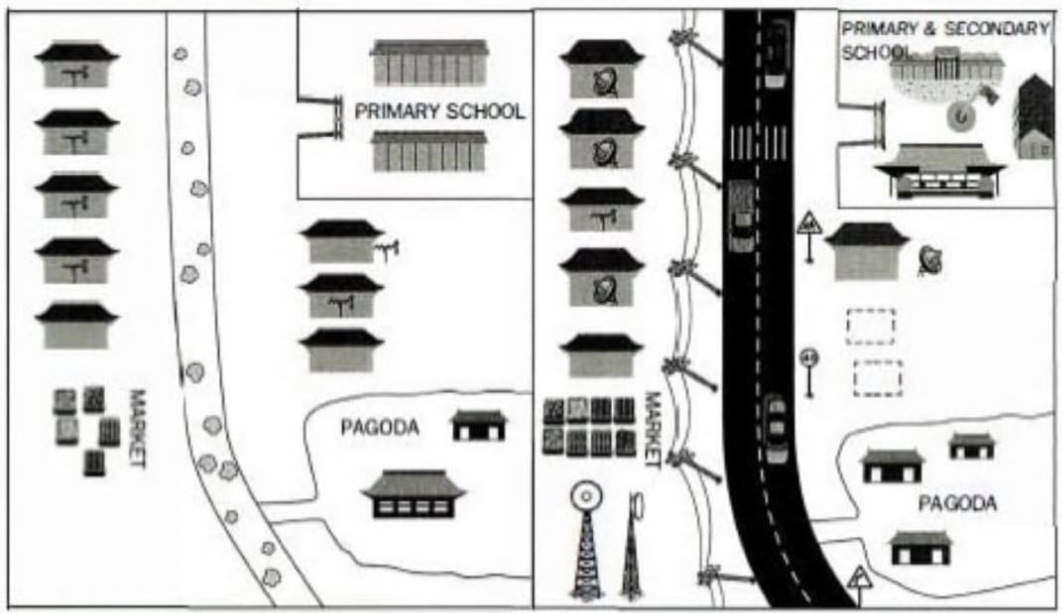
This is an IELTS writing task 1 sample answer essay on the topic of a map of pancha village from the real IELTS exam.
Find all the most recent task 1 topics here and my full IELTS Ebooks here.
Dave
IELTS Essay Task 1: Map of Pancha Village
The maps below show Pancha Village in 2005 and 2015.
Summarise the information by selecting and reporting the main features, and make comparisons where relevant.
The maps detail changes to the village of Pancha from 2005 to 2015. Looking from an overall perspective, it is readily apparent that the town became more developed with the addition of a new road, modern utilities, and general expansion of current residential, commercial and educational areas.
By 2015, the single dirt road present in 2005 had been transformed into a highway lined with road signs, telephone poles and telecommunication towers in the bottom left corner of the map. On the left side of the road, the marketplace has grown and become more organized while the sizes of the homes along the road have also become larger.
To the right side of the road, in the bottom corner, the area demarcated for pagodas now allows for an additional building. Just above the pagodas, two homes have been cleared away and in the upper right corner, the town built a secondary school to complement the primary school.
It is also worth noting that in 2005, most homes only possessed access to telephones but by 2015 satellite service had become common.
Analysis
1. The maps detail changes to the village of Pancha from 2005 to 2015. 2. Looking from an overall perspective, it is readily apparent that the town became more developed with the addition of a new road, modern utilities, and general expansion of current residential, commercial and educational areas.
Paraphrase the overall essay topic.
Write a general over for the map. Include the major changes and group them generally.
1. By 2015, the single dirt road present in 2005 had been transformed into a highway lined with road signs, telephone poles and telecommunication towers in the bottom left corner of the map. 2. On the left side of the road, the marketplace has grown and become more organized while the sizes of the homes along the road have also become larger.
Begin to describe the changes.
Be sure to compare as much as possible.
1. To the right side of the road, in the bottom corner, the area demarcated for pagodas now allows for an additional building. 2. Just above the pagodas, two homes have been cleared away and in the upper right corner, the town built a secondary school to complement the primary school.
Switch to another part of the map.
Don’t include any opinion and don’t forget any areas.
1. It is also worth noting that in 2005, most homes only possessed access to telephones but by 2015 satellite service had become common.
Try to keep it to 3 paragraphs but if there is an extra detail that is better in another paragraph, that is fine!
Vocabulary
What do the words in bold below mean?Take some notes on a piece of paper to aid your memory:
The maps detail changes to the village of Pancha from 2005 to 2015. Looking from an overall perspective, it is readily apparent that the town became more developed with the addition of a new road, modern utilities, and general expansion of current residential, commercial and educational areas.
By 2015, the single dirt road present in 2005 had been transformed into a highway lined with road signs, telephone poles and telecommunication towers in the bottom left corner of the map. On the left side of the road, the marketplace has grown and become more organized while the sizes of the homes along the road have also become larger.
To the right side of the road, in the bottom corner, the area demarcated for pagodas now allows for an additional building. Just above the pagodas, two homes have been cleared away and in the upper right corner, the town built a secondary school to complement the primary school.
It is also worth noting that in 2005, most homes only possessed access to telephones but by 2015 satellite service had become common.
Answers
Try to write down or think of an antonym/opposite word for further practice:
detail describe
village town
Looking from an overall perspective, it is readily apparent that overall
developed became better
addition added on
modern utilities new buildings
general expansion overall growth
current residential right now homes
commercial related to business
educational related to teaching
single dirt road one unpaved street
present in was there
transformed into made into
highway big street
lined with along a row
road signs stop signs, etc.
telephone poles where telephone lines are hung up
telecommunication towers used to connect phones
on the left side of to the left of
grown got bigger
organized in better order
while at the same time
along the road lined up
larger bigger
demarcated sectioned off
pagodas temples
additional building extra place
just above right over
cleared away removed
built constructed
secondary school high school
complement add to, complete
primary school school for young kids
it is also worth noting that it is noticeable that
access get into
satellite service uses satellites to provide internet, TV shows
Remember and fill in the blanks. Note it on a piece of paper so you can remember better:
The maps d______l changes to the v________e of Pancha from 2005 to 2015. L____________________________________________________________t the town became more d___________d with the a_________n of a new road, m__________________s, and g________________n of c______________________l, c___________________l and e________________l areas.
By 2015, the s___________________d p_____________n 2005 had been t________________________o a h___________y l______________________s, t____________________s and t___________________________s in the bottom left corner of the map. O_____________________f the road, the marketplace has g________n and become more o______________d w_______e the sizes of the homes a__________________d have also become l_________r.
To the right side of the road, in the bottom corner, the area d______________d for p____________s now allows for an a____________________g. J____________e the pagodas, two homes have been c_______________y and in the upper right corner, the town b_____t a s______________________l to c_____________t the p__________________l.
I__________________________t in 2005, most homes only possessed a_________s to telephones but by 2015 s_________________e had become c___________n.
Listening Practice
Listen to the related topic below and practice with these activities:
This is an IELTS writing task 2 sample answer essay on the topic of whether or not math and philosophy should be compulsory/mandatory from the real IELTS exam.
It’s a really strange question, to be honest! Read below to see how I handled it….
Please consider supporting me on Patreon.com/howtodoielts to receive my exclusive IELTS Ebooks – you can even sign up for private live lessons with me!
Dave
IELTS Essay: Compulsory Math and Philosophy
Some people think that because children find subjects such as mathematics and philosophy difficult, they ought to be optional instead of compulsory.
To what extent do you agree?
Many feel that overly rigorous subjects such as mathematics and philosophy should not be mandatory for children. In my opinion, though there is a risk students will struggle to cope, teachers should be able to adapt the subject matter.
One reason these subjects should not be mandatory is they are often too abstract for young children. Numbers themselves are abstract. This is why many children are unable to tell time as it is essentially a metaphorical division of a circle into a clock. Teachers who place too much emphasis on abstract numbers and ideas in their lessons will find that students may become bored because they are unable to grasp the concepts. Philosophy could also become tedious and inefficient if the students lack the cognitive ability to apply general rules and ethical considerations to everyday life. This capacity to recognize and apply abstractions typically develops later in adolescence.
However, these subjects can be made accessible for children. The key is the approach of teachers and choice of materials. Math, for example, does not need to begin with complex, abstract equations but could instead involve real world scenarios and simple logic. Numbers could be introduced later as children tend to be confused by less grounded concepts. Similarly, philosophy can be approached from a number of mediums, including through stories. Many children’s stories and fables feature curious protagonists and interesting morals. Instead of explicitly instructing children through academic jargon, they can engage with the same questions about life and its origins more directly through the journey of characters in a story.
In conclusion, despite the risks of theory-heavy subjects for young learners, schools should embrace the challenge and seek less explicit teaching methodologies. This will help form the basis of a well-rounded education.
Analysis
1. Many feel that overly rigorous subjects such as mathematics and philosophy should not be mandatory for children. 2. In my opinion, though there is a risk students will struggle to cope, teachers should be able to adapt the subject matter.
Paraphrase the overall essay topic.
Write a clear opinion. Read more about introductions here.
1. One reason these subjects should not be mandatory is they are often too abstract for young children. 2. Numbers themselves are abstract. 3. This is why many children are unable to tell time as it is essentially a metaphorical division of a circle into a clock. 4. Teachers who place too much emphasis on abstract numbers and ideas in their lessons will find that students may become bored because they are unable to grasp the concepts. 5. Philosophy could also become tedious and inefficient if the students lack the cognitive ability to apply general rules and ethical considerations to everyday life. 6. This capacity to recognize and apply abstractions typically develops later in adolescence.
Write a topic sentence with a clear main idea at the end.
Explain your main idea.
Develop it with specific or hypothetical examples.
Keep developing it fully.
Extend with some long sentences as well.
Finish this main idea.
1. However, these subjects can be made accessible for children. 2. The key is the approach of teachers and choice of materials. 3. Math, for example, does not need to begin with complex, abstract equations but could instead involve real world scenarios and simple logic. 4. Numbers could be introduced later as children tend to be confused by less grounded concepts. 5. Similarly, philosophy can be approached from a number of mediums, including through stories. 6. Many children’s stories and fables feature curious protagonists and interesting morals. 7. Instead of explicitly instructing children through academic jargon, they can engage with the same questions about life and its origins more directly through the journey of characters in a story.
Write a new topic sentence with a new main idea at the end.
Explain your new main idea.
Include specific details and examples.
Continue developing it…
as fully as possible!
This paragraph can be long.
Finish with a strong statement.
1. In conclusion, despite the risks of theory-heavy subjects for young learners, schools should embrace the challenge and seek less explicit teaching methodologies. 2. This will help form the basis of a well-rounded education.
Summarise your main ideas.
Include a final thought. Read more about conclusions here.
Vocabulary
What do the words in bold below mean?Make some notes on paper to aid memory and then check below.
Many feel that overly rigorous subjects such as mathematics and philosophy should not be mandatory for children. In my opinion, though there is a risk students will struggle to cope, teachers should be able to adapt the subject matter.
One reason these subjects should not be mandatory is they are often too abstract for young children. Numbers themselves are abstract. This is why many children are unable to tell timeas it is essentially a metaphorical division of a circle into a clock. Teachers who place too much emphasis on abstract numbers and ideas in their lessons will find that students may become bored because they are unable to grasp the concepts. Philosophy could also become tedious and inefficient if the students lack the cognitive ability to apply general rules and ethical considerations to everyday life. This capacity to recognize and apply abstractionstypically develops later in adolescence.
However, these subjects can be made accessible for children. The key is the approach of teachers and choice of materials. Math, for example, does not need to begin with complex, abstract equations but could instead involve real world scenarios and simple logic. Numbers could be introduced later as children tend to be confused by less grounded concepts. Similarly, philosophy can be approached from a number of mediums, including through stories. Many children’s stories and fables feature curious protagonists and interesting morals. Instead of explicitly instructing children through academic jargon, they can engage with the same questions about life and its origins more directly through the journey of characters in a story.
In conclusion, despite the risks of theory-heavy subjects for young learners, schools should embrace the challenge and seek less explicit teaching methodologies. This will help form the basis of a well-rounded education.
Answers
For extra practice, write an antonym (opposite word) on a piece of paper to help you remember the new vocabulary:
overly rigorous too intensive and challenging
mathematics numbers, geometry, calculus, algebra
philosophy the study of life, knowledge, etc.
mandatory compulsory
risk threat
struggle to cope have a tough time handling
adapt change to fit in with
subject matter what is studied in class
reason rationale
abstract not concrete and real
unable can’t do it
tell timeas know what time it is because
essentially basically
metaphorical division symbolic cutting up
circle shape of the sun, for example
clock what you put on the wall to tell time
place too much emphasis focus too much on
grasp the concepts understand the ideas
tedious boring
inefficient not a good use of time
lack doesn’t have
cognitive ability mental capacity
apply general rules generalize
ethical considerations moral issues
everyday life daily life
capacity ability
recognize understand
apply abstractions force ideas onto
typically normally
later in adolescence as you get older (into your teenage years)
accessible can understand
key important
approach method
choice of materials what is used in class
complex complicated
equations numbers adding up and subtracting
real world scenarios real life situations
simple logic basic reasoning
introduced later learned after that
confused can’t understand
less grounded concepts too abstract
similarly the same
approached introduced
mediums types of ways
feature have in them
curious protagonists adventurers
morals ethics
academic jargon fancy words
engage with care about
origins where it comes from to begin with
directly clearly
journey adventure
despite regardless of
theory-heavy subjects classes with lots of abstract learning
embrace care about
challenge have difficulty
seek try to find
less explicit more implicit
teaching methodologies ways of teaching
basis foundation
well-rounded education good foundation for learning
I recommend getting a pencil and piece of paper because that aids memory. Then write down the missing vocabulary from my sample answer in your notebook:
Many feel that o_______________s subjects such as m_______________s and p______________y should not be m___________y for children. In my opinion, though there is a r____k students will s_______________e, teachers should be able to a______t the s__________________r.
One r________n these subjects should not be mandatory is they are often too a__________t for young children. Numbers themselves are abstract. This is why many children are u_______e to t________________s it is e____________y a m______________________n of a c________e into a c_____k. Teachers who p________________________________s on abstract numbers and ideas in their lessons will find that students may become bored because they are unable to g______________________s. Philosophy could also become t_________s and i_______________t if the students l______k the c__________________y to a_____________________________s and e___________________________s to e_____________________e. This c_____________y to r___________e and a_________________________st_____________y develops l_____________________e.
However, these subjects can be made a______________e for children. The k__y is the a__________h of teachers and c___________________s. Math, for example, does not need to begin with c________x, abstract e_________s but could instead involve r_______________________s and s_____________c. Numbers could be i________________r as children tend to be c____________d by l___________________________s. S___________y, philosophy can be a___________d from a number of m__________s, including through stories. Many children’s stories and fables f_________e c_____________________s and interesting m_______s. Instead of explicitly instructing children through a______________n, they can e_____________h the same questions about life and its o__________s more d________y through the j__________y of characters in a story.
In conclusion, d_________e the risks of t______________________s for young learners, schools should e___________e the c___________e and s_____k l__________________t t__________________________s. This will help form the b______s of a w________________________n.
Listening Practice
Learn more about this topic by watching videos from The New York Times YouTube channel below and practice with these activities:
"The highest quality materials anywhere on the internet! Dave improved my writing and vocabulary so much. Really affordable options you don't want to miss out on!"