Please consider supporting my efforts to creative high quality IELTS materials for students around the world by signing up for my Patreon (and so you won’t miss out on any of my exclusive IELTS Ebooks)!
Dave
IELTS 16 Essay: Ownership of Electrical Appliances Line Chart
The charts below show the changes in ownership of electrical appliances and amount of time spent doing housework in households in one country between 1920 and 2019.
Summarise the information by selecting and reporting the main features, and make comparisons where relevant.
Cambridge 16: Line Chart Electrical Appliances
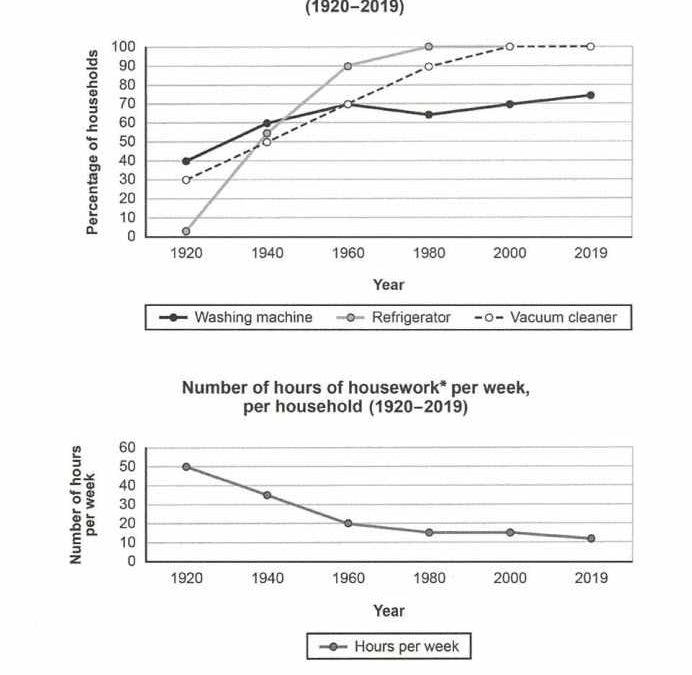
The line charts detail total percentages of electrical appliances in a given country from 1920 to 2019 and the results on housework undertaken per week. Looking from an overall perspective, it is readily apparent that all electrical appliances became more popular, in particular refrigerators and vacuum cleaners. The total time spent doing housework has also declined steadily and dramatically in the last one hundred years.
Refrigerators witnessed the most significant rise, beginning at just over 0% in 1920, surging to more than 50% by 1950, and then continuing to rise steadily until plateauing at 100% around 1980. Vacuum cleaners started higher at 30% and then rose by precisely 20% every 20 years until 1960 when growth tapered and ownership ultimately reached 100% by 1980. In contrast, proportions for washing machines began at 40%, climbed to 70% by 1960, then fell slightly, and recovered to finish the period at just above 70%.
The result for housework was that time spent washing clothes, preparing meals, and cleaning fell steadily from 50 hours a week in 1920 to 20 by 1960. After that, the decline was more gradual, reaching slightly above 10 hours by 2019.
Analysis
1. The line charts detail total percentages of electrical appliances in a given country from 1920 to 2019 and the results on housework undertaken per week. 2. Looking from an overall perspective, it is readily apparent that all electrical appliances became more popular, in particular refrigerators and vacuum cleaners. 3. The total time spent doing housework has also declined steadily and dramatically in the last one hundred years.
Paraphrase what the process shows.
Write a clear overview summarising the major groups. Read here about overviews for processes.
You might need a second sentence for your overview.
1. Refrigerators witnessed the most significant rise, beginning at just over 0% in 1920, surging to more than 50% by 1950, and then continuing to rise steadily until plateauing at 100% around 1980. 2. Vacuum cleaners started higher at 30% and then rose by precisely 20% every 20 years until 1960 when growth tapered and ownership ultimately reached 100% by 1980. 3. In contrast, proportions for washing machines began at 40%, climbed to 70% by 1960, then fell slightly, and recovered to finish the period at just above 70%.
Begin writing about the data for the first category.
Describe the next area and compare it to the area before.
Make sure everything is detailed.
1. The result for housework was that time spent washing clothes, preparing meals, and cleaning fell steadily from 50 hours a week in 1920 to 20 by 1960. 2. After that, the decline was more gradual, reaching slightly above 10 hours by 2019.
Write about the final line chart – include everything!
Try to paraphrase some words used before as well.
Vocabulary
What do the words in bold below mean?Take some notes on a piece of paper to aid your memory:
The line charts detail total percentages of electrical appliances in a given country from 1920 to 2019 and the results on housework undertaken per week. Looking from an overall perspective, it is readily apparent that all electrical appliances became more popular, in particularrefrigerators and vacuum cleaners. The total time spent doing housework has also declined steadily and dramatically in the last one hundred years.
Refrigerators witnessed the most significant rise, beginning atjust over 0% in 1920, surging to more than 50% by 1950, and then continuing to rise steadily until plateauingat 100% around 1980. Vacuum cleaners started higher at 30% and then rose by precisely 20% every 20 years until 1960 when growth tapered and ownership ultimately reached 100% by 1980. In contrast, proportions for washing machines began at 40%, climbed to 70% by 1960, then fell slightly, and recovered to finish the period at just above 70%.
The result for housework was that time spent washing clothes, preparing meals, and cleaning fell steadily from 50 hours a week in 1920 to 20 by 1960. After that, the decline was more gradual, reaching slightly above 10 hours by 2019.
Answers
Try to write down or think of an antonym/opposite word for further practice:
detail describe
electrical appliances toasters, washers, ovens, etc.
a given country a random nation
results causes
housework undertaken chores done
per week each week
Looking from an overall perspective, it is readily apparent that overall
popular common
in particular especially
refrigerators place to keep your food cold
vacuum cleaners pick up dust and dirt on your floor
total complete number
declined steadily decreased at regular intervals
dramatically by a lot
last one hundred years from the last 100 years
witnessed experienced
most significant rise huge increase
beginning atjust over starting just above
surging to rising a lot to
continuing to rise keeping going up
until plateauingat leveling off at
started began
rose increase
precisely exactly
tapered slowed
ownership to have/purchase and keep
ultimately reached finally got to
in contrast however
proportions percentages
washing machines where you wash your clothes (if you do that)
The line charts d_______l total percentages of e_____________________s in a_______________________y from 1920 to 2019 and the r________s on h_____________k u________________________k. L___________________________________________t all electrical appliances became more p________r, i_______________rr____________s and v______________s. The t_______l time spent doing housework has also d_____________y and d______________y in the l___________________________s.
Refrigerators w__________d the m____________________e, b________________tj_________r 0% in 1920, s__________o more than 50% by 1950, and then c_____________________e steadily u____________________t 100% around 1980. Vacuum cleaners s_________d higher at 30% and then r____e by p___________y 20% every 20 years until 1960 when growth t__________d and o______________________________d 100% by 1980. I__________t, p____________s for w___________________s began at 40%, c__________d to 70% by 1960, then f_____________y, and r___________d to f___________________t just a_______e 70%.
The result for housework was that time spent washing clothes, p___________________s, and cleaning fell steadily from 50 hours a week in 1920 to 20 by 1960. A__________t, the decline was more g__________l, reaching s_____________e 10 hours by 2019.
Listening Practice
Listen to the related topic below and practice with these activities:
Please consider supporting my efforts to creative high quality IELTS materials for students around the world by signing up for my Patreon (and so you won’t miss out on any of my exclusive IELTS Ebooks)!
Dave
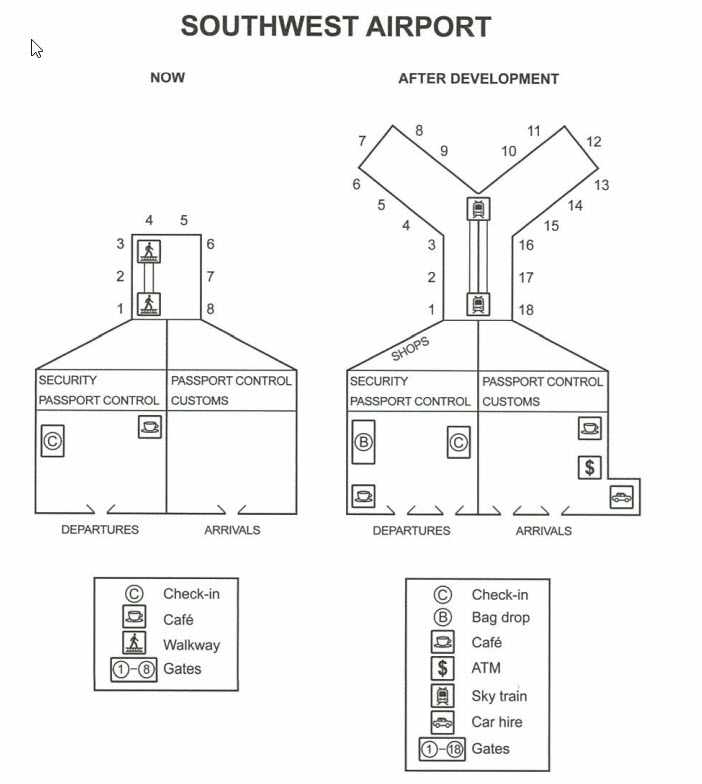
IELTS Cambridge 16 Essay: Airport Map
The plans below show the site of an airport now and how it will look after redevelopment next year.
Summarise the information by selecting and reporting the main features, and make comparisons where relevant.
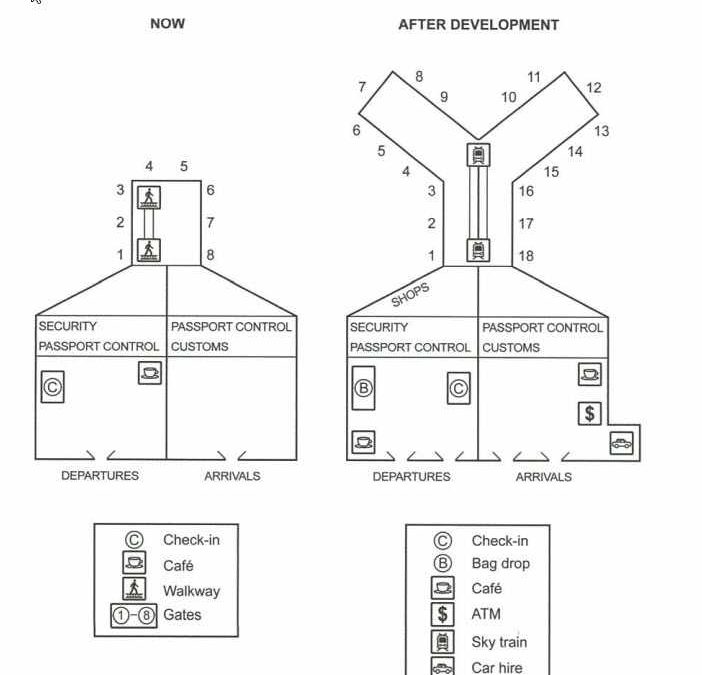
The map details plans for the renovation in the next year of Southwest Airport. Looking from an overall perspective, it is readily apparent that the number of gates will greatly expand and there will be a variety of customer-facing facilities added including shops, a car hire, and an ATM.
The location of the departure and arrival entrances will remain the same but there are plans to install additional doors. Upon entering the airport, there is currently a single check-in and cafe. The future plan projects moving the check-in from the left to right side of the departure space in order to make room for a bag drop area and the repositioning of the cafe. The arrival section will affix a cafe, ATM and car hire that necessitates expanding the size of the building.
Security, passport control, and customs will be unchanged, however, the future floor plan shows shops immediately upon exiting the security section for departures. The largest proposed alterations are replacing a walkway with a long sky train track and constructing 2 branching corridors that will enable flyers to reach more than twice as many gates (8 at the moment and 18 after renovations).
Analysis
1. The map details plans for the renovation in the next year of Southwest Airport. 2. Looking from an overall perspective, it is readily apparent that the number of gates will greatly expand and there will be a variety of customer-facing facilities added including shops, a car hire, and an ATM.
Paraphrase what the process shows.
Write a clear overview summarising the major groups. Read here about overviews for processes.
1. The location of the departure and arrival entrances will remain the same but there are plans to install additional doors. 2. Upon entering the airport, there is currently a single check-in and cafe. 3. The future plan projects moving the check-in from the left to right side of the departure space in order to make room for a bag drop area and the repositioning of the cafe. 4. The arrival section will affix a cafe, ATM and car hire that necessitates expanding the size of the building.
Begin writing about the details of the process.
This one is tricky to get up to the word count (no longer required on IELTS) so try to make it a little wordy.
1. Security, passport control, and customs will be unchanged, however, the future floor plan shows shops immediately upon exiting the security section for departures. 2. The largest proposed alterations are replacing a walkway with a long sky train track and constructing 2 branching corridors that will enable flyers to reach more than twice as many gates (8 at the moment and 18 after renovations).
Write about the rest of the process – include everything!
Try to paraphrase some of the words from process as well.
Vocabulary
What do the words in bold below mean?Take some notes on a piece of paper to aid your memory:
The map details plans for the renovation in the next year of Southwest Airport. Looking from an overall perspective, it is readily apparent that the number of gates will greatly expand and there will be a variety of customer-facing facilities added including shops, a car hire, and an ATM.
The location of the departure and arrival entrances will remain the same but there are plans to install additional doors. Upon entering the airport, there is currently a single check-in and cafe. The future plan projects moving the check-in from the left to right side of the departure space in order to make room for a bag drop area and the repositioning of the cafe. The arrival section will affix a cafe, ATM and car hire that necessitates expanding the size of the building.
Security, passport control, and customs will be unchanged, however, the future floor plan shows shops immediately upon exiting the security section for departures. The largest proposed alterations are replacing a walkway with a long sky train track and constructing 2 branching corridors that will enable flyers to reach more than twice as many gates (8 at the moment and 18 after renovations).
Answers
Try to write down or think of an antonym/opposite word for further practice:
details shows
plans projections
renovation changes
Looking from an overall perspective, it is readily apparent that overall
gates places to get on and off the airplanes
greatly expand make much bigger
variety lots of different
customer-facing facilities shops, cafes, etc.
car hire place to rent a car
ATM place to take out money
location place
departure where you leave from
arrival where you come in from flights
entrances place to enter
remain the same unchanged
plans projections
install additional doors put in new doors
currently at the moment
check-in place to register for you flight
projects predicts
space area
in order to so that
make room for allow for
bag drop area place to leave your bags
repositioning of the cafe moving of the coffee shop
affix add on
necessitates requires
expanding making bigger
size how big it is
security checking to make sure you are safe
passport control checking your ID, passport
customs where they check what you are bringing
unchanged no different
however in contrast
future floor plan blueprint for later
immediately right now
exiting leaving
largest proposed alterations biggest changes to be made
replacing taking the place of
walkway path to walk on
sky train track commuter train line
constructing building
branching corridors hallways splitting off
enable flyers allow people flying
reach more than twice as many go to more than double
The map d_______s p______s for the r___________n in the next year of Southwest Airport. L_______________________________________________________t the number of g______s will g_________________d and there will be a v________y of c___________________________s added including shops, a c___________e, and an A___M.
The l_________n of the d___________e and a_________l e_____________s will r_______________e but there are p_______s to i_____________________s. Upon entering the airport, there is c_______________y a single c__________n and cafe. The future plan p___________s moving the check-in from the left to ride side of the departure s________e i_______________o m______________r a b_________________a and the r______________________e. The arrival section will a______x a cafe, ATM and car hire that n______________s e______________g the s_____e of the building.
S______________y, p__________________l, and c___________s will be u_____________d, h_____________r, the f____________________n shows shops i____________________y upon e___________g the security section for departures. The l__________________________________s are r____________g a w__________y with a long s_______________k and c_______________g 2 b__________________s that will e_____________s to r________________________________y gates (8 a_____________________t and 18 after r________________s).
Listening Practice
Listen to the related topic below and practice with these activities:
This is an IELTS writing task 2 sample answer essay on the topic of manufactured food and drink products containing high levels of sugar and the health problems this causes from Cambridge IELTS 16.
Please consider supporting me on Patreon.com/howtodoielts to receive my exclusive IELTS Ebooks – you can even sign up for private live lessons with me!
Dave
IELTS Cambridge 16: Manufactured Foods and Sugar
Many manufactured food and drink products contain high levels of sugar, which causes many health problems. Sugary products should be made more expensive to encourage people to consume less sugar.
Do you agree or disagree?
Certain concerned citizens believe that prices should be raised to counter the high sugar content in various food and drink products. In my opinion, this solution may have a marginal impact but other reforms would engender greater progress.
Supporters of this policy argue that it has been effective in the past. The best known corollary would be the high price of tobacco products in many nations. Countries where prices are low, such as Indonesia, Vietnam, and India, have considerably higher rates of smokers compared to nations that have instituted heavy taxes. Similarly, taxation has had limited effectiveness concerning food products in European nations where sugary and fatty foods are more expensive and there has been a concomitant marginal decline in consumption. However, the more striking realization from attempts to tax luxuries is that individuals are often willing to pay to satisfy their addictions and would rather sacrifice in other areas.
Therefore, superior solutions involve more holistic government action. This can be illustrated through policies in Japan. From a young age, children are fed healthy meals at school as well as at home, and the government has encouraged health awareness through a variety of programs and initiatives aimed at various demographics. The result is that sugary drinks and products have a place in society that is less prominent than in nations such as the United States where the culture centers on fast food, soda, and packaged meals. A more thoughtful approach should not be discounted simply because of the challenges posed by enacting and evaluating small steps that are aligned and enforced consistently over a period of years.
In conclusion, the immediate and largely ineffective fix offered by raising prices is not advisable compared with more long-term measures. Governments must therefore take a long view and communicate this clearly to the general citizenry.
Analysis
1. Certain concerned citizens believe that prices should be raised to counter the high sugar content in various food and drink products. 2. In my opinion, this solution may have a marginal impact but other reforms would engender greater progress.
Paraphrase the overall essay topic.
Write a clear opinion. Read more about introductions here.
1. Supporters of this policy argue that it has been effective in the past. 2. The best known corollary would be the high price of tobacco products in many nations. 3. Countries where prices are low, such as Indonesia, Vietnam, and India, have considerably higher rates of smokers compared to nations that have instituted heavy taxes. 4. Similarly, taxation has had limited effectiveness concerning food products in European nations where sugary and fatty foods are more expensive and there has been a concomitant marginal decline in consumption. 5. However, the more striking realization from attempts to tax luxuries is that individuals are often willing to pay to satisfy their addictions and would rather sacrifice in other areas.
Write a topic sentence with a clear main idea at the end.
Explain your main idea.
Develop it with specific examples/argument.
Vary long and short sentences and switch to a second reason.
Stay focused on the second main idea.
1. Therefore, superior solutions involve more holistic government action. 2. This can be illustrated through policies in Japan. 3. From a young age, children are fed healthy meals at school as well as at home, and the government has encouraged health awareness through a variety of programs and initiatives aimed at various demographics. 4. The result is that sugary drinks and products have a place in society that is less prominent than in nations such as the United States where the culture centers on fast food, soda, and packaged meals. 5. A more thoughtful approach should not be discounted simply because of the challenges posed by enacting and evaluating small steps that are aligned and enforced consistently over a period of years.
Write a new topic sentence with a new main idea at the end.
Explain your new main idea.
Include specific details and examples.
Continue developing it…
as fully as possible!
1. In conclusion, the immediate and largely ineffective fix offered by raising prices is not advisable compared with more long-term measures. 2. Governments must therefore take a long view and communicate this clearly to the general citizenry.
Summarise your main ideas.
Include a final thought. Read more about conclusions here.
Vocabulary
What do the words in bold below mean?Make some notes on paper to aid memory and then check below.
Certain concerned citizens believe that prices should be raised to counter the high sugar content in various food and drink products. In my opinion, this solution may have a marginal impact but other reforms would engender greater progress.
Supporters of this policy argue that it has been effective in the past. The best known corollary would be the high price of tobacco products in many nations. Countries where prices are low, such as Indonesia, Vietnam, and India, have considerably higher rates of smokers compared to nations that have instituted heavy taxes. Similarly, taxation has had limited effectivenessconcerning food products in European nations where sugary and fatty foods are more expensive and there has been a concomitant marginal decline in consumption. However, the more striking realization from attempts to tax luxuries is that individuals are often willing to pay to satisfy their addictions and would rather sacrifice in other areas.
Therefore, superior solutions involve more holistic government action. This can be illustrated through policies in Japan. From a young age, children are fed healthy meals at school as well as at home, and the government has encouraged health awareness through a variety of programs and initiatives aimed at various demographics. The result is that sugary drinks and products have a place in society that is less prominent than in nations such as the United States where the culture centers on fast food, soda, and packaged meals. A more thoughtful approach should not be discounted simply because of the challenges posed by enacting and evaluating small steps that are aligned and enforced consistentlyover a period of years.
In conclusion, the immediate and largely ineffective fix offered by raising prices is not advisable compared with more long-term measures. Governments must therefore take a long view and communicate this clearly to the general citizenry.
Answers
For extra practice, write an antonym (opposite word) on a piece of paper to help you remember the new vocabulary:
certain particular
concerned worried
citizens people
prices should be raised they should cost more
counter solved
high sugar content has a lot of sugar in it
marginal impact small effect
reforms changes
engender create
progress moving forward
supporters those who believe in it
policy law, regulation
effective works well
corollary related example
high price very expensive
tobacco products cigarettes
considerably a lot
rates figures
smokers people who smoke
instituted heavy taxes enacted higher prices on
similarly also the same
taxation making consumers pay more
limited effectiveness not much effect
concerning having to do with
expensive costs a lot
concomitant marginal related small
consumption eating
striking realization big takeaway
attempts tries
luxuries non-essentials
satisfy their addictions consume what they crave
would rather sacrifice in other areas prefer to not buy other things
therefore thus
superior solutions better remedies
holistic government action combined action from the government
illustrated through seen by
fed healthy meals eat nutritious foods
as well as and
encouraged motivated
awareness knowing about
variety lots of different
programs initiatives
initiatives programs
aimed at directed towards
various demographics different groups of people in society
I recommend getting a pencil and piece of paper because that aids memory. Then write down the missing vocabulary from my sample answer in your notebook:
C________n c__________d c___________s believe that p_____________________d to c__________r the h_______________t in various food and drink products. In my opinion, this solution may have a m_______________t but other r__________s would e__________r greater p___________s.
S_____________s of this p________y argue that it has been e__________e in the past. The best known c___________y would be the h____________e of t_______________s in many nations. Countries where prices are low, such as Indonesia, Vietnam, and India, have c______________y higher r_______s of s_________s compared to nations that have i_______________________s. S___________y, t___________n has had l________________________sc____________g food products in European nations where sugary and fatty foods are more e___________e and there has been a c___________________________l decline in c______________n. However, the more s___________________n from a___________s to tax l____________s is that individuals are often willing to pay to s_____________________s and w_____________________________________s.
T__________e, s__________________s involve more h___________________________n. This can be i______________________h policies in Japan. From a young age, children are f___________________s at school a_____________s at home, and the government has e____________d health a____________s through a v__________y of p__________s and i____________s a________________t v________________________s. The result is that sugary drinks and products h__________________________y that is l__________________t than in nations such as the United States where the culture c_____________n fast food, soda, and p_________________s. A more t___________________h should not be d______________d simply because of the c__________________d by e___________g and e____________g small s_____s that are a_________d and e______________________yo_______________________s.
In conclusion, the i_______________e and l_______________________x o__________y raising prices is n_______________e compared with more l_______________________s. Governments must therefore t________________w and c_______________e this c___________y to the g___________________y.
Listening Practice
Learn more about this topic in the video below and practice with these activities:
Please consider supporting me on Patreon.com/howtodoielts to receive my exclusive IELTS Ebooks – you can even sign up for private live lessons with me!
Dave
IELTS Cambridge 16 Essay: Driverless Vehicles
In the future all cars, buses and trucks will be driverless. The only people travelling inside these vehicles will be passengers.
Do you think the advantages of driverless vehicles outweigh the disadvantages?
A future filled with driverless vehicles is an inevitability. In my opinion, though there are concomitant moral risks, the practical import for health of such a seismic shift will be positive on the whole.
Critics of this trend suggest that machines should not be responsible for the potential loss of human life. This argument rests on the fact that when there is an accident involving humans, it is possible to either assess blame and assign punishment or accept that human error played a role. In contrast, an individual severely injured as the result of a collision caused by a machine may justly feel that all human autonomy and free will is absent from their fate. This is analogous to a natural disaster with the crucial distinction being that humanity has engineered the situation. It is human nature to prefer to control a situation rather than surrender the outcome to an autonomous machine.
Proponents of automated vehicles, on the other hand, argue the tangible ramifications concerning public safety. The evidence overwhelmingly suggests that driverless vehicles cause fewer accidents than humans. The reason for this is that humans are prone to errors related to fatigue, distractions such as smartphones, and, in some cases, altered states. Machines might experience the occasional technical error, however, they are far more consistent by comparison. In fact, the few accidents that have occurred with automated vehicles were the fault of human drivers. If all cars were driverless, this would enable a greater level of sophistication that could, theoretically, all but eliminate automobile accidents.
In conclusion, though many accidents will occur without human agency playing a role, safer roads fully justify this innovation. Companies and consumers must be wary of the influence of automation while also embracing its most transparent benefits.
Analysis
1. A future filled with driverless vehicles is an inevitability. 2. In my opinion, though there are concomitant moral risks, the practical import for health of such a seismic shift will be positive on the whole.
Paraphrase the overall essay topic.
Write a clear opinion. Read more about introductions here.
1. Critics of this trend suggest that machines should not be responsible for the potential loss of human life. 2. This argument rests on the fact that when there is an accident involving humans, it is possible to either assess blame and assign punishment or accept that human error played a role. 3. In contrast, an individual severely injured as the result of a collision caused by a machine may justly feel that all human autonomy and free will is absent from their fate. 4. This is analogous to a natural disaster with the crucial distinction being that humanity has engineered the situation. 5. It is human nature to prefer to control a situation rather than surrender the outcome to an autonomous machine.
Write a topic sentence with a clear main idea at the end.
Explain your main idea.
Develop it with specific examples/argument.
Vary long and short sentences and switch to a second reason.
Stay focused on the second main idea.
1. Proponents of automated vehicles, on the other hand, argue the tangible ramifications concerning public safety. 2. The evidence overwhelmingly suggests that driverless vehicles cause fewer accidents than humans. 3. The reason for this is that humans are prone to errors related to fatigue, distractions such as smartphones, and, in some cases, altered states. 4. Machines might experience the occasional technical error, however, they are far more consistent by comparison. 5. In fact, the few accidents that have occurred with automated vehicles were the fault of human drivers. 6. If all cars were driverless, this would enable a greater level of sophistication that could, theoretically, all but eliminate automobile accidents.
Write a new topic sentence with a new main idea at the end.
Explain your new main idea.
Include specific details and examples.
Continue developing it…
as fully as possible!
Conclude with the furthest possible result.
1. In conclusion, though many accidents will occur without human agency playing a role, safer roads fully justify this innovation. 2. Companies and consumers must be wary of the influence of automation while also embracing its most transparent benefits.
Summarise your main ideas.
Include a final thought. Read more about conclusions here.
Vocabulary
What do the words in bold below mean?Make some notes on paper to aid memory and then check below.
A future filled with driverless vehicles is an inevitability. In my opinion, though there are concomitant moral risks, the practical import for health of such a seismic shift will be positive on the whole.
Critics of this trend suggest that machines should not be responsible for the potential loss of human life. This argument rests on the fact that when there is an accident involving humans, it is possible to either assess blame and assign punishment or accept that human error played a role. In contrast, an individual severely injuredas the result of a collision caused by a machine may justly feel that all human autonomy and free will is absent from their fate. This is analogous to a natural disaster with the crucial distinction being that humanity has engineeredthe situation. It is human nature to prefer to control a situation rather thansurrender the outcome to an autonomous machine.
Proponents of automated vehicles, on the other hand, argue the tangible ramifications concerning public safety. The evidence overwhelmingly suggests that driverless vehicles cause fewer accidents than humans. The reason for this is that humans are prone to errors related to fatigue, distractions such as smartphones, and, in some cases, altered states. Machines might experience the occasional technical error, however, they are far more consistent by comparison. In fact, the few accidents that have occurred with automated vehicles were the fault of human drivers. If all cars were driverless, this would enable a greater level of sophistication that could, theoretically, all but eliminate automobile accidents.
In conclusion, though many accidents will occur without human agency playing a role, safer roads fully justify this innovation. Companies and consumers must be wary of the influence of automation while also embracing its most transparent benefits.
Answers
For extra practice, write an antonym (opposite word) on a piece of paper to help you remember the new vocabulary:
filled with full of
driverless vehicles cars that drive themselves
inevitability will definitely happen
though despite
concomitant related, coming from this
moral risks ethical considerations
practical import actual impact
seismic shift huge change
positive on the whole good overall
critics detractors
trend pattern
suggest say
responsible have a duty
potential loss possible death
argument rests on the fact that position is based in
involving having to do with
possible potential
either assess blame one option is that you can say who is responsible
I recommend getting a pencil and piece of paper because that aids memory. Then write down the missing vocabulary from my sample answer in your notebook:
A future f_____________h d____________________s is an i______________y. In my opinion, t_________h there are c______________t m____________s, the p________________t for health of such a s_____________t will be p__________________e.
C_______s of this t______d s________t that machines should not be r____________e for the p____________s of human life. This a_________________________t when there is an accident i___________g humans, it is p__________e to e__________________e and a__________________t or a_____t that h_____________r p________________e. I_____________t, an individual s_______________da_____________________f a c_________n c___________y a machine may j________y feel that all h________________y and f__________l is a_________t from their f____e. This is a_____________s to a n______________r with the c__________________n being that humanity has e_____________________________n. It is h________________e to p_______r to c________l a situation r___________ns____________r the o_________e to an a______________s machine.
P___________s of a_________________s, o__________________d, a_______e the t________________________s c_____________g p_______________y. The evidence o_________________y suggests that d___________________s cause fewer accidents than humans. The reason for this is that humans are p______e to e_______s related to f_________e, d____________s such as smartphones, and, i_______________s, a_______________s. Machines might experience the o____________l t___________________r, however, they are f______________________________________n. I__________t, the few accidents that have o____________d with automated vehicles were the f_______t of human drivers. If all cars were driverless, this would e________e a g_____________l of s_______________n that could, t______________y, a___________________________________________s.
In conclusion, though many accidents will occur without human agency playing a role, s___________s fully j__________y this i___________n. Companies and consumers must be w____y of the i__________e of automation while also e____________g its m_________________________s.
Listening Practice
Learn more about this topic in the video below and practice with these activities:
Please consider supporting my efforts to creative high quality IELTS materials for students around the world by signing up for my Patreon (and so you won’t miss out on any of my exclusive IELTS Ebooks)!
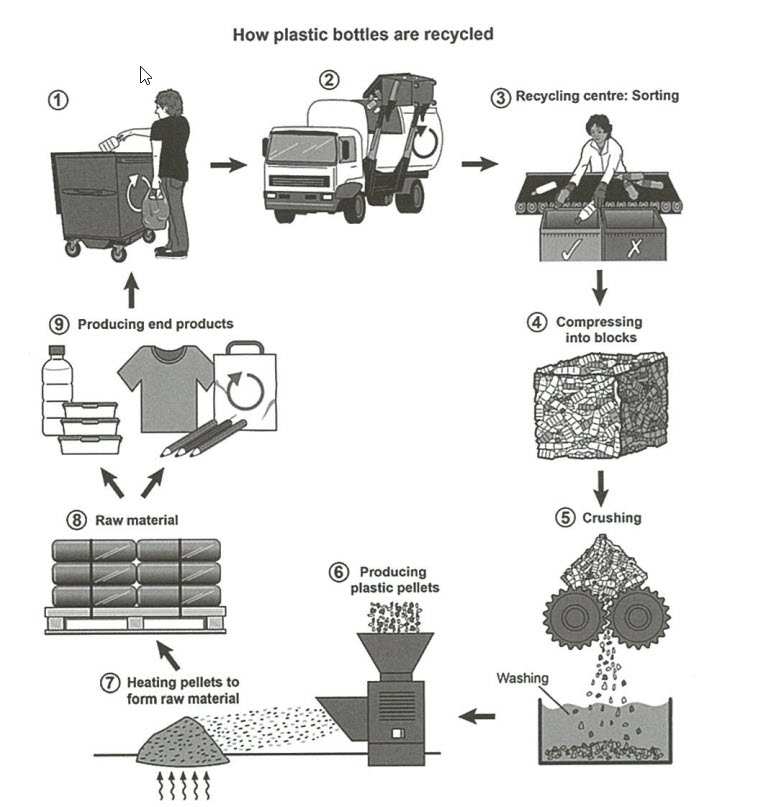
The diagram below shows the process for recycling plastic bottles.
Summarise the information by selecting and reporting the main features, and make comparisons where relevant.
IELTS Cambridge 16: Recycling Plastic Bottles
The diagram detailed above delineates how plastic bottles are recycled. Looking from an overall perspective, it is readily apparent that this circular process is comprised of 3 main stages including initial collection and sorting, followed by processing and cleaning, and finally reconstitution into a novel material for further usage.
Recycling commences when an individual places their rubbish in a designated recycling bin, prior to being loaded into specialized garbage trucks. After transportation to the recycling center, the plastic bottles are sorted by hand, compressed tightly to form blocks and then crushed into small pieces and washed.
The next stages involve transformation into a reusable material. The pieces of plastic are first poured into a machine that turns them into pellets. These pellets are then heated in order to create a raw material that can be used in the manufacture of products ranging from clothes and bottles to containers and pencils. These items are themselves recyclable and the process begins again.
Analysis
1. The diagram detailed above delineates how plastic bottles are recycled. 2. Looking from an overall perspective, it is readily apparent that this circular process is comprised of 3 main stages including initial collection and sorting, followed by processing and cleaning, and finally reconstitution into a novel material for further usage.
Paraphrase what the process shows.
Write a clear overview summarising the major groups. Read here about overviews for processes.
1. Recycling commences when an individual places their rubbish in a designated recycling bin, prior to being loaded into specialized garbage trucks. 2. After transportation to the recycling center, the plastic bottles are sorted by hand, compressed tightly to form blocks and then crushed into small pieces and washed.
Begin writing about the details of the process.
This one is tricky to get up to the word count (no longer required on IELTS) so try to make it a little wordy.
1. The next stages involve transformation into a reusable material. 2. The pieces of plastic are first poured into a machine that turns them into pellets. 3. These pellets are then heated in order to create a raw material that can be used in the manufacture of products ranging from clothes and bottles to containers and pencils. 4. These items are themselves recyclable and the process begins again.
Write about the rest of the process – include everything!
Try to paraphrase some of the words from process as well.
Continue with the next steps.
Be sure to mention that this process begins again!
Vocabulary
What do the words in bold below mean?Take some notes on a piece of paper to aid your memory:
The diagram detailed above delineates how plastic bottles are recycled. Looking from an overall perspective, it is readily apparent that this circular process is comprised of 3 main stages including initial collection and sorting, followed by processing and cleaning, and finally reconstitution into a novel material for further usage.
Recycling commences when an individualplaces their rubbish in a designated recycling bin, prior to being loaded into specialized garbage trucks. After transportation to the recycling center, the plastic bottles are sorted by hand, compressed tightly to form blocks and then crushed into small pieces and washed.
The next stages involve transformation into a reusable material. The pieces of plastic are first poured into a machine that turns them into pellets. These pellets are then heated in order to create a raw material that can be used in the manufacture of products ranging from clothes and bottles to containers and pencils. These items are themselves recyclable and the process begins again.
Answers
Try to write down or think of an antonym/opposite word for further practice:
diagram detailed above process described
delineates shows
recycled used again, reused
Looking from an overall perspective, it is readily apparent that overall
circular process loop, starts again, feeds back into itself
comprised of including
including entailing
initial collection first finding
sorting putting into groups
followed by after that
processing being made
cleaning making clean
reconstitution remade as something new
novel material new substance
further usage used again
commences begins with
individual person
places puts
rubbish trash
designated recycling bin container for recycling
prior to before
loaded into specialized garbage trucks put in trucks for recycling only
The d________________________e d___________s how plastic bottles are r___________d. L________________________________________________________t this c_____________________s is c________________f 3 main stages i_____________g i______________________n and s_________g, f_________________y p____________g and c__________g, and finally r_________________n into a n_______________l for f______________e.
Recycling c______________s when an i____________lp_______s their r________h in a d_______________________n, p__________o being l_________________________________________s. After t______________n to the r___________________r, the plastic bottles are s__________________d, c_____________________y to f________________s and then c___________d into small pieces and w__________d.
The next stages i___________e transformation into a r__________________l. The p_________________c are first p________d into a machine that t______s them into p__________s. These pellets are then h________d i__________o create a r___________________l that can be used in the m________________e of products r______________m clothes a__d bottles t__ containers a__d pencils. These it_____s are themselves r__________e and the process b_____________n.
Listening Practice
Listen to the related topic below and practice with these activities:
"The highest quality materials anywhere on the internet! Dave improved my writing and vocabulary so much. Really affordable options you don't want to miss out on!"