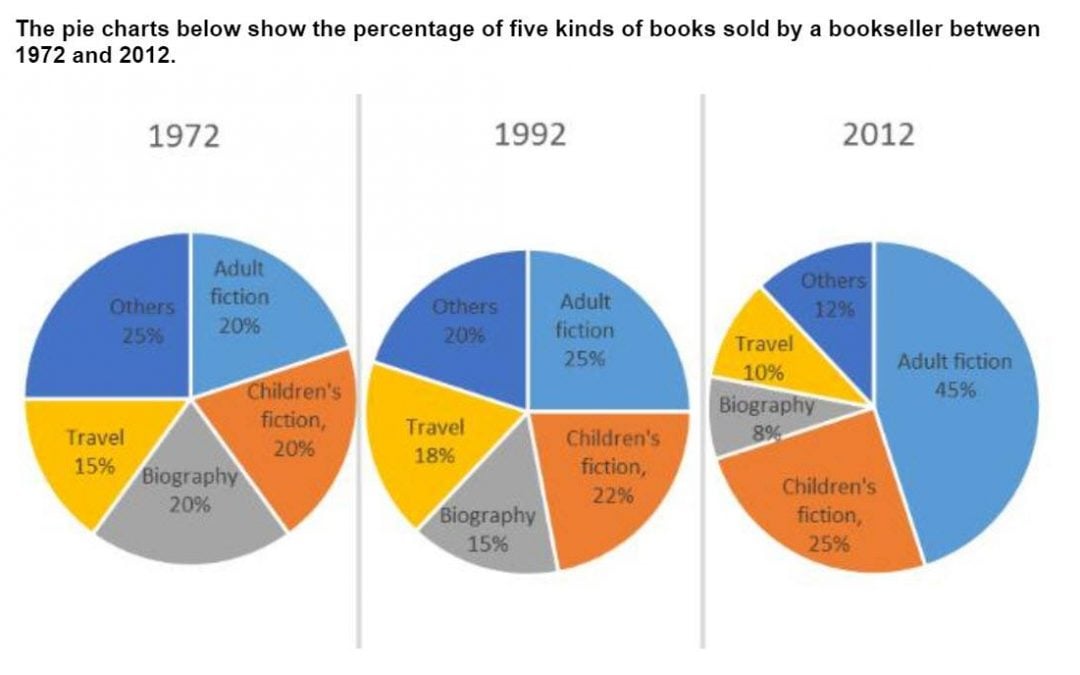
The pie charts detail sales by a bookseller between 1972 and 2012 according to genre. Looking from an overall perspective, it is readily apparent that adult fiction became by far the most popular type at the expense of the genres which declined in popularity (others, biography, and travel). Interest in children’s fiction also increased.
In 1972, this particular bookseller sold relatively equal proportions of each type with others leading at 25%, followed by adult fiction, children’s fiction, and biography all at 20%, and travel lowest at 15%. By 1992, adult fiction had risen by 5%, while others and biography declined by the same number. Travel and children’s fiction grew by 3% and 2%, respectively.
In the final year surveyed, adult fiction surged to 45% and children’s fiction ticked up slightly to 25%. The rise of adult fiction was compensated for by dramatic drops for the remaining genres with others finishing at 12%, travel at 10%, and biography 8%.
Analysis
1. The pie charts detail sales by a bookseller between 1972 and 2012 according to genre. 2. Looking from an overall perspective, it is readily apparent that adult fiction became by far the most popular type at the expense of the genres which declined in popularity (others, biography, and travel). 3. Interest in children’s fiction also increased.
Paraphrase what the table shows.
Write a clear overview summarising the differences.
You might need another sentence for your overview.
1. In 1972, this particular bookseller sold relatively equal proportions of each type with others leading at 25%, followed by adult fiction, children’s fiction, and biography all at 20%, and travel lowest at 15%. 2. By 1992, adult fiction had risen by 5%, while others and biography declined by the same number. 3. Travel and children’s fiction grew by 3% and 2%, respectively.
Begin writing about the data for the first categories.
Make sure you compare as much as possible.
Don’t leave anything out!
1. In the final year surveyed, adult fiction surged to 45% and children’s fiction ticked up slightly to 25%. 2. The rise of adult fiction was compensated for by dramatic drops for the remaining genres with others finishing at 12%, travel at 10%, and biography 8%.
Write about the final, other parts of the graph – include everything!
Compare the categories.
Vocabulary
What do the words in bold below mean?Take some notes on a piece of paper to aid your memory:
The pie charts detail sales by a bookseller between 1972 and 2012 according to genre. Looking from an overall perspective, it is readily apparent that adult fiction became by far the most popular type at the expense of the genres which declined in popularity (others, biography, and travel). Interest inchildren’s fiction also increased.
In 1972, this particular bookseller sold relatively equal proportions of each type with others leading at 25%, followed by adult fiction, children’s fiction, and biography all at 20%, and travel lowest at 15%. By 1992, adult fiction had risen by 5%, while others and biography declined by the same number. Travel and children’s fiction grew by 3% and 2%, respectively.
In the final year surveyed, adult fiction surged to 45% and children’s fiction ticked up slightly to 25%. The rise of adult fiction was compensated for by dramatic drops for the remaining genres with others finishing at 12%, travel at 10%, and biography 8%.
Answers
Try to write down or think of an antonym/opposite word for further practice:
detail show
sales how much was sold
bookseller person who sells books
according to genre by type
Looking from an overall perspective, it is readily apparent that overall
Remember and fill in the blanks. Note it on a piece of paper so you can remember better:
The pie charts d_____________s by a b__________r between 1972 and 2012 a_________________e. L______________________________________________t a________________n became b_______r the m______________r type a______________________f the genres which d_____________________y (o_________s, b____________y, and t_______l). I____________nc___________________n also increased.
In 1972, this p_________________r bookseller sold r______________________________s of each type with others l_____________t 25%, f_____________y adult fiction, children’s fiction, and biography all at 20%, and travel l_________t at 15%. By 1992, adult fiction had r_____n by 5%, while others and biography declined by the same number. Travel and children’s fiction g____w by 3% and 2%, r_____________y.
I________________________d, adult fiction s________d to 45% and children’s fiction t_________________y to 25%. The rise of adult fiction was c__________________r by d______________s for the r___________g genres with others f_____________t 12%, travel at 10%, and biography 8%.
Listening Practice
Listen to the related topic below and practice with these activities:
This is an IELTS writing task 2 sample answer essay on the topic of a universal basic income from the government from the real IELTS recent exam.
Please consider supporting me on Patreon.com/howtodoielts to receive my full, exclusive IELTS Ebooks!
Dave
IELTS Essay: Universal Basic Income
The governments should give each citizen a basic income so that they have enough money to live on, even if they are unemployed.
To what extent do you agree or disagree?
Some today are calling for the institution of a universal basic income for all citizens. In my opinion, while this addresses legitimate fears concerning automation, it would be ill-advised overall as work is central to the human condition.
Those who advocate this legislation point out unemployment risks. Wealth is today accumulated amongst a very small percentage of billionaires. In the future, this situation will be exacerbated by rising corporate investment into advanced robotics and artificial intelligence. For instance, 50 years ago there were thousands of jobs for those working in factories assembling cars and other products. Today, the vast majority of that work is done by machines and humans must locate more creative avenues of employment. The fear that someday most workers will no longer have a viable role in society does justify discussion of a universal wage.
However, these future possibilities are not assured and work is still an essential part of being human. Each person has duty in their personal lives, typically as part of a family, as well as in public through their work. Only by fulfilling each responsibility fully will a person feel connected to the history and present of human progress. A universal wage would allow individuals to focus exclusively on their family and their hobbies but it is nearly impossible to predict possible deeper ramifications. Individuals may lose the motivation to innovate and the world would, in that case, be run by unimaginative technocrats and machines.
In conclusion, though it seems that capitalism will someday necessitate a reform such as a basic income for all, I believe there is enough value in work that alternatives should be pursued instead. Idealistic dreams of a world without work are naive and short-sighted.
Analysis
1. Some today are calling for the institution of a universal basic income for all citizens. 2. In my opinion, while this addresses legitimate fears concerning automation, it would be ill-advised overall as work is central to the human condition.
Paraphrase the overall essay topic.
Write a clear opinion. Read more about introductions here.
1. Those who advocate this legislation point out unemployment risks. 2. Wealth is today accumulated amongst a very small percentage of billionaires. 3. In the future, this situation will be exacerbated by rising corporate investment into advanced robotics and artificial intelligence. 4. For instance, 50 years ago there were thousands of jobs for those working in factories assembling cars and other products. 5. Today, the vast majority of that work is done by machines and humans must locate more creative avenues of employment. 6. The fear that someday most workers will no longer have a viable role in society does justify discussion of a universal wage.
Write a topic sentence with a clear main idea at the end.
Explain your main idea.
Develop it with specific or hypothetical examples.
Keep developing it fully.
Vary long and short sentences.
Make sure you generalize if your example is too specific.
1. However, these future possibilities are not assured and work is still an essential part of being human. 2. Each person has duty in their personal lives, typically as part of a family, as well as in public through their work. 3. Only by fulfilling each responsibility fully will a person feel connected to the history and present of human progress. 4. A universal wage would allow individuals to focus exclusively on their family and their hobbies but it is nearly impossible to predict possible deeper ramifications. 5. Individuals may lose the motivation to innovate and the world would, in that case, be run by unimaginative technocrats and machines.
Write a new topic sentence with a new main idea at the end.
Explain your new main idea.
Include specific details and examples.
Add as much information as you can and make sure it links logically.
Develop the example fully.
1. In conclusion, though it seems that capitalism will someday necessitate a reform such as a basic income for all, I believe there is enough value in work that alternatives should be pursued instead. 2. Idealistic dreams of a world without work are naive and short-sighted.
Summarise your main ideas.
Include a final thought. Read more about conclusions here.
Vocabulary
What do the words in bold below mean?Make some notes on paper to aid memory and then check below.
Some today are calling for the institution of a universal basic income for all citizens. In my opinion, while this addresses legitimate fears concerning automation, it would be ill-advisedoverall as work is central to the human condition.
Those who advocate this legislation point out unemployment risks. Wealth is today accumulated amongst a very small percentage of billionaires. In the future, this situation will be exacerbated by rising corporate investment into advanced robotics and artificial intelligence. For instance, 50 years ago there were thousands of jobs for those working in factories assembling cars and other products. Today, the vast majority of that work is done by machines and humans must locate more creative avenues of employment. The fear that someday most workers will no longer have a viable role in society does justify discussion of a universal wage.
However, these future possibilities are not assured and work is still an essential part of being human. Each person has duty in their personal lives, typically as part of a family, as well as in public through their work. Only by fulfilling each responsibility fully will a person feel connected to the history and present of human progress. A universal wage would allow individuals to focus exclusively on their family and their hobbies but it is nearly impossible to predict possible deeper ramifications. Individuals may lose the motivation to innovate and the world would, in that case, be run byunimaginative technocrats and machines.
In conclusion, though it seems that capitalism will someday necessitate a reform such as a basic income for all, I believe there is enough value in work that alternatives should be pursued instead. Idealistic dreams of a world without work are naive and short-sighted.
Answers
For extra practice, write an antonym (opposite word) on a piece of paper to help you remember the new vocabulary:
calling for demanding
institution creation of
universal basic income money for each person to live off without working
citizens residents
addresses deals with
legitimate fears real worries
concerning about
automation becoming related to machines
ill-advisedoverall not good in general
central key
the human condition how all people live and deal with life
advocate support
legislation laws
unemployment risks possibly not having a job
wealth money
accumulated added up
billionaires people with 1,000,000,000+
exacerbated made worse
rising corporate investment companies putting more money into
advanced robotics sophisticated machines
artificial intelligence smart computers
factories assembling cars putting together automobiles
products items
vast majority most of
locate find
creative avenues of employment new ways of finding jobs
fear worry
someday in the future
viable role useful place
justify discussion give good reason for talking about
universal wage everyone paid but with no job
future possibilities potential changes
assured definite
essential part key element
duty responsibility
personal lives private lives, family, friends, hobbies, etc.
typically usually
as well as and
public in the world, not private
fulfilling satisfying
responsibility fully duty 100%
connected related
focus exclusively emphasize only
hobbies what you do in your free time
predict look forward to
deeper ramifications bigger implications
lose the motivation not feel encouraged
innovate create new ideas
in that case in this situation
run byunimaginative technocrats managed by rich tech people with no creativity
I recommend getting a pencil and piece of paper because that aids memory. Then write down the missing vocabulary from my sample answer in your notebook:
Some today are c________________r the i____________n of a u_____________________e for all c___________s. In my opinion, while this a_______________s l______________e f_________________g a______________n, it would be i____________do_________l as work is c______l to t________________n.
Those who a__________e this l_____________n point out u________________s. W______h is today a___________d amongst a very small percentage of b_______________s. In the future, this situation will be e______________d by r_____________________________t into a______________s and a__________________e. For instance, 50 years ago there were thousands of jobs for those working in f___________________________s and other p_____________s. Today, the v____________y of that work is done by machines and humans must l_______e more c__________________________t. The f____r that s_______y most workers will no longer have a v___________e in society does j___________________n of a u________________e.
However, these f__________________s are not a__________d and work is still an e______________t of being human. Each person has d___y in their p___________s, t__________y as part of a family, a_____________s in p_____c through their work. Only by f___________g each r_________________y will a person feel c________d to the history and present of h_____________s. A universal wage would allow individuals to f_______________y on their family and their h_________s but it is nearly impossible to p________t possible d________________________s. Individuals may l______________________n to i______e and the world would, i_____________e, be r________yu___________________________s and m__________s.
In conclusion, though it seems that c___________m will someday n____________e a reform such as a b______________e for all, I believe there is enough v______e in work that a____________s should be p________________d. I_____________________s of a world without work are n______e and s_______________d.
Listening Practice
Learn more about this topic by watching videos from The New York Times YouTube channel below and practice with these activities:
This is an IELTS writing task 2 sample answer essay on the topic of doctors’ recommendations for older people and their exercise routines from the real recent IELTS exam.
Please consider supporting me on Patreon.com/howtodoielts to receive my full, exclusive IELTS Ebooks!
Dave
IELTS Essay: Doctors’ Recommendations
Many doctors recommend that older people exercise regularly, but most patients do not follow an exercise routine.
Why do you think this happens?
How can people be encouraged to exercise regularly?
A large proportion of healthcare professionals find that their advice to elderly people concerning exercise is not heeded. In my opinion, this is due to practical concerns and the best encouragement would be through government initiatives.
The reasons senior citizens have difficulty staying fit are physical and economic. Firstly, older people naturally suffer from a range of minor or major and debilitating conditions such as poor cardiovascular health, arthritis, and dementia. Each presents unique challenges to a regular exercise regular routine. Moreover, older people are often unable to afford the costs associated with learning a new sport or joining a gym. In the United States most older people survive on a fixed income and must set aside money for medical bills. Sports equipment is simply not a priority.
There is little that can be done to deter the natural ageing process but the financial impediments can be effectively tackled by building more public parks and facilities. An older person living in an urban area may lack easy access to a park or the transportation to travel to one far away. However, if there was one within walking distance they would be encouraged to exercise habitually. This habit could also be reinforced by social interactions. Many older people are lonely and seek companions from their generation. By making friends and regularly meeting to walk to exercise in the park, as is common in many East Asian nations, they can create lasting bonds that will also encourage them to stay fit.
In conclusion, many older people are physically or economically unable to exercise regularly and the this can be partly remedied with greater investment in public spaces. The benefits of such a reform would impact other segments of the population as well.
Analysis
1. A large proportion of healthcare professionals find that their advice to elderly people concerning exercise is not heeded. 2. In my opinion, this is due to practical concerns and the best encouragement would be through government initiatives.
Paraphrase the overall essay topic.
Write a clear opinion. Read more about introductions here.
1. The reasons senior citizens have difficulty staying fit are physical and economic. 2. Firstly, older people naturally suffer from a range of minor or major and debilitating conditions such as poor cardiovascular health, arthritis, and dementia. 3. Each presents unique challenges to a regular exercise regular routine. 4. Moreover, older people are often unable to afford the costs associated with learning a new sport or joining a gym. 5. In the United States most older people survive on a fixed income and must set aside money for medical bills. 6. Sports equipment is simply not a priority.
Write a topic sentence with a clear main idea at the end.
Explain your main idea.
Develop it with specific or hypothetical examples.
Keep developing it fully.
Vary long and short sentences.
Make sure you generalize if your example is too specific.
1. There is little that can be done to deter the natural ageing process but the financial impediments can be effectively tackled by building more public parks and facilities. 2. An older person living in an urban area may lack easy access to a park or the transportation to travel to one far away. 3. However, if there was one within walking distance they would be encouraged to exercise habitually. 4. This habit could also be reinforced by social interactions. 5. Many older people are lonely and seek companions from their generation. 6. By making friends and regularly meeting to walk to exercise in the park, as is common in many East Asian nations, they can create lasting bonds that will also encourage them to stay fit.
Write a new topic sentence with a new main idea at the end.
Explain your new main idea.
Include specific details and examples.
Add as much information as you can and make sure it links logically.
Develop the example fully.
State the results as well.
1. In conclusion, many older people are physically or economically unable to exercise regularly and the this can be partly remedied with greater investment in public spaces. 2. The benefits of such a reform would impact other segments of the population as well.
Summarise your main ideas.
Include a final thought. Read more about conclusions here.
Vocabulary
What do the words in bold below mean?Make some notes on paper to aid memory and then check below.
A large proportion of healthcare professionals find that their advice to elderly people concerning exercise is not heeded. In my opinion, this is due to practical concerns and the best encouragement would be through government initiatives.
The reasons senior citizenshave difficulty staying fit are physical and economic. Firstly, older people naturally suffer froma range of minor or major and debilitating conditions such as poor cardiovascular health, arthritis, and dementia. Each presents unique challenges to a regular exercise regular routine. Moreover, older people are often unable to afford the costs associated with learning a new sport or joining a gym. In the United States most older people survive on a fixed income and must set aside money for medical bills. Sports equipment is simply not a priority.
There is little that can be done to deter the natural ageing process but the financial impediments can be effectively tackled by building more public parks and facilities. An older person living in an urban area may lack easy access to a park or the transportation to travel to one far away. However, if there was one within walking distance they would be encouraged to exercise habitually. This habit could also be reinforced by social interactions. Many older people are lonely and seek companions from their generation. By making friends and regularly meeting to walk to exercise in the park, as is common in many East Asian nations, they can create lasting bonds that will also encourage them to stay fit.
In conclusion, many older people are physically or economically unable to exercise regularly and the this can be partly remedied with greater investment in public spaces. The benefits of such a reform would impact other segments of the population as well.
Answers
For extra practice, write an antonym (opposite word) on a piece of paper to help you remember the new vocabulary:
A large proportion of many of
healthcare professionals doctors
advice suggestions
elderly people older citizens
concerning exercise have to do with staying in shape
not heeded not listened to
due to because of
practical concerns problems that are real
best encouragement ideal way to inspire
government initiatives reforms
senior citizens the elderly
have difficulty staying fit can’t stay in shape
physical related to the body
economic related to finance
naturally of course
suffer from have
a range of many types of
minor small
major big
debilitating conditions issues that really impact them
poor cardiovascular health bad heart health
arthritis bones hurting
dementia Alzheimer’s
presents unique challenges creates new difficulties
regular exercise regular routine normal time to go exercise
unable can’t
afford pay for
costs associated with learning a new sport expenses of taking up a new game
joining a gym going to a sports facility
survive live on
fixed income unchanging amount of money every month
set aside money save funds
medical bills hospital costs
sports equipment items for doing sports
simply merely
priority of great importance
deter discourage
natural ageing process normal getting old
financial impediments money barriers
effectively tackled well handled
building more public parks and facilities constructing more public places for everyone
urban area city
lack easy access can’t get to
transportation how you travel
far away not near
within walking distance near
encouraged inspired to
exercise habitually go walk, play sports often
reinforced supported
social interactions talking to people
lonely isolated
seek companions look for friends
generation people of the same age
regularly meeting normal getting together
as is common in many East Asian nations happens a lot in China, Japan, Vietnam, etc.
create lasting bonds form meaningful relationships
I recommend getting a pencil and piece of paper because that aids memory. Then write down the missing vocabulary from my sample answer in your notebook:
A_________________________________________s find that their a_______e to e_____________e c___________________e is n_____________d. In my opinion, this is d______o p__________________s and the b______________________t would be through g_______________________s.
The reasons s________________sh________________________t are p__________l and e___________c. Firstly, older people n_________y s_____________ma__________f m_____r or m______r and d___________________________s such as p_______________________________h, a________s, and d___________a. Each p__________________________s to a r________________________________e. Moreover, older people are often u_______e to a__________d the c_________________________h l________________________t or j_________________m. In the United States most older people s_________e on a f_______________e and must s________________y for m______________s. S_________________________t is s_________y not a p____________y.
There is little that can be done to d______r the n____________________________s but the f___________________________s can be e__________________________d by b____________________________________s. An older person living in an u___________a may l_____________________s to a park or the t__________________n to travel to one f___________y. However, if there was one w_________________________e they would be e_____________d to e___________________y. This habit could also be r_________________d by s_____________________s. Many older people are l________y and s___________________s from their g_____________n. By making friends and r_______________g to walk to exercise in the park, a______________________________________s, they can c___________________s that will also e_______________e them to s___________t.
In conclusion, many older people are physically or e_____________y unable to exercise regularly and the this can be p________________d with g__________________t in p_______________s. The b__________s of such a r_______m would i________t other s_____________________n as well.
Listening Practice
Learn more about this topic by watching videos from The New York Times YouTube channel below and practice with these activities:
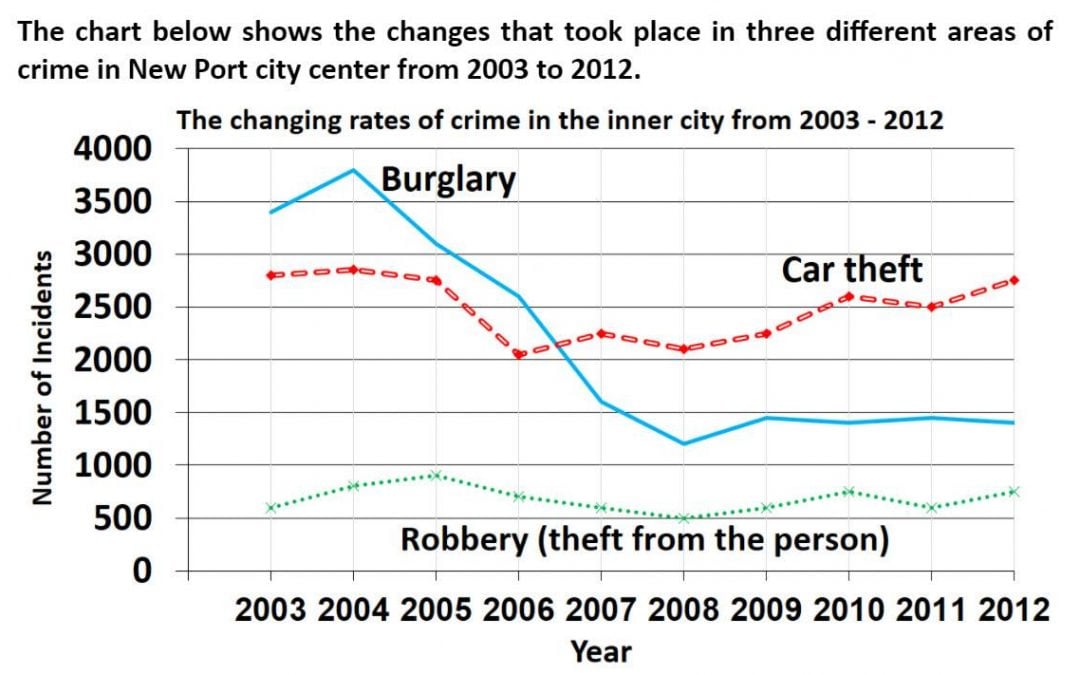
The line chart displays data concerning robberies, car thefts, and burglaries from 2003 to 2012 in New Port city center. Looking from an overall perspective, it is readily apparent that burglaries declined dramatically and were replaced as the most common crime by car thefts, which fell slightly overall. Robberies were least common throughout yet also rose marginally.
In 2003, burglaries were prevalent at a rate of nearly 3,500 per year. This number then peaked at 3,750 the next year before dropping considerably to a nadir of 1,100 in 2008 and remaining generally around this level until the end of the period. In contrast, car thefts began the period lower (2,800), dipped to 2000 in 2006 and rose with minor fluctuations to 2,750 by 2012.
The least common crime was robbery. Statistics indicated just over 500 robberies in 2003 and incidences remained under 1000 the entire time surveyed, finishing at 750 in 2012.
Analysis
1. The line chart displays data concerning robberies, car thefts, and burglaries from 2003 to 2012 in New Port city center. 2. Looking from an overall perspective, it is readily apparent that burglaries declined dramatically and were replaced as the most common crime by car thefts, which fell slightly overall. 3. Robberies were least common throughout yet also rose marginally.
Paraphrase what the bar chart shows.
Write a clear overview summarising the differences.
You might need another sentence for your overview.
1. In 2003, burglaries were prevalent at a rate of nearly 3,500 per year. 2. This number then peaked at 3,750 the next year before dropping considerably to a nadir of 1,100 in 2008 and remaining generally around this level until the end of the period. 3. In contrast, car thefts began the period lower (2,800), dipped to 2000 in 2006 and rose with minor fluctuations to 2,750 by 2012.
Begin writing about the data for the first categories.
Make sure you compare as much as possible.
Vary long and short sentences.
1. The least common crime was robbery. 2. Statistics indicated just over 500 robberies in 2003 and incidences remained under 1000 the entire time surveyed, finishing at 750 in 2012.
Write about the final other parts of the graph –
include everything!
Vocabulary
What do the words in bold below mean?Take some notes on a piece of paper to aid your memory:
The line chart displays data concerning robberies, car thefts, and burglaries from 2003 to 2012 in New Port city center. Looking from an overall perspective, it is readily apparent that burglaries declined dramatically and were replaced as the most common crime by car thefts, which fell slightly overall. Robberies were least common throughout yet also rose marginally.
In 2003, burglaries were prevalent at a rate of nearly 3,500 per year. This number then peaked at 3,750 the next year before dropping considerably to a nadir of 1,100 in 2008 and remaining generally around this level until the end of the period. In contrast, car thefts began the period lower (2,800), dipped to 2000 in 2006 and rose with minor fluctuations to 2,750 by 2012.
The least common crime was robbery. Statistics indicated just over 500 robberies in 2003 and incidences remained under 1000 the entire time surveyed, finishing at 750 in 2012.
Answers
Try to write down or think of an antonym/opposite word for further practice:
displays shows
data numbers
concerning relating to
robberies taking money from a store
car thefts stealing a car
burglaries taking from a person
city center inner city
Looking from an overall perspective, it is readily apparent that overall
declined dramatically fell a lot
replaced took the place of
most common crime most prevalent offense
car thefts stealing cars
fell slightly overall went down a little by the end
least common throughout didn’t happen as much the whole time
yet so far
rose marginally increased a little
prevalent at a rate of nearly common to the level of
per each
peaked rose to the top at
dropping considerably fell a lot
nadir low point
remaining generally around this level staying at about the same point
until the end of the period until 2012
In contrast however
began started
period lower time less than
dipped fell to
rose with minor fluctuations to increased with erratic changes
indicated showed
incidences remained under offenses stayed less than
Remember and fill in the blanks. Note it on a piece of paper so you can remember better:
The line chart d_________s d____a c__________g r_________s, c__________s, and b__________s from 2003 to 2012 in New Port c____________r. L___________________________________________________________________t burglaries d__________________y and were r___________d as the m______________e by c___________s, which f_____________________l. Robberies were l___________________________t also r________________y.
In 2003, burglaries were p___________________y 3,500 p___r year. This number then p_____d at 3,750 the next year before d___________________y to a n______r of 1,100 in 2008 and r_______________________________________________________d. I______________t, car thefts b_______n the p_______________r (2,800), d___________d to 2000 in 2006 and r_______________________________o 2,750 by 2012.
The least common crime was robbery. Statistics i_____________d just over 500 robberies in 2003 and i___________________________r 1000 the e___________________d, f___________t 750 in 2012.
Listening Practice
Listen to the related topic below and practice with these activities:
This is an IELTS writing task 2 sample answer essay on the topic of the present moment from the real IELTS recent exam.
Please consider supporting me on Patreon.com/howtodoielts to receive my full, exclusive IELTS Ebooks!
Dave
IELTS Essay: The Present Moment
Some people think that enjoying the present is more important than planning for the future for both countries and individuals.
To what extent do you agree or disagree?
Many feel that being fully present in the moment is more valuable than thinking of the future in terms of both nations and their residents. In my opinion, this claim is untrue and shortsighted.
Firstly, countries must look to the future to ensure the safe flourishing of all citizens. A country that simply looks to maximize current moments might make unwise decisions that could quickly have catastrophic repercussions. A well-known example of this would be the actions not taken by the United States government in the build-up to The Great Recession of 2007 – 2009. Authorities and governing bodies ignored the over-leveraging of assets and the potential for foreclosures on real estate properties. When the worst scenario occurred, the result was that millions lost their homes and the entire world plunged into a period of stagnation. This same principle applies generally beyond economics and includes the military, medicine, social welfare, and so on.
Secondly, the average person can best attain quality living standards through careful preparation. Admittedly, this can lead to anxiety and a feeling of dissociation with reality. These potential byproducts nonetheless pale in comparison to the risk of not providing for one’s future. For instance, a person who does not study hard in school or apply themselves fully to their career is likely to always face financial pressure. This pressure will itself engender anxiety. In extreme situations, such a person may fail to integrate productively with society. In contrast, someone who thinks about the future, invests wisely, and makes logical decisions is more likely to achieve a sense of happiness and fulfillment.
In conclusion, looking to the future guarantees a higher standard of living and the preservation of various national benefits. Countries in particular must always prioritize consideration of future threats.
Analysis
1. Many feel that being fully present in the moment is more valuable than thinking of the future in terms of both nations and their residents. 2. In my opinion, this claim is untrue and shortsighted.
Paraphrase the overall essay topic.
Write a clear opinion. Read more about introductions here.
1. Firstly, countries must look to the future to ensure the safe flourishing of all citizens. 2. A country that simply looks to maximize current moments might make unwise decisions that could quickly have catastrophic repercussions. 3. A well-known example of this would be the actions not taken by the United States government in the build-up to The Great Recession of 2007 – 2009. 4. Authorities and governing bodies ignored the over-leveraging of assets and the potential for foreclosures on real estate properties. 5. When the worst scenario occurred, the result was that millions lost their homes and the entire world plunged into a period of stagnation. 6. This same principle applies generally beyond economics and includes the military, medicine, social welfare, and so on.
Write a topic sentence with a clear main idea at the end.
Explain your main idea.
Develop it with specific or hypothetical examples.
Keep developing it fully.
Vary long and short sentences.
Make sure you generalize if your example is too specific.
1. Secondly, the average person can best attain quality living standards through careful preparation. 2. Admittedly, this can lead to anxiety and a feeling of dissociation with reality. 3. These potential byproducts nonetheless pale in comparison to the risk of not providing for one’s future. 4. For instance, a person who does not study hard in school or apply themselves fully to their career is likely to always face financial pressure. 5. This pressure will itself engender anxiety. 6. In extreme situations, such a person may fail to integrate productively with society. 7. In contrast, someone who thinks about the future, invests wisely, and makes logical decisions is more likely to achieve a sense of happiness and fulfillment.
Write a new topic sentence with a new main idea at the end.
Explain your new main idea.
Include specific details and examples.
Add as much information as you can and make sure it links logically.
Develop the example fully.
State the results as well.
Conclude strong.
1. In conclusion, looking to the future guarantees a higher standard of living and the preservation of various national benefits. 2. Countries in particular must always prioritize consideration of future threats.
Summarise your main ideas.
Include a final thought. Read more about conclusions here.
Vocabulary
What do the words in bold below mean?Make some notes on paper to aid memory and then check below.
Many feel that being fully presentin the moment is more valuable than thinking of the future in terms of both nations and their residents. In my opinion, this claim is untrue and shortsighted.
Firstly, countries must look to the future to ensure the safe flourishing of all citizens. A country that simply looks to maximize current moments might make unwise decisions that could quickly have catastrophic repercussions. A well-known example of this would be the actions not taken by the United States government in the build-up to The Great Recession of 2007 – 2009. Authorities and governing bodiesignored the over-leveraging of assets and the potential for foreclosures on real estate properties. When the worst scenario occurred, the result was that millions lost their homes and the entire world plunged into a period of stagnation. This same principle applies generally beyond economics and includes the military, medicine, social welfare, and so on.
Secondly, the average person can best attain quality living standardsthrough careful preparation. Admittedly, this can lead to anxiety and a feeling of dissociation with reality. These potential byproducts nonethelesspale in comparison to the risk of not providing for one’s future. For instance, a person who does not study hard in school or apply themselves fully to their career is likely to always face financial pressure. This pressure will itself engender anxiety. In extreme situations, such a person may fail tointegrate productively with society. In contrast, someone who thinks about the future, invests wisely, and makes logical decisions is more likely to achieve asense of happiness and fulfillment.
In conclusion, looking to the future guarantees a higher standard of living and the preservation of various national benefits. Countries in particular must always prioritize consideration of future threats.
Answers
For extra practice, write an antonym (opposite word) on a piece of paper to help you remember the new vocabulary:
fully presentin the moment not thinking about the future
valuable has importance
in terms of concerning
nations countries
residents citizens
claim argue
untrue not true
shortsighted not looking to the future
look to the future thinking of later
ensure make sure of
safe flourishing no danger and getting better
citizens people of a country
simply merely
maximize current moments make the most of right now
make unwise decisions made bad choices
quickly fast
catastrophic repercussions really bad results
A well-known example of this would be a famous instance is
actions steps
build-up period before
The Great Recession of 2007 – 2009 financial crisis of 2008
authorities people in charge
governing bodiesignored people in charge didn’t pay attention to
over-leveraging investing too much
assets money, capital, property, etc.
potential possible
foreclosures homes being lost
real estate properties homes
worst scenario occurred bad thing happened
lost their homes houses foreclosed on
entire world whole Earth
plunged into feel deep into
a period of stagnation time of no growth
principle rule
beyond economics not just the money made in a country
includes applies for
military armies
medicine hospitals
social welfare taking care of people
and so on etc.
average person normal resident
best attain quality living standards live their best lives
through careful preparation thinking ahead
admittedly it is true that
anxiety nervousness
dissociation not connecting to
reality the real world
potential products possible items
nonetheless regardless
pale in comparison not as important as
risk threat
providing for supporting
apply themselves fully to their career work hard
face financial pressure have money trobles
engender anxiety make them feel nervous
In extreme situations in some cases
fail tointegrate productively don’t join in a good way
In contrast however
invests wisely put money in stocks, property
makes logical decisions choose well
achieve asense of happiness and fulfillment feel good about their lives
guarantees makes sure of
higher standard of living quality of life
preservation keeping alive
various national benefits good things for the country
in particular especially
prioritize consideration make more important caring about
I recommend getting a pencil and piece of paper because that aids memory. Then write down the missing vocabulary from my sample answer in your notebook:
Many feel that being f_________________________t is more v____________e than thinking of the future i______________f both n___________s and their r__________s. In my opinion, this c_____m is u_______e and s____________d.
Firstly, countries must l________________e to e_______e the s_____________g of all c_________s. A country that s_______y looks to m__________________s might m_________________________s that could q_______y have c________________________s. A_________________________________e the a________s not taken by the United States government in the b________p to T___________________________________9. A____________s and g_________________________d the o__________________g of a_________s and the p_________l for f_____________s on r______________________s. When the w____________________d, the result was that millions l___________________s and the e____________________________________________n. This same p__________e applies generally b_______________s and i__________s the m_______y, m________e, s_____________e, a____________n.
Secondly, the a_______________n can b___________n q_________________________st______________________n. A____________y, this can lead to a__________y and a feeling of d______________n with r________y. These p____________________s n___________sp____________________n to the r____k of not p______________r one’s future. For instance, a person who does not study hard in school or a____________________________r is likely to always f____________________________e. This pressure will itself e________________y. I____________________s, such a person may f___________________________y with society. I______________t, someone who thinks about the future, i______________y, and m_______________________s is more likely to a_________________________________________t.
In conclusion, looking to the future g____________s a h______________________g and the p___________n of v__________________________s. Countries i________________r must always p_______________________n of future t_________s.
Listening Practice
Learn more about this topic by watching videos from The New York Times YouTube channel below and practice with these activities:
"The highest quality materials anywhere on the internet! Dave improved my writing and vocabulary so much. Really affordable options you don't want to miss out on!"