This is an IELTS writing task 1 sample answer essay on the topic of various energy sources from the real IELTS exam.
Find all the most recent task 1 topics here and my full IELTS Ebooks here and my online courses here.
Dave
IELTS Essay Task 1: Pie Charts Energy
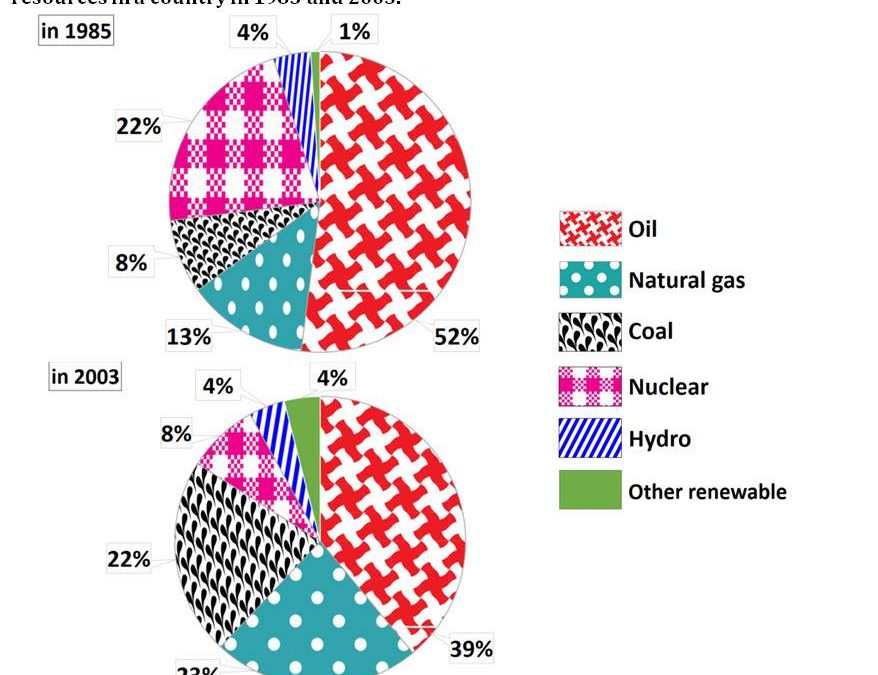
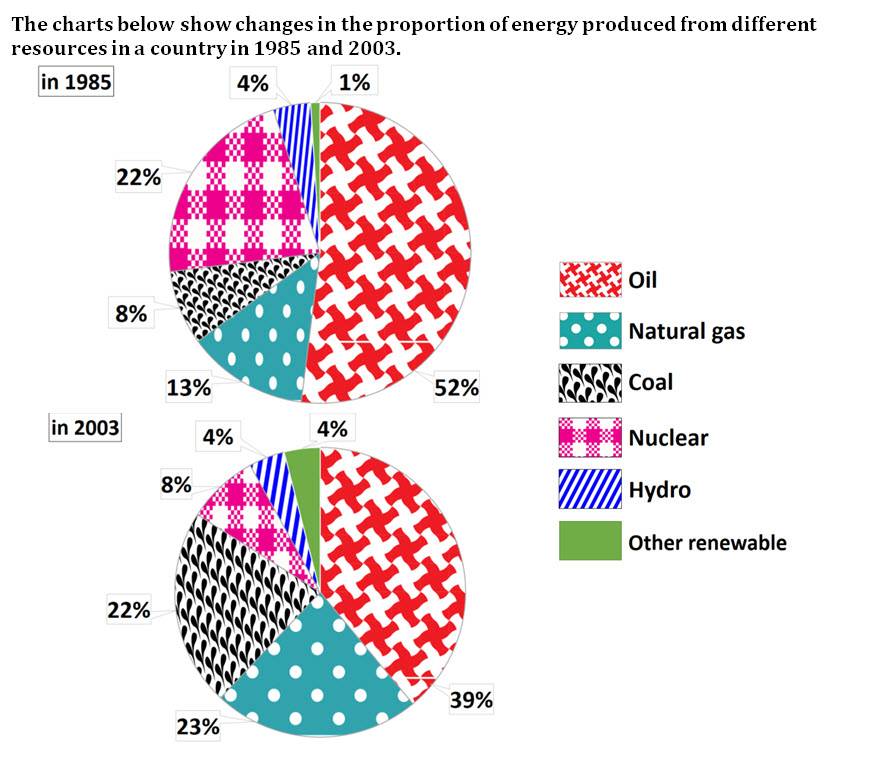
The pie charts display the sources of energy production in 1985 and 2003. Looking from an overall perspective, it is clear that in 1985 the majority of energy came from primarily oil followed by nuclear power, natural gas, and coal with cleaner energy sources rarer. By 2003, renewables became slightly more common or remained level, the use of oil decreased but was still the most used, while both coal and natural gas underwent the largest increases.
In 1985, oil represented 52% of all energy sourced, though this figure had declined to 39% by 2003. Nuclear power, which was the second most pervasive energy source in 1985 at 22%, had the steepest fall to just 8% in 2003. In contrast, natural gas rose from 13% to 23% and coal nearly tripled to 22%.
In terms of the cleaner energy sources, hydro power represented 4% of total usage in both years while other renewables quadrupled from 1% in 1985 to 4% in 2003.
Analysis
1. The pie charts display the sources of energy production in 1985 and 2003. 2. Looking from an overall perspective, it is clear that in 1985 the majority of energy came from primarily oil followed by nuclear power, natural gas, and coal with cleaner energy sources rarer. 3. By 2003, renewables became slightly more common or remained level, the use of oil decreased but was still the most used, while both coal and natural gas underwent the largest increases.
Paraphrase what the bar chart shows.
Write a clear overview summarising the differences.
You might need another sentence for your overview.
1. In 1985, oil represented 52% of all energy sourced, though this figure had declined to 39% by 2003. 2. Nuclear power, which was the second most pervasive energy source in 1985 at 22%, had the steepest fall to just 8% in 2003. 3. In contrast, natural gas rose from 13% to 23% and coal nearly tripled to 22%.
Begin writing about the data for the first categories.
Make sure you compare as much as possible.
Vary long and short sentences.
1. In terms of the cleaner energy sources, hydro power represented 4% of total usage in both years while other renewables quadrupled from 1% in 1985 to 4% in 2003.
Write about the final other parts of the graph – include everything!
Vocabulary
What do the words in bold below mean?Take some notes on a piece of paper to aid your memory:
The pie charts display the sources of energy production in 1985 and 2003. Looking from an overall perspective, it is clear that in 1985 the majority of energy came from primarily oil followed by nuclear power, natural gas, and coal with cleaner energy sources rarer. By 2003, renewables became slightly more common or remained level, the use of oil decreased but was still the most used, while both coal and natural gas underwent the largest increases.
In 1985, oil represented 52% of all energy sourced, though this figure had declined to 39% by 2003. Nuclear power, which was the second most pervasive energy source in 1985 at 22%, had the steepestfall to just 8% in 2003. In contrast, natural gas rose from 13% to 23% and coal nearly tripled to 22%.
In terms of the cleaner energy sources, hydro power represented 4% of total usage in both years while other renewables quadrupled from 1% in 1985 to 4% in 2003.
Answers
Try to write down or think of an antonym/opposite word for further practice:
display show
sources origins
energy production making energy, electricity, etc.
Looking from an overall perspective, it is clear that overall
majority most of
primarily mainly
followed by after that
nuclear power power from nuclear plants and radiation
natural gas a source of heat and power deep in the ground
coal a black rock used for power
cleaner energy sources renewable energies like solar, wind, etc.
Remember and fill in the blanks. Note it on a piece of paper so you can remember better:
The pie charts d_________y the s____________s of e________________n in 1985 and 2003. L______________________________________________t in 1985 the m___________y of energy came from p_________y oil f_____________yn_____________r, n______________s, and c_____l with c____________________s r______r. By 2003, r__________s became s_______________________n or r_______________l, the use of oil decreased but was still the most used, while both coal and natural gas u___________t the largest increases.
In 1985, oil r_____________d 52% of all energy sourced, though this figure had d________d to 39% by 2003. Nuclear power, which was the second most p___________e energy source in 1985 at 22%, had the s_________t fall to just 8% in 2003. I_______________t, natural gas rose from 13% to 23% and coal n___________d to 22%.
I_____________f the cleaner energy sources, hydro power represented 4% of t____________e in both years while other renewables q____________d from 1% in 1985 to 4% in 2003.
Listening Practice
Listen to the related topic below and practice with these activities:
This is an IELTS writing task 2 sample answer essay on the topic of information technology from the real IELTS recent exam.
Please consider supporting me on Patreon.com/howtodoielts to receive my full, exclusive IELTS Ebooks! My online video subscription courses are also available here.
Dave
IELTS Essay: Information Technology
Information technology is changing many aspects of our lives and now dominates our home, leisure and work activities.
To what extent do the benefits of information technology outweigh the disadvantages?
Some today would argue that the revolution in information technology has a pernicious impact generally. In my opinion, the drawbacks related to social interaction do not outweigh the positive possibilities now available to the average person.
The legitimately worrying disadvantages to information technology concern interpersonal relationships. In the past, social interactions in person were more common. Today, a majority of conversations take place through messaging apps and on social media. The short-term result is that communication skills are in decline. The longer-term implications will create wider social trends. As people interact and form groups online they are more prone to groupthink and radicalization. What would normally be mitigated by one’s circle of friends and families, can now grow unabated in the virtual sphere with possible negative results for all of society.
The main advantages of the current age are increases in what is possible. These possibilities are most basically conveniences. Users can save time by taking advantage of their phones to send emails, make calls, organize their day and undertake a variety of other tasks. As technology evolves, it has even become more common for employees to work remotely and therefore conserve time and energy commuting to and from the office. Beyond these simple comforts, people are able to accomplish more with digital devices. This includes the ability to write with word processors, edit video on various applications, and then post and interact with a global audience through the internet and sites such as YouTube.
In conclusion, despite the threat of a less socially active world, there are justifying benefits concerning human potentiality. Both the positives and negatives must be weighed and managed carefully.
Analysis
1. Some today would argue that the revolution in information technology has a pernicious impact generally. 2. In my opinion, the drawbacks related to social interaction do not outweigh the positive possibilities now available to the average person.
Paraphrase the overall essay topic.
Write a clear opinion. Read more about introductions here.
1. The legitimately worrying disadvantages to information technology concern interpersonal relationships. 2. In the past, social interactions in person were more common. 3. Today, a majority of conversations take place through messaging apps and on social media. 4. The short-term result is that communication skills are in decline. 5. The longer-term implications will create wider social trends. 6. As people interact and form groups online they are more prone to groupthink and radicalization. 7. What would normally be mitigated by one’s circle of friends and families, can now grow unabated in the virtual sphere with possible negative results for all of society.
Write a topic sentence with a clear main idea at the end.
Explain your main idea.
Develop it with specific or hypothetical examples.
Keep developing it fully.
Vary long and short sentences.
Keep adding more detail.
Finish development.
1. The main advantages of the current age are increases in what is possible. 2. These possibilities are most basically conveniences. 3. Users can save time by taking advantage of their phones to send emails, make calls, organize their day and undertake a variety of other tasks. 4. As technology evolves, it has even become more common for employees to work remotely and therefore conserve time and energy commuting to and from the office. 5. Beyond these simple comforts, people are able to accomplish more with digital devices. 6. This includes the ability to write with word processors, edit video on various applications, and then post and interact with a global audience through the internet and sites such as YouTube.
Write a new topic sentence with a new main idea at the end.
Explain your new main idea.
Include specific details and examples.
Add as much information as you can and make sure it links logically.
Develop the example fully.
State the results as well.
1. In conclusion, despite the threat of a less socially active world, there are justifying benefits concerning human potentiality. 2. Both the positives and negatives must be weighed and managed carefully.
Summarise your main ideas.
Include a final thought. Read more about conclusions here.
Vocabulary
What do the words in bold below mean?Make some notes on paper to aid memory and then check below.
Some today would argue that the revolution in information technology has a pernicious impact generally. In my opinion, the drawbacks related to social interaction do not outweigh the positive possibilities now available to the average person.
The legitimately worrying disadvantages to information technology concerninterpersonal relationships. In the past, social interactions in person were more common. Today, a majority of conversations take place through messaging apps and on social media. The short-term result is that communication skills are in decline. The longer-term implications will create wider social trends. As people interact and form groupsonline they are more prone to groupthink and radicalization. What would normally be mitigated by one’s circle of friends and families, can now grow unabated in the virtual sphere with possible negative results for all of society.
The main advantages of the current age are increases in what is possible. These possibilities are most basically conveniences. Users can save time by taking advantage of their phones to send emails, make calls, organize their day and undertake a variety of other tasks. As technology evolves, it has even become more common for employees to work remotely and therefore conserve time and energy commuting to and from the office. Beyond these simple comforts, people are able to accomplish more with digital devices. This includes the ability to write with word processors, edit video on various applications, and then post and interact with a global audience through the internet and sites such as YouTube.
In conclusion, despite the threat of a less socially active world, there are justifying benefits concerning human potentiality. Both the positives and negatives must be weighed and managed carefully.
Answers
For extra practice, write an antonym (opposite word) on a piece of paper to help you remember the new vocabulary:
argue claim
revolution big change
information technology internet, computers, etc.
pernicious impact bad effect
generally overall
drawbacks downsides
related to concerning
social interaction people talking
outweigh stronger than
positive possibilities good opportunities
available can happen
legitimately worrying disadvantages real dangerous downsides
concerninterpersonal relationships have to do with people interacting
common happens a lot
majority most of
take place happen
messaging apps Facebook messenger, ios messenger, etc.
social media Facebook, Instagram, TikTok, etc.
short-term result not that far in the future
communication skills talking to people
in decline getting worse
longer-term implications in the future ramifications
wider social trends patterns for all of society
form groupsonline become part of online communities
more prone to groupthink more likely to think the same as others
radicalization becoming extreme
normally in most cases
mitigated weakened
circle of friends people around you
grow unabated increase with no limits
virtual sphere online world
possible potential
results effects
current age nowadays
possibilities potential chances
most basically conveniences essentially make life easier
users people using services
taking advantage of exploiting
organize order
undertake do
variety different kinds
tasks objectives
evolves changes
work remotely work from home
therefore thus
conserve maintain
commuting traveling to work or school
beyond these simple comforts past these conveniences
accomplish get done
digital devices phones, computers, etc.
includes concerns
word processors MS word, Google docs, etc.
edit video work with video files
various different kinds of
post put online
interact with talk with
global audience the whole world
despite regardless of
threat risk
less socially active world people communicating less and less
I recommend getting a pencil and piece of paper because that aids memory. Then write down the missing vocabulary from my sample answer in your notebook:
Some today would a______e that the r____________n in i_____________________y has a p_______________________________y. In my opinion, the d______________s r____________o s________________________n do not o________________h the p_____________________s now a_____________e to the average person.
The l_____________________________________s to information technology c__________ni______________________________s. In the past, social interactions in person were more c______n. Today, a m__________y of conversations t__________e through m____________________s and on s_______________a. The s___________________t is that c________________________s are i____________e. The l________________________s will create w__________________s. As people interact and f______________________e they are m________________o g_______________k and r________________n. What would n____________y be m_____________d by one’s c_________________s and families, can now g____________________d in the v_________________e with p______________e negative r__________s for all of society.
The main advantages of the c_________________e are increases in what is possible. These p______________s are m_______________________________s. U______s can save time by t_________________________f their phones to send emails, make calls, o____________e their day and u___________e a v_______y of other t_______s. As technology e__________s, it has even become more common for employees to w________________y and t___________e c__________e time and energy c__________g to and from the office. B_______________________________s, people are able to a_____________h more with d_______________s. This i__________s the ability to write with w____________________s, e_____________o on v__________s applications, and then p____t and i________________h a g____________e through the internet and sites such as YouTube.
In conclusion, d_________e the t________t of a l__________________________d, there are j___________g benefits c____________g human p_____________y. Both the positives and negatives must be weighed and m_____________________y.
Listening Practice
Learn more about this topic by watching videos from The New York Times YouTube channel below and practice with these activities:
This is an IELTS writing task 1 sample answer essay on the topic of a bar chart showing airline ticket prices from the real IELTS exam.
Find all the most recent task 1 topics here and my full IELTS Ebooks here and my online courses here.
Dave
IELTS Essay Task 1: Visitors to the UK Spending Table
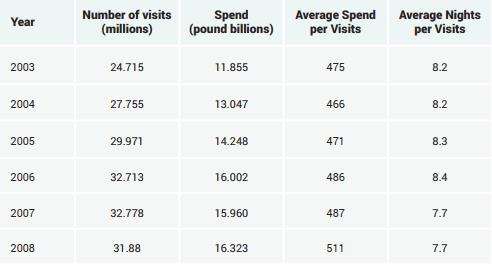
The table below shows the number of visitors in the UK and their average spending from 2003 to 2008.
The table displays information regarding visitors, spending and the length of their trip to the UK from 2003 to 2008. Looking from an overall perspective, it is readily apparent that overall visits, total spending, and average spending rose considerably with only average nights per visit falling towards the end of the period. The largest growth proportionally was for total spending.
Looking first of all at quantity of visits, there were 24,715,000 million travellers to the UK in 2003 and this figure climbed steadily by around 2 to 3 million each year until 2006 when it plateaued at about 32 million before receding slightly to 31.8 million to finish the time surveyed. Similarly, average spending in billions of pounds rose sharply from 11.855 to a 16.002 in 2006, then leveled off and, in contrast, rebounded marginally to finish the period at 16.323.
In terms of average spending, this figure began at 475 pounds in 2003, declined moderately to 266 the next year and then rose consistently to conclude with a final surge to 511 in 2008. The only data to decline was average nights per visit which began at 8.2 in 2003, remained level for a year and then rose by .1 each year until 2006, before a sudden drop to 7.7 nights in 2007 and 2008.
Analysis
1. The table displays information regarding visitors, spending and the length of their trip to the UK from 2003 to 2008. 2. Looking from an overall perspective, it is readily apparent that overall visits, total spending, and average spending rose considerably with only average nights per visit falling towards the end of the period. 3. The largest growth proportionally was for total spending.
Paraphrase what the table shows.
Write a clear overview summarising the differences.
You might need another sentence for your overview.
1. Looking first of all at quantity of visits, there were 24,715,000 million travellers to the UK in 2003 and this figure climbed steadily by around 2 to 3 million each year until 2006 when it plateaued at about 32 million before receding slightly to 31.8 million to finish the time surveyed. 2. Similarly, average spending in billions of pounds rose sharply from 11.855 to a 16.002 in 2006, then leveled off and, in contrast, rebounded marginally to finish the period at 16.323.
Begin writing about the data for the first categories.
Make sure you compare as much as possible.
1. In terms of average spending, this figure began at 475 pounds in 2003, declined moderately to 266 the next year and then rose consistently to conclude with a final surge to 511 in 2008. 2. The only data to decline was average nights per visit which began at 8.2 in 2003, remained level for a year and then rose by .1 each year until 2006, before a sudden drop to 7.7 nights in 2007 and 2008.
Write about the final other parts of the graph – include everything!
Compare the categories.
Vocabulary
What do the words in bold below mean?Take some notes on a piece of paper to aid your memory:
The table displays information regarding visitors, spending and the length of their trip to the UK from 2003 to 2008. Looking from an overall perspective, it is readily apparent that overall visits, total spending, and average spending rose considerably with only average nights per visitfalling towards the end of the period. The largest growth proportionally was for total spending.
Looking first of all at quantity of visits, there were 24,715,000 million travellers to the UK in 2003 and this figure climbed steadily by around 2 to 3 million each year until 2006 when it plateaued at about 32 million before receding slightly to 31.8 million to finish the time surveyed. Similarly, average spending in billions of pounds rose sharply from 11.855 to a 16.002 in 2006, then leveled off and, in contrast, rebounded marginally to finish the period at 16.323.
In terms of average spending, this figure began at 475 pounds in 2003, declined moderately to 266 the next year and then rose consistently to conclude with a final surge to 511 in 2008. The only data to decline was average nights per visit which began at 8.2 in 2003, remained level for a year and then rose by .1 each year until 2006, before a sudden drop to 7.7 nights in 2007 and 2008.
Answers
Try to write down or think of an antonym/opposite word for further practice:
displays information gives data
regarding concerning
visitors people going there
spending money spent
length how long
trip visit
the UK the United Kingdom
Looking from an overall perspective, it is readily apparent that overall overall
average per each person
rose considerably grew a lot
average nights per visitfalling days stayed on the trip declining
towards the end of the period at the conclusion of the time detailed
largest growth proportionally rose the most in comparison
Remember and fill in the blanks. Note it on a piece of paper so you can remember better:
The table d_______________________n r_____________g v__________s, s_________g and the l______h of their t____p to t_______K from 2003 to 2008. L__________________________________________________l visits, total spending, and a__________e spending r____________________y with only a_______________________tf_________g t______________________d. The l____________________________y was for total spending.
L________________________t q__________y of visits, there were 24,715,000 million t____________s to the UK in 2003 and this figure c___________________y by around 2 to 3 million each year u______l 2006 when it p___________d at about 32 million before r__________________y to 31.8 million to f_________h the t_________________d. S____________y, average spending in billions of pounds r_______________y from 11.855 to a 16.002 in 2006, then l______________f and, i______________t, r______________________y to f_____________________t 16.323.
I_____________f average spending, this figure began at 475 pounds in 2003, d_____________________y to 266 the next year and then r______________y to c____________e with a f___________e to 511 in 2008. The only d____a to decline was average nights per visit which began at 8.2 in 2003, r______________l for a year and then rose by .1 each year until 2006, before a s_____________p to 7.7 nights in 2007 and 2008.
Listening Practice
Listen to the related topic below and practice with these activities:
This is an IELTS writing task 2 sample answer essay on the topic of national identity from the real exam.
Please consider supporting me on Patreon.com/howtodoielts to receive my full, exclusive IELTS Ebooks! My online video subscription courses are also available here.
Dave
IELTS Essay: National Identity
Some think increasing business and cultural contact between nations is positive. Others think it leads to the disappearance of the national identity.
Discuss both views and state your own opinion.
Many feel that the effects of globalization on economics and culture are a beneficial. In my opinion, although there is an argument for the financial implications, the risks to the uniqueness of a national identity make it a negative overall.
Supporters of such close contact point out the meaningful economic ramifications. This is particularly important for more isolated and undeveloped nations. There are countries where natural resources are extremely lacking or unbalanced and this has slowed their progress historically. For instance, many countries in the Middle East lack the arable land to support large population growth. The discovery of vast reserves of oil in the 20th century allowed them to exploit trade agreements to improve their economic outlook and basic infrastructure. This same fact applies to varying degrees to nearly all nations as trade enriches and a country without necessarily creating any negative byproducts.
Nonetheless, the danger for culture is more lasting and therefore more significant. The national identity of a country is not simply made up of the dominant ethnic group. Every country has minorities and ethnic populations that are most at risk through this process. For instance, in many parts of Asia and Africa there are numerous indigenous groups that struggle to flourish in a modern, global economy. For instance, the Hmong in Vietnam are famed for their craftsmanship and attention to detail in hand-weaving and dyeing sustainable clothing yet many of them must now abandon their traditional roots to live in cities and work anonymous jobs for large corporations. Once such cultures are lost, they will never return and the economic benefits will be little comfort at that point.
In conclusion, despite the economic advantages of globalization, the possibility of a country losing its individual cultural character is too great a risk. Countries must therefore take steps to safeguard their culture.
Analysis
1. Many feel that the effects of globalization on economics and culture are a beneficial. 2. In my opinion, although there is an argument for the financial implications, the risks to the uniqueness of a national identity make it a negative overall.
Paraphrase the overall essay topic.
Write a clear opinion. Read more about introductions here.
1. Supporters of such close contact point out the meaningful economic ramifications. 2. This is particularly important for more isolated and undeveloped nations. 3. There are countries where natural resources are extremely lacking or unbalanced and this has slowed their progress historically. 4. For instance, many countries in the Middle East lack the arable land to support large population growth. 5. The discovery of vast reserves of oil in the 20th century allowed them to exploit trade agreements to improve their economic outlook and basic infrastructure. 6. This same fact applies to varying degrees to nearly all nations as trade enriches and a country without necessarily creating any negative byproducts.
Write a topic sentence with a clear main idea at the end.
Explain your main idea.
Develop it with specific or hypothetical examples.
Keep developing it fully.
Vary long and short sentences.
Finish development.
1. Nonetheless, the danger for culture is more lasting and therefore more significant. 2. The national identity of a country is not simply made up of the dominant ethnic group. 3. Every country has minorities and ethnic populations that are most at risk through this process. 4. For instance, in many parts of Asia and Africa there are numerous indigenous groups that struggle to flourish in a modern, global economy. 5. For instance, the Hmong in Vietnam are famed for their craftsmanship and attention to detail in hand-weaving and dyeing sustainable clothing yet many of them must now abandon their traditional roots to live in cities and work anonymous jobs for large corporations. 6. Once such cultures are lost, they will never return and the economic benefits will be little comfort at that point.
Write a new topic sentence with a new main idea at the end.
Explain your new main idea.
Include specific details and examples.
Add as much information as you can and make sure it links logically.
Develop the example fully.
State the results as well.
In conclusion, despite the economic advantages of globalization, the possibility of a country losing its individual cultural character is too great a risk. Countries must therefore take steps to safeguard their culture.
Summarise your main ideas.
Include a final thought. Read more about conclusions here.
Vocabulary
What do the words in bold below mean?Make some notes on paper to aid memory and then check below.
Many feel that the effects of globalization on economics and culture are a beneficial. In my opinion, although there is an argument for the financial implications, the risks to the uniqueness of a national identity make it a negative overall.
Supporters of such close contactpoint out the meaningful economic ramifications. This is particularly important for more isolated and undeveloped nations. There are countries where natural resources are extremely lacking or unbalanced and this has slowed their progress historically. For instance, many countries in the Middle East lack the arable land to support large population growth. The discovery of vast reserves of oil in the 20th century allowed them to exploit trade agreements to improve their economic outlook and basic infrastructure. This same fact applies to varying degrees to nearly all nations as trade enriches and a country without necessarily creating any negative byproducts.
Nonetheless, the danger for culture is more lasting and therefore more significant. The national identity of a country is not simply made up of the dominant ethnic group. Every country has minorities and ethnic populations that are most at risk through this process. For instance, in many parts of Asia and Africa there are numerous indigenous groups that struggle to flourish in a modern, global economy. For instance, the Hmong in Vietnam are famed for their craftsmanship and attention to detail in hand-weaving and dyeing sustainable clothingyet many of them must now abandon their traditional roots to live in cities and work anonymous jobs for large corporations. Once such cultures are lost, they will never return and the economic benefits will be little comfort at that point.
In conclusion, despite the economic advantages of globalization, the possibility of a country losing its individual cultural character is too great a risk. Countries must therefore take steps to safeguard their culture.
Answers
For extra practice, write an antonym (opposite word) on a piece of paper to help you remember the new vocabulary:
globalization countries trading and becoming more similar
economics the finances of a country
culture tradition, art, beliefs, etc.
beneficial advantageous
argument opinion
financial implications effects related to money
risks threats
uniqueness what’s special
national identity the character of a country
supporters people in favor of
close contact communicating closely
point out argue
meaningful economic ramifications important effects for the economy
particularly important especially crucial
isolated all alone
undeveloped nations countries that are not as developed
natural resources oil, timber, water, etc.
extremely lacking not having something
unbalanced not in equal proportions
slowed their progress historically kept them from developing in the past
lack don’t have
arable land land that can be farmed
support large population growth allow for lots of people
discovery finding out about
vast reserves large quantities
exploit trade agreements take advantage of pacts to trade
improve their economic outlook make the economy better
basic infrastructure roads, internet, electricity, schools, etc.
applies to varying degrees true to some extent
enriches makes better
without necessarily doesn’t have to
negative byproducts bad symptoms
nonetheless regardless
danger risk
lasting permanent
therefore thus
made up of constituted
dominant ethnic group main demographic
minorities smaller ethnic groups in a population
ethnic populations groups of people
at risk the threat of
numerous indigenous groups many original peoples
struggle have a tough time
flourish do better
modern contemporary
Hmong an ethnic group from Asia
famed for well-known for
craftsmanship how they make things
attention to detail care
hand-weaving making fabric by hand
dyeing sustainable clothing coloring fabric not using chemicals
yet however
abandon leave
traditional roots customs and history
anonymous lacking identity
large corporations big companies
will be little comfort at that point will no longer feel good
I recommend getting a pencil and piece of paper because that aids memory. Then write down the missing vocabulary from my sample answer in your notebook:
Many feel that the effects of g_____________n on e_____________s and c__________e are a b_____________l. In my opinion, although there is an a____________t for the f_______________________s, the r_____s to the u________________s of a n____________________y make it a negative overall.
S______________s of such c__________________tp_________________t the m______________________________s. This is p_______________________t for more i____________d and u______________________s. There are countries where n______________________s are e____________________g or u_______________d and this has s_______________________________y. For instance, many countries in the Middle East l_____k the a_____________d to s_________________________________h. The d___________y of v________________s of oil in the 20th century allowed them to e________________________s to i_____________________________________k and b_________________e. This same fact a_________________________s to nearly all nations as trade e___________s and a country w__________________y creating any n____________________s.
N_________________s, the d_________r for culture is more l__________g and t______________e more significant. The national identity of a country is not simply m_______________f the d_____________________p. Every country has m____________s and e_____________________s that are most a________k through this process. For instance, in many parts of Asia and Africa there are n_______________________s that s__________e to f________h in a m_________n, global economy. For instance, the H________g in Vietnam are f___________r their c________________p and a_____________________l in h_________________g and d_________________________________t many of them must now a_________n their t______________s to live in cities and work a________________s jobs for l______________________s. Once such cultures are lost, they will never return and the economic benefits w_____________________________________t.
In conclusion, despite the economic advantages of globalization, the p____________y of a country losing its individual cultural character is too great a risk. Countries must therefore t___________s to s___________d their culture.
Listening Practice
Learn more about this topic by watching videos from The New York Times YouTube channel below and practice with these activities:
"The highest quality materials anywhere on the internet! Dave improved my writing and vocabulary so much. Really affordable options you don't want to miss out on!"