This is an IELTS writing task 2 sample answer essay on the topic of wild animals in urban areas, towns, and cities from the real IELTS general training exam.
Please consider supporting me on Patreon.com/howtodoielts to receive my full, exclusive IELTS Ebooks – you can even sign up for private live lessons with me! My subscription online courses are also available here.
Many wild birds and animals live in towns and cities. Some people think that the wildlife should be protected. Some think that they should be removed.
Discuss both views and give your opinion.
Some believe that wild animals should not be allowed to live in urban areas. In my opinion, although these animals pose a threat to health and safety, they should remain as they contribute to the character of a city.
Those in favor of eliminating certain animal species argue they can be dangerous. It is common, for instance in various locales in New England, for deer to cause traffic accidents. However, the chances that a motorist is actually injured are extremely low. The more pressing threat relates to the species that often serve as carriers for infectious diseases. Rats are the best examples as they are prevalent in most cities and often transmit diseases. The most infamous instance being an outbreak of bubonic plague caused by rodents termed the Black Death that ravaged Europe in the 1300s.
Nonetheless, the examples above are exceptions and wild animals generally add to the identity of a city or town. There are cities in Asia where locals live in relative harmony with species of monkeys and wild birds. One of the more noteworthy examples of this would be Singapore. In Singapore, it is not uncommon to see rare species of monkeys, tropical birds and wild pigs. These animals are not only cherished by local residents but also serve as an attraction for tourists. The city has managed to control population numbers so that they do not become a nuisance while also allowing them to constitute a key element of the city’s unique charm.
In conclusion, despite potential for the spread of disease and a lack of general safety, the contributions of wild animals to the personality of a city justify their continued existence. Individuals will always have the option to move to areas where there is less wildlife if they are concerned.
Analysis
1. Some believe that wild animals should not be allowed to live in urban areas. 2. In my opinion, although these animals pose a threat to health and safety, they should remain as they contribute to the character of a city.
Paraphrase the overall essay topic.
Write a clear opinion. Read more about introductions here.
1. Those in favor of eliminating certain animal species argue they can be dangerous. 2. It is common, for instance in various locales in New England, for deer to cause traffic accidents. 3. However, the chances that a motorist is actually injured are extremely low. 4. The more pressing threat relates to the species that often serve as carriers for infectious diseases. 5. Rats are the best examples as they are prevalent in most cities and often transmit diseases. 6. The most infamous instance being an outbreak of bubonic plague caused by rodents termed the Black Death that ravaged Europe in the 1300s.
Write a topic sentence with a clear main idea at the end.
Explain your main idea.
Develop it with specific or hypothetical examples.
Keep developing it fully.
Very long and short sentences.
Make it as specific as possible.
1. Nonetheless, the examples above are exceptions and wild animals generally add to the identity of a city or town. 2. There are cities in Asia where locals live in relative harmony with species of monkeys and wild birds. 3. One of the more noteworthy examples of this would be Singapore. 4. In Singapore, it is not uncommon to see rare species of monkeys, tropical birds and wild pigs. 5. These animals are not only cherished by local residents but also serve as an attraction for tourists. 6. The city has managed to control population numbers so that they do not become a nuisance while also allowing them to constitute a key element of the city’s unique charm.
Write a new topic sentence with a new main idea at the end.
Explain your new main idea.
Include specific details and examples.
Add as much information as you can and make sure it links logically.
Develop the example fully.
Finish strong.
1. In conclusion, despite potential for the spread of disease and a lack of general safety, the contributions of wild animals to the personality of a city justify their continued existence. 2. Individuals will always have the option to move to areas where there is less wildlife if they are concerned.
Summarise your main ideas.
Include a final thought. Read more about conclusions here.
Vocabulary
What do the words in bold below mean?Make some notes on paper to aid memory and then check below.
Some believe that wild animals should not be allowed to live in urban areas. In my opinion, although these animals pose a threat to health and safety, they should remain as they contribute to the character of a city.
Those in favor of eliminating certain animal species argue they can be dangerous. It is common, for instance in various locales in New England, for deer to cause traffic accidents. However, the chances that a motorist is actually injured are extremely low. The more pressing threat relates to the species that often serve as carriers for infectious diseases. Rats are the best examples as they are prevalent in most cities and often transmit diseases. The most infamous instance being an outbreak of bubonic plague caused by rodentstermed the Black Death that ravaged Europe in the 1300s.
Nonetheless, the examples above are exceptions and wild animals generally add to the identity of a city or town. There are cities in Asia where locals live in relative harmony with species of monkeys and wild birds. One of the more noteworthy examples of this would be Singapore. In Singapore, it is not uncommon to see rare species of monkeys, tropical birds and wild pigs. These animals are not only cherishedby local residents but also serve as an attraction for tourists. The city has managed to control population numbers so that they do not become a nuisance while also allowing them to constitute a key element of the city’s unique charm.
In conclusion, despite potential for the spread of disease and a lack of general safety, the contributions of wild animals to the personality of a city justify their continued existence. Individuals will always have the option to move to areas where there is less wildlife if they are concerned.
Answers
For extra practice, write an antonym (opposite word) on a piece of paper to help you remember the new vocabulary:
allowed permitted
urban areas cities
pose a threat create problems
health and safety people feeling safe and not in danger
remain stay
contribute add to
character personality
those in favor of supporters of
eliminating destroying
species argue different types of animals claim
dangerous threatening
common happens a lot
various locales different places
cause traffic accidents cars hitting things
however but
motorist person driving
injured hurt
extremely low not much chance
pressing threat urgent problem
relates to concerning
serve as carriers for transport the disease
infectious diseases easily spread conditions
prevalent common
transmit diseases spread illness
infamous instance being notorious example was
outbreak occurrence of
bubonic plague a really infectious disease
caused by a result of
rodents rats and similar animals
termed the Black Death this was the name of the illness
ravaged destroyed by
1300s 1300 – 1400
nonetheless regardless
exceptions outliers
generally overall
identity personality
locals people living there
relative harmony comparable balance
One of the more noteworthy examples of this would be a good instance of this is
not uncommon common
rare species not common types of animals
tropical birds rare birds from hot climates
cherishedby cared a lot by
serve as an attraction be an important sight
tourists visitors
managed were able to
control population numbers keep the number of animals low
I recommend getting a pencil and piece of paper because that aids memory. Then write down the missing vocabulary from my sample answer in your notebook:
Some believe that wild animals should not be a__________d to live in u______________s. In my opinion, although these animals p_________________t to h____________________y, they should r__________n as they c_____________e to the c__________r of a city.
T___________________f e______________g certain animal s______________e they can be d_____________s. It is c__________n, for instance in v__________________s in New England, for deer to c__________________________s. H___________r, the chances that a m____________t is actually i_________d are e________________w. The more p___________________t r______________o the species that often s____________s c_____________r i____________________s. Rats are the best examples as they are p____________t in most cities and often t__________________s. The most i__________________________g an o__________k of b________________e c_____________y r________st__________d t_________________h that r____________d Europe in the 1_________s.
N_______________s, the examples above are e_____________s and wild animals g____________y add to the i___________y of a city or town. There are cities in Asia where l_______s live in r________________y with species of monkeys and wild birds. O___________________________________e Singapore. In Singapore, it is n________________n to see r________________s of monkeys, t___________________s and wild pigs. These animals are not only c_______________y local residents but also s__________________________________n for t________________s. The city has m___________d to c________________________________s so that they do not become a n_____________e while also allowing them to c______________e a k___________________t of the city’s u_________________m.
In conclusion, d___________________l for the s_______d of disease and a l____k of general safety, the contributions of wild animals to the personality of a city justify their c_____________________e. Individuals will always have the option to move to areas where there is less wildlife if they are c_____________d.
Listening Practice
Learn more about this topic by watching videos from The New York Times YouTube channel below and practice with these activities:
Practice with the related IELTS essay topic below:
Some people believe that wild animals should not be kept in zoos or other man-made environments as there is no longer a need for them in the 21st century.
This is an IELTS writing task 1 sample answer essay on the topic of a bar chart showing airline ticket prices from the real IELTS exam.
Find all the most recent task 1 topics here and my full IELTS Ebooks here and my online courses here.
Dave
IELTS Essay: Airline Ticket Prices
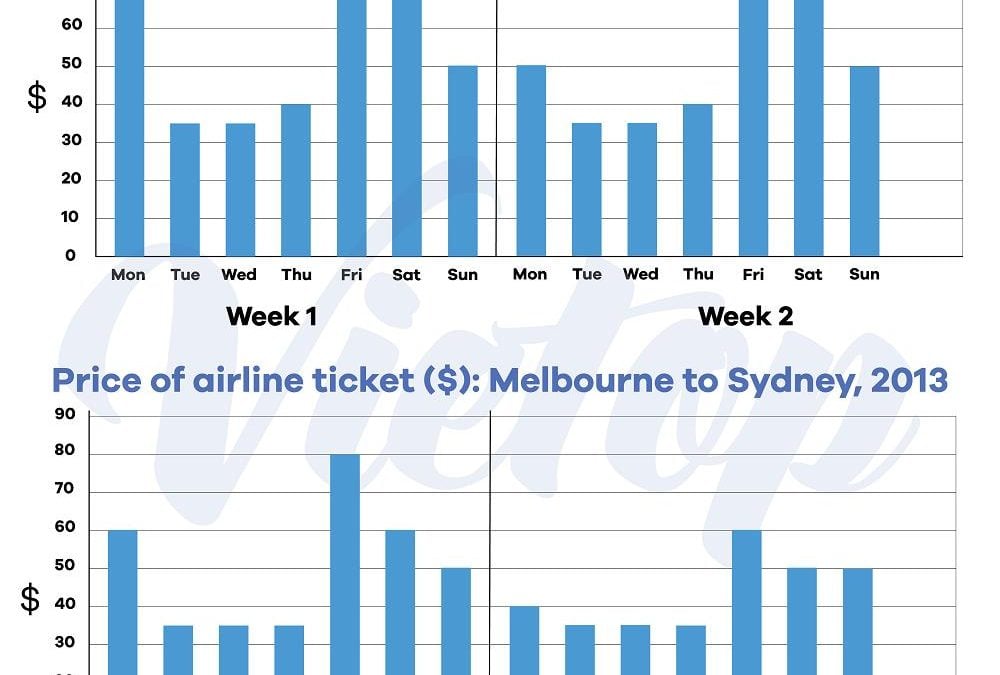
The charts below give information about the price of tickets on one airline between Sydney and Melbourne, Australia, over a two-week period in 2013.
The bar charts display information for the price of airline tickets from Sydney to Melbourne and the reverse flight over a two week period in 2013. Looking from an overall perspective, it is readily apparent that flights in both directions displayed broadly similar patterns with higher prices Friday through Monday. Compared to week 1, week 2 prices were either greatly deflated or identical for nearly all flights.
In week 1, flights from Sydney to Melbourne started at 80$ on Monday, were all under $40 over the next 3 days before a spike to $75, $70, and $50 on Friday, Saturday and Sunday, respectively. During the second week, the prices were unchanged with the notable exception of a decline on Monday to $50 fares.
In terms of flights from Melbourne to Sydney, the trend was comparable with flights on Monday of week 1 elevated to $60, sub-$40 flights on Tuesday, Wednesday, and Thursday and the most expensive flight on Friday at $80. Flights on Saturday and Sunday were also relatively costly at $60 and $50 each day. In week 2, Monday prices displayed a dramatic decline to $40 and there was more variance later in the week. Friday fell to $50 and Saturday to $50. All other tickets remained the same in week 2.
Analysis
1. The bar charts display information for the price of airline tickets from Sydney to Melbourne and the reverse flight over a two week period in 2013. 2. Looking from an overall perspective, it is readily apparent that flights in both directions displayed broadly similar patterns with higher prices Friday through Monday. 3. Compared to week 1, week 2 prices were either greatly deflated or identical for nearly all flights.
Paraphrase what the bar chart shows.
Write a clear overview summarising the differences.
You might need another sentence for your overview.
1. In week 1, flights from Sydney to Melbourne started at 80$ on Monday, were all under $40 over the next 3 days before a spike to $75, $70, and $50 on Friday, Saturday and Sunday, respectively. 2. During the second week, the prices were unchanged with the notable exception of a decline on Monday to $50 fares.
Begin writing about the data for the first categories.
Make sure you compare as much as possible.
Vary long and short sentences.
1. In terms of flights from Melbourne to Sydney, the trend was comparable with flights on Monday of week 1 elevated to $60, sub-$40 flights on Tuesday, Wednesday, and Thursday and the most expensive flight on Friday at $80. 2. Flights on Saturday and Sunday were also relatively costly at $60 and $50 each day. 3. In week 2, Monday prices displayed a dramatic decline to $40 and there was more variance later in the week. 4. Friday fell to $50 and Saturday to $50. All other tickets remained the same in week 2.
Write about the final other parts of the graph – include everything!
Compare the categories.
This is a tricky one, but try to group information too.
Finish with the rest of the data.
Vocabulary
What do the words in bold below mean?Take some notes on a piece of paper to aid your memory:
The bar charts display information for the price of airline tickets from Sydney to Melbourne and the reverse flightover a two week period in 2013. Looking from an overall perspective, it is readily apparent that flights in both directions displayed broadly similar patterns with higher prices Friday through Monday. Compared to week 1, week 2 prices were either greatly deflated or identical for nearly all flights.
In week 1, flights from Sydney to Melbourne started at 80$ on Monday, were all under $40 over the next 3 days before a spike to $75, $70, and $50 on Friday, Saturday and Sunday, respectively. During the second week, the prices were unchanged with the notable exception of a decline on Monday to $50 fares.
In terms of flights from Melbourne to Sydney, the trend was comparable with flights on Monday of week 1 elevated to $60, sub-$40 flights on Tuesday, Wednesday, and Thursday and the most expensive flight on Friday at $80. Flights on Saturday and Sunday were also relatively costly at $60 and $50 each day. In week 2, Monday prices displayed a dramatic decline to $40 and there was more variance later in the week. Friday fell to $50 and Saturday to $50. All other tickets remained the same in week 2.
Answers
Try to write down or think of an antonym/opposite word for further practice:
display information show the data
airline tickets flights
reverse flight return way
over a two week period in for around 14 days
Looking from an overall perspective, it is readily apparent that overall
directions displayed broadly similar patterns going each way showed about the same trend
higher more than
greatly deflated a lot less
identical the exact same
nearly almost
started began
spike surge
respectively in turn
unchanged no difference
notable exception big instance
decline decrease
fares tickets
in terms of flights from when it comes to plans from
Remember and fill in the blanks. Note it on a piece of paper so you can remember better:
The bar charts d_____________________n for the price of a_____________________s from Sydney to Melbourne and the r_______________to________________________n 2013. L______________________________________________________t flights in both d____________s d_____________________________________s with h________r prices Friday through Monday. Compared to week 1, week 2 prices were either g___________________d or i_____________l for n______y all flights.
In week 1, flights from Sydney to Melbourne s__________d at 80$ on Monday, were all under $40 over the next 3 days before a s_______e to $75, $70, and $50 on Friday, Saturday and Sunday, r____________y. During the second week, the prices were u_______________d with the n__________________n of a d_________e on Monday to $50 f_______s.
I____________________m Melbourne to Sydney, the t______d was c____________e with flights on Monday of week 1 e__________d to $60, sub-$40 flights on Tuesday, Wednesday, and Thursday and the m____________e flight on Friday at $80. Flights on Saturday and Sunday were also relatively costly at $60 and $50 each day. In week 2, Monday prices d________d a d_______________e to $40 and there was more v___________e later in the week. Friday fell to $50 and Saturday to $50. All other tickets r______________________e in week 2.
Listening Practice
Listen to the related topic below and practice with these activities:
This is an IELTS writing task 2 sample answer essay on the topic of training and whether or not it is the responsibility of companies or employees.
Please consider supporting me on Patreon.com/howtodoielts to receive my full, exclusive IELTS Ebooks! My online video subscription courses are also available here.
Dave
IELTS Essay: Mixed Ability Schools
Some people think that schools should select students according to their academic abilities, while others believe that it is better to have students with different abilities studying together.
Discuss both views and state your own opinion.
Many are of the opinion that schools should determine classes according to academic ability and distinguish stronger from weaker students. In my opinion, though this must be carefully managed, it is a logical proposal.
Those who prefer mixed-ability classes argue the wider societal implications. If all the brightest students are grouped together, this can essentially create a class system within schools that may then persist later in life. The weaker students will become insecure and feel they are being left behind. A student who has been consistently studying in a lower level class will have virtually no chance of joining a class that has been progressing at a faster pace for years. They are stuck within their group and social mobility becomes virtually impossible. This mirrors the class divisions that exist in society and puts less privileged students who tend to be from vulnerable backgrounds at a sizeable and permanent disadvantage.
However, allowing students to learn with equally capable peers will lead to the best overall progress. This applies to both students who excel at academics and those who struggle. If a student, for instance, cannot master new mathematics but is in a class with students who learn quickly, then they will never grasp the concepts. If the other students in the class work similarly slowly, they may not advance as far but at least they will be able to take the requisite time to understand the math. Naturally, this is even more beneficial for more capable students. They will be able to work quickly through units and subjects without feeling bored by the pace of the lessons. Over time, their progress will grow exponentially faster as the strongest students compete and push each other to new heights of achievement.
In conclusion, the distinctions between students must be skillfully arranged but any step that makes learning more individualized is positive. The ideal school system enables students to work at their own speed.
Analysis
1. Many are of the opinion that schools should determine classes according to academic ability and distinguish stronger from weaker students. 2. In my opinion, though this must be carefully managed, it is a logical proposal.
Paraphrase the overall essay topic.
Write a clear opinion. Read more about introductions here.
1. Those who prefer mixed-ability classes argue the wider societal implications. 2. If all the brightest students are grouped together, this can essentially create a class system within schools that may then persist later in life. 3. The weaker students will become insecure and feel they are being left behind. 4. A student who has been consistently studying in a lower level class will have virtually no chance of joining a class that has been progressing at a faster pace for years. 5. They are stuck within their group and social mobility becomes virtually impossible. 6. This mirrors the class divisions that exist in society and puts less privileged students who tend to be from vulnerable backgrounds at a sizeable and permanent disadvantage.
Write a topic sentence with a clear main idea at the end.
Explain your main idea.
Develop it with specific or hypothetical examples.
Keep developing it fully.
Vary long and short sentences.
Finish development.
1. However, allowing students to learn with equally capable peers will lead to the best overall progress. 2. This applies to both students who excel at academics and those who struggle. 3. If a student, for instance, cannot master new mathematics but is in a class with students who learn quickly, then they will never grasp the concepts. 4. If the other students in the class work similarly slowly, they may not advance as far but at least they will be able to take the requisite time to understand the math. 5. Naturally, this is even more beneficial for more capable students. 6. They will be able to work quickly through units and subjects without feeling bored by the pace of the lessons. 7. Over time, their progress will grow exponentially faster as the strongest students compete and push each other to new heights of achievement.
Write a new topic sentence with a new main idea at the end.
Explain your new main idea.
Include specific details and examples.
Add as much information as you can and make sure it links logically.
Develop the example fully.
State the results as well.
Keep expanding on those results.
1. In conclusion, the distinctions between students must be skillfully arranged but any step that makes learning more individualized is positive. 2. The ideal school system enables students to work at their own speed.
Summarise your main ideas.
Include a final thought. Read more about conclusions here.
Vocabulary
What do the words in bold below mean?Make some notes on paper to aid memory and then check below.
Many are of the opinion that schools should determine classes according to academic ability and distinguish stronger from weaker students. In my opinion, though this must be carefully managed, it is a logical proposal.
Those who prefer mixed-ability classesargue the wider societal implications. If all the brightest students are grouped together, this can essentially create a class system within schools that may then persist later in life. The weaker students will become insecure and feel they are being left behind. A student who has been consistently studying in a lower level class will have virtually no chance of joining a class that has been progressing at a faster pace for years. They are stuck within their group and social mobility becomes virtually impossible. This mirrors the class divisions that exist in society and puts less privileged students who tend to be from vulnerable backgrounds at a sizeable and permanent disadvantage.
However, allowing students to learn with equally capable peers will lead to the bestoverall progress. This applies to both students who excel at academics and those who struggle. If a student, for instance, cannot master new mathematics but is in a class with students who learn quickly, then they will never grasp the concepts. If the other students in the class work similarly slowly, they may not advance as far but at least they will be able to take the requisite time to understand the math. Naturally, this is even more beneficial for more capable students. They will be able to work quickly through units and subjects without feeling bored by the pace of the lessons. Over time, their progress will grow exponentially faster as the strongest students compete and push each other to new heights of achievement.
In conclusion, the distinctions between students must be skillfully arranged but any step that makes learning more individualized is positive. The ideal school systemenables students to work at their own speed.
Answers
For extra practice, write an antonym (opposite word) on a piece of paper to help you remember the new vocabulary:
Many are of the opinion that lots of people think
determine decide
according to academic ability depending on how good you are at study
distinguish separate
carefully managed skillfully controlled
logical proposal rational idea
mixed-ability classes students with different ability in the same classroom
argue claim
wider societal implications ramifications for all of society
brightest smartest
grouped put together
essentially basically
class system differences in levels in society
persist later in life continue as they get older
insecure no confident
left behind trailing
consistently all the time
lower level class weaker students
virtually no chance almost no possibility
joining becoming part of
progressing gettin better
faster pace faster speed
stuck within their group together in the same class
social mobility rising in society
virtually impossible almost can’t be
mirrors replicates
class divisions differences in standing in society
exist be present
puts less privileged students makes poorer kids in a certain position
vulnerable backgrounds poorer situations
sizeable large
permanent disadvantage persistent loss
allowing enabling
equally capable peers students who are just as good
bestoverall progress best general growth
applies to concerns
excel do really well at
struggle have difficulty
master new do well at novel
grasp the concepts understand the ideas
similarly slowly also not fast
advance as far go to the same level
at least at minimum
requisite needed
Naturally of course
beneficial helps
capable students strong learners
without feeling bored not a tedious lesson
Over time later on
progress growth
exponentially faster always getting quicker
compete do better than
push each other compete with one another
new heights of achievement rise to new levels
distinctions differences
skillfully arranged carefully ordered
step stage
individualized made individual, according to each person’s abilities
ideal school systemenables perfect school would encourage
I recommend getting a pencil and piece of paper because that aids memory. Then write down the missing vocabulary from my sample answer in your notebook:
M____________________________t schools should d_____________e classes a___________________________y and d______________h stronger from weaker students. In my opinion, though this must be c_____________________d, it is a l____________________l.
Those who prefer m___________________________e the w____________________________s. If all the b______________t students are g__________d together, this can e______________y create a c_______________m within schools that may then p________________e. The weaker students will become i__________e and feel they are being l___________d. A student who has been c___________y studying in a l__________________s will have v____________________e of j________g a class that has been p_____________g at a f_____________e for years. They are s______________________p and s___________________y becomes v_____________________e. This m_________s the c_______________s that e________t in society and p______________________________s who tend to be from v______________________________s at a s_______________e and p____________________________e.
However, a___________g students to learn with e_________________s will lead to the b_____________________s. This a_____________o both students who e_____l at academics and those who s______________e. If a student, for instance, cannot m___________w mathematics but is in a class with students who learn quickly, then they will never g__________________s. If the other students in the class work s______________y, they may not a______________r but a__________t they will be able to take the r____________e time to understand the math. N_________y, this is even more b___________l for more c___________________s. They will be able to work quickly through units and subjects w________________d by the pace of the lessons. O______________e, their p________s will grow e______________________r as the strongest students c___________e and p________________r to n__________________________t.
In conclusion, the d____________s between students must be s__________________d but any s_____p that makes learning more i_______________d is positive. The i_________________________s students to work at their own speed.
Listening Practice
Learn more about this topic by watching videos from The New York Times YouTube channel below and practice with these activities:
This is an IELTS writing task 2 sample answer essay on the topic of training and whether or not it is the responsibility of companies or employees.
Please consider supporting me on Patreon.com/howtodoielts to receive my full, exclusive IELTS Ebooks! My online video subscription courses are also available here.
Dave
IELTS Essay: Training Staff
Many jobs require ongoing training and research to stay competitive in a world with rapidly evolving information and technology. Some believe that it is the responsibility of businesses to pay for this training for their staff while others feel it is up to the individual.
Discuss both views and give your own opinion.
In an era of technological disruption, it is becoming increasingly important for businesses to consistently train their employees. In my opinion, though individuals in certain professions should undertake training for their own self-respect, this requirement is generally the responsibility of businesses.
There are particular sectors where the duty to continue training is a matter of self-respect. This applies to professions where employees are well-compensated and play a key role in society. For instance, doctors receive high salaries and impact public health greatly. A doctor who works with cancer patients has a responsibility to read the latest research in order to understand the best possible options for treatment. Failing to do so would amount to wasting their potential and not fulfilling their duty of care. However, these positions are the exception and, for most jobs, lack of current training will not have such dire ramifications.
I believe companies should be primarily responsible for training as they possess the means and motive. An illustrative example of this would be banks. At many banks, it is essential for employees to understand regulatory changes and learn about new developments in the field. Such training benefits the individual to an extent but the bank itself gains the most from having a qualified staff that can make sound financial decisions. However, the average bank worker may not have the time or finances to afford such courses. Therefore, it is common practice at well-run banks to provide free online or university courses for committed employees. This strategy holds true not simply for banking but for any job where new training will be beneficial for the overall business.
In conclusion, despite exceptions in certain professions, companies that are financially able and also stand to benefit the most should be responsible for training. This will only become more crucial in coming years as technology continues to outpace other industries.
Analysis
1. In an era of technological disruption, it is becoming increasingly important for businesses to consistently train their employees. 2. In my opinion, though individuals in certain professions should undertake training for their own self-respect, this requirement is generally the responsibility of businesses.
Paraphrase the overall essay topic.
Write a clear opinion. Read more about introductions here.
1. There are particular sectors where the duty to continue training is a matter of self-respect. 2. This applies to professions where employees are well-compensated and play a key role in society. 3. For instance, doctors receive high salaries and impact public health greatly. 4. A doctor who works with cancer patients has a responsibility to read the latest research in order to understand the best possible options for treatment. 5. Failing to do so would amount to wasting their potential and not fulfilling their duty of care. 6. However, these positions are the exception and, for most jobs, lack of current training will not have such dire ramifications.
Write a topic sentence with a clear main idea at the end.
Explain your main idea.
Develop it with specific or hypothetical examples.
Keep developing it fully.
Vary long and short sentences.
Finish development.
1. I believe companies should be primarily responsible for training as they possess the means and motive. 2. An illustrative example of this would be banks. 3. At many banks, it is essential for employees to understand regulatory changes and learn about new developments in the field. 4. Such training benefits the individual to an extent but the bank itself gains the most from having a qualified staff that can make sound financial decisions. 5. However, the average bank worker may not have the time or finances to afford such courses. 6. Therefore, it is common practice at well-run banks to provide free online or university courses for committed employees. 7. This strategy holds true not simply for banking but for any job where new training will be beneficial for the overall business.
Write a new topic sentence with a new main idea at the end.
Explain your new main idea.
Include specific details and examples.
Add as much information as you can and make sure it links logically.
Develop the example fully.
State the results as well.
Generalize to other areas.
1. In conclusion, despite exceptions in certain professions, companies that are financially able and also stand to benefit the most should be responsible for training. 2. This will only become more crucial in coming years as technology continues to outpace other industries.
Summarise your main ideas.
Include a final thought. Read more about conclusions here.
Vocabulary
What do the words in bold below mean?Make some notes on paper to aid memory and then check below.
In an era of technological disruption, it is becoming increasingly important for businesses to consistently train their employees. In my opinion, though individuals in certain professions should undertake training for their own self-respect, this requirement is generally the responsibility of businesses.
There are particular sectors where the duty to continue training is a matter of self-respect. This applies to professions where employees are well-compensated and play a key role in society. For instance, doctors receive high salaries and impact public health greatly. A doctor who works with cancer patients has a responsibility to read the latest research in order to understand the best possible options for treatment. Failing to do so would amount to wasting their potential and not fulfilling their duty of care. However, these positions are the exception and, for most jobs, lack of current training will not have such dire ramifications.
I believe companies should be primarily responsible for training as they possess the means and motive. An illustrative example of this would be banks. At many banks, it is essential for employees to understand regulatory changes and learn about new developments in the field. Such training benefits the individual to an extent but the bank itself gains the most from having a qualified staff that can make sound financial decisions. However, the average bank worker may not have the time or finances to afford such courses. Therefore, it is common practice at well-run banks to provide free online or university courses for committed employees. This strategy holds true not simply for banking but for any job where new training will be beneficial for the overall business.
In conclusion, despite exceptions in certain professions, companies that are financially able and also stand to benefit the most should be responsible for training. This will only become more crucial in coming years as technology continues to outpace other industries.
Answers
For extra practice, write an antonym (opposite word) on a piece of paper to help you remember the new vocabulary:
in an era of technological disruption as tech becomes more advanced
increasingly important more and more crucial
consistently train constantly improve and learn more
certain particular
undertake do
self-respect dignity
requirement need
generally overall
responsibility duty
particular sectors individual jobs
duty responsibility
is a matter of self-respect pertains to how you view yourself
applies is true for
well-compensated make a lot of money
play a key role in society important to the public
high salaries making a lot of money
impact public health greatly help people get healthier
cancer patients people who have cancer
latest research in order to understand new studies to learn about
best possible options well-informed choices
treatment medicines
failing to do so would amount to wasting their potential not doing this would constitute a waste
I recommend getting a pencil and piece of paper because that aids memory. Then write down the missing vocabulary from my sample answer in your notebook:
I______________________________________n, it is becoming i________________________t for businesses to c__________________n their employees. In my opinion, though individuals in c_________n professions should u___________e training for their own s____________t, this r______________t is g____________y the r________________y of businesses.
There are p_________________s where the d_____y to continue training i__________________________t. This a________s to professions where employees are w____________________d and p_______________________y. For instance, doctors receive h_____________s and i__________________________y. A doctor who works with c________________s has a responsibility to read the l_______________h i________________o u________________d the b____________________s for t_____________t. F_________________o w__________________o w_____________________l and not f__________g their d______________e. However, these positions are the e______________n and, for most jobs, l_____k of c__________t training will not have such d____________________s.
I believe companies should be p______________y responsible for training as they p__________s the m_________s and m_________e. An i____________________e of this would be banks. At many banks, it is essential for employees to u___________________________s and learn about n________________________s in the f_______d. Such training benefits the individual t______________t but the bank itself g_________________t from having a q________________f that can m_____________________________s. However, the a_____________e bank worker may not have the time or f___________s to a_________d such courses. Therefore, it is c______________e at w_____________________s to p__________e free online or university courses for c_______________________s. This s__________________e not simply for banking but for any job where new training will be b_______________l for the o____________________s.
In conclusion, d_____________________s in certain professions, companies that are f_______________e and also s_____________________________t should be responsible for training. This will only become more c__________l in coming years as technology continues to o__________e other industries.
Listening Practice
Learn more about this topic by watching videos from The New York Times YouTube channel below and practice with these activities:
This is an IELTS writing task 1 sample answer essay on the topic of the process of using leather to make products like bags, shoes, and balls.
Please consider supporting my efforts to creative high quality IELTS materials for students around the world by signing up for my Patreon (and so you won’t miss out on any of my exclusive IELTS Ebooks)!
Dave
IELTS Essay Task 1: Leather Process
The diagram details the process of making leather products.
Summarise the information by selecting and reporting the main features, and make comparisons where relevant.
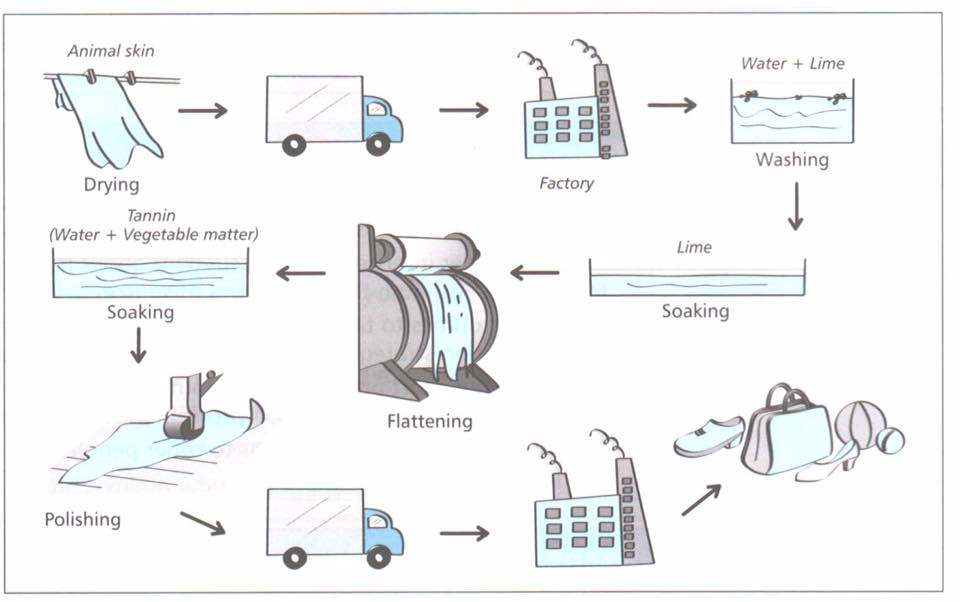
The diagram details the process by which leather products are made for retail. Looking from an overall perspective, it is readily apparent that there are 3 main steps to this entirely man-made process beginning with initial transportation of the raw material to the factory, followed by preparation and processing of the material, and finally the production of consumer products.
Firstly, the leather skins from various animals are dried. Subsequent to this, they are taken to a factory by truck where they are washed in water and lime. The skins are then soaked in more lime for a period of time before being run through a machine with large rollers that flattens them out.
Next, the flattened skins are soaked in tannin, which is composed of water and vegetable matter. They are then polished by another rolling device and taken to another factory by trucks. In this factory, the final products are crafted and available to consumer shops.
Analysis
1. The diagram details the process by which leather products are made for retail. 2. Looking from an overall perspective, it is readily apparent that there are 3 main steps to this entirely man-made process beginning with initial transportation of the raw material to the factory, followed by preparation and processing of the material, and finally the production of consumer products.
Paraphrase what the process shows.
Write a clear overview summarising the major groups. Read here about overviews for processes.
1. Firstly, the leather skins from various animals are dried. 2. Subsequent to this, they are taken to a factory by truck where they are washed in water and lime. 3. The skins are then soaked in more lime for a period of time before being run through a machine with large rollers that flattens them out.
Begin writing about the details of the process.
This one is tricky to get up to the word count (no longer required on IELTS) so try to make it a little wordy.
Include every step in the process.
1. Next, the flattened skins are soaked in tannin, which is composed of water and vegetable matter. 2. They are then polished by another rolling device and taken to another factory by trucks. 3. In this factory, the final products are crafted and available to consumer shops.
Write about the rest of the process – include everything!
Try to paraphrase some of the words from process as well.
Add in the last step of the process.
Vocabulary
What do the words in bold below mean?Take some notes on a piece of paper to aid your memory:
The diagram details the process by which leather products are made for retail. Looking from an overall perspective, it is readily apparent that there are 3 main steps to this entirely man-made process beginning with initial transportation of the raw material to the factory, followed by preparation and processing of the material, and finally the production of consumer products.
Firstly, the leather skins from various animals are dried. Subsequent to this, they are taken to a factory by truck where they are washed in water and lime. The skins are then soaked in more lime for a period of time before being runthrough a machine with large rollers that flattens them out.
Next, the flattened skins are soaked in tannin, which is composed of water and vegetable matter. They are then polished by another rolling device and taken to another factory by trucks. In this factory, the final products are crafted and available to consumer shops.
Answers
Try practicing with the vocabulary below by writing an antonym/opposite word on a piece of paper (or just thinking of one):
diagram details process hows
process diagram
leather products made from animal skins, usually from cows
retail for sale
Looking from an overall perspective, it is readily apparent that overall
main steps biggest stages
entirely completely
man-made process done by humans
beginning with starting with
initial transportation first sending
raw material basic substance
factory place to make items
followed by next
preparation being made
processing making into
finally in the end
production making into something
consumer products objecets for sale
firstly to start
skins the hide of an animal
dried not wet
subsequent to this after this
taken sent to
truck big car
washed cleaned
lime cleaning substance
soaked left in water
a period of time some period
runthrough put through
machine device
large rollers big objects for flattening
flattens them out stretches them
next after this
tannin a chemical protein
composed of made of
vegetable matter comes from vegetables
polished made shiny
rolling device circular object for flattening or spreading
The d_________________s the p__________s by which l____________________s are made for r______l. L________________________________________________t there are 3 m____________s to this e__________y m________________s b_________________h i____________________n of the r__________________l to the f__________y, f_______________y p____________n and p_____________g of the m__________l, and f_________y the p____________n of c____________________s.
F_______y, the leather s______s from various animals are d______d. S____________________s, they are t______n to a factory by t______k where they are w________d in water and l_______e. The skins are then s____________d in more lime for a___________________e before being r______________h a m____________e with l_______________s that f_________________t.
N_____t, the flattened skins are soaked in t_________n, which is c_______________f water and v______________r. They are then p__________d by another r_______________e and taken to another factory by trucks. In this factory, the f______l products are c_______d and a___________e to c_________________s.
Listening Practice
Listen to the related topic below and practice with these activities:
"The highest quality materials anywhere on the internet! Dave improved my writing and vocabulary so much. Really affordable options you don't want to miss out on!"