This is an IELTS writing task 2 sample answer essay on the topic of whether or not newspapers are still the most important source of news from the real IELTS exam.
Please consider supporting me on Patreon.com/howtodoielts to receive my exclusive IELTS Ebooks – you can even sign up for private live lessons with me!
Dave
IELTS Essay: Newspapers as the Most Important News Source
Although more and more people read news on the Internet, newspapers will remain the most important source of news for the majority of people.
To what extent do you agree or disagree?
Some believe that despite the rise in consumption of online news, newspapers will always be the primary news source for most. In my opinion, though newspapers may remain more trustworthy, online news will surely only become more popular in the future.
Those who argue for the primacy of newspapers point out their reputations. Before publication, newspaper articles are researched thoroughly, often for several months, by accomplished and professional writers who then pass their articles on to editors who verify the information and approve inclusion in the next edition. Most individuals are dimly aware of this process and therefore more likely to carefully read and trust reputable papers like The New York Times and Washington Post. This stands in marked contrast to online news which is written hastily and published instantly, often with the intended purpose of generating clicks and advertising revenue rather than accurately informing their audience.
Nonetheless, the majority of people already receive most news from sources other than newspapers. This includes television and podcasts, but websites and social media now dominate the media landscape. Most individuals find articles through websites like Facebook and Twitter that allow for the direct posting of links, which can then redirect users to a primary news source. Other more popular social media, including YouTube, Instagram, and TikTok, are more likely to aggregate and summarize or respond to recent news stories. Their potential audience is far wider than the dwindling circulations of physical newspapers.
In conclusion, despite the reliability of newspapers, there is little that can curb the growing ubiquity of online news. Individuals must therefore be more discerning as to which influencers they trust.
Analysis
1. Some believe that despite the rise in consumption of online news, newspapers will always be the primary news source for most. 2. In my opinion, though newspapers may remain more trustworthy, online news will surely only become more popular in the future.
Paraphrase the overall essay topic.
Write a clear opinion. Read more about introductions here.
1. Those who argue for the primacy of newspapers point out their reputations. 2. Before publication, newspaper articles are researched thoroughly, often for several months, by accomplished and professional writers who then pass their articles on to editors who verify the information and approve inclusion in the next edition. 3. Most individuals are dimly aware of this process and therefore more likely to carefully read and trust reputable papers like The New York Times and Washington Post. 4. This stands in marked contrast to online news which is written hastily and published instantly, often with the intended purpose of generating clicks and advertising revenue rather than accurately informing their audience.
Write a topic sentence with a clear main idea at the end.
Explain your main idea.
Develop it with specific or hypothetical examples.
Keep developing it fully.
1. Nonetheless, the majority of people already receive most news from sources other than newspapers. 2. This includes television and podcasts, but websites and social media now dominate the media landscape. 3. Most individuals find articles through websites like Facebook and Twitter that allow for the direct posting of links, which can then redirect users to a primary news source. 4. Other more popular social media, including YouTube, Instagram, and TikTok, are more likely to aggregate and summarize or respond to recent news stories. 5. Their potential audience is far wider than the dwindling circulations of physical newspapers.
Write a new topic sentence with a new main idea at the end.
Explain your new main idea.
Include specific details and examples.
Continue developing it…
as fully as possible!
1. In conclusion, despite the reliability of newspapers, there is little that can curb the growing ubiquity of online news. 2. Individuals must therefore be more discerning as to which influencers they trust.
Summarise your main ideas.
Include a final thought. Read more about conclusions here.
Vocabulary
What do the words in bold below mean?Make some notes on paper to aid memory and then check below.
Some believe that despite the rise in consumption of online news, newspapers will always be the primary news source for most. In my opinion, though newspapers may remain more trustworthy, online news will surely only become more popular in the future.
Those who argue for the primacy of newspapers point out their reputations. Before publication, newspaper articles are researched thoroughly, often for several months, by accomplished and professional writers who then pass their articles on to editors who verify the information and approve inclusion in the next edition. Most individuals are dimly aware of this process and therefore more likely to carefully read and trustreputable papers like The New York Times and Washington Post. This stands in marked contrast to online news which is written hastily and published instantly, often with the intended purpose of generating clicks and advertising revenue rather thanaccurately informing their audience.
Nonetheless, the majority of people already receive most news from sources other than newspapers. This includes television and podcasts, but websites and social media now dominate the media landscape. Most individuals find articles through websites like Facebook and Twitter that allow for the direct posting of links, which can then redirect users to a primary news source. Other more popular social media, including YouTube, Instagram, and TikTok, are more likely to aggregate and summarize or respond to recent news stories. Their potential audience is far wider than the dwindling circulations of physical newspapers.
In conclusion, despite the reliability of newspapers, there is little that can curb the growing ubiquity of online news. Individuals must therefore be more discerning as to which influencers they trust.
Answers
For extra practice, write an antonym (opposite word) on a piece of paper to help you remember the new vocabulary:
despite regardless of
rise increase
consumption reading
online news websites, social media
newspapers where you read the news, physical papers
primary news source main way of getting news
remain stay
trustworthy can be trusted
surely definitely
argue claim
primacy importance, dominance
point out argue
reputations how people trust them
publication release
researched thoroughly lots of time preparing
several months 3 – 4 months
accomplished experienced
professional qualified
pass their articles on give their writing to
editors people who check articles
verify make sure it is true
information what is in the article
approve inclusion allow it to be published
next edition next issue
dimly aware kind of know about
process way it is done
carefully read spend time reading
trustreputable papers believe in professional newspapers
The New York Times the most trusted newspaper
Washington Post another trusted newspaper
stands in marked contrast to is clearly different from
hastily quickly and without care
published instantly released right away
intended purpose the reason they are written
generating clicks getting people to open them up
advertising revenue money from ads
rather than instead of
accurately informing conveying correct information
audience readers
nonetheless regardless
majority most of
receive most news get their news
other than besides
includes has inside
podcasts people talking online
social media Instagram, TikTok, Facebook, etc.
dominate have power over
media landscape news and papers generally
articles stories
direct posting put it right on there
links a redirect to another website
redirect users send to another site
primary news source main way to get news
aggregate summarize and combine
summarize sum up
respond to answer
potential audience possible readers/viewers
far wider much larger
dwindling circulations less and less people subscribing
I recommend getting a pencil and piece of paper because that aids memory. Then write down the missing vocabulary from my sample answer in your notebook:
Some believe that d___________e the r____e in c_________________n of o________________s, n______________s will always be the p____________________e for most. In my opinion, though newspapers may r____________n more t______________y, online news will s________y only become more popular in the future.
Those who a________e for the p__________y of newspapers p__________t their r______________s. Before p____________n, newspaper articles are r___________________y, often for s_____________________s, by a________________d and p_________________l writers who then p__________________n to e__________s who v______y the i_______________n and a____________________n in the n_______________n. Most individuals are d___________e of this p_________s and therefore more likely to c____________________d and t____________________________s like T______________________s and W___________________t. This s________________________________o online news which is written h___________y and p_______________________y, often with the i__________________e of g____________________s and a__________________e r__________________na______________________g their a____________e.
N_______________s, the m____________y of people already r________________s from sources o_____________n newspapers. This i___________s television and p___________s, but websites and s_____________a now d___________e the m___________________e. Most individuals find a_________s through websites like Facebook and Twitter that allow for the d________________g of l_______s, which can then r_______________s to a p____________________e. Other more popular social media, including YouTube, Instagram, and TikTok, are more likely to a____________e and s________________e or r_____________o recent news stories. Their p_______________e is f______________r than the d______________________s of p____________________s.
In conclusion, d________e the r____________y of newspapers, there is l____________________b the g__________________y of online news. Individuals must t____________e be more d_____________g as to which i_________________s they trust.
Listening Practice
Learn more about this topic by watching videos from The New York Times YouTube channel below and practice with these activities:
This is an IELTS writing task 1 sample answer essay on the topic of social media presences for small, medium, and large businesses in the UK from the real IELTS exam.
IELTS Essay Task 1: Social Media Presence for Businesses
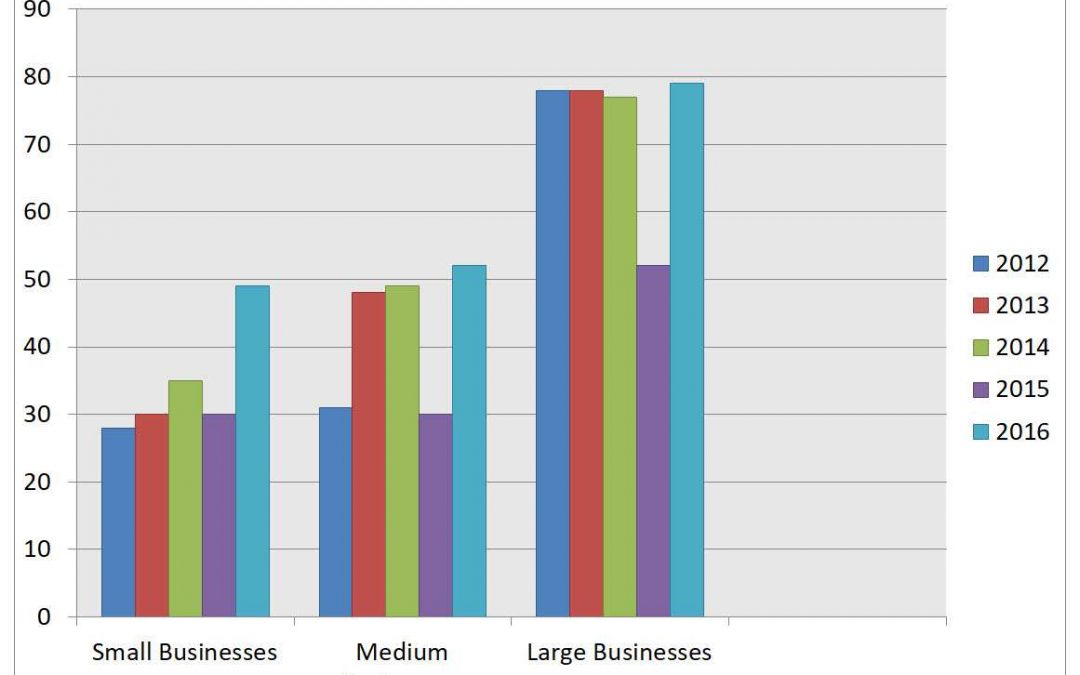
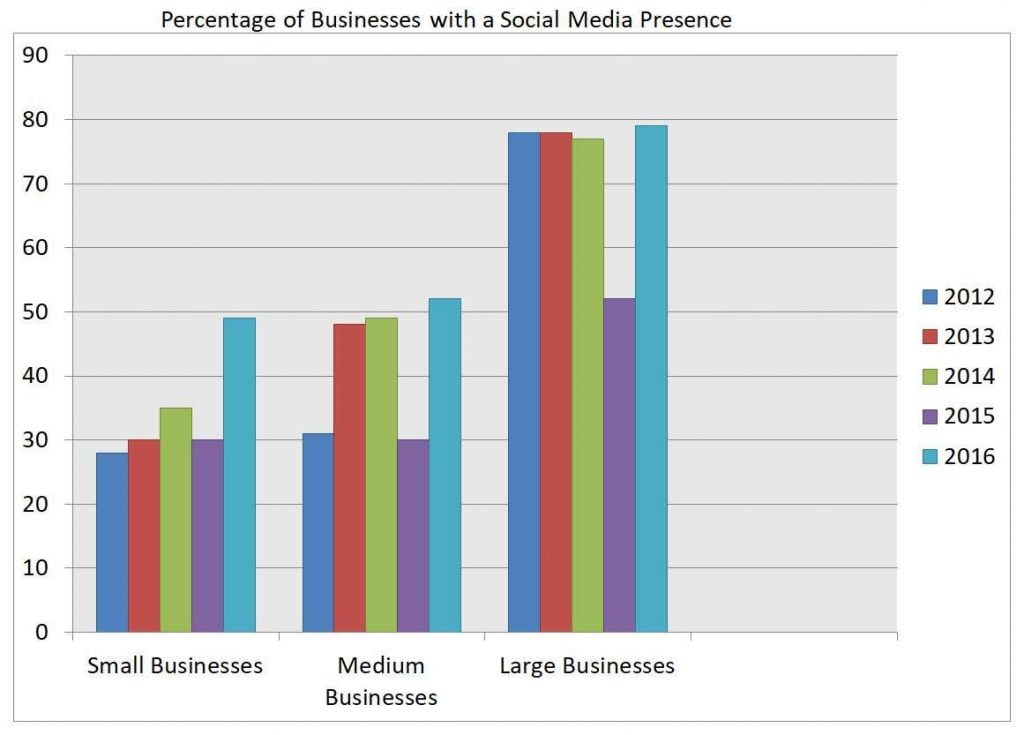
The bar chart illustrates the percentage of businesses in the UK who had a social media presence from 2012 to 2016.
Summarise the information by selecting and reporting the main features, and make comparisons where relevant.
IELTS Essay: Social Media Presence for Businesses
The bar chart displays data concerning the social media presence of small, medium and large businesses in the UK between 2012 and 2016. Looking from an overall perspective, it is readily apparent that figures for all types of businesses grew despite a widespread and significant pullback in 2015. Large businesses increased the least yet had by far the greatest presence each individual year.
In terms of small businesses, less than 30% (the lowest data point on the chart) had a social media presence in 2012. This number then rose to 35% by 2014, before a pullback to 30%, and a final surge to fewer than 50% with a presence to end the period. The trend for medium-sized businesses was similar, beginning at 31%, rising significantly to slightly under 50% in 2013 and 2014, falling to 30% in 2015, before finally growing to 52% by 2016.
The proportions for large businesses were more than double small and medium enterprises to begin the period (78%). This figure largely plateaued until 2015 when it fell to its nadir of 51%, preceding a final recovery to 79% in 2016.
Analysis
1. The bar chart displays data concerning the social media presence of small, medium and large businesses in the UK between 2012 and 2016. 2. Looking from an overall perspective, it is readily apparent that figures for all types of businesses grew despite a widespread and significant pullback in 2015. 3. Large businesses increased the least yet had by far the greatest presence each individual year.
Paraphrase what the bar chart shows.
Write a clear overview summarising the differences.
You might need a second sentence for your overview.
1. In terms of small businesses, less than 30% (the lowest data point on the chart) had a social media presence in 2012. 2. This number then rose to 35% by 2014, before a pullback to 30%, and a final surge to fewer than 50% with a presence to end the period. 3. The trend for medium-sized businesses was similar, beginning at 31%, rising significantly to slightly under 50% in 2013 and 2014, falling to 30% in 2015, before finally growing to 52% by 2016.
Begin writing about the data for the first category.
Describe the next area and compare it to the area before.
Continue describing the data.
1. The proportions for large businesses were more than double small and medium enterprises to begin the period (78%). 2. This figure largely plateaued until 2015 when it fell to its nadir of 51%, preceding a final recovery to 79% in 2016.
Write about the final other parts of the bar chart – include everything!
There is a lot of data in this one but try to get to all of it.
Vocabulary
What do the words in bold below mean?Take some notes on a piece of paper to aid your memory:
The bar chart displays data concerning the social media presence of small, medium and large businesses in the UK between 2012 and 2016. Looking from an overall perspective, it is readily apparent that figures for all types of businesses grew despite a widespread and significant pullback in 2015. Large businesses increased the least yet had by far the greatest presence each individual year.
In terms of small businesses, less than 30% (the lowest data point on the chart) had a social media presence in 2012. This number then rose to 35% by 2014, before a pullback to 30%, and a final surge to fewer than 50% with a presence to end the period. The trend for medium-sized businesses was similar, beginning at 31%, rising significantly toslightly under 50% in 2013 and 2014, falling to 30% in 2015, before finally growing to 52% by 2016.
The proportions for large businesses were more than double small and medium enterprises to begin the period (78%). This figure largely plateaued until 2015 when it fell to its nadir of 51%, preceding a final recovery to 79% in 2016.
Answers
Try to write down or think of an antonym/opposite word for further practice:
displays data shows statistics
concerning having to do with
social media presence how active you are on Instagram, Facebook, TikTok, etc.
small, medium and large businesses local and international companies
the UK England, the United Kingdom
Looking from an overall perspective, it is readily apparent that figures overall
all types of every kind of
grew despite increased regardless of
widespread common throughout
significant pullback big reduction
least yet lowest however still
by far a lot more
greatest biggest
each individual year every single year in question
in terms of when it comes to
less than lower compared to
lowest the least
rose increased
final surge last increase
fewer than less than
to end the period at the end of the time surveyed
trend pattern
medium-sized not too big or small
similar almost the same
beginning at starting at
rising significantly to increasing a lot to
slightly under a little less than
falling to decreasing to
before finally prior to a last
proportions percentages
more than double 200%+
enterprises companies
to begin the period at the start
largely plateaued until mostly stay the same up to
Remember and fill in the blanks. Note it on a piece of paper so you can remember better:
The bar chart d_____________________________g the s______________________e of s______________________________s in t________K between 2012 and 2016. L________________________________________________________________s for a______________f businesses g_____________e a w___________d and s____________k in 2015. Large businesses increased the l________t had b______r the g__________t presence e__________________r.
I______________f small businesses, l____________n 30% (the l_________t data point on the chart) had a social media presence in 2012. This number then r_____e to 35% by 2014, before a pullback to 30%, and a f___________e to f____________n 50% with a presence t_________________d. The t_______d for m_______________d businesses was s__________r, b_____________t 31%, r________________________os________________r 50% in 2013 and 2014, f_____________o 30% in 2015, b____________y growing to 52% by 2016.
The p______________s for large businesses were m_______________e small and medium e_____________s t__________________d (78%). This figure l_______________________l 2015 when it f_____l to its n_________r of at 51%, p___________g a final r__________y to 79% in 2016.
Listening Practice
Listen to the related topic below and practice with these activities:
Here are the questions – comment your answers below for some feedback!
What kind of flowers do you know?
Are there any flowers that have special meanings in your country?
Have you ever planted any flowers?
Have you sent flowers to others?
Here is a preview to the answer for the first one:
What kind of flowers do you know?
I wouldn’t say I’m a big flower person but naturally I recognize roses, lilies, sunflowers – the famous ones, haha. In my hometown in the spring tourists flock there to see the flowers blooming – the plum blossom, cherry blossoms and so on. Taking selfies with flowers is one of the biggest national pastimes in China.
If you want sample answers for these questions, the full speaking Ebook is available on my Patreon.
This is an IELTS writing task 2 sample answer essay on the topic of the number of animals and plants declining and the causes and solutions from the real IELTS exam.
Please consider supporting me on Patreon.com/howtodoielts to receive my exclusive IELTS Ebooks – you can even sign up for private live lessons with me!
Dave
IELTS Essay: Breaking Traffic Laws
Not all drivers obey the laws while driving on roads.
What are the reasons for this?
What can be done to fix this problem?
It is very common globally for motorists to break the rules when driving. The reasons for this typically relate to personality and extreme situations and the best solutions involve various governmental regulations.
Individuals often do not follow traffic laws because of individual temperament and exceptional circumstances. Regarding the former reason, there are many who have a more rebellious attitude towards rules in general that may extend to all areas of their lives including driving. This could itself be the result of upbringing, hereditary factors, or societal influences. The second reason is an impaired state. These situations include being in a rush, driving under the influence of a drug such as alcohol, using a portable device while driving, and being tired. All these contexts imply that the breaking of the rules is a result of neglect rather than harmful intent.
In order to remedy these public safety hazards, governments must implement comprehensive, long-term reforms. The fastest fixes are stricter penalties for infractions. If the repercussions for speeding, for example, include jail time, then this will act as a powerful deterrent. However, it does little to address the root causes of misbehavior. To counter this, governments must regulate the advertising and distribution of alcoholic beverages. Most accidents are caused while individuals are under the influence and therefore any measures taken against the alcohol industry will likely have the greatest impact. The government can also legislate in other related areas including requirements for licenses, raising awareness of driving safety in schools, and limits on the hours truckers and taxis can drive to avoid driver fatigue.
In conclusion, the causes of rule-breaking on roads are personality and the situation and the ideal solutions come from government intervention. Individuals also play a role but governments can affect the greatest changes.
Analysis
1. It is very common globally for motorists to break the rules when driving. 2. The reasons for this typically relate to personality and extreme situations and the best solutions involve various governmental regulations.
Paraphrase the overall essay topic.
Write a clear opinion. Read more about introductions here.
1. Individuals often do not follow traffic laws because of individual temperament and exceptional circumstances. 2. Regarding the former reason, there are many who have a more rebellious attitude towards rules in general that may extend to all areas of their lives including driving. 3. This could itself be the result of upbringing, hereditary factors, or societal influences. 4. The second reason is an impaired state. 5. These situations include being in a rush, driving under the influence of a drug such as alcohol, using a portable device while driving, and being tired. 6. All these contexts imply that the breaking of the rules is a result of neglect rather than harmful intent.
Write a topic sentence with a clear main idea at the end.
Explain your main idea.
Develop it with specific examples.
Keep developing it fully.
You can have some long sentences like this to really argue your point.
State the fullest possible result.
1. In order to remedy these public safety hazards, governments must implement comprehensive, long-term reforms. 2. The fastest fixes are stricter penalties for infractions. 3. If the repercussions for speeding, for example, include jail time, then this will act as a powerful deterrent. 4. However, it does little to address the root causes of misbehavior. 5. To counter this, governments must regulate the advertising and distribution of alcoholic beverages. 6. Most accidents are caused while individuals are under the influence and therefore any measures taken against the alcohol industry will likely have the greatest impact. 7. The government can also legislate in other related areas including requirements for licenses, raising awareness of driving safety in schools, and limits on the hours truckers and taxis can drive to avoid driver fatigue.
Write a new topic sentence with a new main idea at the end.
Explain your new main idea.
Include specific details and examples.
Continue developing it…
as fully as possible!
Try some longer sentences to show off your grammatical range.
Conclude with a strong statement and more detail.
1. In conclusion, the causes of rule-breaking on roads are personality and the situation and the ideal solutions come from government intervention. 2. Individuals also play a role but governments can affect the greatest changes.
Summarise your main ideas.
Include a final thought. Read more about conclusions here.
Vocabulary
What do the words in bold below mean?Make some notes on paper to aid memory and then check below.
It is very common globally for motorists to break the rules when driving. The reasons for this typically relate to personality and extreme situations and the best solutionsinvolve various governmental regulations.
Individuals often do not follow traffic laws because of individual temperament and exceptional circumstances. Regarding the former reason, there are many who have a more rebellious attitude towards rules in general that may extend to all areas of their lives including driving. This could itself be the result of upbringing, hereditary factors, or societal influences. The second reason is an impaired state. These situations include being in a rush, driving under the influence of a drug such as alcohol, using a portable device while driving, and being tired. All these contexts imply that the breaking of the rules is a result of neglect rather than harmful intent.
In order to remedy these public safety hazards, governments must implement comprehensive, long-term reforms. The fastest fixes are stricter penalties for infractions. If the repercussions for speeding, for example, include jail time, then this will act as a powerful deterrent. However, it does little to address the root causes of misbehavior. To counter this, governments must regulate the advertising and distribution of alcoholic beverages. Most accidents are caused while individuals are under the influence and therefore any measures taken against the alcohol industry will likely have the greatest impact. The government can also legislate in other related areas including requirements for licenses, raising awareness of driving safety in schools, and limits on the hours truckers and taxis can drive to avoid driver fatigue.
In conclusion, the causes of rule-breaking on roads are personality and the situation and the ideal solutions come from government intervention. Individuals also play a role but governments can affect the greatest changes.
Answers
For extra practice, write an antonym (opposite word) on a piece of paper to help you remember the new vocabulary:
common globally happens all around the world
motorists people who drive
break the rules not obey the law
typically relate to usually have to do with
personality your character
extreme situations rare contexts
best solutions ideal fixes
involve have to do with
various governmental regulations many government laws
do not follow traffic laws disobey traffic rules/laws
individual temperament a person’s character
exceptional circumstances rare instances
regarding the former as it relates to the first mentioned reason
rebellious attitude defiant personality
in general overall
extend to include
be the result of upbringing because of how you were raised
hereditary factors genetics
societal influences the effects of others
impaired state drunk, under the influence, tired, emotional, etc.
being in a rush being in a hurry
driving under the influence of a drug driving drunk, high, etc.
alcohol beer, wine, etc.
using a portable device smartphones
contexts imply situations mean
neglect not paying attention to
harmful intent desiring to hurt
in order to remedy so that it can be fixed
public safety hazards not good for the public
implement comprehensive enact total
long-term reforms changes that take place over a long time
fastest fixes more immediate solutions
stricter penalties harsher punishments
infractions breaking the rules
repercussions implications
speeding driving too fast
jail time going to prison
powerful deterrent strong way of dissuading people
address the root causes handle the main reasons/sources
misbehavior not behaving well
counter fight against
advertising and distribution of alcoholic beverages ads for and selling of beer, wine, etc.
accidents collisions
under the influence using a drug
measures steps
alcohol industry companies that make alcoholic beverages
greatest impact most effect
legislate make laws, rules
requirements for licenses stipulations to be able to drive
I recommend getting a pencil and piece of paper because that aids memory. Then write down the missing vocabulary from my sample answer in your notebook:
It is very c____________________y for m_____________s to b______________s when driving. The reasons for this t__________y r___________o p____________y and e___________________s and the b_______________si___________e v___________________________s.
Individuals often d_________________________s because of i_______________________t and e__________________________s. R_____________________r reason, there are many who have a more r______________________e towards rules i_______________l that may e_____________o all areas of their lives including driving. This could itself b____________________________________g, h__________________s, or s_____________________s. The second reason is an i________________e. These situations include b_______________h, d____________________________________g such as a_________l, u_________________e while driving, and being tired. All these c________________y that the breaking of the rules is a result of n__________t rather than h________________t.
I______________________y these p________________________s, governments must i________________________e, l_______________________s. The f_______________s are s_________________s for i______________s. If the r______________s for s____________g, for example, include j____________e, then this will act as a p_____________________t. However, it does little to a_________________________s of m________________r. To c________r this, governments must regulate the a_________________________________________________s. Most a___________s are caused while individuals are u_______________e and therefore any m__________s taken against the a___________________y will likely have the g___________________t. The government can also l______________e in other related areas including r_____________________s, r___________________________________y in schools, and l_________s on the hours t____________s and t______s can drive to a______________________e.
In conclusion, the causes of r__________________g on roads are personality and the situation and the i________l solutions come from government i__________________n. Individuals also p____________e but governments can a_________________________s.
Listening Practice
Learn more about this topic in the video below and practice with these activities:
I’ve written this official IELTS step-by-step preparation guide because I get a lot of the same questions from students and this may help you achieve the score you want!
There are a lot of areas to consider.
If you have specific questions, comment them below!
Dave
Starting with IELTS Writing
The lowest score for IELTS is almost always for writing.
This has been confirmed in numerous studies all around the world. See the official studies here.
Therefore, you should start your writing practice first.
Start by writing a whole essay, then check it against the links below.
Then practice individual skills before writing another whole essay.
Writing will be the most important skill to improve for IELTS and you should break it down skill by skill and improve each one before working on your whole essay.
IELTS Writing Resources
Now that you know writing is the most important and you have some practice in, what’s next?
I would recommend you begin by studying sample answers more closely.
Pay close attention to the structure and then you can focus on the vocabulary and grammar after that.
Be careful because there are a lot of bad sample answers out there that will do more to hurt your English and IELTS score than help it.
Here are trustworthy IELTS sample answer essays that I have personally written:
Start learning from reliable sample answers and focus on consistent structure using my essays.
Know How Long you Will Need to Prepare
This is a really important question and will determine how you study.
You have to know first of all:
What score do you need?
When do you need it?
What is your score right now?
Once you can answer all those questions (if you need help about your score, consider signing up for my Patreon for practice tests), then you have a timeline.
If you need your score really soon and are close, then you can study about IELTS using online resources.
If you don’t need your score for a long time (it doesn’t matter if you are close or far from it), then you should focus on long-term goals.
Be careful you don’t make the mistake that many students do: don’t spend years studying IELTS while your band score remains the same because your English is not improving.
Establish a realistic timeline based on your English level and desired IELTS score.
Study Consistently Rather Than in Big Blocks
Research has shown that it is much more effective to study a little bit consistently every day instead of studying in big blocks sometimes.
Consistent study, even less than an hour a day, can dramatically aid memory retention.
Therefore, try to study every day!
The best way to do this is to tie it to a habit you already have.
Try studying right before or after you have coffee in the morning, before you go to work/school, before or after dinner, right after you brush your teeth at night, etc.
Make it a habit and stick to it consistently!
Here are some ideas for study that might help you:
It is important to have feedback from another source so that you can be sure you are not wasting your time.
Identify your Strengths & Weaknesses
It’s important to work on your strengths and your weaknesses.
In my experience, 90% of IELTS students have the same weaknesses: writing task 1 overviews, writing task 2 main ideas development, speaking fluency and pronunciation, reading T/F/NG and listening multiple choice.
Most students should focus on those areas.
Your weaknesses might be different though so you should seek outside advice as well.
Here are some resources to deal with the problems above:
Improve the most common weaknesses for IELTS candidates.
Develop your Speaking Skills
Speaking is another area that presents huge challenges for students.
You will often find that your speaking lags behind your other skills.
This is because speaking is fast and it takes practice to make all the words you can understand in reading and listening run out your mouth faster when you talk.
It is also really hard to improve compared to other skills.
If you don’t have a partner or a class to work with, you will have to be creative with different methods.
If you study the exact same way every time, then your progress will be slow.
Change the ways that you practice speaking – be creative!
IELTS Speaking Resources
This comes down to the four areas you get marked on: fluency, vocabulary, grammar, and pronunciation.
Here is an explanation of each of the band scores you are marked on:
Fluency:how fast you speak, how much you hesitate (use um/uh) or pause, how much you over-use words like ‘like’, how much you correct yourself, how much you repeat yourself, if you answers make sense logically, how long your answers are
Vocabulary:range (lots of different collocations, phrasal verbs, expressions) and how accurate (correct) they are, can you paraphrase
Grammar:range (how many different types of complex grammar you use), and how accurate (correct) your grammar is, how much you repeat the same structures
Pronunciation: how easy it is to understand all the sounds/words, word stress, sentence stress, intonation, chunking, how natural you sound
Here are some of my speaking model answers with ideas for creative practice:
Don’t waste all your time doing listening test after listening test.
IELTS Listening Resources
To improve your listening and prepare for IELTS, find a balance between IELTS and other resources.
I would always recommend that after you listen, you go back, read the tape script, and highlight the answers you got wrong.
Figure out the reason why you got an answer wrong and then try to develop that skill – it might be vocabulary, the way a word is pronounced, a trick in the test, a difficult synonym, etc.
When you are ready to focus on just IELTS here are some resources you can use:
You will develop reading a lot faster if you use interesting, native English sources.
Choose the Paper-Based or Computer-Based Exam
Here is a summary of 12 main differences for each section of the exam:
The paper-based test means you will use a pencil and answer sheet. The computer-based uses a keyboard and mouse.
The test is in exactly the same order.
For listening and reading, you do not get 10 minutes at the end to transfer your answers for the computer-based test (you do have time in between sections to double-check your answers and 2 minutes at the end to check all your answers).
You have your own computer and headphones for the computer-based test.
For the computer-based writing test, you can more easily edit your writing and see the time and your word count clearly.
Most people make more typos on computers (me included!) so you must be more careful about careless mistakes.
You will still receive a pencil and paper for notes on the computer-based test (for listening, reading, and writing).
For the computer-based reading test, you can see the reading and the questions at the same time so you don’t have to flip back and forth between pages.
For reading on the computer, you can also copy and paste your answers to avoid spelling mistakes and increase the font size.
For the computer-based listening, you can highlight parts of the text.
For listening on the computer, you should try one online to get familiar with how to move between pages and do the different question types.
You get your results faster for the computer-based test.
Personally, I would go with the computer-based exam because I am confident on a computer and there are a lot of advantages (especially for writing).
The speaking test is the same for both.
Practice with both tests and then make your decision!
Practice both and make a good decision about which one suits you the best.
Change your Mindset
The most important factor learning English and studying for IELTS is motivation.
Studies have shown again and again that nothing is more important than motivation when it comes to success with English.
Many students become discouraged when they fail or make mistakes.
But there is a simple way to avoid feeling bad about yourself.
Just remember that you are improving and that your mistakes are not about you – they are just about the work.
That simple shift – from criticizing yourself to criticizing your world, will take tons of psychological pressure off you and free you up to have fun studying.
Change your mindset and everything will go a lot easier in your studies and not feel like a chose!
"The highest quality materials anywhere on the internet! Dave improved my writing and vocabulary so much. Really affordable options you don't want to miss out on!"