This is an IELTS writing task 1 sample answer essay on the topic of employment for men and women in 1970 and 2000 in Belgium, the USA, Japan, and Indonesia in a bar chart from the real IELTS exam.
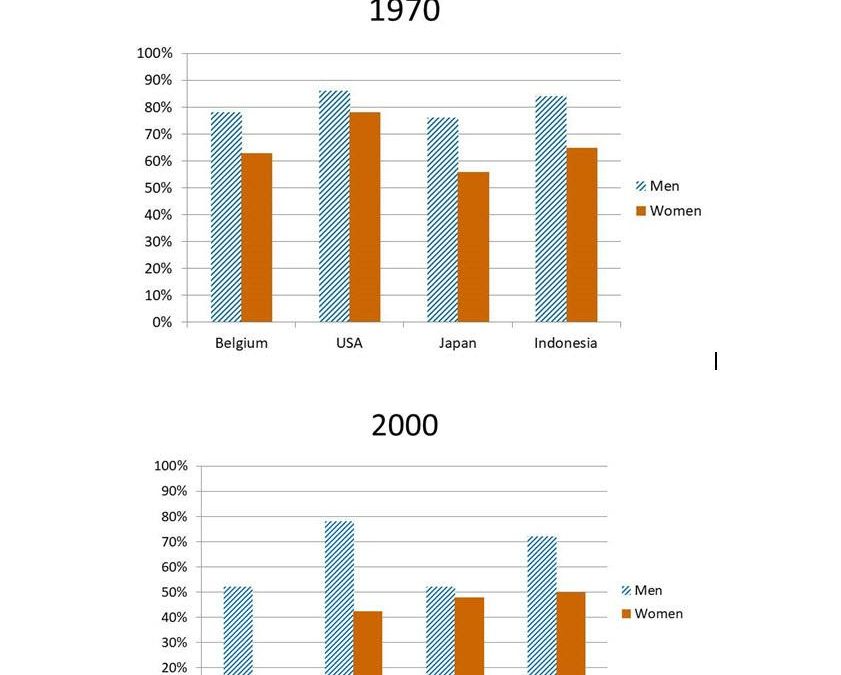
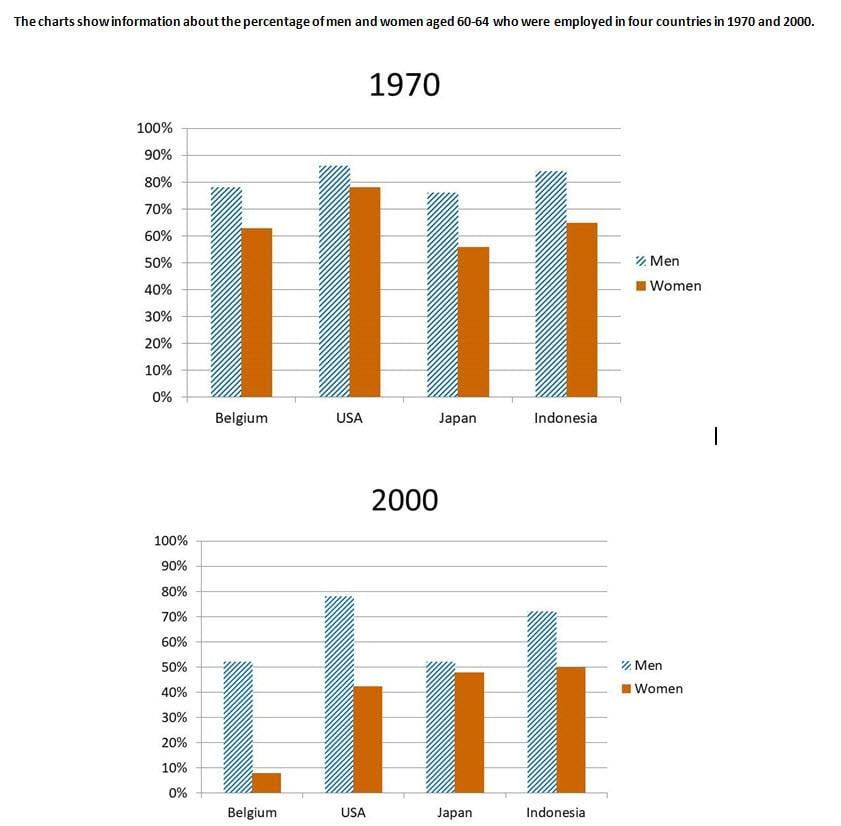
The bar charts detail men and women between the ages of 60 and 64 working in Belgium, the USA, Japan, and Indonesia in 1970 and 2000. Looking from an overall perspective, it is readily apparent that men had higher employment figures for all countries in both years with the largest disparity being the difference between men and women in Belgium and the USA in 2000. Proportions of males and females employed decreased across all nations, especially in Belgium.
In the United States in 1970, 88% of men between 60 and 64 were employed compared to just under 80% of women. These proportions were broadly similar to Belgium (79% and 62%) and Indonesia (83% and 63%). The disparity in Japan was slightly larger with 78% of men working and 55% of women.
By 2000, figures for the United States had declined to 79% of men and 41% of women, the second largest drop recorded. Belgium had the largest fall for female employment (down to fewer than 10% working) with a more moderate fall for men to 51%. In Indonesia, employed males fell to 72% as their counterparts slipped by 12% to 50%. Finally, Japan displayed the narrowest gap between genders with 51% of men working and 48% of women.
Analysis
1. The bar charts detail men and women between the ages of 60 and 64 working in Belgium, the USA, Japan, and Indonesia in 1970 and 2000. 2. Looking from an overall perspective, it is readily apparent that men had higher employment figures for all countries in both years with the largest disparity being the difference between men and women in Belgium and the USA in 2000. 3. Proportions of males and females employed decreased across all nations, especially in Belgium.
Paraphrase what the bar chart shows.
Write a clear overview summarising the differences.
You might need another sentence for your overview.
1. In the United States in 1970, 88% of men between 60 and 64 were employed compared to just under 80% of women. 2. These proportions were broadly similar to Belgium (79% and 62%) and Indonesia (83% and 63%). 3. The disparity in Japan was slightly larger with 78% of men working and 55% of women.
Begin writing about the data for the first categories.
Make sure you compare as much as possible.
Vary long and short sentences.
1. By 2000, figures for the United States had declined to 79% of men and 41% of women, the second largest drop recorded. 2. Belgium had the largest fall for female employment (down to fewer than 10% working) with a more moderate fall for men to 51%. 3. In Indonesia, employed males fell to 72% as their counterparts slipped by 12% to 50%. Finally, Japan displayed the narrowest gap between genders with 51% of men working and 48% of women.
Write about the final other parts of the graph – include everything!
Compare the categories.
Finish with the rest of the data.
Vocabulary
What do the words in bold below mean?Take some notes on a piece of paper to aid your memory:
The bar charts detail men and women between the ages of 60 and 64 working in Belgium, the USA, Japan, and Indonesia in 1970 and 2000. Looking from an overall perspective, it is readily apparent that men had higher employment figures for all countries in both years with the largest disparity being the difference between men and women in Belgium and the USA in 2000. Proportions of males and females employed decreased across all nations, especially in Belgium.
In the United States in 1970, 88% of men between 60 and 64 were employed compared to just under 80% of women. These proportions were broadly similar to Belgium (79% and 62%) and Indonesia (83% and 63%). The disparity in Japan was slightly larger with 78% of men working and 55% of women.
By 2000, figures for the United States had declined to 79% of men and 41% of women, the second largest drop recorded. Belgium had the largest fall for female employment (down to fewer than 10% working) with a more moderate fall for men to 51%. In Indonesia, employed males fell to 72% as their counterparts slipped by 12% to 50%. Finally, Japan displayed the narrowest gap between genders with 51% of men working and 48% of women.
Answers
Try to write down or think of an antonym/opposite word for further practice:
detail show
between from … to ….
Looking from an overall perspective, it is readily apparent overall
Remember and fill in the blanks. Note it on a piece of paper so you can remember better:
The bar charts d_________l men and women b_________n the ages of 60 and 64 working in Belgium, the USA, Japan, and Indonesia in 1970 and 2000. L__________________________________________t that men had higher e___________________s for all countries in both years with the l____________________y being the difference between men and women in Belgium and the USA in 2000. P________________s of males and females employed decreased a___________________s, e_______________n Belgium.
In the United States in 1970, 88% of men between 60 and 64 were employed c______________o j______________r 80% of women. These p_______________s were b_______________r to Belgium (79% and 62%) and Indonesia (83% and 63%). The disparity in Japan was s_________________r with 78% of men working and 55% of women.
By 2000, figures for the United States had d__________d to 79% of men and 41% of women, the s____________________________d. Belgium had the largest fall for female employment (down to fewer than 10% working) with a more m_____________l for men to 51%. In Indonesia, employed males fell to 72% as their c___________________d by 12% to 50%. Finally, Japan d___________d the n________________p between g_________s with 51% of men working and 48% of women.
Listening Practice
Listen to the related topic below and practice with these activities:
This is an IELTS writing task 2 sample answer essay on the topic of fuel costs from the real IELTS general training exam.
Please consider supporting me on Patreon.com/howtodoielts to receive my full, exclusive IELTS Ebooks – you can even sign up for private live lessons with me!
Dave
IELTS Essay: Fuel Costs
The best way to solve the world’s environmental problems is to increase the cost of fuel for cars and other private vehicles.
To what extent do you agree or disagree?
Some feel that the optimal solution to the current environmental crisis is to raise fuel costs for various private vehicles. In my opinion, though this would have a tangible impact, a more holistic approach is advisable.
On the one hand, increasing the price of fuel would have a clearly identifiable impact. In both developing and developed countries, private vehicles are becoming more common. More expensive fuel costs would discourage individuals from taking long trips and encourage them to seek alternative modes of transport such as walking, riding a bicycle, sharing transportation, and using public transportation. The average family that struggles to pay their bills every month might then decide to stay home rather than take a short trip on weekends if the cost of travel outweighs the potential enjoyment. Governments would be able to clearly chart the effects produced by these taxes and adjust them accordingly.
On the other hand, a wide variety of measures that do not target less affluent segments of society would have a greater effect. A single remedy is unlikely to produce the desired result as the majority of middle and upper class citizens would not be deterred by minor taxes. Instead, governments should consider all the relevant environment issues ranging from deforestation and single-use plastics to fossil fuel consumption in industry and the methane released in factory farming. To truly and sustainably counter these issues, governments will need to employ a variety of tactics that will likely include not only taxes but also regulations and various educational initiatives. The tackling of a single cause, such as the fuel used in private vehicles, will have marginal impact at best.
In conclusion, despite tangible results that a tax might engender, governments should opt for a more comprehensive environmental policy. This is a pressing issue and requires a nuanced, long-term approach.
Analysis
1. Some feel that the optimal solution to the current environmental crisis is to raise fuel costs for various private vehicles. 2. In my opinion, though this would have a tangible impact, a more holistic approach is advisable.
Paraphrase the overall essay topic.
Write a clear opinion. Read more about introductions here.
1. On the one hand, increasing the price of fuel would have a clearly identifiable impact. 2. In both developing and developed countries, private vehicles are becoming more common. 3. More expensive fuel costs would discourage individuals from taking long trips and encourage them to seek alternative modes of transport such as walking, riding a bicycle, sharing transportation, and using public transportation. 4. The average family that struggles to pay their bills every month might then decide to stay home rather than take a short trip on weekends if the cost of travel outweighs the potential enjoyment. 5. Governments would be able to clearly chart the effects produced by these taxes and adjust them accordingly.
Write a topic sentence with a clear main idea at the end.
Explain your main idea.
Develop it with specific or hypothetical examples.
Keep developing it fully.
Finish strong.
1. On the other hand, a wide variety of measures that do not target less affluent segments of society would have a greater effect. 2. A single remedy is unlikely to produce the desired result as the majority of middle and upper class citizens would not be deterred by minor taxes. 3. Instead, governments should consider all the relevant environment issues ranging from deforestation and single-use plastics to fossil fuel consumption in industry and the methane released in factory farming. 4. To truly and sustainably counter these issues, governments will need to employ a variety of tactics that will likely include not only taxes but also regulations and various educational initiatives. 5. The tackling of a single cause, such as the fuel used in private vehicles, will have marginal impact at best.
Write a new topic sentence with a new main idea at the end.
Explain your new main idea.
Include specific details and examples.
Add as much information as you can and make sure it links logically.
Develop the example fully.
1. In conclusion, despite tangible results that a tax might engender, governments should opt for a more comprehensive environmental policy. 2. This is a pressing issue and requires a nuanced, long-term approach.
Summarise your main ideas.
Include a final thought. Read more about conclusions here.
Vocabulary
What do the words in bold below mean?Make some notes on paper to aid memory and then check below.
Some feel that the optimal solution to the current environmental crisis is to raise fuel costs for various privatevehicles. In my opinion, though this would have a tangible impact, a more holistic approach is advisable.
On the one hand, increasing the price of fuel would have a clearly identifiable impact. In both developing and developed countries, private vehicles are becoming more common. More expensive fuel costs would discourage individuals from taking long trips and encourage them to seek alternative modes of transport such as walking, riding a bicycle, sharing transportation, and using public transportation. The average family that struggles to pay their bills every month might then decide to stay home rather than take a short trip on weekends if the cost of travel outweighs the potential enjoyment. Governments would be able to clearly chart the effects produced by these taxes and adjust them accordingly.
On the other hand, a wide variety of measures that do not target less affluent segments of society would have a greater effect. A single remedy is unlikely to produce the desired result as the majority of middle and upper class citizens would not be deterred by minor taxes. Instead, governments should consider all the relevant environment issues ranging from deforestation and single-use plastics to fossil fuel consumption in industry and the methane released in factory farming. To truly and sustainably counter these issues, governments will need to employ a variety of tactics that will likely include not only taxes but also regulations and various educational initiatives. The tackling of a single cause, such as the fuel used in private vehicles, will have marginal impact at best.
In conclusion, despite tangible results that a tax might engender, governments should opt for a more comprehensive environmental policy. This is a pressing issue and requires a nuanced, long-term approach.
Answers
For extra practice, write an antonym (opposite word) on a piece of paper to help you remember the new vocabulary:
optimal solution best method
current environmental crisis problems related to nature happening now
raise fuel costs make gas more expensive
various privatevehicles different kinds of cars, etc.
tangible impact real effect
holistic approach comprehensive method
advisable recommended
clearly identifiable impact definite effect
developing and developed countries poor and rich nations
expensive costs a lot
discourage not make someone want to do it
taking long trips traveling far
encourage make people want to do it
alternative modes different ways
transport ways of getting around
sharing transportation travelling together such as in the same car
public transportation buses, subways, etc.
average family normal family
struggles have difficulty
pay their bills afford the cost of
decide choose
rather than instead of
outweighs stronger than
potential enjoyment possible jobs
clearly chart easily record
produced by created by
taxes money paid to governments
adjust change
accordingly based on what they learn
a wide variety of measures different kinds of actions
target less affluent segments focus on poorer areas
remedy fix
produce the desired result create what is meant to be done
majority most of
middle and upper class citizens medium rich and very rich people
deterred not encouraged to
minor small
instead rather than
consider think about
relevant environment issues problems related to nature and climate change
deforestation cutting down trees
single-use plastics bottles, bags, etc.
fossil fuel consumption burning oil
industry business
methane released gas sent into the air
factory farming giant farms
truly definitely
sustainably counter good long-term solution
employ use
tactics strategies
regulations rules, laws
various educational initiatives different kinds of policies
tackling fighting
single cause main source
marginal impact at best small effect in the best case scenario
despite tangible regardless of the real effect
engender create
opt for choose to
comprehensive total
policy laws, regulations
pressing issue important problem
requires needs
nuanced complex
long-term approach thinking of the future, not short-term
I recommend getting a pencil and piece of paper because that aids memory. Then write down the missing vocabulary from my sample answer in your notebook:
Some feel that the o_________________n to the c____________________________s is to r_______________________s for v___________________________s. In my opinion, though this would have a t________________t, a more h________________h is a_____________e.
On the one hand, increasing the price of fuel would have a c___________________________t. In both d__________________________________s, private vehicles are becoming more common. More e___________e fuel costs would d__________e individuals from t________________s and e_________e them to seek a___________________s of t_____________t such as walking, riding a bicycle, s______________________n, and using p________________________n. The a_________________y that s________________s to p_______________s every month might then d_____e to stay home r___________n take a short trip on weekends if the cost of travel o____________s the p___________________________t. Governments would be able to c_____________t the effects p______________y these t_______s and a_______t them a_____________y.
On the other hand, a_________________________s that do not t_________________________________s of society would have a greater effect. A single r___________y is unlikely to p_________________________t as the m_________y of m______________________________s would not be d___________d by m_____r taxes. I_________d, governments should consider all the r____________________________s ranging from d________________n and s____________________s to f___________________________n in i____________y and the m_________________d in f____________________g. To t_____y and s____________________r these issues, governments will need to e__________y a variety of t__________s that will likely include not only taxes but also r_______________s and v____________________________s. The t___________g of a s______________e, such as the fuel used in private vehicles, will have m__________________________t.
In conclusion, d_________________e results that a tax might e_________r, governments should opt for a more comprehensive environmental p_______y. This is a p___________e and r__________s a n__________d, l________________________h.
Listening Practice
Learn more about this topic by watching videos from The New York Times YouTube channel below and practice with these activities:
This is an IELTS writing task 2 sample answer essay on the topic of the formal school age for children and whether or not they should begin education before the age of 7.
Please consider supporting me on Patreon.com/howtodoielts to receive my full, exclusive IELTS Ebooks – you can even sign up for private live lessons with me!
Dave
IELTS Essay: Formal School Age
Some people think that children should begin their formal education at a very early age. Others think they should begin after 7 years of age.
Discuss both views and give your own opinion.
Many feel that children ought to commence formal schooling from a very young age while others feel classes should start after the age of 7. In my opinion, though there are social benefits to early schooling, many of these can be replicated outside the classroom and there are emotional advantages to attending school later.
There are legitimate reasons for young children to enter school related to socializing. This can be best illustrated by the case of home-schooled children who often have underdeveloped social skills that can persist into adulthood. In contrast, children who are active members of a social group from a young age are far more likely to develop outgoing, positive ways of engaging with others. As they progress through normal childhood developmental stages and become less egocentric, the presence of other children, and teachers to some extent, has enormous benefits. However, parents can reproduce these advantages by ensuring their children have time to socialize with neighborhood friends.
Furthermore, entering school after the age of 7 can serve as a long-term boon for emotional health. When students begin formal schooling, they necessarily feel stressed not only from competition with other children but also due to the burden of homework and grades. If children remain home longer, they will form stronger familial bonds that will encourage healthy relationships later in life. Research has shown that the early years are essential in dictating how a child will develop interpersonally. A child who received adequate love and attention is considerably more likely to feel secure and establish healthy relationships with friends and family in adulthood. Academics can always be strengthened later but this is not always true for unseen emotional work.
In conclusion, despite the social benefits of schooling for young children, the emotional ramifications of remaining home in a supportive environment are more important. School administrators should consider this question carefully.
Analysis
1. Many feel that children ought to commence formal schooling from a very young age while others feel classes should start after the age of 7. 2. In my opinion, though there are social benefits to early schooling, many of these can be replicated outside the classroom and there are emotional advantages to attending school later.
Paraphrase the overall essay topic.
Write a clear opinion. Read more about introductions here.
1. There are legitimate reasons for young children to enter school related to socializing. 2. This can be best illustrated by the case of home-schooled children who often have underdeveloped social skills that can persist into adulthood. 3. In contrast, children who are active members of a social group from a young age are far more likely to develop outgoing, positive ways of engaging with others. 4. As they progress through normal childhood developmental stages and become less egocentric, the presence of other children, and teachers to some extent, has enormous benefits. 5. However, parents can reproduce these advantages by ensuring their children have time to socialize with neighborhood friends.
Write a topic sentence with a clear main idea at the end.
Explain your main idea.
Develop it with specific or hypothetical examples.
Keep developing it fully.
Finish development.
1. Furthermore, entering school after the age of 7 can serve as a long-term boon for emotional health. 2. When students begin formal schooling, they necessarily feel stressed not only from competition with other children but also due to the burden of homework and grades. 3. If children remain home longer, they will form stronger familial bonds that will encourage healthy relationships later in life. 4. Research has shown that the early years are essential in dictating how a child will develop interpersonally. 5. A child who received adequate love and attention is considerably more likely to feel secure and establish healthy relationships with friends and family in adulthood. 6. Academics can always be strengthened later but this is not always true for unseen emotional work.
Write a new topic sentence with a new main idea at the end.
Explain your new main idea.
Include specific details and examples.
Add as much information as you can and make sure it links logically.
Develop the example fully.
Conclude with a strong statement.
1. In conclusion, despite the social benefits of schooling for young children, the emotional ramifications of remaining home in a supportive environment are more important. 2. School administrators should consider this question carefully.
Summarise your main ideas.
Include a final thought. Read more about conclusions here.
Vocabulary
What do the words in bold below mean?Make some notes on paper to aid memory and then check below.
Many feel that children ought to commenceformal schooling from a very young age while others feel classes should start after the age of 7. In my opinion, though there are social benefits to early schooling, many of these can be replicated outside the classroom and there are emotional advantages to attending school later.
There are legitimate reasons for young children to enter school related to socializing. This can be best illustrated by the case of home-schooled children who often have underdeveloped social skills that can persist into adulthood. In contrast, children who are active members of a social group from a young age are far more likely to develop outgoing, positive ways of engaging with others. As they progress through normal childhood developmental stages and become less egocentric, the presence of other children, and teachers to some extent, has enormous benefits. However, parents can reproduce these advantages by ensuring their children have time to socialize with neighborhood friends.
Furthermore, entering school after the age of 7 can serve as a long-termboon for emotional health. When students begin formal schooling, they necessarily feel stressed not only from competition with other children but also due to the burden of homework and grades. If children remain home longer, they will form stronger familial bonds that will encourage healthy relationships later in life. Research has shown that the early years are essential in dictating how a child will develop interpersonally. A child who received adequate love and attention is considerably more likely to feel secure and establish healthy relationships with friends and family in adulthood. Academics can always be strengthened later but this is not always true for unseen emotional work.
In conclusion, despite the social benefits of schooling for young children, the emotional ramifications of remaining home in a supportive environment are more important. School administrators should consider this question carefully.
Answers
For extra practice, write an antonym (opposite word) on a piece of paper to help you remember the new vocabulary:
ought to should
commence start
formal schooling real school
social benefits advantages for communicating with others
early schooling first years of school
replicated outside the classroom reproduced not in school
emotional advantages benefits for one’s emotions
attending going to
legitimate reasons good causes
enter school go to class
socializing interacting with others
best illustrated by the case of clearest example of this is
home-schooled children kids who learn at home
underdeveloped not grown
persist continue
adulthood as you get older, no longer a child
in contrast however
active members participants
social group peer groups
far more likely much greater chance
outgoing friendly
positive ways good methods
engaging with others talking to people
progress improving
normal childhood developmental stages how kids grow up cognitively
egocentric caring only about yourself
presence being around them
enormous benefits big advantages
reproduce replicate
ensuring making sure
neighborhood friends kids living nearby
furthermore also
serve as a long-termboon help in the future
emotional health how you feel
necessarily definitely
stressed anxious
competition competing with others
burden extra weight to carry
remain stay the same
form stronger familial bonds get along with family better
encourage healthy relationships form good bonds
later in life as they get older
research has shown that studies indicate
dictating determining
interpersonally between people
received adequate love got enough care
attention looking after
considerably more likely much better chance
secure confident
establish healthy relationships have good bonds
academics learning in school
strengthened made stronger
unseen emotional work not immediately obvious mental health growith
I recommend getting a pencil and piece of paper because that aids memory. Then write down the missing vocabulary from my sample answer in your notebook:
Many feel that children ought to commenceformal schooling from a very young age while others feel classes should start after the age of 7. In my opinion, though there are social benefits to early schooling, many of these can be replicated outside the classroom and there are emotional advantages to attending school later.
There are legitimate reasons for young children to enter school related to socializing. This can be best illustrated by the case of home-schooled children who often have underdeveloped social skills that can persist into adulthood. In contrast, children who are active members of a social group from a young age are far more likely to develop outgoing, positive ways of engaging with others. As they progress through normal childhood developmental stages and become less egocentric, the presence of other children, and teachers to some extent, has enormous benefits. However, parents can reproduce these advantages by ensuring their children have time to socialize with neighborhood friends.
Furthermore, entering school after the age of 7 can serve as a long-termboon for emotional health. When students begin formal schooling, they necessarily feel stressed not only from competition with other children but also due to the burden of homework and grades. If children remain home longer, they will form stronger familial bonds that will encourage healthy relationships later in life. Research has shown that the early years are essential in dictating how a child will develop interpersonally. A child who received adequate love and attention is considerably more likely to feel secure and establish healthy relationships with friends and family in adulthood. Academics can always be strengthened later but this is not always true for unseen emotional work.
In conclusion, despite the social benefits of schooling for young children, the emotional ramifications of remaining home in a supportive environment are more important. School administrators should consider this question carefully.
Listening Practice
Learn more about this topic by watching videos from The New York Times YouTube channel below and practice with these activities:
"The highest quality materials anywhere on the internet! Dave improved my writing and vocabulary so much. Really affordable options you don't want to miss out on!"